DD
MM
YYYY

PAGES

DD
MM
YYYY

spot_img

PAGES

Home Blog Page 1612

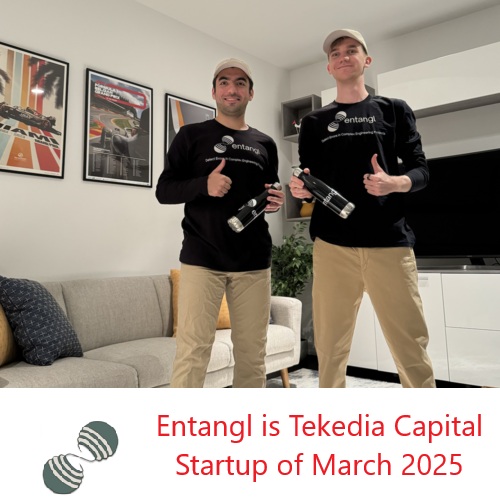
Entangl Is Tekedia Capital Startup of March 2025

0

Techcrunch ranked it one of the top startups in 2024. Today, Tekedia Capital honours Entangl as Tekedia Capital Startup of March 2025. This firm is one of the fastest growing companies in our portfolio, and we project a unicorn on the way. The revenue growth is exponential and the quality of customers is supreme. Just days into launch, the team spoke with Amazon CEO Andy Jassy, as noted by Techrcunch.

Entangl uses AI to detect and automatically resolve issues in data center engineering and operations, ensuring efficiency and uptime. Tekedia Capital is super-excited to be part of this mission. We’re not aware of any company which does this mission better.

Fresh engineering grads, the firm is hiring and the min pay there is $120k per year (could make up to $170k) . Apply here.

To learn more about Tekedia Capital, go here capital.tekedia.com . We invest in category-defining companies around the world.

Customer-Driven Growth through Referral Marketing

0
Customers

What is Customer-Driven Growth and How Does Referral Marketing Drive It?

Times are competitive now, and ordinary advertising simply no longer works to fuel long-term growth. Customer-driven growth is the winning solution in its stead, where content customers become rabid brand proponents. Referral marketing is what drives this strategy, utilizing word-of-mouth to generate quality leads and lock in customers.

An efficiently executed referral marketing program not only expands business but also builds trust, loyalty and long-term customer relationships. When customers love a product or service they will naturally want to tell their friends. This natural word of mouth is what fuels customer-driven growth, and that makes referrals an affordable and high-converting marketing channel.

The Power of Referral Marketing in Driving Customer-Led Growth

Referral marketing is better than traditional marketing tactics because it’s based on trust. People will be more likely to utilize a product or service when it’s endorsed by a coworker or acquaintance, rather than an ad. In essence referral marketing tools are so great due to the following:

  • Higher conversion rates – Referred customers are more likely to buy than cold leads.
  • Lower acquisition costs – No necessity to spend money on paid ads.
  • Increased customer loyalty – Referred customers spend more and have a longer average tenure.
  • Improved brand reputation – A successful referral marketing program makes customers evangelists for the brand.

How to Develop a Referral Marketing Strategy for Exponential Growth

You need a solid strategy to create a referral program that drives customer-led growth. First, you need to find your super fans, representing those who are most engaged and likely to refer. When these super fans have been identified, ensure they are offered the right incentives — ones that will motivate referrals while supporting your business goals.

Always remember to keep it simple, as a complicated referral process will kill engagement. Once these steps are in place you can get the word out, using email, social media, and in-app messaging to alert the target customers you identified earlier.

Finally, remember to measure and optimize – use referral marketing tools and make incremental and consistent improvements based on analytics.

Irresistible Rewards: Turning Customers into Loyal Advocates

Your referral marketing effort is only as good as the incentives you offer. Excellent incentives do the following:

  • Offer tangible value (discounts, store credit, or exclusive privileges).
  • Align with customer needs.
  • Are tiered to encourage more than one referral.
  • Reward the referrers with appreciation and bonuses.
  • Create a feedback mechanism where the customer has concrete input.

By creating a sense of belonging, you will get repeat referrals and lasting loyalty.

Scaling Your Referral Marketing Program: Best Practices and Tips

As your company grows, so should your referral marketing campaign. To expand successfully, allow referrals via multiple channels (email, SMS, social media, etc.). In addition, try and reduce barriers, which will lead to more participation and a greater chance of your referral program going viral.

Referral marketing + Customer Success = Sustainable Growth

A good referral marketing program not only brings in new sales but also strengthens relationships with existing customers. With customer success programs, referral marketing can:

  • Build retention with engaged customers.
  • Maximize lifetime value by incentivizing long-term advocacy.
  • Increase customer satisfaction with personalized experiences.

Technology and Data to Maximize Your Referral Program

New technology in referral marketing helps organizations monitor and maximize efforts based on data-driven insights. Many top businesses employ artificial intelligence analytics to spot top referrers, automated reward fulfillment for a seamless experience, and behavioral-based personalized messaging.

From there, you should be able to optimize your referral program to perform optimally.

Turn Customers into Lifelong Brand Ambassadors

The ultimate goal of referral marketing solutions is to turn casual customers into lifelong brand evangelists. For this, you should:

  • Create a community around your brand.
  • Provide referrers with the rewards that they actually want to see.
  • Create a solid two-way feedback channel for ongoing improvements.

By creating a sense of belonging, you will get repeat referrals and lasting loyalty.

Scaling Your Referral Marketing Program: Best Practices and Tips

As your company grows, so should your referral marketing campaign. To expand successfully:

  • Automate referral tracking and rewards.
  • Expand to new customer segments.
  • A/B test different referral incentives.
  • Optimize based on real-time data insights.

By continually refining your program, you’ll make sure referral marketing remains a driver of sustainable growth.

Ready to go? Referral marketing is not just a tactic – it’s a growth machine that turns happy customers into your biggest fans. Get it right and you’ll foster customer-led growth, where the sky’s the limit. Build your referral program today and watch your brand grow!

RCO Finance Gains Institutional Interest Faster Than Solana, What’s Driving It?

0

Amid the recent market bounce, RCO Finance is quickly gaining institutional interest faster than established altcoins like Solana in the competitive crypto space. With its innovative features and forward-thinking strategies, RCO Finance has positioned itself as a leader among emerging cryptocurrencies for Investors seeking reliable and transformative solutions in the crypto market.

Read on to discover what’s fueling the excitement around RCO Finance and why it may reshape the future of crypto investments.

Why is RCO Finance Attracting Institutional Interest?

RCO Finance has rapidly established itself as a frontrunner in the DeFi platform landscape. Although Solana has an already established presence, RCO Finance offers something different—a strategic, data-driven approach that appeals to seasoned investors and institutions alike.

A standout feature of the platform is its advanced Robo-Advisor, which tracks asset volatility and notifies users when it’s time to adjust their portfolios. This real-time feedback not only helps mitigate losses but also enhances gains, giving investors a substantial advantage in the unpredictable cryptocurrency market.

Powered by artificial intelligence, the Robo-Advisor conducts real-time market analysis, providing users with actionable insights and tailored investment strategies. Its trend forecasts, such as an astounding 4,300% increase in Zenqira (ZENQ), can be truly transformative for investors.

The best part? RCO Finance’s recently launched beta platform invites users to experience its features before the full release, enhancing trust and functionality. By adopting a KYC-free model, the platform simplifies onboarding while prioritizing user privacy, making it accessible to a global audience.

To further bolster confidence, RCO Finance has partnered with SolidProof for smart contract audits, ensuring security and reliability. These measures underscore the DeFi trading platform’s commitment to user trust and solidify its reputation as one of the best crypto platforms of the year.

Solana Price Surges Following ETF Launch on NASDAQ

A Florida-based ETF company is launching the Volatility Shares Solana ETF (SOLZ) on NASDAQ, enabling investors to speculate on Solana’s future price without actually owning the asset. Additionally, the Volatility Shares 2X Solana ETF (SOLT) provides double the investment exposure.

As a result, Solana’s price rose by over 5% on its weekly charts, breaking through a key resistance level. However, it still needs to reach $200, a price point last seen on Valentine’s Day. Analysts believe that surpassing $136 could trigger further gains.

Despite this optimism, the SOL/USD one-day chart indicates a “death cross,” where the 50-day moving average has fallen below the 200-day moving average, suggesting a potential price decline. Solana’s price has fluctuated between $140.92 and $121.18, but increasing selling pressure signals that it may soon drop below $121.18.

RCOF Presale Soars Past $14M: The Best Crypto Presale of 2025?

As enthusiasm for meme coins like Shiba Inu wanes, RCOF is emerging as one of the best crypto investments of 2025. This is evidenced in its ongoing token presale, which has already raised over $14 million and sold more 30 million tokens.

Currently priced at just $0.10, there’s talk that RCO Finance could rise to $0.13 in the next presale stage, offering a chance for a 30% gain soon. Even more exciting, experts are forecasting that the value of RCO Finance’s tokens might increase by as much as 1000x before the end of 2025.

Investing early in RCO Finance not only positions you for high returns but also comes with several benefits. These include lower trading fees, quarterly dividends, the ability to vote on key decisions, and a chance to win cash prizes totaling $100,000!


Join the growing community of over 10,000 users on the RCO Finance platform today!

For more information about the RCO Finance (RCOF) Presale:

Visit RCO Finance Presale

Join The RCO Finance Community

Kenyan BNPL Platform Lipa Later Placed Under Administration Amid Financial Crisis

0

Lipa Later, a prominent buy now, pay later (BNPL) fintech company operating in Kenya, Uganda, Rwanda, and Nigeria, has been placed under administration as the company struggles with financial crisis and failed attempts to secure additional funding.

The administration effective March 24, 2025, will see a new administrator take over the business assets and the management of affairs of the company without personal liability.

In an insolvency notice seen by Tekedia, titled “The Insolvency Act 2015 Notice of Appointment of Administrator Over Odyssey Capital Limited”, part of the documents reads,

“Pursuant to Section 563 (2) (b) of the Insolvency Act 2015 of Kenya, Notice is hereby given that effective 24th March 2025, Joy Vipinchandra Bhatt of Moore JVB Consulting LLP IP No. OR/P/024. has been appointed as an Administrator (The Administrator) of Lipa Later Limited (‘LLL’ or ‘The Company ].
The Administrator takes control over the business, assets, and the management of the affairs of the company without personal liability. By virtue of the administration, the powers of the directors of the company in terms of dealing and/or transacting with the company’s assets have ceased, unless with the express permission of the Administrator.

“Moving forward, all matters, operational or otherwise, pertaining to the affairs of the Company shall be directed to the Administrator or their authorized representatives. The Administrator is currently engaging all key stakeholders of the Company to elicit their cooperation in order to achieve the best possible outcome for the Company. Creditors of the Company are required to send full particulars of any claims they may have against the Company to the undersigned on or before 23th April 2025.”

These developments come after Lipa Later raised Ksh 1.36 billion in funding in January 2022, to expand operations within its current markets of Kenya, Uganda, and Rwanda. Following the fund raised, the company’s Co-founder and CEO Eric Muli said “In the next 12 months we are looking to grow and double our presence in the existing markets, even as we open in three to five new markets in Africa”. However, the funds proved insufficient to stabilize its financial position.

As part of the administration process, creditors have been instructed to submit their claims by April 23, 2025. The appointed administrator is reportedly engaging with stakeholders to determine the best course of action for the company’s future, which may include restructuring or liquidation.

The company’s financial position came under scrutiny in December 2022, when it acquired the struggling e-commerce platform Sky. Garden for KES 250 million. The deal raised concerns about Lipa Later’s financial health, as it was already grappling with mounting obligations at the time.

What Went Wrong?

Reports reveal several challenges that impacted the fall of Lipa Later, which includes the following;

1.) Fierce competition from local giants like M-Pesa and M-KOPA

2.) Regulatory Pressures that increase compliance costs.

3.) Rapid expansion into new markets without tailored strategies

Founded in 2018, Lipa Later emerged as a major player in Kenya’s Buy-Now-Pay-Later (BNPL) space. It built its model around offering consumers the ability to purchase goods upfront and pay in installments, with Lipa Later handling the full payment to merchants. It wasn’t just a lender; it positioned itself as a consumer credit platform backed by proprietary data. The company uses a credit scoring and machine learning system that allows consumers to sign up and get a credit limit in seconds with no bulky documentation and a long lengthy credit approval process.

Notably, the BNPL company became one of the first African fintechs to receive SEC approval to raise funds from the general public in the U.S. In May 2024, it was listed in the Financial Times’ prestigious list of Africa’s fastest-growing companies, placing alongside industry leaders like M-KOPA, Quick Mart, and Kentegra Biotechnology.

Lipa Later’s downfall follows a troubling pattern in Kenya’s startup ecosystem, where high-profile companies collapse despite visible growth and funding milestones. Some examples are Twiga Foods and Sendy Sky. Garden, Kune Foods, amongst others.

Each of these companies had once been heralded as innovators disrupting their respective industries. From logistics to food delivery to urban mobility, their visions resonated with investors, partners, and the public. But volatile macroeconomic conditions, weak unit economics, unsustainable burn rates, and regulatory pressures continue to drive many into crisis. The outcome of Lipa Later’s administration will be closely watched by industry observers and stakeholders.

Imprint Of The Great Escape Maneuvers

0

The fuel behind the enduring imprint of The Great Escape maneuvers—taking the 1944 Stalag Luft III breakout as a prime example—comes down to a mix of human grit, ingenuity, and defiance. That event saw 76 Allied POWs tunnel out of a supposedly escape-proof camp, a feat that still echoes because it was less about the three who made it home and more about the sheer audacity of 600 men plotting under Nazi noses. The meticulous planning—three tunnels (Tom, Dick, Harry), forged papers, stolen bed boards—shows a relentless will to resist, even when odds were bleak. Hitler’s fury, ordering 50 recaptured escapees shot, only amplified its legend; it turned a tactical loss into a moral jab at the Third Reich.

Culturally, the 1963 film cemented this. Steve McQueen’s motorcycle chase (pure Hollywood) and Elmer Bernstein’s score made it mythic, but the real story’s grit—digging through sandy soil, hiding dirt in pant legs—keeps it grounded. It’s a template for underdog defiance, inspiring everything from books to video games. Strategically, it shifted German resources; millions reportedly hunted the escapees, diverting manpower from the war. That disruption, even if exaggerated, left a mark on how we view resistance.

Today, what fuels its imprint is adaptability and symbolism. In 2025, with tech like drones or AI, the mechanics differ, but the core—outsmarting a stronger foe—still resonates. Africa’s trajectory, as we discussed, mirrors this: old patterns of constraint persist, yet new maneuvers (fintech, trade blocs) carve escape routes. The Great Escape’s imprint endures because it’s a blueprint for beating the system, whatever the cage.

Modern resistance strategies in 2025 are less about tunnels and forged papers and more about leveraging networks, tech, and information to outmaneuver power. They’re shaped by a world where surveillance is omnipresent, yet so are tools to subvert it. Digital defiance is a cornerstone. Encrypted platforms like Signal or Telegram let groups—think Hong Kong protesters or Sudanese activists—organize beyond state reach. In 2024, Myanmar’s rebels used VPNs and satellite internet (thanks, Starlink) to dodge junta blackouts, coordinating strikes via coded posts.

Algorithms and bots can drown them out, and regimes adapt—China’s Great Firewall now sniffs out VPNs with AI. Disruption’s gone decentralized. Hacktivist crews like Anonymous still hit targets—leaking Russian military docs in 2023—but smaller, anonymous cells now mimic this. In Ethiopia’s Tigray conflict, locals used open-source mapping to track troop movements, sharing intel via WhatsApp. Crypto fuels this too: crowdfunding resistance in Ukraine raked in $200 million in Bitcoin post-2022 invasion, untouchable by banks.

It’s not flawless—blockchain’s traceable if you slip—but it flips traditional power chokeholds.
Physical strategies lean on chaos and mobility. Flash mobs in Belarus outpace riot police; drones drop leaflets in Cuba where internets throttled. In Africa, Sahel insurgents use cheap motorbikes for hit-and-run raids, exploiting terrain and speed. Climate activists, like Europe’s Last Generation, glue themselves to roads—low-tech, high-impact. The playbook’s about asymmetry: small moves, big ripples. Imprints come from adaptability.

Resistance learns fast—Sudan’s 2019 barricades evolved into 2024’s encrypted “neighborhood committees.” But power learns too: facial recognition in Xinjiang or Pegasus spyware in Mexico shows the cat-and-mouse game’s escalating. The fuel? Frustration with stagnation—economic, political, ecological—and a belief that systems can still be gamed. Africa’s fintech boom or trade maneuvers echo this: sidestep the old guard, build your own lanes. It’s less romantic than 1944’s Great Escape, but the spirit’s the same—outwit, outlast.