DD
MM
YYYY

PAGES

DD
MM
YYYY

spot_img

PAGES

Home Blog Page 1657

Magic Eden Review: Everything You Need to Know About the NFT Marketplace

0

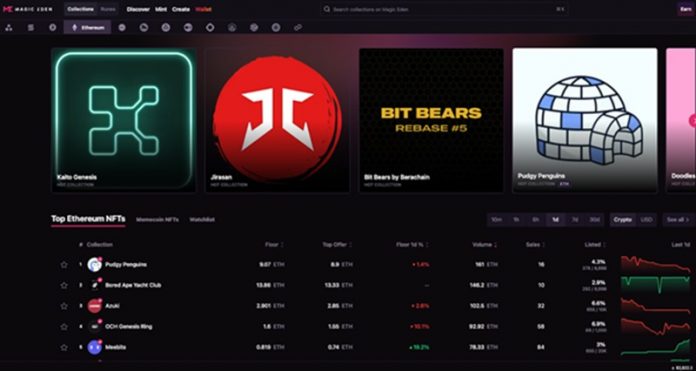
Magic Eden is a market-leading, multi-chain NFT marketplace for creating, minting, collecting, and trading unique digital assets across various blockchains. The NFT platform stands out for its broad range of features targeting both creators and collectors, as well as the long list of supported blockchains.

Read on to learn what Magic Eden is, how it works, what features it offers, and how it compares against other NFT marketplaces.

What Is Magic Eden?

Founded in 2021, San Francisco-based Magic Eden is an NFT trading ecosystem that allows users to buy, mint, sell, and trade NFTs across several blockchains, such as Ethereum, Polygon, and Solana.

Although initially launched to support NFT trading on the Solana network, Magic Eden expanded to accommodate numerous blockchains, giving users the flexibility to create and trade digital assets across multiple blockchains.

Magic Eden has a low-fee structure and a user-friendly interface that makes it easy for users to trade tokens.

Besides the low-fee structure, the platform features a suite of tools for creators and collectors. Some of the tools include analytics and trading tools, a creator’s dashboard, a cross-chain marketplace, a launchpad, a Mint Terminal, and a Web3 wallet.

As the leading NFT marketplace on Solana, Magic Eden has a 0% NFT listing fee, making it attractive to creators.

How Does Magic Eden Work?

As a non-custodial platform, you don’t need to sign up for an account to trade NFTs on Magic Eden. To use the platform, visit the Magic Eden website and connect your crypto wallet.

Besides its own Web3 wallet, Magic Eden also supports several other wallets, including Bitget Wallet, Coinbase, Exodus, MetaMask, Trust Wallet, and WalletConnect, among others.

Once your wallet has been successfully connected, you can browse through the various fungible tokens and NFT collections available on the platform. Moreover, you can also improve your search by applying different filters to get the most relevant results.

When you find an NFT you’d like to purchase, either place a bid or buy it immediately if the listing allows. The platform accepts several digital currencies, such as BNB, BTC, ETH, SOL, and more.

Alternatively, if you want to sell NFTs, simply list them on Magic Eden and either list them for auction or set a price. The platform has a launchpad that enables creators to mint and launch their projects.

Now that we know how Magic Eden works, let’s take a look at some of its key features.

Magic Eden’s Key Features

Below are some key features of the Magic Eden platform:

Mint Terminal

Magic Eden’s mint terminal allows users to discover and mint new fungible and non-fungible tokens. As a live aggregator, the mint terminal collects real-time live mints from various blockchain networks supported by Magic Eden, providing users with a huge pool of assets.

Launchpad

Magic Eden’s launchpad is designed to help creators mint and launch their NFT projects. However, creators looking to launch their projects using Magic Eden’s launchpad platform have to undergo a meticulous application, screening, and approval process to ensure project quality and safety.

Creator Dashboard

Magic Eden’s creator dashboard is the go-to platform for creators looking to list and manage their NFT collections. Creators can sign in/sign up to the creator dashboard, create a new collection, select the blockchain they want to mint their collection on and follow the prompts to list it.

Cross-Chain Marketplace

Magic Eden is not just another NFT marketplace. It’s a cross-chain marketplace that enables users to buy, sell, swap, and trade assets across multiple blockchain networks under one platform. The cross-chain functionality allows users access to a wider pool of tokens and buyers without the need to switch between several marketplaces on single chains.

Analytics and Trading Tools

The platform offers a suite of tools and resources for creators and collectors, including an analytics dashboard to help them track various trading activities, trends, and asset prices. This way, users get insights on top-performing and trending NFT collections.

Magic Eden Wallet

Magic Eden has its own Web3 wallet that allows users to send, receive, and swap digital assets. Additionally, users can manage several digital assets and connect to numerous dApps across multiple blockchains.

Magic Eden’s Supported Blockchains

Magic Eden supports several blockchains. As a multi-chain platform, it enables users to seamlessly trade and manage their digital collectibles across these different networks.

Below is a list of the blockchain networks that Magic Eden supports:

  • Abstract
  • ApeChain
  • Arbitrum
  • Base
  • Berachain
  • Bitcoin Ordinals
  • BNB Chain
  • Ethereum
  • Polygon
  • Sei
  • Solana

Magic Eden’s multi-chain support sets it apart as a leading NFT ecosystem. By supporting several blockchains, users have access to NFT collections across various blockchain ecosystems, which gives them more trading opportunities. Magic Eden users can also enjoy lower fees and faster transactions, as different protocols have varying cost structures.

Moreover, the multi-chain support functionality offers creators a broader reach as they can launch their non-fungible tokens on their preferred chain.

Magic Eden Rewards Program and the $ME Token

Magic Eden’s reward program is built for everyone; from traders to collectors and creators. Users can earn rewards paid out in $ME.

There are two ways users can earn rewards on Magic Eden: by completing tasks and staking $ME tokens.

Users can complete different quests on Magic Eden to earn rewards in $ME tokens. Completing tasks also allows users to improve their staking power on the platform.

Besides completing tasks, users can stake their $ME tokens to increase their rewards. $ME holders can stake their tokens by locking them up for a specific period. To stake your $ME tokens, simply connect your wallet, click on the ‘Earn’ tab, key in the amount you want to stake, add a lock period, and confirm the stake.

User Experience
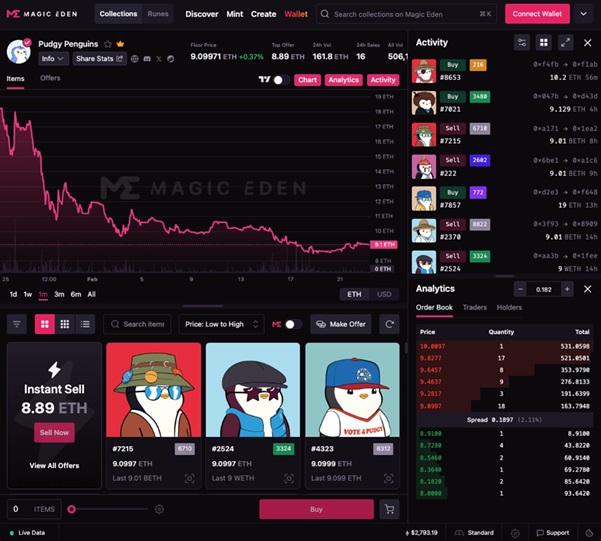
Magic Eden is a platform that was built with the end user in mind. The platform is user-centric, intuitive, and easy to navigate. This makes it ideal for creators and collectors of all levels. The inclusion of a Web3 wallet also makes cross-chain trading fast and seamless.

Security

Magic Eden takes user security seriously. The platform uses multi-signature security for its Web3 wallet, which offers increased security against cyberattacks. Since its launch, there has been no major security breach that has been reported.

Moreover, all smart contracts used on the Magic Eden platform undergo regular audits by reputable third-party firms, and it integrates with trusted wallets such as Ledger, MetaMask, and Phantom.

Pros and Cons of Magic Eden

Now, let’s take a look at Magic Eden’s pros and cons.

Pros

  • A comprehensive suite of tools for creators and collectors
  • Low fee structure
  • Offers multi-chain support
  • 0% listing fee for NFTs

Cons

  • The mobile wallet doesn’t support all chains available on the marketplace

Magic Eden vs. OpenSea vs. Blur vs. Rarible: A Comparison

Below is a table highlighting how Magic Eden compares to other NFT marketplaces available in the market.

Feature Magic Eden OpenSea Blur Rarible
User interface Beginner-friendly User-friendly Advanced User-friendly
Listing fees 0% 2.5% 0.5% 2%
Transaction fees 2% 2.5% 0% 0.5% – 7.5%
Multi-chain functionality Yes Yes No Yes
Launch year 2021 2017 2022 2020


Final Verdict: Is Magic Eden Worth Using?

Magic Eden is a great platform for anyone looking to create, mint, collect, or trade non-fungible tokens across multiple blockchains.

The platform is suitable for NFT traders looking for a platform with low fees, a smooth user experience, and plenty of collections to choose from. For creators, Magic Eden offers a suite of tools to make it easier to get NFTs out into the world and on its marketplace.
Ethereum’s Inflection Point Signaling Pectra as next Upgrade

0

The phrase “Ethereum’s Inflection Point” suggests a pivotal moment for the Ethereum ecosystem—a time to assess its past achievements, current challenges, and future direction. Austin Griffith, known for his work with BuidlGuidl, a community focused on onboarding developers to build on Ethereum, likely emphasized practical development, usability, and scaling solutions to make Ethereum more accessible.

Danny Ryan, a key figure in Ethereum’s transition to Proof-of-Stake (PoS) via “The Merge” and now co-founder of Etherealize, probably brought a perspective blending technical expertise with a vision for institutional adoption and real-world integration.

My thesis is that the world is actually ready to adopt blockchain systems. There is also a gap between meeting the world where it is and Ethereum as it is today, getting to where it needs to be.” How should this be done? “We talk to institutions, we talk to the banks, we talk to governments.

Post-Merge Evolution: Danny Ryan’s experience coordinating The Merge, which transitioned Ethereum from Proof-of-Work to PoS in 2022, would be a natural starting point. They might have explored how this shift has impacted Ethereum’s scalability, energy efficiency, and decentralization, and what technical upgrades (like the upcoming Pectra upgrade) are needed to maintain momentum.

Scaling and Usability: Austin Griffith’s focus on developer experience suggests he might have highlighted Layer 2 solutions (e.g., rollups like Optimism or Arbitrum) and tools like burner wallets or Gas Station Networks to lower barriers for users and builders. The conversation could have addressed how these innovations help Ethereum compete with faster blockchains like Solana.

Institutional Adoption: With Danny Ryan now at Etherealize, an organization aimed at bridging Ethereum with institutional investors, they likely discussed how to market Ethereum to Wall Street and traditional finance. This could involve promoting Ethereum’s security, staking yields, and role in asset tokenization to make it a cornerstone of the digital economy.

Both speakers might have acknowledged Ethereum’s struggles—stagnant price action compared to its 2021 peak, community debates over leadership (e.g., the Ethereum Foundation’s direction), and competition from other blockchains. They could have proposed solutions like better governance, increased transparency, or doubling down on Ethereum’s strengths in decentralization and smart contracts.

Pectra is Ethereum’s next major network upgrade, set to launch around mid-March 2025, and it’s a combination of the “Prague” (execution layer) and “Electra” (consensus layer) updates. Pectra is designed to enhance Ethereum’s scalability, efficiency, and usability post-Merge. It builds on prior upgrades like Dencun (March 2024), which introduced blobs for Layer 2 scaling, and aims to refine staking, smart contract functionality, and network performance.

As of early 2025, it’s been tested across seven devnets and the Mekong testnet (November 7, 2024), with final testnet runs on Sepolia and Holesky scheduled for February 2025 before the mainnet rollout. The upgrade includes eight confirmed EIPs, with twelve others deferred to the subsequent Fusaka upgrade due to complexity or stability concerns.

EIP-7702: Account Abstraction Enhancement – What it does: Introduces a new transaction type that temporarily allows Externally Owned Accounts (EOAs)—basic Ethereum wallets—to execute smart contract code within a single transaction. Drafted by Vitalik Buterin in just 22 minutes, it replaces EIP-3074 after community backlash over security risks.

Technical details: Adds a code field to EOAs during execution, enabling features like gas sponsorship (third parties pay fees), transaction batching (multiple actions in one signature), and social recovery (e.g., key recovery via trusted contacts). It uses a simpler opcode structure than EIP-3074’s AUTH/AUTHCALL, reducing attack surfaces.

Impact: Improves user experience by making wallets more flexible and programmable, akin to smart contracts, without requiring users to hold ETH for gas—stablecoins like USDC or DAI can be used instead. This could boost dApp adoption but risks lowering ETH demand as a fee currency.

Pectra doesn’t overhaul Ethereum like The Merge did; it’s a refinement upgrade. It doubles down on rollup scaling (blobs, PeerDAS groundwork), enhances staking efficiency (validator consolidation, withdrawals), and nudges usability toward mainstream adoption (account abstraction).

However, it sidesteps thornier issues like censorship resistance (over 50% of blocks are OFAC-compliant) and ETH issuance reduction, which developers prioritize for later upgrades. For Griffith and Ryan’s discussion, this likely framed debates on balancing technical progress with ecosystem cohesion—Griffith pushing developer-friendly tools, Ryan eyeing institutional-grade infrastructure.

The Shift Toward Onchain Exchanges

0

Onchain Crypto Exchanges refer to decentralized platforms that execute trades directly on a blockchain, leveraging smart contracts rather than centralized order books or custodians. This contrasts with traditional centralized exchanges (CEXs) like Coinbase or Binance, which handle transactions offchain and custody user funds.

The panel likely explored how DeFi is evolving to bring exchange functionality onchain, driven by Layer 2 Scaling solutions like Arbitrum, Optimism, and rollups (e.g., zkSync) reduce transaction costs and latency, making onchain trading viable. Coinbase’s Base, a Layer 2 built on Optimism’s OP Stack, exemplifies this shift, and Phil Girard, a Coinbase director, probably highlighted its role.

Interoperability: Protocols like LayerZero, led by Bryan Pellegrino, enable seamless cross-chain communication, allowing assets and data to move between blockchains without intermediaries. This is key for onchain exchanges to aggregate liquidity across ecosystems.

User Experience (UX): Projects like Backpack Exchange (Armani Ferrante’s venture) and Morpho (represented by 0xloth) focus on simplifying DeFi interactions, abstracting away blockchain complexity to rival CEXs in usability.

Pellegrino’s Quote and Abstraction

Bryan Pellegrino, CEO of LayerZero Labs, is a vocal advocate for abstraction in blockchain UX. His statement, “Users shouldn’t have to worry about chains or gas—what they need is abstraction,” reflects LayerZero’s mission and the industry’s direction. Users currently juggle multiple blockchains (Ethereum, BNB Chain, Solana, etc.), each with distinct wallets, tokens, and fees.

LayerZero’s omnichain protocol uses Ultra Light Nodes (ULNs) to verify cross-chain messages onchain, enabling applications to operate across ecosystems without users manually bridging assets. For exchanges, this means unified liquidity pools—trade ETH on Ethereum for SOL on Solana without leaving the platform.

Gas: Transaction fees (gas) deter mainstream adoption, especially on Ethereum’s Layer 1, where costs can spike during congestion. Abstraction here involves gasless transactions—either via meta-transactions (third-party fee sponsorship, as in EIP-7702) or Layer 2s, where fees drop to cents. Pellegrino likely tied this to LayerZero’s support for gas abstraction, letting apps handle fees behind the scenes.

Abstraction: This buzzword means hiding blockchain complexity from users. For onchain exchanges, it’s about delivering a CEX-like experience—fast trades, no seed phrases, no chain selection—while retaining DeFi’s trustlessness. LayerZero’s generic messaging (beyond asset transfers) supports this by enabling dApps to sync state and logic across chains, creating a seamless frontend.

Pellegrino’s view aligns with LayerZero’s tech: a messaging layer that abstracts chain-specific details, letting developers build exchanges where users just click “trade” without wrestling with RPCs or gas limits. At ETHDenver, he might’ve contrasted this with clunky bridges (e.g., Wormhole’s past exploits) or CEX vulnerabilities (FTX’s 2022 collapse), emphasizing trustless abstraction as the future.

Phil Girard (Coinbase): Discussed Base’s role in onboarding users to onchain trading, leveraging Coinbase’s infrastructure. Base’s low fees (sub-1-cent transactions) and OP Stack integration could’ve been pitched as a scalable foundation for exchanges.

Armani Ferrante (Backpack Exchange): Backpack, a Solana-based exchange, emphasizes speed and UX. Ferrante might’ve argued for high-throughput chains as the backbone for onchain trading, with abstraction layered on via wallets or APIs.

0xloth (Morpho): Morpho, a lending protocol transitioning to a full DeFi stack, could’ve tied exchange shifts to liquidity optimization. Abstraction here might mean integrating trading with lending/borrowing seamlessly onchain.

Margaux Nijkerk (CoinDesk): As a seasoned crypto journalist, Nijkerk likely pressed on challenges—centralization risks in abstracted systems, regulatory hurdles, or scaling pains—grounding the discussion in real-world stakes.

As of March 2, 2025, DeFi’s total value locked hovers around $100 billion (per recent trends), with onchain exchanges like Uniswap and Curve growing but still dwarfed by CEX volumes. The6 panel likely positioned abstraction as the tipping point—making DeFi as intuitive as Coinbase while keeping self-custody. Pellegrino’s LayerZero, with its $3 billion valuation (2023) and cross-chain dominance, is central to this vision.

Smart Mining is the most trusted and US-regulated node cloud mining platform, which can earn $6686 a day

0

Smart Cloud Mining Innovatively launches ETH dual-node mining pool, with computing power 1.5 times that of traditional mining

In the turbulent cryptocurrency market, AI cloud mining has gradually become an emerging choice for investors. Compared with traditional mining, cloud mining is favored for its simple operation and considerable returns.

Advantages of cloud mining

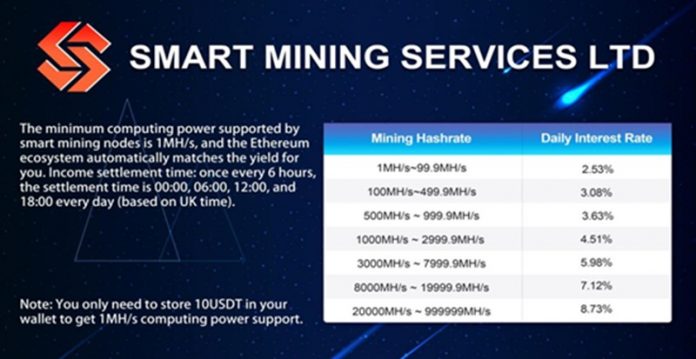
Smart Mining was established in 2020 and has attracted 10 million users worldwide, supporting the mining of Bitcoin and multiple cryptocurrencies. Its AI management system optimizes the status of the mining pool in real time, ensures 100% operation rate, and helps users achieve passive income. Users only need to deposit more than $10 in their trust wallet to start making profits.

Easy participation

Joining Smart Cloud Mining only takes a few steps:

  1. Open the ETH authorized cooperation trust wallet (recommended) and visit the mining pool website (3dmining.cc) through the Dapp browser.
  1. Go to the official website of Smart Mining, select ETH chain mining, and prepare 0.000133ETH as the startup fee.
  2. The minimum withdrawal is 1USDT, 0 pledge, 0 risk, no handling fees and management fees. Customer service is available 24/7.

Flexible mining experience

Smart mining uses advanced node mining technology. Users only need to connect their wallet to the system to generate their own computing power. Unlike the high hardware investment and difficult technical operations required for traditional mining, smart cloud mining eliminates the restrictions on pledge fees, allowing users to choose to mine or exit at any time. This flexibility greatly reduces investment risks and enhances user experience.

Security and compliance

The platform does not collect personal information, and all operations are based on smart contracts and blockchain technology to ensure fund security and user privacy. At the same time, it follows compliance requirements such as anti-money laundering (AML) and know your customer (KYC) to provide investors with a transparent and secure experience.

Summary

Smart mining’s node cloud mining provides investors with a stable and secure wealth appreciation channel through a decentralized structure, compliant management, and simple operation. In a market environment with frequent fluctuations, smart cloud mining has become an important choice for many investors to open the door to wealth.


For more information and details,

Welcome to visit the official website: https://3dmining.cc

Telegram channel: https://t.me/smartmining6

With smart cloud mining, you can seize new opportunities for cryptocurrency investment in 2025.

Company name: SMART MINING SERVICES LTD

Official email: SmartMining@3dmining.org

XRP’s Biggest Rival On Track To Secure Huge CEX Listings As It Raises More Than $13.3 Million In Just 10 Weeks!

0

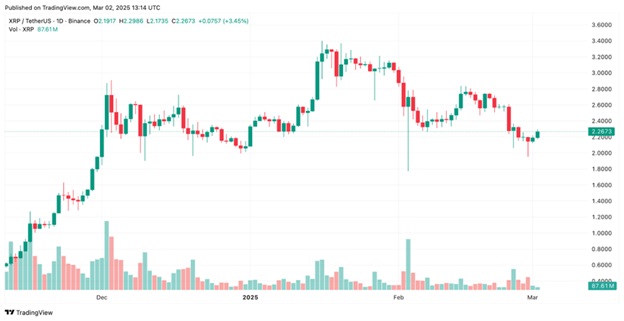
A recent outage in the Xaman Wallet (formerly XUMM) has put a spotlight on the challenges of depending on single wallet services for XRP transactions. Users found themselves unable to move XRP, currently priced around $2.27, highlighting how reliant the network is on external infrastructures.

Meanwhile, an emerging project called Remittix (RTX) is drawing comparisons to a “rival” of XRP, thanks to its cross-border payment model and rapid fundraising success. Below, we explore both the Xaman Wallet incident and how RTX—having already raised over $13.3 million—might overshadow some of XRP’s market share.

The Xaman Wallet Outage and XRP’s Vulnerabilities

XRP at $2.27 as Xaman Wallet goes offline

Xaman Wallet going offline underscores the delicate nature of crypto access points. Many XRP holders rely on third-party platforms to manage assets, and when these services falter, user funds become effectively frozen until the service is restored.

Observers recommend hardware or paper wallets as fallback options, both of which reduce reliance on a single online system. Although the  Xaman outage was brief, it highlighted recurring trust and dependability challenges in the XRP ecosystem.

Ripple’s XRP has seen its ups and downs, including legal battles and huge network expansions. . But as these events unfold, many investors realize that a single wallet outage can undercut the currency’s day-to-day usability, especially if no convenient alternative is on hand.

Remittix (RTX): The New Challenger

While XRP grapples with wallet infrastructure hiccups, Remittix (RTX)—priced around $0.0694 and having sold more than 512 million tokens—has raised over $13.3 million in just 10 weeks. Its PayFi protocol aims to streamline cross-border transactions by seamlessly converting crypto into local fiat, typically within 24 hours.

This direct approach resonates with families sending remittances, freelancers billing international clients, and businesses navigating import/export logistics. Critics often label Remittix as an “XRP 2.0,” believing it refines the cross-border dream that first propelled Ripple into the spotlight.

Locked liquidity and an audited contract strengthen RTX’s position as a secure investment, especially for those weary of new tokens or projects that vanish quickly. Early supporters point to massive potential if Remittix secures partnerships with top-tier exchanges or e-commerce portals, allowing the token to serve an even broader user base.

Observers also note that RTX might soon land major centralized exchange listings—an event historically linked with considerable price boosts, especially if the token’s day-to-day use case is easily understood.

Why RTX Could Dethrone XRP

While XRP has built a strong reputation and network effect, Remittix (RTX) is catching up fast by addressing a fundamental pain point: the complexity and cost of cross-border transfers. By requiring minimal blockchain know-how from end users, Remittix might on-board a more casual or business-focused audience—beyond the realm of hardcore crypto enthusiasts.

This stands in sharp contrast to XRP’s partial reliance on specialized partners and wallet services like Xaman, which can be single points of failure if they encounter downtime.

Moreover, as the recent wallet outage shows, even well-established tokens aren’t immune to infrastructure snags. Meanwhile, Remittix touts an approach that circumvents heavy dependencies—recipients simply see typical bank deposits, while crypto usage happens behind the scenes.

Conclusion: Racing Toward Global Adoption

The Xaman Wallet incident serves as a reminder that established tokens like XRP can suffer setbacks when the surrounding ecosystem stumbles. In contrast, Remittix (RTX)—with over $13.3 million raised, more than 512 million tokens sold, and a price near $0.0694—continues to gain momentum by focusing on the needs of everyday users.

If upcoming major CEX listings proceed as rumored, RTX may solidify its reputation as the leading cross-border token, potentially edging out XRP among newcomers and mainstream investors searching for a simpler, more reliable option.

Ready to Check Out Remittix?
Website: https://remittix.io/
Socials: https://linktr.ee/remittix