DD
MM
YYYY

PAGES

DD
MM
YYYY

spot_img

PAGES

Home Blog Page 17

Michael Saylor Pushes Back at Critics, Clarifies That Corporate Bitcoin Bets Are Not Reckless

0

Strategy chairman and Bitcoin advocate Michael Saylor has pushed back against critics who argue that companies holding Bitcoin are acting recklessly.

In a recent podcast, he compared corporate treasury Strategies to individual investing, arguing that ownership levels vary, but the underlying decision to hold BTC is rational regardless of company size or business model.

According to Saylor, companies today face limited attractive options for idle funds. Traditional instruments such as government treasuries offer low returns, while stock buybacks can fail to create value if the underlying business is struggling. He therefore argues that Bitcoin represents one of several possible alternatives, particularly for firms that can tolerate sharp price swings.

The Bitcoin advocate further stated that a company running at a loss could still improve its overall financial position if the value of its Bitcoin holdings rises faster than its operating losses. “If you’re losing $10 million a year but making $30 million in Bitcoin gains, didn’t I just save the company?”, he added.

“The Bitcoin community tends to eat its young,” Saylor said, adding that companies that hold Bitcoin are often held to a different standard than those that avoid the asset altogether.

His comment comes as CoinGecko’s annual report revealed that crypto treasury companies were among the year’s biggest buyers even as prices fell. Their balance sheets grew sharply, and their actions left a clear mark on supply and markets.

Reports disclose that these treasury firms deployed close to $50 billion into Bitcoin, Ethereum, and other tokens during 2025. At the start of the year, treasuries held more than $56 billion in crypto. By January one, 2026, that figure had risen to $134 billion, a gain of 137%. This buying helped push institutional ownership higher, with treasuries holding more than 5% of both Bitcoin and Ethereum supply by year-end.

94-Year-Old Fast Food Chain Steak ‘n Shake, stated on Saturday that it increased its Bitcoin (BTC) exposure and reiterated that its same-store sales have risen “dramatically” ever since it began accepting Bitcoin payments about eight months ago. In its post on X on Friday, the company said all Bitcoin sales are directed into its Strategic Bitcoin Reserve (SBR) and that it has now increased its Bitcoin stack by $10,000,000.

Data from public disclosures shows that listed companies collectively hold about 1.1 million BTC, representing roughly 5.5% of the 19.97 million coins currently in circulation. Strategy remains the largest public holder, with 687,410 BTC, according to Bitcoin Treasuries.

These figures help explain why corporate Bitcoin purchases draw significant attention from both markets and regulators. When companies accumulate large positions, the move is no longer seen as experimental; it becomes a material part of how their financial health is assessed.

Market observers remain divided. Some view large Bitcoin positions as a sign of strong conviction and long-term thinking. Others see them as a concentration risk that introduces additional volatility into corporate earnings and valuations.

As more firms adopt Bitcoin as a treasury asset, scrutiny is likely to increase. Once holdings reach the hundreds of thousands, the choice becomes central to how investors judge a company’s financial strategy.

Outlook

Looking ahead, corporate Bitcoin adoption is likely to remain a polarizing but increasingly influential trend. As more companies allocate meaningful portions of their treasuries to digital assets, the debate will shift from whether firms should hold Bitcoin to how they manage the risks associated with it.

Regulatory scrutiny is also expected to intensify. With treasuries now controlling over 5% of Bitcoin and Ethereum’s circulating supply, policymakers may view corporate accumulation not just as a financial decision, but as a systemic factor capable of influencing markets.


Forget DOGE and ZEC: Smart Money is Rotating Millions into Zero Knowledge Proof for a Predicted 6000x Gains

0

The global crypto market hit $3.23 trillion this week. While the Dogecoin (DOGE) price bull narrative targets $0.17, the recent Zcash (ZEC) price breakdown saw values test $380. But do these saturated giants truly offer life-changing multipliers?

Analysts point to Zero Knowledge Proof (ZKP). Experts report billions in stagnant capital aggressively rotating from Zombie Chains into ZKP, sparking a bidding war. This liquidity shift creates a supply shock, which researchers claim fuels a massive 6000x repricing event as demand overwhelms the daily allocation.

Wealth managers describe a liquidity avalanche flooding the ZKP auction, forcing prices vertical. With entry discounts evaporating, ZKP outperforms legacy assets, cementing its status as the top bullish crypto for investors racing against this tidal wave.

The $1.7 Billion ZKP Liquidity Vacuum

Zero Knowledge Proof stands as a fortress of completed infrastructure, boasting $100 million in self-funded development and hardware shipping immediately. Unlike projects selling promises, this Layer-1 protocol utilizes daily coin auctions to mechanically squeeze supply. Financial researchers reviewing these unique mechanics have identified it as the top bullish crypto, pointing to its finalized Inverted launch model.

A historic capital shift is accelerating. Wealth managers observe billions in stagnant funds fleeing Zombie Chains and aggressively rotating into the ZKP auction. This phenomenon, described as a liquidity avalanche, forces vast sums of capital to compete for a fixed daily allocation of 200 million tokens.

The math punishes hesitation. As liquidity floods the contract, the price per token spikes vertically, causing the Early Bird discount to evaporate in real-time. A strict $50,000 daily purchase cap forces wide distribution, creating a supply shock that prevents whale manipulation.

Analysts claim this structural imbalance fuels a 6000x repricing event, where overwhelming demand chases scarce assets. The $1.7 billion liquidity target is nearing completion, creating a high-stakes race against the market’s velocity.

Investors must beat this capital influx today to avoid the premium prices set by tomorrow’s winners. This race to front-run the rotation cements ZKP as the top bullish crypto, offering a mathematical path to generational returns.

Regulatory Wins Spark the Dogecoin (DOGE) price bull

Dogecoin currently sits between $0.145 and $0.15, yet massive institutional changes are unfolding. On January 15, 2026, 21Shares filed for a Dogecoin ETF, a move that brings Wall Street money closer to the asset. Simultaneously, the new CLARITY Act proposes classifying the coin as a safe non-security, clearing away long-standing legal fears. These shifts provide a solid base for the developing Dogecoin (DOGE) price bull, as analysts now eye a push past the $0.16 resistance level.

Technical data supports this optimism. A bullish divergence on the charts suggests momentum is building despite flat prices. Furthermore, the House of Doge is expanding into Japan to increase actual usage. If the price maintains support above $0.14, experts target a rise to $0.175. This mix of legal safety and global growth is driving the current Dogecoin (DOGE) price bull, marking a mature phase for the asset.

SEC Victory Reverses the Zcash (ZEC) price breakdown

Zcash recently faced a scary moment that traders identified as a severe Zcash (ZEC) price breakdown. Between January 10 and 13, the price dropped to support levels near $380 after reports confirmed the entire core development team had resigned. This sudden governance crisis caused panic selling, with many investors fearing the value would crash toward $164. However, the situation changed completely on January 14 when the Zcash Foundation announced that the US SEC had closed its investigation without recommending any legal action.

This major regulatory win triggered a sharp recovery, effectively canceling the expected Zcash (ZEC) price breakdown. In just 24 hours, the asset surged 14% to reclaim the $445 level. While the initial drop scared the market, the clarity from the SEC has restored confidence. With the price now holding firmly above $400, experts believe the immediate danger is over and the focus is shifting back to growth.

Summing Up

The market is witnessing a massive shift. Institutional ETF filings are currently driving the Dogecoin (DOGE) price bull, while a crucial SEC victory has officially reversed the dangerous Zcash (ZEC) price breakdown. Yet, the single biggest opportunity lies elsewhere.

Wealth managers describe a liquidity avalanche as capital flees stagnant chains to flood the Zero Knowledge Proof (ZKP) auction. This bidding war is overwhelming supply, and analysts claim this structural imbalance is triggering a massive 6000x repricing event.

With the daily discount evaporating, researchers call ZKP the top bullish crypto. The race is on. Experts warn that if investors do not beat this rush of capital today, they will miss the chance for generational wealth tomorrow.

Find Out More about Zero Knowledge Proof:

Website: https://zkp.com/

Auction: https://auction.zkp.com/

X: https://x.com/ZKPofficial

Telegram: https://t.me/ZKPofficial

EU Prepares Mandatory Ban on Chinese Tech in Critical Infrastructure as Security Concerns Collide with Cost, Supply Chains, and Geopolitics

0
US sanctions are affecting it

The European Union is moving closer to a binding crackdown on Chinese-made technology in sensitive sectors, signaling a sharp escalation in its effort to reduce strategic dependence on Beijing amid rising geopolitical tensions and intensifying pressure from Washington.

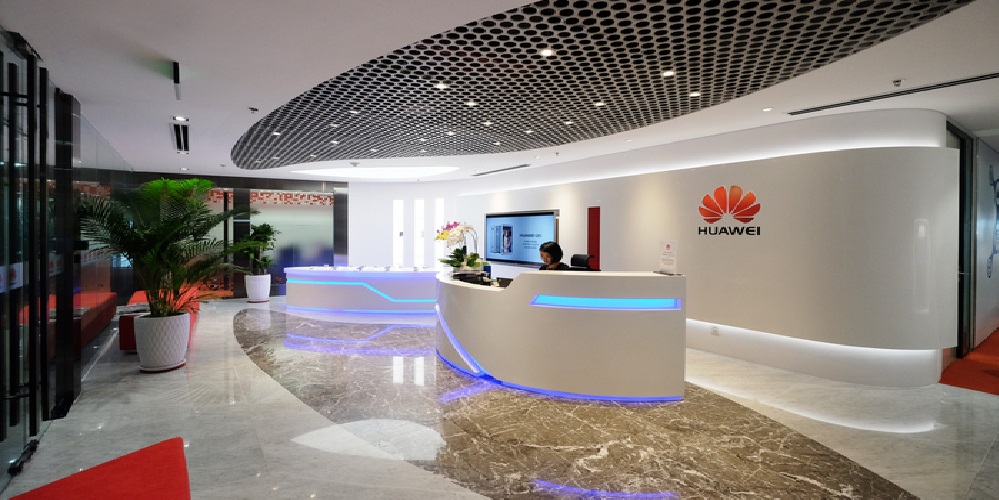
According to the Financial Times, Brussels is preparing a proposal that would force EU member states to phase out equipment from companies deemed “high-risk vendors,” including Huawei and ZTE, from critical infrastructure such as telecommunications networks and solar energy systems. The plan would effectively end the bloc’s current voluntary approach and replace it with a mandatory regime under its broader cybersecurity framework.

If adopted, the shift would mark one of the EU’s most consequential security-driven technology interventions to date, with far-reaching implications for telecom operators, energy providers, supply chains, and EU–China relations.

From voluntary guidelines to binding rules

Since 2020, the EU has relied on a non-binding “toolbox” that encourages member states to assess and mitigate risks from foreign vendors in 5G and other critical networks. While some countries, including Sweden and Denmark, moved quickly to restrict Chinese suppliers, others took a far more cautious stance.

Large economies such as Germany and Spain resisted outright bans, citing the cost of replacing existing equipment, potential disruptions to network stability, and the lack of sufficient alternatives at scale. As a result, Huawei equipment remains deeply embedded in parts of Europe’s telecom infrastructure, particularly in legacy 4G networks that underpin 5G roll-outs.

EU officials now appear convinced that the voluntary model has reached its limits. The proposed cybersecurity initiative, expected to be unveiled on Tuesday, would compel governments to act, closing loopholes that have allowed national discretion to override bloc-wide security concerns.

Notably, the scope of the proposal goes beyond telecommunications. By extending restrictions to solar energy systems, the EU is signaling that it now views energy infrastructure through the same national security lens as digital networks.

China dominates large segments of the global solar supply chain, from polysilicon to finished panels, and European policymakers have grown increasingly uneasy about that reliance as renewable energy becomes central to economic and industrial strategy. For Brussels, the issue is no longer just cybersecurity, but long-term resilience, control over critical inputs, and protection against coercive leverage.

The timelines for phasing out Chinese equipment would vary depending on the sector, perceived risk, and the availability of alternative suppliers. Officials cited in the report said cost considerations would also be factored in, suggesting a gradual transition rather than an abrupt dismantling of existing infrastructure.

Industry resistance and economic trade-offs

Telecom operators are likely to push back. Industry groups have repeatedly warned that forced equipment replacement could cost billions of euros, slow network upgrades, and weaken Europe’s competitiveness in 5G and future 6G technologies. Many operators are already grappling with heavy capital expenditure, weak revenue growth, and rising energy costs.

Replacing Chinese equipment is not simply a matter of switching vendors. Networks are deeply integrated systems, and removing one supplier often requires broader redesigns. European alternatives such as Ericsson and Nokia stand to benefit commercially, but scaling up quickly enough to meet demand remains a challenge.

There are also concerns that higher infrastructure costs could ultimately be passed on to consumers or delay digital inclusion goals, particularly in rural and underserved regions.

Alignment with the United States

The EU’s move brings it closer to the U.S. position, which has taken a far more aggressive stance. Washington banned approvals of new telecommunications equipment from Huawei and ZTE in 2022 and has consistently urged allies to exclude Chinese vendors, framing the issue as a matter of national security and intelligence protection.

While European officials have often bristled at what they see as American pressure, the convergence of policy suggests a growing alignment driven by shared threat assessments rather than diplomacy alone.

Strained EU–China relations

For Beijing, the proposal is likely to be viewed as another sign that Europe is hardening its stance. China has previously accused the EU of politicizing trade and discriminating against Chinese companies, warning that such measures could damage economic ties.

Huawei, once a symbol of deep technological cooperation between China and Europe, has already felt the chill. The company has been reassessing the future of a newly completed manufacturing plant in eastern France, amid regulatory uncertainty, slow 5G deployment, and shrinking market access across the continent.

Taken together, the proposal reflects a broader recalibration of EU policy toward “economic security.” Brussels has increasingly emphasized de-risking rather than full decoupling, but mandatory exclusions from critical infrastructure represent a more forceful use of regulatory power.

The challenge now lies in execution. Member states must balance security priorities with economic realities, manage industry fallout, and ensure that Europe does not simply swap one dependency for another.

Why AVAX & SOL Holders Are Sweating: ZKP Auction Unlocks 190M Coin/Day Phase 2 With “Up Only” Code Ahead of Schedule

0

Global markets maintain a solid $3.23 trillion market cap, but wild price swings limit room for growth. The Solana price prediction points toward $150, and the Avalanche price sits at $14. Yet these big names face crowded markets. Can these older assets really deliver the speed needed for life-changing wealth?

Zero Knowledge Proof [ZKP] responds with proven infrastructure and a viral presale auction. Market watchers report that presale auction inflows show a viral growth rate that basically guarantees a $1.7 billion liquidity event. This is the “Ripple” stage that comes before the vertical “Hockey Stick” path that researchers call a mathematical lock.

A coming supply shock from the presale auction’s phase 2 makes ZKP better than slow-moving alternatives. Buyers hunting the most popular cryptocurrency are joining in huge numbers before worldwide liquidity rushes in.

ZKP: The $1.7 Billion Viral Explosion

Zero Knowledge Proof [ZKP] totally changes the game by building a $100 million self-funded network before asking for public money. Unlike empty promises, this project is already running, and the entry window is closing fast. We are shifting to Phase II, where supply gets cut, and scarcity takes control. Experts looking at the most popular cryptocurrency candidates point to this “deflationary turn” as the main reason for the amazing early momentum.

Data experts watching on-chain numbers spot a supply shock coming soon. With daily allocation falling to 190 million and unsold coins burning right away, the road to a $1.7 billion raise is a mathematical sure thing. This is not guesswork. It is algorithmic certainty based on shrinking supply and growing demand.

Buyers are leaving the founders phase and stepping into a time of huge growth within the presale auction timeline. The massive vertical jump is building, powered by the $5 million viral giveaway and a hidden rewards system that tracks early loyalty. Early participants joining now place themselves before the burn starts, and the “Hockey Stick” growth curve shoots straight up.

Experts warn that waiting for Phase II is a losing move. The 190M hard cap plus the burn system creates a forced supply shock. This means latecomers pay higher prices while early adopters lock in the floor. You need to be in the water before the supply dries up.

The $1.7 billion wave is coming, and the window for massive returns closes quickly. As ZKP locks in its spot as the most popular cryptocurrency for 2026, the mathematical chance of 5000x gains becomes too big to ignore.

Solana Price Prediction: Bulls Aim for $190 Breakout

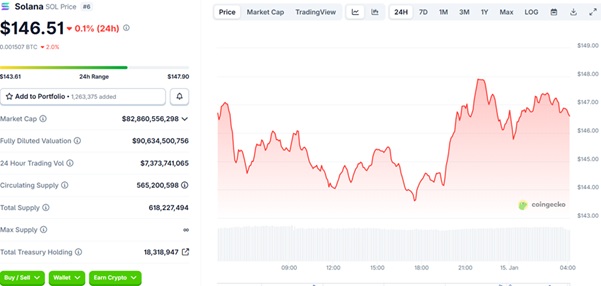
Solana currently trades firmly above $145, smashing through resistance levels that blocked it for weeks. Traders feel excited as the asset targets a quick push toward $150 and possibly $190. Data confirms big institutions are jumping in hard, with Spot Solana ETFs recording $5.91 million in net inflows on January 13 alone. This fresh money fuels a strong rally backed by rising trading volumes. Experts say the current Solana price prediction looks very positive as buyers defend key support areas. Technical patterns show a major breakout is happening right now.

Source: CoinGecko

Beyond price charts, big changes in Washington add real heat to this rally. The new CLARITY Act aims to label SOL as a commodity. This removes legal questions and welcomes more large-scale buyers. With clearer rules and heavy buying pressure, the Solana price prediction stays super bullish for late January as the asset builds speed.

Avalanche Price Study: Holding Strong Through Updates

Avalanche shows amazing strength, trading near $14.75 after a sharp 9% rally. The network recently connected with GhostSwap. This lets users trade privately across different blockchains without middlemen. This major update sparked fresh interest from buyers who care about privacy and speed. Despite a large release of new coins worth nearly $10 million, the Avalanche price held firm as eager buyers quickly grabbed the supply. This power to absorb selling pressure proves that real demand is growing fast among retail traders.

Technical charts show the asset building a strong base above $13.50. It looks ready for a possible jump much higher. Market watchers believe the successful handling of the recent coin unlock clears the way for future gains. With creative tech upgrades driving real usage, the Avalanche price outlook stays very promising for the rest of January as the network grows its global user base.

Why ZKP Is the Most Popular Cryptocurrency

While the bullish Solana price prediction and stable Avalanche price offer safety, they lack the explosive speed of early-stage projects. These established assets swim in crowded waters. They offer predictable but limited returns for careful traders.

On the other hand, experts name Zero Knowledge Proof [ZKP] as the market’s new center of gravity. Data shows that the project sits in the “Ripple” stage of a viral event guaranteed to grow into a $1.7 billion liquidity wave. This mathematical certainty drives the movement of smart money.

Buyers looking for the most popular cryptocurrency of 2026 must see the signal. The ZKP presale auction phase 1 window is closing. You can either ride this vertical wave to generational wealth or watch from the shore as the chance disappears forever.

Find Out More about Zero Knowledge Proof:

Website: https://zkp.com/

Auction: https://auction.zkp.com/

X: https://x.com/ZKPofficial

Telegram: https://t.me/ZKPofficial


Is OpenAI Running Out of Money? Financial Experts Think so

0

The artificial intelligence boom is no longer just a story of rapid breakthroughs and bold promises. It is increasingly a story about money — staggering amounts of it — and how long investors are willing to keep writing cheques before profits appear.

Across the industry, companies are spending tens of billions of dollars on ever-larger models, sprawling data centers, and specialized chips, all in pursuit of dominance in what is widely described as a once-in-a-generation technological shift.

For now, the narrative still holds. AI, its backers argue, will eventually transform productivity, business models, and entire economies. That belief has been strong enough to support eye-watering valuations and justify losses that would be unthinkable in most other sectors. But as spending accelerates, a harder question is pushing its way to the surface: who can afford to stay in the race long enough to win?

That question hangs most heavily over OpenAI, the company that did more than any other to bring generative AI into the mainstream. Since the release of ChatGPT just over three years ago, OpenAI has become a household name and a central force in the global AI conversation. Yet behind the visibility and influence lies a financial position that many analysts now see as increasingly precarious.

Unlike rivals such as Google and Meta, OpenAI does not have a mature, cash-generating core business to fund its ambitions. Google can lean on advertising and cloud computing. Meta can tap profits from its social media empire. Both can afford to pour hundreds of billions of dollars into AI over many years, even if returns are slow to materialize. OpenAI cannot. It survives on external funding, partnerships, and the hope that scale will eventually unlock a sustainable business.

That has not stopped the company from committing to extraordinary levels of spending. OpenAI is expected to lay out well over $1 trillion before the end of the decade, largely on computing infrastructure and model development. It is a bet that size and speed will prove decisive, even as revenue lags far behind costs.

Subscription uptake for ChatGPT has been weaker than many early forecasts suggested, highlighting users’ limited willingness to pay directly for AI tools. While the company has begun exploring enterprise services, licensing deals, and other commercial avenues, those efforts are still in their infancy.

The imbalance between spending and income has sharpened concerns about how long OpenAI can keep burning cash. In a recent essay for the New York Times, quoted by Yahoo Finance, Sebastian Mallaby, a senior fellow at the Council on Foreign Relations, warned that the company could run out of money “over the next 18 months.” His argument is rooted less in skepticism about AI itself and more in the brutal economics of the race now unfolding.

Mallaby is not dismissive of the technology. On the contrary, he is bullish, arguing that while new technologies usually take decades to be deployed effectively, AI has made “striking” progress in just three years. His analysis instead focuses on competitive advantage. Companies with deep, profitable legacy businesses can afford to treat AI as a long-term investment. OpenAI, without that cushion, must repeatedly return to capital markets to fund losses that are already enormous.

Those losses are mounting fast. Despite raising record sums for a private company, OpenAI is estimated to have burned through more than $8 billion in 2025 alone. Mallaby argues that even if the firm scales back some commitments or uses its highly valued shares to offset certain costs, it still faces a daunting funding gap. The scale of capital required, he suggests, may simply exceed what investors are willing to provide indefinitely.

If funding dries up, consolidation becomes the most likely outcome. Mallaby suggests OpenAI could be absorbed by a cash-rich technology giant such as Microsoft or Amazon, effectively ending its existence as an independent player. Such a scenario would not necessarily mark a failure of AI as a technology. Instead, it would underline how capital-intensive the industry has become and how difficult it is for standalone firms to compete with tech behemoths that can afford years of losses.

That distinction matters. Even in a collapse or takeover scenario, OpenAI’s influence would be hard to erase. The company helped set the pace of innovation, forced competitors to accelerate their own AI efforts, and reshaped public expectations of what machines can do. As Mallaby puts it, the failure of OpenAI would not be an indictment of AI, but rather the end of what he describes as the most hype-driven builder of it.

Others across the industry share the sense that a reckoning is approaching. Several analysts describe 2026 as a make-or-break year for OpenAI, as investor patience wears thin and competition intensifies. Pressure is also rising on the broader AI sector to show clearer paths to profitability, particularly as interest rates and macroeconomic uncertainty make easy money harder to come by.

Sam Altman, OpenAI’s chief executive, shows no sign of backing down. He has reportedly declared “code red” internally and is doubling down on ChatGPT, determined to keep pace with Google, which is rapidly closing the gap with its own AI models. The strategy suggests a belief that retreat would be more dangerous than pressing ahead.

However, the efforts have done so little to quell growing skepticism. One venture capital executive, who invested in a rival AI firm, recently described OpenAI’s trajectory to The Economist as “the WeWork story on steroids,” invoking a company that expanded aggressively on the back of hype and capital before collapsing under the weight of its own business model.

Against this backdrop, it is becoming clear that the AI boom is entering a more unforgiving phase, and the focus is shifting from what the technology can do to what it can earn.