DD
MM
YYYY

PAGES

DD
MM
YYYY

spot_img

PAGES

Home Blog Page 1704

Top Cryptos to Invest in for Short Term: Qubetics’ dVPN Rises as Monero Price Prediction Holds Strong And Kaspa Breaks Out

0

In today’s fast-paced digital world, privacy and speed aren’t just nice-to-haves—they’re essential. With data breaches on the rise and online surveillance becoming the norm, people are looking for new ways to protect their digital lives.

At the same time, the cryptocurrency market is booming, offering exciting opportunities for those looking to cash in quickly. But with thousands of projects popping up, figuring out which ones have the potential for short-term gains can feel like finding a needle in a haystack.

The truth is, not all crypto projects are created equal. Some focus on fancy tech with no real-world use, while others deliver practical solutions to everyday problems. The best bets for short-term gains often combine strong technology, growing demand, and clear market advantages—and a few projects are ticking all these boxes right now.

Let’s break down three standout contenders that are making waves: Qubetics, with its game-changing decentralized VPN (dVPN) that protects online privacy; Monero, a long-time leader in anonymous transactions; and Kaspa, known for blazing-fast transaction speeds. Each project brings something unique to the table, and all three are gaining momentum as the top cryptos to invest in for short term.

Qubetics ($TICS): Pioneering Online Privacy with Decentralized VPN

Imagine browsing the internet without worrying about prying eyes or data breaches. Traditional VPNs promise privacy but often fall short due to centralized control, making them susceptible to hacks and surveillance. Enter Qubetics, a blockchain-based platform revolutionizing online privacy with its decentralized VPN (dVPN).

What Makes Qubetics’ dVPN Stand Out?

Unlike regular VPNs that rely on centralized servers, Qubetics’ dVPN operates on a peer-to-peer network. This means your data isn’t stored in one vulnerable spot, reducing the risk of unauthorized access. For businesses, professionals, and individuals alike, this decentralized approach ensures a more secure and private browsing experience.

Why Should You Care About Qubetics Now?

Qubetics is currently in its 25th crypto presale stage, having sold over 499 million tokens to more than 22,900 holders, raising upwards of $14.9 million. At this stage, $TICS tokens are priced at $0.1074 each. Analysts are buzzing about its potential, with some predicting significant returns post-mainnet launch.

How Does Qubetics Solve Real-Life Problems?

In an era where data breaches and online surveillance are rampant, Qubetics offers a solution that traditional VPNs haven’t fully addressed. By decentralizing the VPN infrastructure, it eliminates single points of failure, ensuring that your online activities remain private and secure. This innovation is perfectly suited to meet the future needs of blockchain and digital finance, making it a compelling option among the top cryptos to invest in for short term gains.

Monero (XMR): Community Engagement and Price Outlook

The Monero community is gearing up for MoneroKon 2025, scheduled from June 20 to 22 in Prague, Czechia. Organizers are actively seeking presentation proposals, with the submission deadline set for March 15, 2025.

A Monero Technical Meeting was held to discuss ongoing development topics, including Seraphis/JAMTIS and other long-term projects. Additionally, the community participated in the Monero Ask Anything Monday (MAAM) session on March 10, 2025, fostering open dialogue and knowledge sharing.

Monero (XMR) is trading at $207.19, with a market capitalization of $3.82 billion. Technical analysis shows a bullish engulfing pattern, indicating strong buyer momentum. Market analysts predict that XMR will not fall below $198.59 in March 2025, with potential peaks at $218.03, and an average trading value around $208.31.

Kaspa (KAS): Price Recovery and Market Sentiment

Kaspa (KAS) has experienced a significant rebound, surging 15% from a two-year low. This recovery is attributed to rising market confidence and increased trading activity, with volumes reaching $189 million—a 95% increase—indicating strong investor interest.

Technical analysis suggests that KAS is attempting to break out of a downtrend that began in December 2024. A successful breakout could lead to a price target of $0.105, followed by a potential downward correction to the $0.0045-$0.0050 range. Additionally, KAS has been highlighted as a top cryptocurrency to watch in March 2025, with potential for substantial portfolio growth in the upcoming quarter.

Understanding Decentralized VPNs: The Future of Online Privacy

With increasing concerns about online surveillance and data breaches, decentralized VPNs (dVPNs) are emerging as a promising solution. Unlike traditional VPNs that route traffic through centralized servers, dVPNs distribute data across a network of nodes, enhancing privacy and security.

Why Are dVPNs Gaining Traction?

  • Enhanced Privacy: By eliminating central points of control, dVPNs reduce the risk of data interception.
  • Censorship Resistance: dVPNs make it harder for authorities to block or censor internet access.
  • Community-Driven: Users can contribute to the network by sharing bandwidth, promoting a more open internet.

How Does Qubetics Fit In?

Qubetics’ dVPN is at the forefront of this movement, offering a decentralized solution that addresses many shortcomings of traditional VPNs. Its innovative approach not only enhances user privacy but also aligns with the broader goals of blockchain technology.

Conclusion: Top Cryptos to Invest in for Short Term

In the crypto world staying informed and agile is key. Qubetics, with its groundbreaking dVPN, offers a unique opportunity to address pressing privacy concerns. Monero continues to champion financial confidentiality, while Kaspa pushes the envelope on transaction speed.

For those seeking top cryptos to invest in for short term gains, these projects present compelling cases. However, always conduct thorough research and consult with financial advisors before making investment decisions.

For More Information:

Qubetics: https://qubetics.com

Presale: https://buy.qubetics.com

Telegram: https://t.me/qubetics

Twitter: https://x.com/qubetics


FAQs

  1. What is Qubetics’ dVPN?
    Qubetics’ decentralized VPN is a blockchain-based service that enhances online privacy by eliminating centralized control, reducing risks associated with traditional VPNs.
  2. How can I participate in Qubetics’ presale?
    You can purchase $TICS tokens directly from Qubetics’ official website during their presale stages.
  3. Why is Monero popular among privacy advocates?
    Monero uses advanced cryptographic techniques to keep transaction details confidential, appealing to those who prioritize financial privacy.
  4. What makes Kaspa’s transaction speed noteworthy?
    Kaspa’s DAG architecture allows multiple blocks to be confirmed simultaneously, leading to faster transactions compared to traditional blockchains.
  5. Are decentralized VPNs better than traditional ones?
    dVPNs offer enhanced privacy and security by distributing data across a network of nodes, reducing vulnerabilities associated with centralized servers.

Exploring Trump’s Executive Order on Banks Reducing Crypto Regulations

0

President Donald Trump has indeed signed an executive order aimed at reducing cryptocurrency regulations, particularly those affecting banks, as part of his broader pro-crypto policy agenda. On January 23, 2025, Trump issued the executive order titled “Strengthening American Leadership in Digital Financial Technology,” which addresses several aspects of digital asset regulation, including banking services for crypto companies. This action fulfills campaign promises to create a more favorable regulatory environment for the cryptocurrency industry, which faced significant scrutiny and enforcement actions under the previous Biden administration.

A key component of the executive order is its directive to protect and promote “fair and open access to banking services” for law-abiding individuals and private entities in the crypto sector. This addresses long-standing industry complaints about “Operation Choke Point 2.0,” a term used by crypto advocates to describe what they perceive as a deliberate effort by regulators to pressure banks into denying services to crypto companies.

The order does not explicitly terminate this alleged policy but signals a shift toward ensuring that crypto firms can access banking services without undue restriction. This is particularly significant for banks, as it could encourage them to custody digital assets, offer crypto-related services, and integrate cryptocurrencies into their portfolios, activities that were previously constrained by regulatory guidance.
One specific regulatory rollback highlighted in the executive order’s implementation is the rescission of the Securities and Exchange Commission’s (SEC) Staff Accounting Bulletin 121 (SAB 121), announced on the same day the order was signed.

SAB 121, issued in 2022, required banks and other custodians to record digital assets held on behalf of clients as both assets and liabilities on their balance sheets, effectively making it prohibitively expensive for many institutions to engage in crypto custody services. The rollback of this guidance, as directed by Trump’s order, is expected to lower the cost of compliance for banks, thereby encouraging greater participation in the crypto market. Industry leaders, such as Circle CEO Jeremy Allaire, have publicly supported this repeal, arguing that it removes a significant barrier to banks holding digital assets.

The executive order also establishes the President’s Working Group on Digital Asset Markets, chaired by Trump’s appointed crypto and AI czar, David Sacks. This working group, comprising key agencies like the Department of the Treasury, the Department of Justice, and the SEC, is tasked with proposing a comprehensive federal regulatory framework for digital assets within 180 days. Within 30 days of the order, the group must identify existing regulations affecting the crypto sector, and within 60 days, it must recommend whether these should be rescinded, modified, or adopted.

This framework aims to provide regulatory clarity, particularly for banks, by establishing “well-defined jurisdictional regulatory boundaries” and ensuring “technology-neutral regulations.” Such clarity could further reduce barriers for banks, enabling them to offer crypto trading, custody, and investment services to clients, including wealthy individuals and institutional investors.
The potential impact on banks is significant.

Bank of America CEO Brian Moynihan, speaking at the World Economic Forum in Davos, indicated that if the new rules make crypto a viable business, banks would actively participate, particularly in transactional services, treating crypto as “just another form of payment.” This shift could widen crypto adoption, bringing more institutional players into the market and increasing liquidity. However, the executive order’s approach to reducing regulations raises concerns about investor protection and systemic risks.

Critics argue that easing banking restrictions without robust safeguards could expose the financial system to the volatility and fraud risks inherent in the crypto market, as evidenced by past scandals like FTX and Binance. The order’s focus on deregulation, combined with the Trump administration’s broader appointment of crypto-friendly regulators—such as Paul Atkins at the SEC, Travis Hill at the FDIC, and Scott Bessent at the Treasury—suggests a potential prioritization of industry growth over consumer safety.

While this ban supports private sector cryptocurrencies by eliminating potential competition, it could limit the U.S.’s ability to innovate in digital finance and maintain the dollar’s global dominance, especially if other nations adopt CBDCs for cross-border transactions. The order instead promotes dollar-backed stablecoins, which could benefit banks by providing a regulated avenue for crypto-related services, but this approach may not fully address the systemic risks associated with stablecoins, such as those seen in the collapse of TerraUSD.

Trump’s executive order reduces cryptocurrency regulations on banks by rescinding restrictive guidance like SAB 121, promoting banking access for crypto firms, and tasking a working group with creating a broader regulatory framework. While this could significantly boost crypto adoption and institutional participation, it also raises concerns about investor protection, financial stability, and potential conflicts of interest, particularly given the administration’s close ties to the crypto industry.

Salesforce to Invest $1 Billion in Singapore as AI Industry Race Heats Up in Asia

0

Salesforce has announced a major commitment to Singapore, pledging to invest $1 billion over the next five years as it accelerates the adoption of Agentforce, its AI-powered autonomous agent platform.

The move highlights the growing strategic importance of Singapore in the global AI industry, particularly as tensions between the U.S. and China limit American tech companies’ opportunities in the world’s second-largest economy.

With China increasingly off-limits due to regulatory and geopolitical restrictions, Singapore has become an attractive alternative for U.S. technology firms looking to expand in Asia. The city-state has been making significant strides in AI and automation, positioning itself as a leading hub for AI-driven enterprise solutions. Government-backed initiatives, such as the National AI Strategy, have helped foster an innovation-friendly ecosystem, making it easier for companies like Salesforce to scale their AI products.

Salesforce has already established a long-standing presence in Singapore, having invested in the country for nearly two decades. In 2019, it set up its first overseas AI Research hub in Singapore, underscoring the city’s significance in its global expansion plans. The company believes Agentforce could play a transformative role in addressing Singapore’s labor market challenges by enabling businesses to create “digital workforces”, where AI-powered agents complement human employees.

The latest investment follows Salesforce’s $500 million commitments in both Saudi Arabia and Argentina, reinforcing its global push into AI-driven cloud computing. With Singapore’s strong emphasis on automation, digital transformation, and enterprise AI adoption, it is well-positioned to benefit from the company’s latest wave of AI innovation.

As part of its expanding footprint in the region, Salesforce has also announced a partnership with Singapore Airlines to integrate Agentforce, its AI layer Einstein in Service Cloud, and Data Cloud into the airline’s customer case management system. The collaboration is expected to enhance customer service automation, streamline operational efficiency, and introduce new AI-driven solutions tailored for the aviation sector.

Additionally, both companies will work together at Salesforce’s AI Research hub in Singapore to develop new AI-powered innovations for the airline industry, reinforcing Singapore’s role as a center for aviation technology.

Salesforce’s investment in AI comes amid a significant workforce restructuring, with the company reportedly reducing over 1,000 jobs while hiring around 2,000 employees to focus on AI sales and enterprise adoption. The shift reflects Salesforce’s broader strategic pivot towards AI-driven enterprise solutions, as it seeks to remain competitive against rivals such as Microsoft and Google, which are also ramping up their AI offerings.

Singapore is gradually emerging as a key player in the global AI industry as U.S. tech giants increasingly look beyond China for expansion. In the past year, major players like Amazon Web Services (AWS) and Microsoft have announced billion-dollar investments in Southeast Asia, reinforcing the region’s growing role in the global AI and cloud computing race. AWS recently pledged $9 billion in Singapore to expand its cloud infrastructure, while Microsoft committed $2.2 billion to Malaysia and $1.7 billion to Indonesia to strengthen its AI ecosystem.

With its pro-business environment, advanced digital infrastructure, and government-backed AI initiatives, Singapore has become a natural choice for companies looking to scale AI-powered solutions across finance, healthcare, aviation, and retail sectors. The country’s regulatory stability also provides a safer alternative for AI expansion compared to other Asian markets, where data privacy laws and government intervention pose challenges for foreign companies.

The race for AI dominance is intensifying, and with China increasingly inaccessible to Western countries, Singapore stands to gain as one of the most important AI hubs outside the U.S.

Veteran Investor, Known as the ‘Warren Buffett of Crypto,’ Sold XRP at $3.40 and Has Been Loading Up on These 2 Coins

0

A veteran investor, widely regarded as the “Warren Buffett of Crypto,” has been making strategic moves in the digital asset market. After selling XRP at $3.40, the investor has shifted focus to Aptos (APT) and Cardano (ADA), with Rexas Finance emerging as a major investment. The rise of Real World Asset (RWA) tokenization has positioned Rexas Finance as a transformative force in blockchain-powered asset management.

Aptos (APT) Gains Momentum Amid Increased Adoption

The Layer-1 blockchain Aptos advances rapidly as it provides Ethereum an alternative network with high-speed functionality. February price increases on the network hit 12% because of rising DeFi and NFT activities. The combination of rapid functionalities and affordable costs makes Aptos blockchain solutions appealing to both developers and investors who need fast and cheap blockchain operations. The blockchain executes parallel operations combined with its Move-based smart contracts to achieve 100,000 transactions per second (TPS) capability. The high data processing speed makes Aptos a major sector challenger compared to Solana and Ethereum platforms. Institutional investors and developers are now studying Aptos because its future system scalability and economy-friendly transactions have caught their interest.

The Web3 space becomes stronger because Aptos keeps expanding through new project additions. The speed of Aptos’ network allows DeFi platforms and NFT projects to flourish, which in turn drives more usage of the network. Veteran investors identified Aptos’ potential, which prompted them to select it as a fundamental part of their diversified crypto collection.

Rexas Finance Leads the Future of Asset Tokenization

Rexas Finance maintains its position as the top blockchain-enabled platform for Real World Asset (RWA) tokenization. Innovation through the platform provides secure asset transmission through tokenization, enabling users and commercial entities to handle their assets together and trade them effectively. Through its AI protection system and automated smart contracts, Rexas Finance enhances security and produces cost-saving benefits for transactions. Ecosystem users benefit from a tool that enables the no-code creation of digital assets. Implementing DeFi solutions in Rexas Finance produces better liquidity components and additional investment platforms for tokenized products. The increasing blockchain adoption makes Rexas Finance position itself as an open and reliable system for asset management.

RXS token serves fundamental purposes for governance functions alongside staking and decentralized finance services within the network. Rexas’s pre-sale operation continues until the present time at a 90.40% achievement level, where investors can purchase RXS at a lowered price. Rexas Finance will drive the upcoming blockchain financial revolution through RWA tokenization because a veteran investor demonstrates his faith in this initiative.


Website: https://rexas.com

Whitepaper: https://rexas.com/rexas-whitepaper.pdf

Twitter/X: https://x.com/rexasfinance

Telegram: https://t.me/rexasfinance

Billionaires Who Backed Trump Have Since Lost $209 Billion in Market Collapse

0

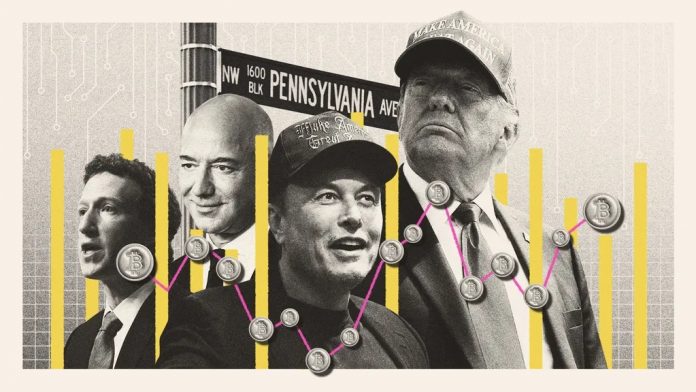
Donald Trump’s second coming as the U.S. President was marked by the unwavering support of U.S. billionaires who had jettisoned their soured past with the President for a new beginning. On January 20, as Trump took the oath of office for his second term, some of the world’s richest individuals stood behind him in the Capitol Rotunda, basking in the glow of record-breaking stock market gains.

The group included Elon Musk, Jeff Bezos, Mark Zuckerberg, Bernard Arnault, and Sergey Brin, among others—billionaires who, despite a contentious history with Trump, had aligned with him this time, hoping to protect their wealth.

Ironically, just seven weeks later, these same billionaires are watching their fortunes collapse, with a staggering $209 billion wiped from their net worths, according to the Bloomberg Billionaires Index. The companies that fueled their wealth have collectively lost $1.39 trillion in market value since January 17, the final trading day before Trump’s inauguration.

A Relationship of Convenience

During Trump’s first term (2017–2021), many of these billionaires had a rocky relationship with the president. Jeff Bezos and Mark Zuckerberg faced direct attacks from Trump, while Sergey Brin openly protested his immigration policies. Elon Musk, after initially joining Trump’s advisory council, quit in 2017 over the U.S. withdrawal from the Paris Climate Agreement.

This time, however, the billionaires took a different approach. Their decision to align with Trump was a strategic move, aimed at ensuring that his policies worked in their favor—from tax cuts to deregulation and corporate-friendly economic policies.

Amazon, Meta and some others, donated $1 million each to Trump’s inauguration fund. Bezos dined with the president in February. Musk, once a critic, began publicly supporting Trump’s stance on free speech and attacking Democrats on his social media platform, X. Even Brin, who once led protests against Trump, attended a private dinner at Mar-a-Lago.

The logic was simple: Trump’s pro-business stance could benefit their companies and portfolios. But that gamble, according to the Bloomberg Billionaire Index, has backfired spectacularly.

The period between Trump’s reelection and inauguration was a financial goldmine for these billionaires. The S&P 500 surged to record highs, Tesla stock nearly doubled, and luxury markets boomed. The expectation was that Trump’s second term would fuel further market gains.

Instead, Trump’s return to power has triggered market turmoil. The S&P 500 has fallen 6.4% since January 20, with a sharp 2.7% drop on March 10 alone. Trump has also embarked on mass layoffs of government employees and trade tariffs that have rattled Wall Street. Investors are increasingly concerned about the president’s unpredictability, leading to a wave of panic selling in some of the market’s biggest names.

For the billionaires who bet on Trump to safeguard their wealth, the irony is now undeniable.

The Billionaires Who Took the Hardest Hit

Elon Musk: Down $148 Billion

Elon Musk has suffered the biggest loss among Trump’s billionaire backers, with $148 billion wiped from his fortune. Tesla, which had surged 98% in the weeks after Trump’s election, has since lost all those gains.

The reasons behind Tesla’s collapse:

  • European consumers are rejecting Tesla over Musk’s right-wing politics, leading to a 70% sales decline in Germany in early 2024.
  • Chinese Tesla sales have plunged 49% in February, falling to their lowest level since 2022.
  • Trump’s trade policies have created uncertainty over EV subsidies, discouraging buyers.

Jeff Bezos: Down $29 Billion

Bezos, 61, had a bitter relationship with Trump during his first term, with Trump constantly attacking him over Amazon’s business practices and his ownership of The Washington Post.

But in Trump’s second term, Bezos changed course. Amazon made a publicized $1 million donation to Trump’s inauguration fund, and Bezos met privately with the president in February.

Amazon stock, however, has nosedived 14% since January 17, wiping out nearly $30 billion of Bezos’s fortune.

Sergey Brin: Down $22 Billion

Brin’s company, Alphabet, has since lost billions, with stock prices tumbling 7% in early February. Meanwhile, the Justice Department has intensified its antitrust battle against Google, a case that could force a breakup of the company’s search engine division.

Mark Zuckerberg: Down $5 Billion

Meta was initially one of the biggest winners from Trump’s reelection, rising 19% from mid-January to mid-February.

Zuckerberg, who had previously banned Trump from Facebook, appeared to quietly rebuild ties, with Meta adopting a more hands-off approach to content moderation.

But those early gains have evaporated, with Meta stock plunging, mirroring the 20% drop in the broader Magnificent Seven tech index.

Bernard Arnault: Down $5 Billion

Arnault, chairman of LVMH, has been a friend of Trump for decades, speaking with him personally after the Pennsylvania assassination attempt in July 2024.

Luxury markets initially surged following Trump’s election, as investors expected his policies to favor the ultra-wealthy. But LVMH’s rally has collapsed, driven by fears of Trump’s proposed tariffs on European luxury goods, which could cripple sales and a decline in global luxury spending, as economic uncertainty grows.

A Bitter Irony

Trump’s presidency has so far brought instability rather than prosperity, with erratic tariff policies, uncertainty over tech regulation, and widespread government layoffs sending markets into a tailspin.

The billionaires who once defied Trump, then embraced him, have not been spared. To make matters worse, it is quite uncertain the tides are going to change any time soon, given Trump’s unflinching stance in using tariffs as bargaining power. This means that the billionaires are in for a long rough ride.