DD
MM
YYYY

PAGES

DD
MM
YYYY

spot_img

PAGES

Home Blog Page 179

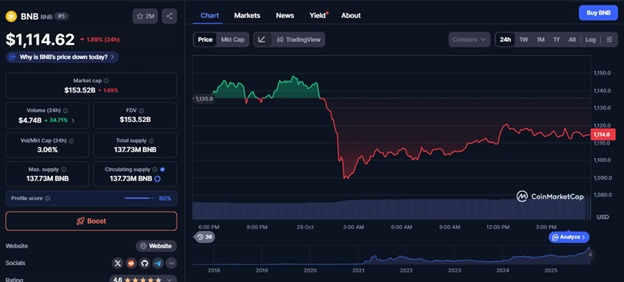
BNB’s $1,114 Price Impresses, But Ozak AI’s $4.24M Raise Signals Where Next 100× Gains Could Come From

0

The crypto market is in a stage of structural rotation—after years of blue-chip dominance, investors are increasingly hunting for high-utility projects with early-stage entry points. Furthermore, while major tokens continue to climb, the next wave of 100x opportunities may lie in the lower tiers of utility blockchain meets smart innovation. Furthermore, Enter Ozak AI ($OZ)—a presale project that’s already raised over $4.24 million and trades at just $0.012, putting it on the radar as a potential generational play.

BNB (Binance Coin) Snapshot

The native token of the Binance ecosystem, BNB, currently trades around $1,114, boasts a market capitalization in the ballpark of $153.52 billion, and sees daily trading volume over $4 billion. Furthermore, BNB’s utility as a fee-token, platform incentive, and launchpad sees it firmly positioned, but at this scale, the room for exponential returns is comparatively limited.

Ozak AI— Blockchain + AI Fusion at a Ground Floor Entry

Ozak AI is a next-generation project built around the idea of integrating advanced computing systems, predictive analytics, and autonomous trading systems into blockchain infrastructure. Furthermore, its design targets new narratives: real-time decision engines, information-driven automation across DeFi and Web3, and tokenized value tied to usage rather than hype. Furthermore, the presale is currently in Phase 6, with over $4.24 million raised and 986 million tokens sold, all priced at $0.012 per token.

Token Allocation

To support growth while protecting early entrants, Ozak AI’s tokenomics are structured as follows:

  • 30% – presale & public sale
  • 20% – ecosystem and community development
  • 20% – future reserve
  • 10% – liquidity and listings
  • 10% – team

This transparency and allocation model suggests the project is built for sustained value rather than short-term speculation.

Strategic Partnerships Fueling Utility

Ozak AI’s momentum is backed by meaningful partnerships that bring tangible utility. Integrating Ozak AI’s prediction agents with Dex3’s on-chain intelligence platform unlocks advanced market forecasting, automated workflows, and cross-community information sharing. One-click smart innovation upgrades and voice-activated execution via SINT plug-ins transform Ozak’s signals into actionable, autonomous systems bridging Web2 and Web3.

With 1,600+ price feeds, sub-second latency, and coverage across 100+ blockchains, Pyth Networks feeds Ozak AI’s agents with high-fidelity information—enhancing accuracy and reliability of predictions. These collaborations lay the foundation for Ozak’s token to be used actively, which is key to upside potential.

Conclusion

BNB at $1,114 remains a strong, established asset—but its scale limits upside from here. Furthermore, Ozak AI, trading at just $0.012, backed by smart tokenomics, real-world utility, and meaningful partnerships, represents one of the rare opportunities where the math still favors 100×-plus potential. Furthermore, for investors hunting the next big breakout, Ozak AI’s presale performance and infrastructure signal that the next wave of gains could lie not with the giants, but with the new challengers.


For more information about Ozak AI, visit the links below:

Website: https://ozak.ai/

Twitter/X: https://x.com/OzakAGI

Telegram: https://t.me/OzakAGI

Solana Price Prediction: SOL Investors Are Building Whale-Sized Positions in This Cheap Crypto for a Quick 4,500% Profit

0

In the ever-shifting world of cryptocurrency, traditional Layer 1s such as Solana (SOL) remain formidable infrastructure plays, yet the hunt for explosive short-term returns has increasingly shifted to lower-priced, high-volatility tokens. One project capturing attention is Little Pepe (LILPEPE), currently in its presale phase at approximately $0.0022 per token, compelling major investors and “whales” to amass sizable positions ahead of potential listings and parabolic price moves. The presale has already raised over $27.4 million and sold over 16.6 billion tokens across all stages. With 2025 racing to its end, Little Pepe is attracting Solana Whales, targeting a quick 4,500% profit before the year runs out.

Little Pepe (LILPEPE): From Meme Culture to Utility Infrastructure

At first glance, Little Pepe appears to fit the familiar mold of meme-coins that only ride community momentum. Yet it distinguishes itself via its Ethereum-compatible Layer 2 meme ecosystem designed to deliver fast, low-fee transactions. The token’s architecture includes a zero-tax trading model, staking and rewards mechanisms, and a planned launchpad for new meme tokens, signalling that the team intends to move beyond hype into structural growth.  From a tokenomics standpoint, the total supply is pegged at 100 billion LILPEPE, with a significant portion allocated to presale purchasers and ecosystem rewards, building scarcity into the model as tokens are sold stage by stage. Such layering of design, meme culture meets chain architecture, addresses a key investor question: can a token go beyond “just funny” to build long-term value?

Why Solana (SOL) Investors Are Looking Elsewhere

Solana has established itself as a robust Layer 1 solution, with strong DeFi and NFT ecosystems, high throughput, and institutional interest. But in terms of short-term upside, say 1,000%+, many investors are turning their attention to smaller-cap tokens where entry is early, supply constraints are more acute, and narrative momentum is building rapidly. A token trading at $0.0022 with presale momentum represents a fundamentally different risk-reward profile than chasing SOL at multi-dollar levels.

In this light, SOL investors looking to rotate some capital into high-beta opportunities may find Little Pepe’s combination of cheap entry, viral branding, and infrastructure promises more aligned with “moonshot” upside. The presale price staging mechanism, where price increases as fewer tokens remain, adds a built-in scarcity dynamic that can magnify gains.

Targeting a 4,500% Move: How Realistic?

With the token priced around $0.0022 and with projections referencing eventual value multiples, the concept of 4,500% (i.e., 45x) gains is not purely speculative. If Little Pepe lists at, for example, $0.10, that would equate to 45x. The narrative around listing prices is more conservative (many cite US$0.003 or higher), but the “best-case” modelling for meme tokens can go far beyond listing levels if viral momentum, scarcity, and utility converge.

The logic for this potential rests on a few pillars: one, the presale selling out quickly (which signals demand). For example, one stage sold out ahead of schedule. Two, the project’s promise of utility and architecture gives the model staying power beyond hype. Three, the token’s entry price is extremely low, offering a wide runway for appreciation, as opposed to mature tokens where much upside is already priced in. When whales begin building positions under such parameters, the implied statement is: “the risk-reward is skewed heavily in favour of reward.” It’s not a guarantee, of course, but the conditions for outsized gains are present.

Final Takeaway

For investors coming from a Solana mindset, focused on infrastructure, ecosystem growth, and long-term thesis, shifting a portion of capital into a high-beta opportunity like Little Pepe may represent a calculated rotation. The token’s entry price, presale progress, utility narrative, and scarcity setup all point toward a potential 4,500% upside scenario in the event of a strong listing and subsequent pump. Conclusively, the thesis for Little Pepe is built on “cheap entry + building narrative + community momentum + utility promise”. For investors willing to accept the risk and target outsized returns, the position being built now may look like what whales see, and the 4,500% target may not be fanciful, just assuming everything aligns in the coming months.


For more information about Little Pepe (LILPEPE) visit the links below:

Website: https://littlepepe.com

Whitepaper: https://littlepepe.com/whitepaper.pdf

Telegram: https://t.me/littlepepetoken

Twitter/X: https://x.com/littlepepetoken

$777k Giveaway: https://littlepepe.com/777k-giveaway/

Apple and the Coming Satellite Era

0

Apple continues to dance around the main court and is yet to take the decisive shot which is launching a fully satellite-based iPhone. The latest news remains an incremental step: Apple is working on satellite-powered Apple Maps, APIs for third-party satellite connectivity, and enhanced photo messaging features. All these still depend heavily on its partner, Globalstar. But the twist in the story is fascinating, Globalstar itself may be up for sale, and Elon Musk’s SpaceX has reportedly emerged as a possible buyer.

Apple is developing a series of new satellite features for the iPhone and Apple Watch, Bloomberg reports, citing anonymous sources. Planned upgrades include a satellite-powered version of Apple Maps, a new API that would allow third-party developers to embed satellite connectivity into Apple apps and enhanced photo messaging capabilities. However, Apple would need to work closely with its satellite partner, Globalstar, to bring these premium features to market. Meanwhile, Globalstar is exploring a potential sale and Elon Musk’s SpaceX has emerged as a potential buyer.

When Apple eventually releases a satellite iPhone under the same form factor and at a consumer-friendly price, the world will begin to grasp the true strategic depth of what Musk has built in SpaceX. Because only SpaceX, through its vast Starlink constellation, currently has the infrastructure to deliver global satellite coverage at the scale and latency consumer smartphones demand.

Two years ago, I wrote here that “By the 2030s, I expect the satellite era to be here at scale.” That thesis remains firm from the African angle. Every decade, technology resets the architecture of communication: the 2000s gave us voice telephony, the 2010s birthed mobile internet, and the 2020s became the era of application utilities. The 2030s will belong to satellite-anchored ecosystems.

A massive disintermediation is coming. What GSM operators did to CDMA networks, satellite constellations will do to some terrestrial mobile carriers. When cost and coverage converge under low-Earth-orbit efficiency, competition will not be national but orbital. Telcos in Africa and across the developing world must prepare. Because soon, connectivity will not come from towers, but from the skies. It takes just Apple to switch and the era will begin.

Streamlining Operations with Advanced Technology Consulting Techniques

0

Are you looking for the best tips on how to run a more efficient business?

You probably guessed it by now, but that’s not going to happen by just “trying harder”. The key to a smooth running business is getting the right technology consulting services. Bonus: 95% of tech buyers report that they are planning to increase their digital tech investment over the next 18 months.

We’re talking major business transformation here.

Technology consulting services are fast becoming a core part of how every business can be more efficient. They have the know-how to help you lower your costs, get more out of your team, and get a leg up on the competition who are still stuck in outdated ways of doing things.

Here’s the catch: Most businesses have no idea where to start.

In this article you’ll discover:

  • Why Technology Consulting Services Are Necessary
  • The Real Benefits Of Streamlining Operations
  • Advanced Techniques That Actually Work
  • Choosing The Right Technology Consulting Partner

Why Technology Consulting Services Are Necessary

Technology consulting is more than just installing new software and calling it a day.

It’s about rethinking the way your entire business works. When you hire experienced technology consulting services like Bravo Team, you are getting access to a team of experts who know both technology and business strategy. They see the blind spots in your operations and know how to fix them.

Your team is already working hard to manage day-to-day operations. Do you really want them adding technology implementation on top of that? The results won’t be good.

Leave it to the professionals instead.

The Real Benefits Of Streamlining Operations

Let’s get real for a moment.

What does it actually mean to get operations right? Everything. Squeezed. Stops. The constant time sink of manual tasks, operations headache and team stress can all come to a halt with expert help.

Imagine a business where your team is working on what really matters – innovating, growing your customer base and adding value for your clients. Where your team isn’t bogged down with low-value work.

We all know this is how things should be, but in reality most businesses struggle to achieve it.

Businesses that have worked with technology consulting services are already seeing big gains in productivity. Experts report an increase of up to 30% in business productivity – and that’s with some of the biggest names in the industry.

Real-life examples of streamlined operations include:

  • Automated workflows that take care of repetitive data entry
  • Integrated systems that “talk to each other” without manual intervention
  • Real-time analytics and reporting that make better decision-making possible
  • Lower operating costs throughout the business.

Pretty sweet, right?

Advanced Techniques That Actually Work

I can see you on the edge of your seat, so let me show you the techniques that separate winners from losers.

Process Automation

The big one. This is where you stop your team from wasting time on all those repetitive tasks. Data entry, report generation, customer follow-ups – these are all done automatically, while your team is free to do high-value work.

Automation is not one-size-fits-all. It has to be designed specifically to fit your business processes. Good consultants know how to identify opportunities for automation that actually make sense.

Cloud Integration

Moving to the cloud isn’t just trendy – it’s a must these days. It gives you flexibility, scalability, and access to your business anywhere. Your team can collaborate in real-time, your data is secure, and you are no longer paying huge amounts for on-premises servers.

The technology consulting market is expected to reach $421 billion by 2025, with cloud services being a major growth driver.

Data Analytics & Business Intelligence

Here’s a secret that many business owners are not aware of: You’re sitting on a goldmine of data. The only problem? You have no idea how to use it.

Data analytics turn raw data into actionable insights. You can anticipate trends, know exactly what your customers are looking for, and make data-driven decisions instead of relying on gut instinct.

System Integration

This is a biggie. A huge number of businesses are running on multiple systems that don’t communicate with each other. Your accounting software doesn’t “talk” to your CRM system. Your inventory is a separate world. Nightmare.

System integration creates a unified system where everything is connected. Data flows freely between platforms, which eliminates duplicate data entry and the errors that come with it.

Choosing The Right Technology Consulting Partner

Do you know what the biggest mistake is?

Businesses who pick the cheapest option or the first person who replies to an email. This is like choosing a surgeon based on who has the flashiest billboard.

Instead, look at these traits instead:

Industry Experience

Your consultant should have a deep understanding of your specific industry. They need to be familiar with the challenges you face, the regulations you need to deal with and the competitive landscape.

Proven Track Record

Ask to see case studies, references and real-world examples of other businesses they’ve helped. No “here’s what we claim we can do” – only actual results.

Strategic Thinking

The very best consultants will not just implement technology. They work with you to develop a holistic strategy that aligns with your overall business goals. They focus on the long-term, rather than the next quick fix.

The Implementation Process That Works

Let me walk you through the steps of a successful technology consulting engagement.

Step 1: Assessment

Your consultant will do a deep dive into your current operations. They will identify bottlenecks, inefficiencies and hidden opportunities that even you may not be aware of.

Step 2: Strategy Development

A custom strategy roadmap is created that is tailored specifically to your business needs. This takes into account your budget, timeline and business goals. It’s not one-size-fits-all but custom-built for you.

Step 3: Implementation

The actual tech implementation work happens in this phase. Your consultant does the technical work and keeps everything running smoothly.

Step 4: Training & Support

Your team is trained to use the new systems and processes, and ongoing support is provided to keep things humming along nicely.

That’s really how it works with the right team. It’s that simple.

The Challenges You Can Expect

Truth time: Implementing technology is not always a breeze.

Expect resistance from team members who like the way things used to be. Expect some technical glitches. Expect budget overruns.

Successful companies are different because they communicate clearly to their team about why things need to change. They choose consultants who specialize in change management. They stay flexible and adapt their approach as needed.

The companies that struggle? They try to rush the process, skip the training and expect things to just work overnight.

Please don’t be that company.

Measuring Your Success

So how do you know if all the time and money you spent on technology consulting was actually worth it?

Look at metrics like how much time you are saving on manual tasks, reduction in operation costs, increase in customer satisfaction, improvement in employee productivity and other key performance indicators (KPIs).

Set your benchmarks before you start the implementation process, and then track these things regularly. This way you have hard data that shows exactly where you are succeeding, and where you may need to pivot.

Wrapping Things Up

Streamlining operations with advanced technology consulting techniques is no longer optional. It is mandatory if you want to remain competitive.

The businesses that are thriving are the ones that are embracing technology consulting and using it strategically to improve their operations. They partner with experienced experts who know both technology and business strategy.

The results are clear: Lower costs, higher productivity, happier customers, and more time to focus on growth.

It’s an investment, yes. But one that will pay for itself many times over when done correctly.

Can you really afford not to invest in technology consulting?

High-Risk Strategies in New Betting Platforms

0

In the last few years, internet betting has changed drastically. What used to be a world of sports betting and horse competitions with classic casino games is now filled with technological advancements, the integration of crypto, and rapid risk frameworks. In addition to more conservative approaches, punters are starting to test out high-put in high-pay systems that have high returns, but which also have higher potential losses. Awareness of these strategies and the way they are applied, how they might fail, and how they are handled by the platforms is critical in any serious betting activity in the modern world.

The Allure and Danger of High-Risk Betting Strategies

Simply put, any betting strategy that is high risk is an effort to tilt the risk-reward profile even farther than the house or the bookmaker would provide. These strategies are usually intended to generate outsized returns on relatively modest investments by capitalizing on volatility, momentum or psychological forces.

This is clearly appealing: if the outcome is favorable, the reward is larger than any conservative play could ever give. But the risk is in multiplication. Losing streaks build up much faster than many might predict, and what some might assume was a fun experiment may turn out to be a financial disaster. People tell many stories of miraculous wins, which help to spread the belief that high-risk actions can pay off, but those who lose accept the real cost of the risk.

High-Risk Strategies

Martingale

One of the most famous and oldest systems is the Martingale strategy. Players place two times the bet each time they lose, under the assumption that one win will cancel all the previous losses and result in a profit that is equal to the initial investment. It may look foolproof on paper, but in reality bankrolls are limited, and the betting platforms put limits on the table. The system breaks down in seconds when a losing streak is prolonged more than anticipated and it can empty your account in minutes.

Laddering

Another high-risk strategy is laddering, in which players re-invest their winnings into successively larger bets. Every single step up the ladder provides more possibility of profit, but any failure will result in a total collapse of the whole project. Although the strategy has the ability to generate the exciting feeling of momentum, its vulnerability means that only a very small number of players continue a successful streak long enough to be beneficial in the long run. When the ladder breaks, so does the bankroll that made it.

Trend Chasing

Trend chasing has its basis in the view that previous performances have a bearing on future consequences. When a particular color has already occurred multiple times in roulette or a team has made a series of wins, players are tempted to increase their bet, hoping that the trend will also continue. The fallacy is in the concept of probability itself: the results of multiple betting events are independent from each other; that is, the results of previous bets do not influence the next one. Once the so-called streak is bound to be broken, the losses are stacked up in a short span, and players are in a state of confusion over how their money is going away.

Parlay Overreach

Parlays, or accumulators, are a number of individual bets, put into a single ticket, which has much greater payoffs. The enticement is the multiplier effect: as more legs are added, the bet grows exponentially in terms of potential returns. But the more additional legs, the lesser the chance of winning, and even a single misjudgment destroys the whole ticket. Players will commonly take chances with too many parlays, working up wagers that are not only mathematically impressive but are also certainly going to lose.

All-In Plays

When playing in crypto betting settings in particular, some gamblers take all-in bets in which they put all their money on one high-volatility outcome. It is the simplest kind of risk-taking: win and get a windfall, or lose and start again at the bottom. It is more reflective of the mindset of playing on the speculative side, rather than the structured betting, and, despite the occasional tales of overnight wealth, the majority of bets will more likely result in a total loss.

Crash Games with Crypto

An explicit case of risky games is crash games associated with cryptocurrency. In these games, a multiplier starts with a value of one and increases very fast, and players must decide when to cash out. Leaving early means only a modest profit, but the longer you wait, the more likely you are to lose all your money when the crash inevitably comes.

The format is very straightforward but psychologically charged, particularly the rounds which take only a few seconds and the results seem to be close. Since the transactions are crypto-driven, players can deposit and withdraw funds fast without the need to go through a middleman, which makes them play more often and without thinking. Instances of taking dangerous gambits are frequent, such as setting auto cash-outs at very high multipliers, or increasing bets after a loss. The speed allows them to pursue the losses in an emotional state, and the volatility means that bankrolls can be wiped in a few minutes. Crypto crash games are the new frontier of high-risk betting, mixed with the allure of  fast and tech-forward gambling.

Risk Controls: Strategy Meets Reality

Although such strategies appear effective on paper, betting sites are programmed with limitations that prevent them from reaching infinity. Table limits prevent the infinite doubling demanded by Martingale systems, and payout caps prevent spectacular wins from being claimed. The liquidity of sports markets means that wagers can be smaller than the optimal size, as larger wagers can skew the odds and reduce profitability. Some platforms also enforce responsible gambling through commissions, time-out periods or daily limits.

While these precautions are discussed as defensive mechanisms, they are also employed to ensure the house’s long-term advantage. Many of these safeguards are weak in less regulated or crypto-exclusive settings, creating a sense of openness but a more hazardous environment for players attracted to high-risk play.

The failure of High-Risk Strategies

These strategies often fail because players don’t consider certain factors. Long losing streaks are a statistical certainty, and once they happen, they sweep away even a disciplined person’s reserves.

Bankroll exhaustion is a common issue because many participants don’t have enough funds to survive such extremes. Emotional betting makes matters worse by causing players to stray from their plans. At the same time, the house advantage slowly but surely erodes profits, so players never have an advantage. Even strategies that initially appear effective can fail when circumstances change. This is why many high-risk plans, which may seem exciting, actually lead to defeat.

Taking a Gamble but Staying Down to Earth

Moderation is needed for those who still want to play something risky. The first step is to define a set budget prior to a session and consider it already spent. It is also important to avoid the urge to plow back all gains into new bets, as the only way that one can ensure success is by taking away some of the winnings.

Players should also understand that the majority of high-risk approaches are more entertainment than income strategy. Breaks following loss streaks help avoid the devastating chasing, while the use of logs or records of play gives a clear picture of performance in the long term. Finally, the most healthy solution is to consider risky strategies as a side experiment in a bigger betting routine and not as the basis of it.

Disciplined Approaches to Betting

On the other end of the scale from high-risk gambling, we see systematic betting strategies that focus on data and discipline. An example is well illustrated in this article, where the emphasis is placed on patience, emotional control and odds assessment. Rather than chasing uncertainty, the approach is founded on reliable examination and future-oriented thinking.

The difference is that high-risk strategies outpace variance through aggression, while disciplined methods work with probabilities to find value over time. Most of the players who take a hit in risky approaches would later shift to this more stable approach. They soon understand that consistency is a more effective way of surviving.

Final Thoughts

Contemporary gambling sites offer excitement but also danger. Systems like the Martingale and parlay overreach can lead to quick wins and losses. Gambling sites set their limits to prevent irresponsible gambling – but the appeal of sudden riches and adrenaline remains. Some see these strategies as harmless, others a reminder of the importance of moderation. With knowledge of these strategies, players can better understand the risks.