DD
MM
YYYY

PAGES

DD
MM
YYYY

spot_img

PAGES

Home Blog Page 1809

Ripple (XRP) and Rexas Finance (RXS) Heat Up, While Dogecoin (DOGE) Might Experience a Slow Q2 2025

0

Due to volatility in the cryptocurrency market in 2025, Ripple and Rexas Finance have emerged as potential titans. While the market is anticipating a breakout surge from XRP, Dogecoin looks weak and shows signs of struggle. Let’s take a closer look at these tokens.

XRP Showing Overwhelming Bullish Signals and Breakouts

Analysts such as Ali Martinez have recently noticed the surge in XRP and given multiple reasons for the potential rally. Martinez shares one of the most important technical factors: The XRP token has created a symmetrical triangle since 2018. As per the available data, XRP has been stuck in consolidation, but it has recently broken out of the pattern, indicating a price increase is on the horizon. Martinez predicts that XRP could surge as high as $15. The importance of this possible increase is not only reliant on chart patterns. XRP’s presence in the market has been growing exponentially. One clear sign of this development is the increase in XRP wallets, which now stand at a record high of 6.87 million. As Martinez pointed out, the increasing number of wallets clearly reflects rising users, a positive sign of the market’s interest. With more users interacting with the token and the breakout from the symmetrical triangle, the chances that XRP will warm up for a bullish run are very high. XRP’s price movement has been positively impacted by expectations of clearer regulations supporting these broader market developments. With XRP’s partnerships in cross-border payments and its use in the financial industry, it has a credible value that will appeal to retail and institutional investors. Because of this, XRP is highly anticipated to surge significantly in 2025, with price action set to increase.

Rexas Finance (RXS): A New Challenger on the Block

As XRP prepares for what could be a powerful comeback, Rexas Finance (RXS) is already on the radar of many crypto enthusiasts. With a presale price of $0.20, Rexas Finance attracts investors and industry analysts due to its emphasis on tokenizing real-world assets. Many think its form of bridging traditional finance and decentralized finance (DeFi) will still be able to compete with well-known tokens like Cardano (ADA) and Ethereum (ETH). The DeFi ecosystem has always had a liquidity problem, and Rexas Finance’s promise comes from its capability to solve it with real-world use cases. By focusing on the tokenization of real estate, commodities, and other physical assets, RXS attempts to bridge the gap between decentralized markets and traditional finance. If successful, this strategy will create wide-scale adoption as more investors seek tokens that provide value and utility rather than just hype. In addition to that, the token’s presale has been highly successful, raising millions of dollars and selling hundreds of millions of tokens. With Withpresale ending, Rexas Finance is expected to be listed on major exchanges by June 2025, making it an attractive investment opportunity for those seeking to buy a token primed for explosive growth. With the continuous expansion of DeFi and the slow acceptance of tokenization by traditional markets, Rexas Finance could be a serious contender for significant returns and may outperform the rest of the market in the coming years, much more than other tokens have recently offered.

Dogecoin Faces Challenges Amidst Market Decline

While XRP and Rexas Finance are riding the wave of a bull market, DOGE finds itself in a precarious position. Unfortunately, the meme coin sector, especially Dogecoin, faces immense selling pressure, which has resulted in a sharp decline over the last few weeks. Dogecoin has fallen by a concerning 16% in the span of a single week. Currently, on March 18, 2025, Dogecoin’s value is sitting at $0.1683, making it a 4.28% decrease over the last day. Furthermore, these losses are compounded by the fact that DOGE is below its long-term support level- the 200 day moving average. In 2025, the RSI indicated a sharp correction after overbought conditions. Undoubtedly, the technicals for DOGE look dreadful. Analysts, such as Ali Martinez, have cited the next crucial support level for Dogecoin at $0.16; however, if this fails, DOGE can further plummet toward the lower bound at $0.125. Dogecoin’s price drop can also be related to how other meme coins perform in the market. The coin has not been able to gain bullish momentum without market-moving events or high-profile figures like Elon Musk. Compared to XRP or Rexas Finance, Dogecoin has less real-world utility, making it less appealing to investors looking for tokens with strong fundamentals and real-world applications.

Conclusion: Rexas Finance and XRP Are On The Rise As Dogecoin Stumbles

By 2025, Rexas Finance and XRP will be the strongest competitors in cryptocurrency as they are the most likely candidates to experience growth. There is a strong bullish case with XRP’s recent breakout from its symmetrical triangle formation and the increasing number of wallets. Some analysts even expect the token to hit $15 at some point. On the other hand, Rexas Finance’s new and advanced approach to DeFi and tokenizing real-world assets makes it a big contender with excellent growth potential. While this is good news for many, Dogecoin struggles to make itself relevant as it continues to experience losses until it manages to hold essential support regions. Its overdependence on social media trends and market speculation has caused it to have an extremely shallow fundamental value, which stagnates its price and cycles. Investors intent on achieving strong growth over the foreseeable future might become less interested in Dogecoin and focus on more promising projects, such as XRP and Rexas Finance. Both make sense from the perspective of utility and fundamentals.


For more information about Rexas Finance (RXS) visit the links below:

Website: https://rexas.com

Win $1 Million Giveaway: https://bit.ly/Rexas1M

Whitepaper: https://rexas.com/rexas-whitepaper.pdf

Twitter/X: https://x.com/rexasfinance

Telegram: https://t.me/rexasfinance

A Foray Into the STABLE and GENUIS Acts Advancing in the U.S. House/Senate

0

The STABLE Act, formally known as the Stablecoin Transparency and Accountability for a Better Ledger Economy Act, advanced through the U.S. House Financial Services Committee with a 32-17 vote on April 2, 2025. This bipartisan support included six Democrats voting in favor alongside Republicans. The bill, introduced by Representatives French Hill and Bryan Steil, aims to establish a regulatory framework for payment stablecoins, such as those pegged to the U.S. dollar, by mandating transparency in reserves and business operations. It now awaits a full House floor vote, while a related Senate bill, the GENIUS Act, also progresses toward its own floor debate.

The advancement of the STABLE Act through the House Financial Services Committee with a 32-17 vote on April 2, 2025, alongside the parallel progress of the Senate’s GENIUS Act, signals a potential transformation in the stablecoin market. These bills aim to regulate payment stablecoins—digital assets pegged to fiat currencies like the U.S. dollar—by enforcing strict reserve requirements, transparency, and oversight. Both acts mandate 1:1 reserve backing with high-quality liquid assets (e.g., cash, U.S. Treasuries), regular audits, and public disclosures. This could bolster confidence among investors and consumers, reducing the risk of de-pegging events like the Terra/Luna collapse in 2022.

Stablecoins such as USDC (issued by Circle) could see enhanced credibility, potentially increasing adoption in mainstream finance. However, issuers like Tether (USDT), which have faced scrutiny over reserve opacity, might need to overhaul operations to comply, affecting their market dominance (currently around 61% of the $230 billion stablecoin market as of early 2025). The dual federal-state framework—federal oversight for issuers with over $10 billion in market cap and state options for smaller players—provides a clear legal pathway. This could attract institutional players, including banks and tech giants, who have hesitated due to regulatory uncertainty.

For example, firms like Meta or Google might explore stablecoin issuance, leveraging their scale to compete with traditional financial systems. This could drive transaction volumes on public blockchains into the trillions, enhancing efficiency in payments and remittances. Stricter compliance costs (e.g., AML/KYC, audits) may disproportionately burden smaller issuers, potentially consolidating the market around larger, well-capitalized players. The STABLE Act’s two-year ban on algorithmic stablecoins and prohibition on yield-bearing stablecoins could further limit innovation in decentralized models, favoring centralized, fiat-backed options. This might reduce diversity in the stablecoin ecosystem, locking in leaders like USDC and USDT while sidelining experimental projects.

Stablecoins are a backbone of decentralized finance (DeFi), facilitating trades and lending. Regulatory clarity could accelerate DeFi growth by integrating stablecoins into traditional systems, but restrictions on yield or algorithmic designs might constrain certain protocols. Crypto exchanges, heavily reliant on stablecoins for liquidity, may need to adjust listings, particularly if non-compliant issuers lose U.S. market access. This could shift trading dynamics, potentially boosting compliant stablecoins’ market share. By reinforcing dollar-backed stablecoins, these acts aim to maintain the U.S. dollar’s role as the world’s reserve currency amid competition from digital currencies like China’s e-CNY.

The GENIUS Act’s push for international reciprocity could align U.S. standards with frameworks like the EU’s MiCA, enhancing cross-border interoperability. However, stringent rules might disadvantage U.S.-based issuers against offshore competitors with laxer regulations, unless global coordination mitigates this gap. As the bills await full House and Senate votes, uncertainty could spark volatility. Issuers adjusting reserves or exiting non-compliant models might trigger price fluctuations or redemption pressures. Markets will closely watch implementation timelines and enforcement rigor, especially post-enactment.

The STABLE and GENIUS Acts could legitimize and stabilize the stablecoin market, driving adoption and reinforcing the dollar’s digital dominance. Yet, they risk entrenching large players, stifling innovation, and creating near-term uncertainty—outcomes that will hinge on final legislation details and execution. The $230 billion stablecoin market stands at a pivotal moment, with ripple effects likely across crypto, banking, and global finance.

How Visual Storytelling Enhances Business Communication in the Digital Age

0

In today’s hyper-connected digital ecosystem, communication is no longer just about exchanging information — it’s about making an impact. Businesses operate in a world overflowing with data, content, and constant notifications. Amidst this noise, getting your message across clearly and memorably is a challenge. Whether you’re a startup pitching to investors, a corporate team sharing quarterly results, or a consultant presenting strategies to clients, the question remains: how do you make your audience not just listen — but truly understand and remember?

The answer lies in visual storytelling.

Visual storytelling goes beyond pretty slides or decorative graphics. It is the strategic use of visuals—charts, icons, infographics, timelines, and more—woven together with a clear narrative to communicate complex ideas effectively. Today, professionals are turning to impactful PowerPoint templates to enhance the clarity and appeal of their business presentations. It taps into the human brain’s natural preference for images and stories, making communication not only faster but also far more engaging and persuasive.

In this article, we explore why visual storytelling is reshaping business communication, how it simplifies complexity, and how tools like SlideUpLift empower professionals to craft visually compelling stories that drive results.

The Shift: From Text-Heavy to Visual-First Communication

Historically, business communication leaned heavily on text — long emails, detailed memos, static documents. But now, executives, investors, and employees alike are expecting something more engaging and efficient. Why? Because visuals are processed 60,000 times faster than text by the human brain. That means a single infographic or slide can communicate what a paragraph might struggle to express.

Enter visual storytelling — a method that combines graphics, data, icons, and narrative flow to convey ideas in a more compelling way.

Why Visual Storytelling Works in Business

  1. Simplifies Complexity
    Business data, processes, and strategies can be complex. Visual storytelling breaks them down into digestible pieces — using diagrams, timelines, charts, or frameworks. This helps teams make better decisions faster. PowerPoint SmartArt templates are particularly effective here, allowing presenters to visualize steps, comparisons, and connections clearly and intuitively. This helps teams make better decisions faster.
  2. Boosts Engagement and Retention
    A well-designed slide with relevant visuals can increase retention by up to 42%. In meetings and presentations, this keeps the audience attentive and aligned.
  3. Supports Cross-Functional Understanding
    In global, digital teams, language barriers and functional silos can create communication gaps. Visuals act as a universal language, fostering better understanding across departments and geographies.
  4. Drives Action and Persuasion
    A strong narrative paired with visuals is persuasive. Whether you’re presenting to clients, stakeholders, or leadership, a visual story builds emotional connection and trust — crucial in decision-making. 

Real-World Application: Presentations that Speak Volumes

Consider this scenario: You’re an entrepreneur pitching to investors. You only have 10 minutes. You could either read through a text-heavy deck — or tell a clear story with visual slides that show the market opportunity, product roadmap, traction, and revenue model. The latter not only saves time but leaves a lasting impression.

SlideUpLift provides ready-to-use, professionally designed PowerPoint templates tailored for business scenarios — from investor decks and OKR reports to project planning and marketing strategies. These templates help you visually structure your content and maintain consistency in tone and style, even if you’re not a designer.

The Future: Visual-First Workplaces

As remote work, hybrid teams, and asynchronous communication continue to rise, visual storytelling isn’t just a “nice-to-have” — it’s a business necessity. Teams using visuals are more aligned, more productive, and more effective in communication.

Final Thoughts

In the digital age, communication is currency — and visual storytelling is one of its most valuable forms. Businesses that harness it are not only better at expressing ideas but also at driving innovation, collaboration, and growth.

Whether you’re preparing a board presentation or crafting internal training materials, remember: people may forget what you said, but they’ll remember what they saw.

Upgrade your next business communication — start with a story, and let visuals do the talking.

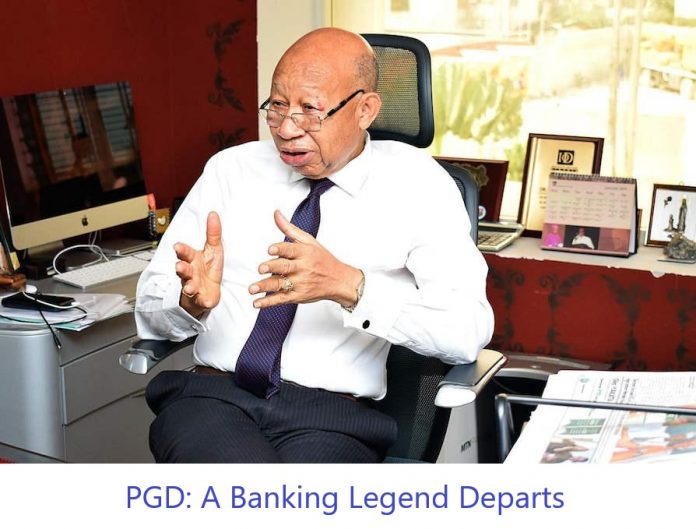
Pascal Dozie: A Banking Legend Departs

0

A legend departs from the solid bounds of the earth to the ecclesiastical heaven where cymbals, tapestries and flutes, with cherubic melodies welcome a man who raised a generation of young people, pushing them into the path of prosperity and abundance.

In November 2023, a phone rang, and I picked it. And from the other side, an unmistakable voice said, ‘Prof Ekekwe, I am PGD, your colleague in Diamond Bank”. I jumped and shouted “Ifeoma [my wife], come over here because a Legend is on the line”. Yes, a banking legend, Pascal Dozie, Founder of Diamond Bank, called one of his boys.

I was to be hired for the Owerri branch of the bank, but during the final level interview, the leadership decided to post me to the headquarters. And in just three years, I experienced transformation, turning a village boy-FUTO-educated engineer into a top-grade professional. While in the bank, they paid for my two master’s degrees and a correspondence doctoral degree in banking and finance.

As we spoke, I thanked our Chairman for his grace, kindness and generosity, reciting Diamond Bank’s mission and vision statements which I memorized while in the training school. Great leaders inspire generations and PGD served.

Chairman remembers everything. Many years ago, on a January morning, I came to the bank to drop my resignation letter; I was to fly into New York that day. Hours before, the bank had paid my upfront, a big chunk of my yearly salary. I quickly updated the letter, and asked the bank to reverse the entry as I was leaving the country and would not be around to earn the money. To cut the story short, our Chairman later approved for me to keep the money, covering it for the Bank.

In the world of African banking, PGD was peerless on innovation. He pioneered the integrated banking system (DIBS) which used technology to link branches together, making operations of accounts agnostic of location. In short, during the research of my undergraduate final year seminar in FUTO, I came into contact with DIBS and the Valucard system, and decided that it would be fun to work in Diamond Bank. I got in and right in the training school, I received a message that I needed to visit Schlumberger in PHC, to decline a job, because then it was a heritage in FUTO that best graduating engineering students were given multiple job offers. I flew the first time to decline that, because I wanted to work in Diamond Bank.

Chairman ascended to heaven today, aged 85, leaving behind a generation of men and women he inspired. An icon of African business, innovator personalized, THANK YOU for all you did for a village boy to understand the physics of finance.

Exploring Alabama’s Legislation on Bitcoin Investments

0

Alabama has introduced legislation to allow state investment in Bitcoin. In March 2025, House Bill 482 (HB482) was introduced in the Alabama House of Representatives, followed by its companion, Senate Bill 283 (SB283), filed in early April 2025 by Senator April Weaver. These bills propose that the Alabama State Treasurer be permitted to invest up to 10% of certain state funds in digital assets, provided those assets have a market capitalization exceeding $750 billion over the preceding 12 months. As of now, Bitcoin is the only cryptocurrency that meets this criterion, effectively making it the focus of the legislation, though it isn’t explicitly named in the bills.

The legislation stipulates that these digital assets must be held directly by the State Treasurer, a qualified custodian, or through exchange-traded products, and it would take effect on October 1, 2025, if passed. The bills have bipartisan support and are currently under review, with HB482 assigned to the House Ways and Means General Fund Committee. This move aligns Alabama with a growing number of U.S. states exploring Bitcoin as part of their financial reserves, reflecting a broader trend of institutional interest in cryptocurrency.

The implications of Alabama’s proposed bills HB482 and SB283 to allow state investment in Bitcoin are multifaceted, spanning economic, political, and social dimensions. Allowing up to 10% of certain state funds to be invested in Bitcoin could diversify Alabama’s financial portfolio. Bitcoin’s historically high returns—despite its volatility—might offer a hedge against inflation or underperforming traditional assets like bonds, especially in an era of rising national debt and fiat currency concerns. Bitcoin’s price is notoriously volatile. A significant drop could strain state finances, especially if the investment coincides with a market downturn.

Critics might argue this introduces unnecessary risk to taxpayer funds, which are typically held in safer, more liquid assets. Alabama joining states like Texas or Wyoming in embracing Bitcoin could signal broader governmental acceptance, potentially boosting Bitcoin’s price and adoption. Even a modest state investment e.g., millions from Alabama’s $14 billion General Fund could amplify this effect if other states follow suit. Direct custody or reliance on qualified custodians/exchange-traded products would require new infrastructure, expertise, and fees, potentially offsetting some financial benefits. The bills’ bipartisan backing suggests cryptocurrency is becoming less of a partisan issue, which could encourage similar legislation elsewhere. This might reshape state-level fiscal policy debates nationwide.

While states have autonomy over their treasuries, significant Bitcoin adoption could draw scrutiny from federal regulators or the Treasury Department, especially if it’s perceived as undermining the U.S. dollar’s dominance or complicating monetary policy. In a politically polarized state, embracing Bitcoin could appeal to libertarian-leaning voters or younger demographics while alienating traditionalists wary of “speculative” assets. It might become a 2026 election talking point. State investment could normalize cryptocurrency in Alabama, encouraging businesses and individuals to adopt it. This might position Alabama as a forward-thinking, tech-friendly state, attracting blockchain-related industries.

Most Alabamians might lack the knowledge to understand or support this shift. Public backlash could emerge if losses occur, especially without clear communication about risks and benefits. Pairing this with Alabama’s growing tech sector (e.g., Huntsville’s aerospace hub) could amplify its reputation as an innovation leader, though it hinges on successful execution. If passed, Alabama would join a small but growing list of states experimenting with Bitcoin—Texas has crypto-friendly laws, and Wyoming has pioneered blockchain legislation.

Globally, nations like El Salvador which adopted Bitcoin as legal tender provide a precedent, though Alabama’s approach is more conservative, focusing on investment rather than currency status. The $750 billion market cap threshold ensures a focus on Bitcoin currently ~$1.5 trillion as of early 2025 estimates, excluding riskier altcoins. In summary, this could be a bold economic play with significant upside if Bitcoin’s value rises, but it carries risks of financial loss and political blowback. Its success might hinge on market timing, public education, and whether other states amplify the trend.