DD
MM
YYYY

PAGES

DD
MM
YYYY

spot_img

PAGES

Home Blog Page 2

Aligning Spare Parts Planning With Preventive Maintenance in Manufacturing

0

Preventive maintenance issues in manufacturing rarely arise due to missing schedules or poorly defined tasks. Most plants know what needs to be done and when. Problems arise when planned work reaches execution and cannot be completed because the required spare parts are unavailable, incorrect, or not accessible at the time of work. When this happens repeatedly, planned maintenance is missed, and reactive work increases.

In practice, spare parts planning determines whether preventive maintenance can be executed consistently. That said, maintenance teams must focus on stabilizing parts availability before considering broader changes, including reviewing the best preventive maintenance software for manufacturing. Without alignment between the maintenance plan and parts availability, preventive work becomes unreliable regardless of how well it is documented or planned.

Scheduling And Execution Are Not The Same

Preventive maintenance tasks are scheduled based on asset requirements and operating hours. Execution depends on whether the job can be completed as planned. The two are related but not interchangeable.

When parts readiness is not verified before work reaches the floor, common outcomes include:

  • The job is deferred after the technician arrives
  • The job is closed without completing all steps
  • A substitute part is used without updating records

These are not deliberate decisions. These are execution issues that distort maintenance history and inventory data.

When these execution shortcuts repeat, planning data becomes unreliable. Deferred work is not visible, part consumption is understated, and task durations appear shorter than reality. Over time, planners schedule more work than teams can complete. This leads to overloaded weeks, rushed closeouts, and growing gaps between the schedule and what actually happens on the floor.

Basic Readiness Checks Improve Execution

Plants with stable PM execution apply simple readiness checks before work starts. These checks confirm that the job can be completed without interruption.

A few key checks for a successful PM execution include:

  • Confirmation of the correct part number
  • Verification that the part is available or has a confirmed delivery date
  • Confirmation of quantity
  • Clarity on approved substitutes
  • Clarity on who can approve changes if needed

Applying these checks consistently reduces last-minute deferrals and incomplete work.

Without these checks, technicians arrive ready to work but spend time searching, waiting, or improvising. They may close the task, but key steps are skipped. Over time, this normalizes partial completion, masks recurring shortages, and makes it difficult to distinguish planning errors from execution failures during reviews.

Bills Of Materials Must Match Actual Use

Bills of materials (BOMs) link preventive tasks to spare parts planning. When BOMs are inaccurate, technicians make adjustments to complete the job. These adjustments include parts being borrowed, substituted, or taken from emergency stock. While the equipment may be serviced, inventory records no longer reflect reality.

These changes over time lead to:

  • Recurring shortages of the same items
  • Inconsistent usage records
  • Reduced confidence in inventory data

Teams that maintain reliable PM execution treat BOMs as operational records. When substitutes are used repeatedly, the BOM is reviewed and corrected. High-impact assets are checked regularly to keep parts lists aligned with actual usage.

Spare Parts Should Be Prioritized By Impact

Applying the same inventory rules across all spare parts creates unnecessary risk. Some parts cause immediate production loss if unavailable. Others can be sourced quickly with minimal impact.

A practical approach is to prioritize parts based on the following key aspects:

  • Production impact
  • Supplier lead time
  • Replacement difficulty
  • Usage frequency

Critical spares with long lead times should be managed differently from routine preventive consumables. Low-use insurance spares should also be reviewed periodically to avoid obsolescence. This will keep inventory focused on supporting production continuity rather than simply increasing stock levels.

Kitting Supports Planned Maintenance

For repeat preventive tasks, kitting improves execution consistency. Parts are pulled in advance and staged for the job, reducing delays and interruptions.

Kitting is most effective when applied selectively:

  • High-volume preventive tasks
  • Jobs with a history of delays
  • Assets that directly affect production output

Clear rules are needed for what happens to unused parts and pre-picked kits when work is postponed, so inventory records stay accurate. When kitting is informal or unmanaged, parts are staged but not consumed, returned late, or reassigned without record updates. This creates false availability, complicates reordering decisions, and increases last-minute shortages for future preventive jobs.

Reorder Levels Should Reflect Preventive Demand

Preventive maintenance creates predictable parts demand. Reorder points should reflect actual PM usage rather than historical purchasing patterns or emergency orders.

This requires:

  • Issuing PM parts against the work order
  • Reviewing usage during planning cycles
  • Reviewing and updating supplier lead times regularly

When PM consumption is tracked accurately, inventory stabilizes and emergency purchasing declines.

Maintenance And Procurement Must Stay Aligned

Spare parts planning falls between maintenance and procurement. When these teams operate independently, preventive maintenance execution suffers.

Effective coordination involves:

  • Agreed lead-time categories
  • Clear escalation thresholds
  • Approved alternate suppliers
  • Regular review of slow-moving and obsolete stock

Final Thoughts

When spare parts planning supports preventive maintenance, planned work can be completed as scheduled. Technicians spend less time waiting for parts, inventory decisions become more predictable, and downtime risk is reduced. In turn, preventive maintenance remains effective as manufacturing operations grow.

Europe Pushes “Made in Europe” Strategy to Shield Industries from Chinese Imports

0

As the European Union grapples with intensifying competition from subsidized Chinese imports, EU Industry Commissioner Stéphane Séjourné has rallied over 1,100 CEOs and business leaders in a high-profile op-ed calling for a bold “Made in Europe” strategy to prioritize local production in strategic sectors.

Published across major European newspapers on February 1, 2026, the piece warns that without an “ambitious, effective, and pragmatic industrial policy,” the EU risks becoming a mere “playground” for rivals like China and the United States.

This push comes ahead of the European Commission’s delayed proposal for the Industrial Accelerator Act, now slated for February 25, 2026, which aims to introduce preferences for EU-made products in public procurement and state aid to counter unfair global competition.

Séjourné, a French centrist and the Executive Vice President for Prosperity and Industrial Strategy, framed the initiative as essential for sovereignty: “We must establish, once and for all, a genuine European preference in our most strategic sectors. It is based on a very simple principle: Whenever European public money is used, it must contribute to European production and quality jobs.”

He drew parallels to “Made in China” and “Buy American” policies, arguing that Europe’s open market has left it vulnerable to distorted competition.

The op-ed garnered signatures from a diverse array of industry titans, spanning steel (ArcelorMittal, Tata Steel, Thyssenkrupp Steel Europe), pharmaceuticals (Novo Nordisk, Sanofi), automotive components (Continental, Michelin, Pirelli), aviation (Air France-KLM), and energy (Engie), among others.

Thyssenkrupp CEO Marie Jaroni, a signatory, invoked Canadian Prime Minister Mark Carney’s warning, saying: “Those who are not sitting at the table now will end up on the menu… Steel is inextricably linked to this.”

The backdrop is Europe’s mounting alarm over Chinese dominance in critical sectors like clean energy, semiconductors, batteries, and electric vehicles, where state subsidies enable dumping at below-market prices.

Chinese customs data show EU imports from China rising 14.8% over the past year, with spikes of 15.5% in Germany, 17.5% in France, and 25.4% in Italy.

The EU has responded with provisional anti-dumping duties on Chinese EVs and investigations into subsidies for wind turbines and other goods. Former ECB President Mario Draghi, in a 2025 report, warned Europe must federate to avoid being “picked off one by one” by China and the U.S., advocating for strategic autonomy.

However, the “Made in Europe” push has ignited fierce internal divisions. France, Italy, and Spain champion the approach as vital to counter unfair trade, while Germany, the Netherlands, Sweden, and the Czech Republic oppose it, fearing deterred foreign investment, inflated public tender costs, and reduced global competitiveness.

A December 2025 letter from nine EU nations urged “extreme caution” on buy-European policies.

The automotive sector, notably absent from signatories, has been vocal in opposition due to reliance on global supply chains. Ford of Europe President Jim Baumbick told Reuters: “Ford supports strengthening Europe’s industrial base, but the planned ‘Made in Europe’ rules must remain open to trusted partners like the UK and Turkey… excluding them would weaken production inside the EU itself.”

Bosch CEO Stefan Hartung cautioned the rules should address “level-playing field issues” rather than compensate for disadvantages. Mercedes-Benz CEO Ola Källenius warned such requirements risk “driving up inflation and shrinking the market,” advocating a “scalpel” approach.

The Industrial Accelerator Act, initially dubbed the Industrial Decarbonization Accelerator Act but renamed for a broader scope, is now expected on February 25, 2026—delayed from December 2025 due to these splits. A leaked draft emphasizes accelerating decarbonization in energy-intensive industries like steel, streamlining permitting, mobilizing investments, and creating stockpiling centers for critical raw materials to enhance supply chain resilience. It includes a carbon intensity label for steel products and focuses on priority sectors for climate objectives and economic resilience.

The proposal integrates with the EU’s Net-Zero Industry Act, Critical Raw Materials Act, and upcoming 2028-2034 budget negotiations, where local content could influence funding. BusinessEurope and the European Round Table for Industry urge a balance to avoid disrupting global chains.

Against the backdrop of the bloc’s different interests, the “Made in Europe” debate tests its unity in a multipolar world, weighing protectionism against openness. With the Act’s proposal imminent, the EU faces a fundamental choice: double down on strategic autonomy through targeted preferences or risk alienating trade partners and investors in pursuit of self-sufficiency.

Oracle’s Shares Rise 5% Following Plan of $50bn Capital Raise for Data Centers

0

Oracle’s shares rose 5% in premarket trading on Monday after the company disclosed plans to raise as much as $50 billion to expand data center capacity.

The company said it aims to raise between $45 billion and $50 billion in gross proceeds during the 2026 calendar year through a combination of debt and equity. The funds will be used to build additional capacity to meet what Oracle described as “contracted demand” from its cloud customers, which include Nvidia, Meta, OpenAI, AMD, TikTok, and xAI. Those customers sit at the heart of the global AI boom, where demand for computing power has surged far faster than supply.

The move underscores both the scale of the artificial intelligence buildout underway and the growing financial risks companies are taking to stay competitive.

Oracle’s announcement comes as hyperscalers and infrastructure providers race to lock in land, power, and financing for data centers capable of supporting large language models and other compute-intensive AI systems. Data center deals reached a record $61 billion in 2025, reflecting the speed at which capital is being deployed across the sector as companies try to avoid capacity bottlenecks that could slow AI development.

For Oracle, the fundraising plan marks a deepening of a strategic shift that has transformed the company from a traditional enterprise software provider into a major AI infrastructure player. In recent years, Oracle has leaned heavily into cloud computing, pitching its data centers as a cost-effective alternative to those run by Microsoft, Amazon, and Google, particularly for customers with massive, predictable workloads.

That repositioning became more explicit in September, when Oracle raised $18 billion through a bond sale and announced a landmark agreement with OpenAI valued at up to $300 billion. Under that deal, Oracle committed to providing large-scale computing resources to support OpenAI’s expanding model training and deployment needs, tying Oracle’s fortunes more closely to the trajectory of the AI sector.

Yet the scale and speed of Oracle’s investments have also heightened investor unease. The company’s stock has fallen roughly 50% from its September peak, reflecting concerns that aggressive capital spending and debt issuance could pressure its balance sheet before returns fully materialize. Shares dropped 11% in December after Oracle reported quarterly revenue that narrowly missed expectations, reinforcing worries that near-term financial performance may lag behind long-term ambitions.

The reaction to Oracle’s plans mirrors a broader pattern across big tech, where markets have become more sensitive to execution risks even as companies commit extraordinary sums to AI. Last week, Microsoft shares fell 10% after growth in its Azure cloud business came in slightly below expectations, despite the company’s dominant position in AI through its partnership with OpenAI. By contrast, Meta’s shares jumped 8% after it reported heavy AI spending, suggesting investors are still willing to reward companies that show clear momentum and confidence in monetizing AI over time.

Oracle’s move also highlights the capital-intensive nature of the AI era. Building modern data centers requires not just advanced chips from suppliers like Nvidia and AMD, but also long-term access to power, cooling infrastructure, and high-speed networks. Securing those inputs at scale increasingly demands billions of dollars upfront, often years before the full revenue benefits are realized.

Investors have flagged that Oracle’s reliance on both debt and equity to fund its expansion could dilute shareholders or strain cash flows if AI demand softens or if competition intensifies. At the same time, Oracle argues that long-term contracts with major customers reduce the risk of overbuilding, positioning its capacity expansion as a response to confirmed demand rather than speculative growth.

The company’s disclosure that the funds will be raised in 2026 also suggests Oracle is trying to pace its financing with the rollout of projects already in the pipeline, rather than flooding the market with new debt immediately. Even so, the headline figure reinforces how far the AI infrastructure race has pushed spending expectations beyond historical norms.

However, Oracle’s $50 billion plan stands as another marker of how central data centers have become to economic and technological competition. The challenge for Oracle will be to convert its bold investment push into sustained revenue growth while convincing investors that the risks it is taking today will not outweigh the rewards promised by an AI-driven future.

Deepsnitch AI Price Prediction: Bed Bath & Beyond Pivots to RWA and Top Coins Crash, But Smart Investors Are Buying DeepSnitch AI for Maximum Alpha

0

Bed Bath & Beyond has signed an agreement to acquire Tokens.com, indicating a massive push into real estate finance and tokenized real-world assets (RWAs). As more tokens crash in the market, smart investors are accumulating DeepSnitch AI.

Now in Stage 5 with a price of $0.03830, DeepSnitch AI has surged more than 153% from its opening, proving that AI token analysis and superior market intelligence are the only safe harbors in a storm. The current Deepsnitch AI price prediction suggests that this intelligence ecosystem is poised to outperform many other projects.

Bed Bath & Beyond’s crypto bet

Bed Bath & Beyond is transforming from a home goods retailer into a financial technology investor. The company’s acquisition of Tokens.com is part of a strategy to develop a platform focused on real estate finance and tokenized securities.

By integrating blockchain systems with regulated financial services, the retailer aims to aggregate traditional and tokenized assets into a single interface. This platform will allow users to view ownership, estimated values, and liquidity options for RWAs, supported by Bed Bath & Beyond’s existing stakes in blockchain businesses like tZERO and GrainChain.

The best gem to invest in the market decline

Deepsnitch AI Price Prediction: The green candle in a red market

While the rest of the market searches for a bottom, the DSNT growth outlook is overwhelmingly bullish. The project has raised over $1,470,000 and is defying the global crash by consistently hitting higher highs in its presale stages. Currently priced at $0.03830, DeepSnitch AI represents a sanctuary for capital fleeing the volatility of public markets.

The bullish Deepsnitch AI price prediction is driven by its utility, as it has AI agents that provide trading intelligence to investors. In a crashing market, traders need answers. They need to know if a drop is a buying opportunity or a death spiral.

DeepSnitch AI provides these answers through real-time data analysis and risk scoring. Smart investors are buying DeepSnitch AI now, and they can also earn passive income with over 33 million tokens staked.

The high demand for its tools suggests a listing price target potentially exceeding $1.00 in 2026. That’s why the DeepSnitch AI price prediction is very bullish, with many investors buying as much as they can before TGE.

ZKsync ($ZK) price prediction

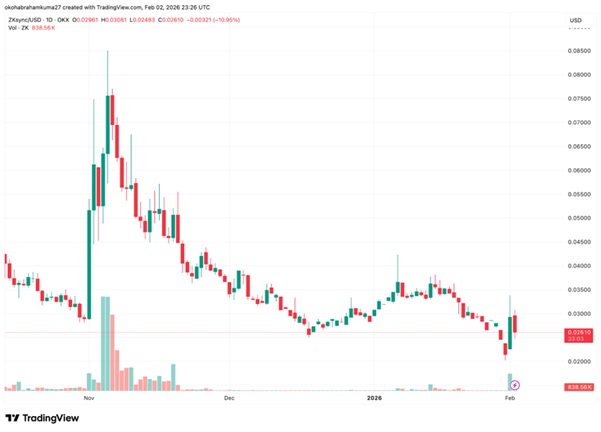
ZKsync ($ZK) is currently caught in the crossfire of the market sell-off. The token has declined by 6% in the last seven days as of February 2nd. While this is a loss, it is technically outperforming the global crypto market, which is down 10%.

The sentiment for ZKsync is bearish with a Fear & Greed Index of 14. Volatility is very high, making it a risky hold for short-term traders. The long-term forecast sees ZKsync hitting $0.05323 by the end of 2026, a 101% gain. However, waiting for a 2x return while enduring extreme volatility is a difficult proposition. The DeepSnitch AI price prediction offers a superior risk-reward profile. By investing in the presale, you lock in a fixed price and avoid the daily anxiety of watching charts bleed.

Ondo ($ONDO) price prediction

Ondo ($ONDO) should theoretically benefit from the Bed Bath & Beyond news, as it is a leader in the RWA space. However, the market is irrational. Ondo has declined by 15% in the last week as of February 2nd, underperforming both the global market and its peers.

The RSI is at 27.10, indicating the asset is oversold, but in a crash, oversold conditions can persist for weeks. While Ondo is forecasted to recover to $0.5859 by the end of 2026, DeepSnitch AI is ready for immediate post-launch growth.

Final thoughts

The market is crashing, but your portfolio doesn’t have to. DeepSnitch AI is the green lifeboat in a sea of red. Hence, keeping an eye on the Deepsnitch AI price prediction matters most. It is a project that has the potential to deliver massive profits for investors.

Visit the official DeepSnitch AI website, join Telegram, and follow on X for more updates.

FAQs

What is the Deepsnitch AI price prediction for 2026?

The Deepsnitch AI price prediction for 2026 is highly bullish, with targets exceeding $1.00 post-listing.

How does the Bed Bath & Beyond news affect AI token analysis?

The entry of major retailers into tokenized assets increases market complexity. This validates the need for AI token analysis platforms like DeepSnitch AI.

What makes the Deepsnitch AI price forecast better than Ondo’s?

The Deepsnitch AI price forecast is superior because it is an early-stage asset with a huge growth potential of more than 100x.

Rethink Sales

0
Good People, if you truly believe you have the best products and services, then silence is not humility; it is neglect. Not telling people about them is not modesty; it is unfairness. I carry a simple business philosophy: when you have something that improves human welfare, you have a moral obligation to let the world know. Value hidden is value denied.
 
In Igbo wisdom, good things do not sell themselves unless they are shown. If you do not speak for your product, you have already voted against it. When I tell you about our products, do not see it as noise; see it as social good. Why should people be denied access to the best simply because the producer chose to be quiet? Lol.
 
Many people misunderstand marketing and sales. They think selling is begging. It is not. Selling is education. It is helping people make better choices. I often say: if your product is truly superior, then not promoting it is an injustice to the market.
 
That is why I ask leaders to reframe sales in their minds. Invite me to speak with your marketing team. I have studied how to overcome sales inertia, that invisible force that keeps customers stationary even when value is right in front of them. Like in physics, motion does not happen without energy. Sales teams fail not because products are weak, but because motivation is misdirected.
 
Why deny the world the best products if you believe you have them? When we accelerate people’s confidence to market boldly, we unlock growth. Advertising is not deception when the product is excellent; it is public service. Do not be apologetic. Be responsible. Inform customers that better options exist.
 
In Igbo land, I learned this early. As a young boy in Oriendu Market, Ovim, I would shout, “bia z?? ji nnenne m!”; buy my grandmother’s yam. That was not arrogance; it was fairness. It would have been wrong to deny customers the chance to buy the best yam in the market!!!
 
Change your attitude to sales, and you will change your business. See selling as a call to duty, a higher-purpose assignment to improve lives by making people aware of the best products.
 
But this message comes with a condition: I hope you truly have the best products!
 
(At Tekedia Mini-MBA, we have improved thousands of businesses across Africa with a business education that delivers a motion of growth & success. Next edition begins on Feb 9)