DD
MM
YYYY

PAGES

DD
MM
YYYY

spot_img

PAGES

Home Blog Page 2

Crypto Card Spend Hits a New All-Time High

0

Crypto adoption is increasingly moving beyond trading, investing and speculation, as consumers use digital assets for everyday purchases.

The latest indication of this shift is the rise in spending through crypto-linked payment cards, which has reached a new all-time high. The milestone highlights how cryptocurrency is gradually becoming integrated into conventional financial activity.

Crypto cards allow users to spend digital assets through payment networks that resemble traditional debit or prepaid cards.

Depending on the provider, cryptocurrency can be converted into fiat currency at the point of purchase, allowing merchants to receive familiar currencies while customers retain access to their crypto holdings.

This model has helped remove one of the biggest barriers to everyday cryptocurrency use: the need for merchants to directly accept digital assets. The surge in card spending also reflects the expanding infrastructure around stablecoins.

Unlike volatile cryptocurrencies such as Bitcoin and Ether, stablecoins are designed to maintain relatively stable values against fiat currencies. This makes them particularly suitable for payments, allowing users to hold digital dollars and spend them without worrying about large price fluctuations between the time of purchase and settlement.

Another factor behind the growth is the increasing integration between crypto companies and traditional payment networks. Crypto platforms are developing cards that can be used at millions of merchants worldwide.

While financial institutions and payment companies are becoming more comfortable supporting blockchain-based settlement. As these connections improve, consumers can use crypto balances without necessarily understanding the underlying blockchain infrastructure.

The new spending record is significant because transaction activity can provide a different measure of adoption than cryptocurrency prices or exchange volumes.

A rising Bitcoin price can be driven by investment demand, while higher crypto card spending suggests that digital assets are increasingly being used as a financial utility. In other words, crypto is moving from an asset people hold to an asset people can use.

Rewards and cashback programs are also contributing to this trend. Some crypto cards offer users incentives in digital assets for everyday purchases, creating an additional reason to use them instead of conventional payment cards.

For frequent users, these rewards can turn routine spending on groceries, transportation, subscriptions and other services into opportunities to accumulate crypto. Transaction fees, foreign-exchange costs, regulatory requirements, taxation and the volatility of certain cryptocurrencies can complicate crypto-based payments.

Providers must maintain strong compliance and security systems as their products become more widely adopted. The record in crypto card spending points toward a broader transformation in digital finance. The next phase of cryptocurrency adoption may not be defined solely by new tokens or higher market valuations.

But by how seamlessly blockchain-based money becomes embedded in everyday commerce. If the trend continues, crypto cards could become an important bridge between decentralized assets and the traditional financial system.

The new all-time high therefore represents more than a spending record. It is evidence that cryptocurrency is increasingly being treated not just as an investment, but as a practical payment tool. This evolution could create new opportunities to reach a global customer base while reducing reliance on traditional banking intermediaries.

As blockchain payment infrastructure becomes faster and cheaper, crypto cards may increasingly compete with conventional payment products, particularly in markets where access to reliable financial services remains limited.


Japan Swings to First Current-Account Deficit in 17 Months as Oil Costs, Foreign Payouts Bite

0

June deficit sharply misses forecasts, but record first-half surplus shows AI-driven exports and overseas investment income continue to underpin Japan’s external finances

Japan recorded its first current-account deficit in 17 months in June as larger dividend payments to foreign investors and higher oil import costs eroded the country’s external surplus, although a record first-half surplus underscored the continuing strength of its overseas investment income and technology exports.

The current-account balance was a deficit of 92.3 billion yen ($584.5 million) in June, Finance Ministry data showed on Monday. The result was a sharp reversal from a surplus of 1.28 trillion yen a year earlier and fell far short of economists’ median forecast for a surplus of 1.51 trillion yen in a Reuters poll.

The monthly deficit is notable because Japan has relied on income from its vast overseas investment holdings to offset periods of weak trade performance. June’s figures show how quickly that cushion can narrow when payments to foreign investors rise and energy costs increase.

The primary-income balance, which captures earnings from overseas securities and direct investment, fell 74% to 380 billion yen. It is normally the single largest contributor to Japan’s current-account surplus. The decline was driven largely by larger dividend payments by Japanese companies to foreign investors following increased investment in Japan’s domestic markets. The development illustrates an important shift in Japan’s external accounts: stronger foreign participation in Japanese equities and businesses can support asset prices and corporate financing while simultaneously increasing the income that flows out of the country.

Higher oil import costs added to the pressure. Japan remains heavily dependent on imported energy, making its trade balance particularly sensitive to movements in global crude prices. Rising oil costs pushed the country into a trade deficit in June and helped drag the overall current account below zero.

The June result, however, needs to be viewed against a much stronger performance over the first half of the year. Japan’s current-account surplus increased 22.5% to a record 17.4 trillion yen in the six months through June. The improvement was supported by a trade surplus, with exports of semiconductors destined for artificial-intelligence data centers providing a significant boost.

The contrast between the June deficit and the record first-half surplus highlights the changing structure of Japan’s external finances. The country is no longer dependent solely on merchandise trade to generate foreign currency. Investment income from overseas assets has become a critical source of support, while Japan’s manufacturers are increasingly benefiting from the global expansion of AI infrastructure.

AI Boom Strengthens Japan’s Export Position

The strength of semiconductor-related exports is enormous because it links Japan’s external balance to one of the fastest-growing areas of global capital spending. Japanese companies occupy important positions across the semiconductor supply chain, supplying chipmaking equipment, materials and components required to manufacture advanced processors and build AI data centers. Strong demand for these products has helped support exports even as other parts of global trade have faced uncertainty.

The first-half figures suggest that the AI investment cycle is becoming an important source of external demand for Japan. If spending on data centers and advanced computing infrastructure remains strong, Japanese exporters could continue to benefit through demand for semiconductor manufacturing equipment and related technology.

At the same time, the June figures demonstrate that the export gains can be offset temporarily by movements in investment income and energy costs.

Foreign Investment Creates A Two-Way Income Flow

The sharp contraction in primary income is also a consequence of Japan’s growing integration with global capital markets.

Foreign investors have increased their exposure to Japanese shares and companies, attracted by corporate-governance reforms, improving profitability and a shift away from years of deflation. That capital supports Japanese asset prices and can provide companies with access to international investors.

But the resulting dividends and other investment returns eventually flow back overseas. In June, those payments were large enough to materially reduce the primary-income surplus. This means a stronger foreign investment presence in Japan does not automatically translate into a larger current-account surplus. It can improve the country’s financial position in other ways while increasing the amount of income that leaves Japan.

The trade balance remains another source of volatility. Japan imports most of the energy it consumes, leaving its external accounts exposed to swings in oil and gas prices. A sustained increase in energy costs can quickly widen the import bill and reverse gains from stronger exports.

That vulnerability is relevant as geopolitical tensions continue to create uncertainty in global energy markets. A renewed oil-price surge would raise Japan’s import costs and could place additional pressure on the trade balance, especially if export growth slows.

Conversely, lower energy prices would provide an immediate benefit to the country’s external position by reducing the value of imports.

Record Surplus Offers Broader Reassurance

Despite the June deficit, the record 17.4 trillion yen first-half surplus indicates that Japan’s external position remains substantial.

The data also underline the resilience provided by the country’s huge stock of overseas assets. Japanese investors and companies have accumulated significant foreign investments over decades, generating a recurring stream of dividends and interest income that has increasingly compensated for the country’s historically weaker merchandise trade balance.

For the yen, the latest figures offer a mixed signal. A current-account surplus generally creates underlying demand for the currency, but larger outward investment-income payments and higher import costs can reduce that support. The record first-half surplus, however, suggests Japan continues to generate considerable external income even as individual monthly readings become more volatile.

The key question for markets will be whether the June deterioration proves temporary or marks the beginning of a broader weakening in Japan’s external balance. Currently, the first-half figures are arguing against the latter.

Sunrise Energy Metals Soars as U.S. Backs Australian Scandium Mine in Bid to Break China’s Mineral Grip

0

Shares of Australia’s Sunrise Energy Metals surged as much as 29% on Monday after the Trump administration backed the company with a $400 million conditional loan commitment to develop a major scandium project, giving fresh momentum to Washington’s drive to build critical-mineral supply chains outside China.

The stock later pared some of its gains but still closed more than 16% higher, as investors responded to a U.S. government commitment that could help Sunrise finance development of its Syerston project in New South Wales.

The U.S. Department of War said its Office of Strategic Capital had agreed to provide the conditional long-term debt financing to support Sunrise’s plan to establish an integrated scandium value chain, beginning with primary mining and extending into processing.

The proposed development matters notably because scandium is a relatively obscure but highly specialized metal whose properties make it valuable in aerospace, defense and advanced manufacturing. Adding scandium to aluminum can significantly increase strength while improving resistance to heat and corrosion. Those characteristics make scandium-aluminum alloys attractive for applications where manufacturers need lighter and stronger materials, including aerospace and defense systems.

The metal is also being considered for energy infrastructure supporting power-intensive industries such as artificial intelligence data centers, adding another potential source of demand as global investment in AI computing capacity accelerates.

More importantly for Washington, the project offers a potential alternative to China’s dominance of critical-mineral supply chains.

China produces nearly 70% of the world’s rare earths from domestic mines and controls almost 90% of global rare-earth processing, according to figures cited in the report. Its position has given Beijing considerable leverage over industries dependent on strategic minerals and has heightened concerns in Washington and other Western capitals about supply disruptions and export restrictions.

The Sunrise financing is therefore part of a much broader industrial policy. The United States is increasingly using government-backed loans, equity investments and other forms of financial support to encourage mining, processing and manufacturing capacity at home and in allied countries.

“Under the leadership of President Donald J. Trump, securing our critical minerals supply chain is a top national security priority,” David A. Lorch, director of the Office of Strategic Capital and senior adviser to Deputy Secretary of War Steve Feinberg, said in a statement.

Lorch said the proposed Sunrise transaction would help establish a more resilient scandium supply chain and facilitate the mineral’s use in defense and commercial applications.

The U.S. government said the broader transaction, combining public and private capital, could approach $1 billion.

That distinction is important. The $400 million announced by Washington is a conditional loan commitment rather than a direct government grant, while the wider financing package is expected to include private capital. The government support could nevertheless improve Sunrise’s ability to secure the additional funding required to develop the project.

For Sunrise, access to government-backed capital could be particularly valuable because scandium is an extremely small market compared with commodities such as copper, lithium and rare earths. The limited size of the existing market has historically constrained investment in dedicated scandium production.

Most scandium has traditionally been recovered as a byproduct of other mining operations rather than through large-scale primary mines. Sunrise’s strategy is consequently based on creating a dedicated supply source and expanding the market for the metal through new applications.

Sunrise Chairman Robert Friedland described the U.S. backing as a “landmark moment” for the company and Australia’s mining industry.

“The world has entered an era in which access to critical minerals will shape industrial strength, technology leadership and national security,” Friedland said.

“Scandium is one of the clearest examples, supporting the technologies, industries and defence capabilities that will shape the coming decades,” he added.

The project’s strategic appeal is also linked to its potential scale. Sunrise Chief Executive Sam Riggall said in June that Syerston could become the world’s largest single source of scandium and have the capacity to replace China’s current supply from one operation.

“What we are building in Australia, very close to Sydney, will be the world’s single largest source of scandium supply and it will have the capacity to replace everything that China supplies today from this one mining operation,” Riggall said.

“So, with this particular metal, it is possible to find ready solutions that can address this supply risk very quickly,” he added.

That potential makes Syerston significant beyond Sunrise itself. A large, reliable source outside China could give Western manufacturers greater certainty over a material that is strategically important but currently has a fragmented and relatively opaque supply chain.

The project also fits Australia’s important role in the critical-minerals strategy of the United States and its allies. Australia combines substantial mineral resources with an established mining industry and close security and economic ties with Washington, making it a natural partner as Western governments seek alternatives to Chinese-controlled supply chains.

The move comes as China increasingly uses its position in critical minerals as an instrument of economic leverage.

The U.S. backing for Sunrise follows a broader acceleration in Washington’s efforts to secure strategic minerals needed for defense equipment, electric vehicles, energy infrastructure and advanced technology.

However, the announcement does not eliminate the risks associated with developing Syerston. The loan remains conditional, and Sunrise will still have to navigate financing, permitting, construction, technical and commercial hurdles before the project generates revenue.

Strategy Sells Approximately $105 Million in Bitcoin to Support Preferred Stock And Cash Reserves

0

Strategy, the Bitcoin-focused company led by CEO Michael Saylor, has recently sold 1,638 Bitcoin for about $104.7 million.

The transactions took place between July 27 and August 2, 2026, at an average price of roughly $63,957 per coin, according to an SEC filing.

The recent sale saw the company’s BTC holdings reduced to 842,138 Bitcoin. Proceeds were directed toward preferred stock obligations. Approximately $52.4 million funded dividend payments, while another $52.3 million supported repurchases of STRC preferred shares.

Strategy also raised additional capital by selling common shares and increased its U.S. dollar reserve to $4 billion, extending its liquidity runway.

The Bitcoin was sold below the company’s average acquisition cost of $75,419 per coin. Strategy has accumulated its treasury over years at a total cost of about $63.5 billion including fees.

The latest sale forms part of a broader pattern in 2026 in which the company has sold a modest portion of its holdings totaling several thousand Bitcoin across multiple transactions to meet dollar-denominated obligations rather than continue uninterrupted accumulation.

Strategy sale of part of its Bitcoin holdings has come under heavy criticism.

Critics note the company has repeatedly used capital raised through equity and preferred-stock offerings to increase its Bitcoin holdings, making its decision to liquidate BTC a significant shift in how some investors view its treasury strategy.

The sales are primarily connected to Strategy’s need to maintain liquidity and meet obligations associated with its preferred stock and other financial commitments.

In June this year, the company established a Bitcoin Monetization Program that allows it to sell up to $1.25 billion worth of Bitcoin to strengthen its U.S. dollar reserve. Strategy said the reserve is designed to support dividends on its preferred stock and interest payments on outstanding debt.

This means the sales do not necessarily represent a change in Strategy’s long-term belief in Bitcoin. Rather, the company is treating part of its Bitcoin holdings as a source of liquidity when other financing options become less attractive.

CEO Michael Saylor last week, addressed the distinction between personal and corporate actions shortly after the disclosure. “When I say ‘Never Sell Your Bitcoin,’ I speak as one saver to another.”

I have never sold mine. Not one satoshi. Strategy is a public company, not my wallet,” he posted. He noted that the company has long disclosed it may buy or sell Bitcoin as part of capital management while maintaining its overall conviction in the asset.

The move marks a practical shift for a firm long known primarily as a relentless Bitcoin buyer. Preferred stock distributions and the need to support STRC trading levels have created ongoing cash requirements.

By converting a small fraction of its Bitcoin into dollars and using equity issuance, Strategy has prioritized balance-sheet flexibility and preferred-share support while still holding more than 4 percent of Bitcoin’s total supply the largest corporate treasury of its kind.

Holdings remain substantial even after the sales, and the company continues to frame Bitcoin as its core long-term reserve asset.

Investors and observers are watching whether the pause in net purchases continues or whether stronger preferred-stock performance and higher Bitcoin prices will allow Strategy to resume adding to its stack.

For now, the latest transactions illustrate the realities of running a public company with structured liabilities alongside a large digital-asset treasury.

How I Solve System Freezes and Crashes by Keeping Graphics Drivers Up-to-Date with Driver Booster

0

Outdated graphics drivers may be responsible if your system experiences crashes, slow performance, or black screens, just like me. Driver updates help our system run smoothly by improving performance and stability while avoiding display issues. This guide explores graphics drivers, common issues, warning signs, update options, and the use of a reliable driver updater to improve system performance.

What Are Graphics Drivers? Common Causes of System Freezes and Crashes

Graphics drivers enable the computer to send display commands to the graphics card. They provide smooth display output, improved gaming performance, and correct functioning of multimedia and 3D applications. Simply put, it converts application requests into GPU-readable commands.

5 Signs: Graphics Drivers Need an Update

I found there are five clear signs that my graphics drivers may need an update.

Frequent crashes or low FPS: Outdated drivers can cause lag and repeated game crashes.

Screen flickering or artifacts: Poor driver communication can cause flickering, tearing, or visual glitches.

Windows Update issues: Corrupted drivers can cause updates to fail or get stuck.

Freezes after sleep: The system may show a black or frozen screen when the driver fails to restart.

Display driver errors: Messages like “Display driver stopped responding” indicate driver instability.

Common Causes of System Freezes and Crashes:

To figure out the causes of system freezes, I searched a lot and finally learned that graphics-related problems—such as black screens, blue screens (BSOD), or app crashes—are often caused by several factors. These include:

  • Outdated or corrupted drivers: These can cause system instability and errors.
  • Overheating (thermal issues): Poor airflow or dust buildup can cause the GPU to overheat and fail under load.
  • Insufficient power (PSU issues): A weak or failing power supply may not deliver stable power under heavy graphics loads.
  • Driver conflicts and bugs: Certain driver versions may cause bugs or conflicts with system updates (such as Windows 11) or other software.
  • Unstable overclocking: Running the GPU at speeds beyond safe limits can cause crashes and instability.
  • Hardware problems: Faulty components (such as RAM or a GPU) or incorrect cable connections (e.g., using the wrong DisplayPort cable) can also trigger issues.

Different Methods – How to Update Graphics Drivers

Keeping my graphics drivers up-to-date, which is essential for smooth performance and system stability. Here are different methods I tried to update my graphics drivers easily and effectively.? 

Best Way I Found – Using IObit Driver Booster 13 Free

Dependable as they are, Device Manager and official websites may still require manual driver updates that take additional time and effort. An automated solution is more convenient. For this, Driver Booster stands out as an efficient tool that simplifies updates and improves system stability and performance.

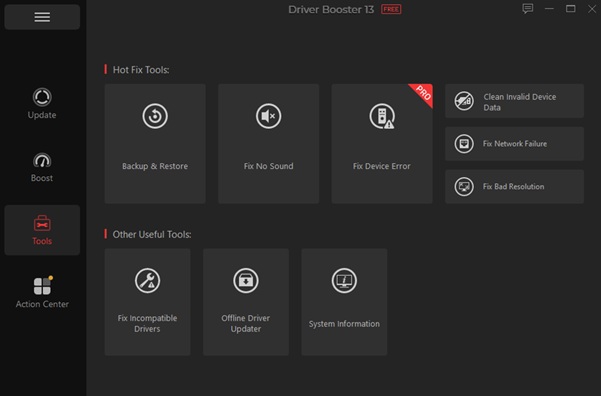
IObit Driver Booster 13 Free makes updating outdated graphics drivers easy with a fast one-click process.  It ensures driver safety by creating backups and choosing stable versions for installation. With real-time monitoring and easy automation, it simplifies driver management while improving system stability, performance, and overall reliability.

Key Features for IObit Driver Booster 13 Free

  • Supports a database of 12+ million drivers.
  • Uses WHQL-tested and verified drivers.
  • Prioritizes graphics and gaming updates.
  • Fixes network driver issues with built-in tools.

  • Supports offline driver installation.

Step-by-step guide: I updated graphics drivers with IObit Driver Booster 13 Free

Step 1. Download Driver Booster from the official IObit website.

Step 2. Install the program by running the setup file and following the on-screen instructions.

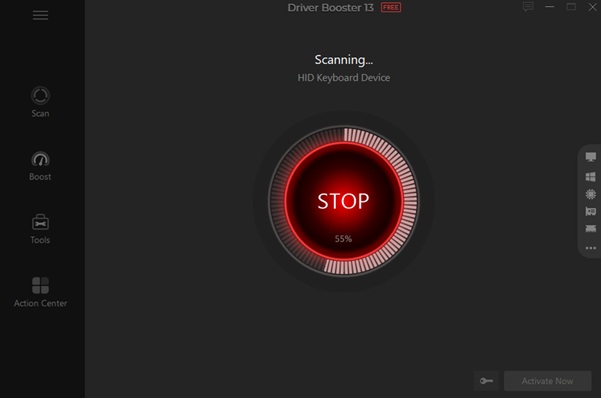
Step 3. Launch Driver Booster. The main dashboard will automatically start scanning my PC.

Note: Wait for 20-30 seconds while it identifies all outdated, missing, or faulty drivers.

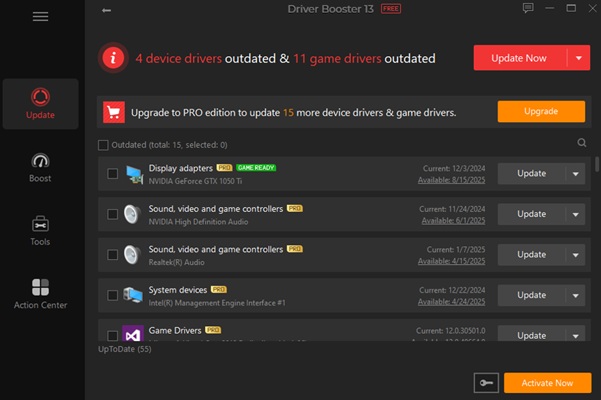
Step 4. And, I look for my graphics drivers in the scan results. I click the red “Update” button next to the graphics driver. 

Download Drivers from Official Websites

Downloading drivers from official websites such as NVIDIA, AMD, or Intel is a reliable way to stay up to date. These sources provide the latest drivers with performance improvements, bug fixes, and “Game Ready” updates. They are also secure and malware-free. However, this method requires manual effort, such as identifying the GPU model and operating system.

Here’s how to download drivers from official websites.

Step 1. Open Device Manager > expand Display adapters > note the exact GPU model (e.g., NVIDIA GeForce RTX 3060 or AMD Radeon RX 6600).

Step 2. Go to the correct site based on the GPU brand—NVIDIA, AMD, or Intel.

Step 3. Use the site’s search, auto-detection tool, or manually input my GPU model and Windows version to find the right driver.

Step 4. Choose the most recent stable version (not beta, unless needed).

Step 5. Run the installer and select Clean Installation (if available) to remove old or conflicting files.

Step 6. Reboot the system to apply changes and ensure everything works properly. 

Using Windows Device Manager

Most hardware drivers, including graphics cards and printers, are updated automatically by Windows Update. These drivers are stable but may not always be the latest versions, as reliability is prioritized. Newer updates may appear under “Optional Updates.”

Device Manager provides more control, enabling manual or automatic updates, hardware scans, rollbacks, and driver reinstallation for troubleshooting.

Here’s how to update graphics drivers using Device Manager.

Step 1. Press Windows Key + X and select Device Manager from the menu, or search for it in the Start menu.

Step 2. Expand the Display adapters section to find the graphics card (e.g., NVIDIA, AMD, or Intel).

Step 3. Right-click the graphics card name, then select Update driver.

Step 4. Choose Search automatically for drivers to have Windows scan the computer and the internet for the best available driver.

Step 5. If an update is found, it will install automatically. If not, Windows will inform me that the best drivers are already installed. 

Most Important Tips to Improve System Stability

Keeping my system stable requires more than just updating drivers—it involves a few smart maintenance habits. Here are some important tips to help improve overall system stability and performance.

  • Perform a clean driver installation: It eliminates corrupted or outdated drivers to support stable, efficient system operation.
  • Disable auto driver updates: Prevents Windows from replacing stable drivers.
  • Monitor GPU temperature: Keep it below 85°C to avoid overheating.
  • Update other drivers: Keep chipset, audio, and network drivers up to date.
  • Create a restore point: Allows easy rollback if problems occur.

Conclusion

Installing the latest graphics drivers is important for maintaining stable and reliable system performance. Ongoing updates are important for better stability, bug fixes, and smoother performance. Manual updates work, but using Driver Booster simplifies and speeds up the entire process. I will never let outdated drivers slow me down again—update regularly and use Driver Booster to keep my system running smoothly and efficiently.