DD
MM
YYYY

PAGES

DD
MM
YYYY

spot_img

PAGES

Home Blog Page 2

We Tested 5 New Crypto Casinos in 2026

0

New crypto casinos surface almost weekly, each promising faster payouts, better odds, or a smoother experience. But “new” doesn’t always mean “good”, so we tested 50+ casinos to bring you the 5 most trusted new crypto gambling sites.

As always, online gambling is 19+ (or 21+ depending on your jurisdiction), and availability varies by country and state, always confirm the legal status of crypto gambling where you live before signing up.

Here is our pick:

  1. Moonbet: Loved by high rollers for its unlimited withdrawals and no-KYC setup.
  2. BitStarz: Known for its huge game selection and crypto-friendly experience.
  3. Ignition Casino: A popular choice for Bitcoin poker alongside its casino games.
  4. Thunderpick: Built around crypto betting, with a strong focus on esports and sports.
  5. Mbit Casino: A straightforward Bitcoin casino with a good mix of games and bonuses.


Why crypto casinos moving up in 2026

A few trends are driving the shift toward crypto-first gambling platforms this year:

  • Speed of payouts. Traditional online casinos can take days to process a withdrawal. Crypto withdrawals, once verified, often land in a player’s wallet within minutes to a few hours.
  • Lower friction for international players. Because crypto sidesteps a lot of traditional banking rails, players in regions with limited payment options have an easier time funding accounts.
  • Provably fair gaming. Many crypto-native games publish the cryptographic seed used to generate results, letting players independently verify that a spin, roll, or hand wasn’t manipulated after the fact.
  • Crypto deposits generally require less personal financial data upfront than a linked bank card, though most licensed operators still require identity verification before withdrawals.

With that context, here’s a closer look at the five top crypto casinos worth putting on your radar.

1. Moonbet
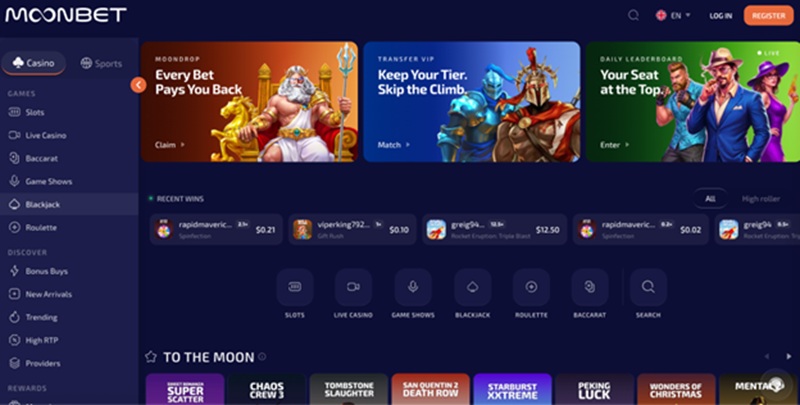
Moonbet combines a fast, streamlined interface with a casino built for crypto players, from provably fair games to slots, table games, and live casino titles. The platform also caters to high rollers, with features such as Moonback rakeback designed to give regular players more value over time. No KYC is required, making it possible to get started without going through a lengthy verification process.

What stands out:

  • Regular players can get a portion of their losses back through Moonback, helping improve their effective RTP and stretch their bankroll further.
  • Moonbet is particularly suited to players who prefer larger bets, higher limits, and a platform designed to accommodate bigger bankrolls.
  • Moonbet now offers no-KYC access for everyone, removing the need for the previous $2,000 KYC threshold and making deposits, gameplay, and withdrawals more straightforward.
  • Play with a broad selection of cryptocurrencies across casino games, including provably fair titles, slots, table games, and live dealer options.
  • Players can move between crypto casino games and sports betting without needing separate platforms.

Worth knowing: Moonbet is best suited to crypto players who value fast access, bigger betting options, and ongoing rewards through Moonback rather than simply choosing a casino based on the size of its slot library.

2. Bitstarz
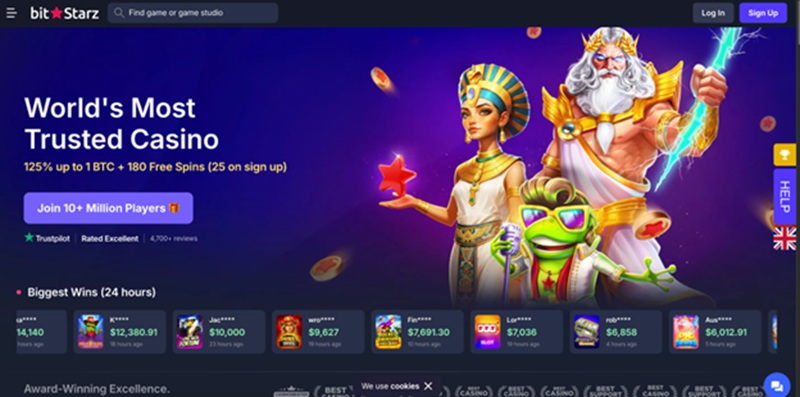
Bitstarz is one of the longest-running names in crypto gambling, and it’s often used as the benchmark other crypto casinos are compared against. It supports both crypto and fiat currencies, which makes it a comfortable entry point for players who aren’t fully committed to crypto-only platforms yet.

What stands out:

  • One of the largest game libraries in the space, with thousands of slots and table games from dozens of software providers.
  • A loyalty and VIP program that rewards long-term play rather than just first deposits.
  • A track record of relatively fast payout processing and responsive customer support, which matters more than almost anything else once you’re ready to cash out.

Worth knowing: Because Bitstarz has been around for years, expectations are high — some players find the bonus wagering requirements stricter than on newer, more aggressively promotional platforms.

3. Ignition

Ignition has carved out a strong reputation specifically among poker players, thanks to anonymous tables that hide opponents’ stats and usernames, a feature poker regulars appreciate because it reduces the advantage that tracking software normally gives sharks against recreational players.

What stands out:

  • Anonymous poker tables, a genuinely differentiated feature you won’t find on most competitors.
  • A strong casino side too, with live dealer games and a solid slot selection beyond the poker room.
  • Crypto deposits and withdrawals processed alongside traditional payment methods, giving players flexibility.

Worth knowing: Ignition’s strength is really the poker room. If poker isn’t your focus, it’s still a decent casino, but it’s not the platform’s standout feature.

More new crypto casinos worth a look

  1. JACK
  2. MyStake
  3. Betshark

How we tested these new crypto casinos

Whichever platform you’re considering, a few checks apply universally:

  1. Licensing. Look for a recognized gaming license (Curaçao, Malta, or similar) displayed clearly on the site, and confirm it’s still active.
  2. Provably fair verification. If a game claims to be provably fair, check that the platform actually explains how to verify a result — not just that it uses the term as marketing.
  3. Withdrawal limits and KYC. Even crypto-first sites usually require identity verification before a first withdrawal. Read the terms so you’re not surprised later.
  4. Customer support responsiveness. Test live chat before you deposit real money. Slow or evasive support is a red flag.
  5. Bonus terms. Wagering requirements, maximum bet limits while a bonus is active, and game weighting all affect how realistic it is to actually clear a bonus.

Why Moonbet tops this list

Moonbet earns the top spot because it’s built around the things high-stakes crypto players actually care about: speed, flexibility, and a rewards structure that scales with how much you play. The rakeback system stands out in particular, instead of a one-time bonus that dries up after your first few sessions.

The sportsbook sits alongside the casino rather than feeling bolted on, deposit and withdrawal limits are built with bigger bankrolls in mind, and the platform leans into a streamlined.

Benefits & Drawbacks of the Best New Crypto Casinos

Here’s a quick comparison of top bitcoin casino sites before your deposit:

Casino Benefits Drawbacks
Moonbet Rakeback rewards consistent play; high limits for big bankrolls; sportsbook + casino in one place (fast payouts & No KYC, no threshold is there) Less online process right now
Bitstarz Massive game library from dozens of providers; long-standing reputation; crypto + fiat supported Stricter bonus wagering requirements; less standout for newer-platform perks
Ignition Anonymous poker tables (rare feature); solid live dealer casino; crypto + traditional payments Casino games feel secondary to poker; less appealing if poker isn’t your focus
Thunderpick Strong esports betting (CS2, League, Dota 2); provably fair in-house originals; modern interface Smaller traditional slot/table selection; esports-first, casino second
mBit Casino Broad multi-coin support; frequent promotions and seasonal offers; mobile-friendly, no app needed Bonus terms require close reading; game library doesn’t have a standout specialty


Which cryptocurrency is best for gambling?

Stablecoins (like USDT or USDC) are often the practical choice since their value doesn’t fluctuate while you play or wait to withdraw. Bitcoin and Ethereum remain the most widely accepted across casinos, but their price can shift between deposit and cashout. The “best” option really depends on whether you prioritize broad acceptance (BTC/ETH) or price stability (stablecoins).


Unitree CEO Says Humanoid Robots Near ‘ChatGPT Moment’ as China Races to Dominate Physical AI

0

The global humanoid robotics industry is approaching a potential breakthrough that could transform artificial intelligence from software operating on screens into machines capable of acting autonomously in the physical world, according to Wang Xingxing, founder and CEO of Chinese robotics company Unitree.

Speaking Thursday at the World Robot Conference in Beijing, Wang said advances in embodied intelligence were moving the industry toward what he called a “ChatGPT moment,” referring to a breakthrough comparable to the launch of OpenAI’s ChatGPT in late 2022 that triggered mass adoption of generative AI.

“We are marching towards a ‘ChatGPT moment’ in embodied intelligence,” Wang said.

The comparison is reverberating because the next major phase of the AI industry is expected to depend not only on models that can understand and generate language, images and code, but also on systems that can perceive physical environments and translate AI decisions into precise movements.

Wang said the critical milestone would be reached when a robot could be placed in an unfamiliar environment and complete roughly 80% of tasks using simple voice or text instructions.

“We hope that in the future, we can see a robot be introduced into an unfamiliar household and it can achieve approximately 80% of tasks successfully through voice or text commands,” he said. “It is an important tipping point for the robot industry to usher in explosive growth.”

The benchmark illustrates the scale of the challenge facing the industry. A robot that can walk, run, dance or perform a choreographed sequence in a controlled demonstration is fundamentally different from one that can reliably understand an unfamiliar home, identify objects, plan a sequence of actions and recover when something goes wrong.

That gap between impressive demonstrations and dependable autonomy is now one of the central problems in physical AI.

Wang was notably cautious about how quickly the breakthrough could arrive. In an optimistic scenario, he said a major advance in robot software could emerge within two to three years. At the other end of the range, it could take five to 10 years.

That matters for an industry that has attracted enormous investor enthusiasm before achieving widespread commercial deployment. Unitree’s shares surged nearly sixfold in their Shanghai debut on Wednesday before falling 11% on Thursday, illustrating the extraordinary expectations surrounding China’s robotics sector.

Unitree’s debut also highlighted the growing financial importance of humanoid robotics to China’s technology market. The company’s spectacular listing came as more than 300 exhibitors gathered at the World Robot Conference, showcasing robots designed for factories, logistics, research, education and consumer applications.

But the industry’s current economics remain considerably less mature than its stock-market valuations suggest. Humanoid robots are still expensive, have limitations in battery life and dexterity, and in many practical applications remain less efficient than human workers. Most deployments are still concentrated in research, training and controlled industrial environments rather than ordinary homes.

Wang said Unitree’s largest investment in both capital and manpower is currently focused on “world models,” the AI systems intended to help robots understand and predict events in physical environments.

The emphasis represents a shift in the robotics race. Hardware has advanced rapidly, helped by improvements in electric motors, batteries, sensors, actuators, and lightweight materials. The more difficult problem is developing an AI “brain” capable of generalizing what it has learned from one environment to another.

A robot trained to pick up a particular box in a factory, for example, must eventually be able to recognize a different box, understand a different instruction, deal with different lighting and positioning, and complete the task without human intervention.

Wang said Unitree was still “lagging behind” in applying physical AI models to real-world environments and that current AI models powering robots’ decision-making and interaction remain the industry’s biggest bottleneck.

That limitation helps explain why the industry’s anticipated “ChatGPT moment” is not simply a question of building a better humanoid body. The breakthrough requires an integrated system combining perception, reasoning, planning, control and learning, while maintaining sufficient reliability for real-world use.

Galbot founder Wang He expects the milestone to arrive by 2028. He defines the breakthrough as the point when robots can perform about 70% to 80% of everyday tasks without specialized training.

“With continued accumulation of data and further technological breakthroughs, we expect to reach the ‘ChatGPT moment’ for embodied intelligence by 2028,” he said.

Data is necessary because robots need something that conventional AI models did not require at the same scale: physical experience. Language models can be trained on enormous quantities of text and other digital information, whereas robots need data describing how actions translate into physical consequences.

China is attempting to build that advantage through rapid manufacturing, government-backed robotics programmes and the deployment of robots in controlled environments where companies can collect additional training data. The emergence of more than 90 robotics training centers across China by mid-2026 has become part of that ecosystem, although questions remain over how effectively data generated in such centers translates into performance in uncontrolled environments.

China already has a commanding lead in humanoid robot shipments. Global shipments reached about 19,100 units in the first half of 2026, according to industry research cited in recent reports, with Chinese manufacturers accounting for more than 97% of the global total. AgiBot shipped about 8,400 units, while Unitree shipped roughly 5,900, putting the two Chinese companies at the top of the global market.

The figures show that China’s advantage is no longer confined to prototypes and demonstrations. Its manufacturers are producing robots at a scale that is beginning to create a manufacturing ecosystem around humanoids.

That ecosystem draws on capabilities China has developed in electric vehicles, consumer electronics, batteries, industrial automation and drones. Components such as motors, batteries, sensors and precision-machined parts can increasingly be sourced from established domestic supply chains, potentially allowing Chinese manufacturers to reduce costs as production expands.

Unitree itself has moved beyond the robot-dog demonstrations that initially made it internationally famous. The company has become one of China’s most prominent humanoid manufacturers and is increasingly targeting industrial and research applications. Its 2026 shipment figures, however, also show that the market is still at an early stage. Unitree said its humanoid shipments exceeded 5,500 units in 2025, while production exceeded 6,500 units.

What It Means for Beijing

The importance of the technology extends beyond commercial robotics.

Beijing views humanoid robots as a potential response to a structural demographic problem: a shrinking working-age population and rising demand for automation. Robots capable of handling repetitive, hazardous, or physically demanding tasks could eventually allow manufacturers and logistics companies to automate portions of their workforces.

The technology is also becoming another arena in the U.S.-China competition over advanced technology.

In July, the U.S. Federal Communications Commission barred new foreign-made humanoid and quadruped robots from entering the U.S. market, citing national security and cybersecurity risks. The measure is expected to affect Chinese manufacturers most heavily because China controls the overwhelming majority of the global humanoid market.

That creates a paradox for Chinese robotics companies. China has built the world’s largest manufacturing base for humanoids, but geopolitical restrictions could limit access to some of the world’s most valuable overseas markets.

Several Chinese companies at the Beijing conference said they were seeking international expansion, indicating that the next phase of competition may not be about who can build the most impressive robot, but who can turn those machines into commercially viable products at scale.

For investors, the spectacular performance of Unitree’s shares shows that financial markets are already pricing in the possibility that humanoids could become a major technology platform. The underlying industry, however, has yet to demonstrate that robots can consistently perform complex tasks outside carefully controlled settings.

Binance Launches AI Agent Platform To Let Users Automate Crypto Trading

0

Binance has launched a new platform that allows artificial intelligence agents to analyze markets, access account information, and execute trades on behalf of users, marking a significant step in the crypto industry’s shift from AI tools that provide information to systems capable of taking financial action.

The world’s largest cryptocurrency exchange, with more than 300 million registered users, said Thursday that its new Agent OS platform allows developers to connect AI applications and autonomous agents directly to Binance’s financial infrastructure.

The platform brings together Binance’s APIs, Wallet Agentic Hub, x402 transaction verification and payment facilitator API, and Skill Hub, alongside newly introduced support for the Model Context Protocol (MCP). It also works with AI development tools including OpenAI’s ChatGPT and Codex, Anthropic’s Claude Code and Cursor.

The development could accelerate the use of AI in financial markets, but it also raises a more difficult question: how much control should autonomous software have over real money?

Binance is allowing users to determine the level of authority given to an AI agent, including whether it can merely analyze markets and recommend trades or independently execute transactions once its permissions have been configured.

“Instead of total freedom, we put the power in users’ hands to give them the granular access control of what they can do through the agent,” Jeff Li, Binance’s vice president of product, said in an interview. “We put [the control] at the account level to protect the users’ funds.”

The exchange’s main safeguard is a system of dedicated sub-accounts that users can assign to AI agents. Those accounts can be configured for specific activities, including spot or futures trading, while withdrawals are blocked by default.

Users can also require an agent to seek approval before every transaction or allow it to trade autonomously within the permissions assigned to it.

There is no separate Binance-imposed ceiling on how much an AI agent can trade or lose through a trading sub-account. Instead, the amount transferred by the user into that account effectively determines the financial exposure.

That approach places much of the risk management responsibility on users. An agent with permission to trade autonomously could make repeated transactions without requiring approval, meaning the safeguards established by the user become an important barrier against excessive losses.

AI Agents Bring A New Risk To Crypto Trading

The move comes as the AI industry shifts from conversational systems that answer questions toward so-called agents that can take actions on behalf of users.

For Binance, that could mean AI systems moving beyond market analysis into executing strategies such as arbitrage, monitoring market conditions, conducting research, responding to trading signals, and managing transactions. But autonomous trading introduces risks that are different from those associated with conventional financial software.

Binance does not have visibility into the reasoning that leads an external AI agent to make a particular trade. The decision-making process occurs outside Binance’s systems, either on the user’s computer or within the AI application selected by the user.

“We really cannot see the reasoning of what the user’s action is,” Li said.

That creates a potential blind spot. Binance can observe the transaction an agent ultimately executes, but it may not know whether the decision was based on reliable market information, a faulty instruction, or manipulated input. The concern becomes more significant in the case of prompt-injection attacks, in which malicious instructions can manipulate an AI agent into taking actions that its user did not intend.

When asked how Binance would protect customers if an agent were compromised, Li again pointed to the sub-account structure. The exchange also said its existing security, risk-control and anti-money-laundering policies governing sub-account APIs will apply to Agent OS.

The architecture therefore resembles a financial sandbox: users can give an agent access to funds and trading functions while keeping withdrawals disabled and limiting the scope of what the agent can do.

Binance Is Also Opening The Door To Autonomous Payments

Agent OS goes beyond trading.

Binance said developers can use the platform to build agents capable of monitoring markets, conducting research, and executing trading strategies, while its payment and wallet infrastructure allows agents to interact with on-chain financial services.

Through Binance’s x402 integration, AI agents can send and settle payments. Its Agentic Wallet allows them to interact with tokens and decentralized-finance protocols.

The company has imposed daily limits on transactions through Agentic Wallet. Regular swaps are capped at $50,000 a day, DeFi transactions have a default $100,000 daily limit, and x402 payments are limited to $20 a day. Those limits provide a more explicit layer of protection than Binance’s trading sub-accounts, where the user’s deposited funds effectively determine the maximum potential loss.

Li described Agent OS as Binance’s “first step” toward enabling developers to build AI-powered applications capable of operating across crypto and traditional financial markets.

Binance’s move also shows that crypto exchanges see AI agents as a new interface for financial services rather than simply another software tool.

The exchange is not alone. Kraken launched an open-source command-line tool with an integrated MCP server in March that allows AI agents to perform actions including spot and futures trades. Coinbase followed in June with Coinbase for Agents, connecting AI agents to customer accounts for trading, payments, and other financial workflows. OKX has also introduced an open-source MCP toolkit for agentic trading.

The broader significance is that AI agents could eventually become a new layer between users and financial platforms.

Instead of opening an exchange application, studying charts and manually placing orders, a user could potentially instruct an agent to monitor a portfolio, identify opportunities, execute a predefined strategy, and make payments, with the exchange providing the underlying infrastructure. That could make financial services considerably more automated. It could also make mistakes, malicious instructions, and poorly designed permissions more consequential because an AI system would have the ability to act rather than simply respond.

Fortune Tiger Slot Guide: Features, Symbols and Gameplay Explained

1

Fortune Tiger is a PG Soft slot with a 3×3 reel grid and five fixed paylines. Its gameplay centres on regular line wins, a Tiger Wild, random respins and an x10 multiplier for a full-screen winning combination.

The Fortune Tiger game uses a Chinese prosperity theme dominated by red, gold and traditional lucky symbols. Its compact layout makes combinations easy to track, while the random Fortune Tiger Feature adds respins without introducing a separate bonus round.

What Is Fortune Tiger?

PG Soft designed the slot around short, direct rounds rather than a complex bonus structure. Unlike formats associated with Fan Tan evolution, Fortune Tiger uses reel-based slot mechanics: three reels, three rows and five paylines determine standard wins.

The symbol set includes a tiger, gold ingots, jade ornaments, coin bags, red envelopes, firecrackers and oranges. The Tiger is both the highest-paying symbol and the Wild, giving it a direct role in standard combinations and the game’s special feature.

How Fortune Tiger Gameplay Works

Each round begins with a selected stake and one spin of the 3×3 grid. Once the reels stop, the game checks the five paylines and awards any qualifying combinations according to the paytable. The Wild substitutes for regular symbols where applicable.

How to Start a Round

The basic Fortune Tiger gameplay is straightforward, but it helps to understand what happens at each stage of a spin. The player controls the stake and starts the round, while the game determines the reel positions and checks the resulting combinations against the five fixed paylines. No additional action is required during a standard spin.

The sequence works as follows:

  1. Select the available stake.
  2. Start the spin.
  3. Wait for the three reels to stop.
  4. Check paylines and any activated special feature.

A normal round ends after the result is calculated. If the Fortune Tiger Feature activates, the game moves into its respin mechanic before determining the final payout.

Fortune Tiger Symbols and Their Values

Fortune Tiger uses six regular paying symbols and one Tiger Wild. Read more details in the game’s paytable when checking payouts, since symbol values are tied to the selected stake.

The main Fortune Tiger symbols are:

  • Tiger Wild: 250x for three and substitutes for regular symbols.
  • Gold Ingot: 100x for three.
  • Jade Ornament: 25x for three.
  • Bag of Coins: 10x for three.
  • Red Envelopes: 8x for three.
  • Firecrackers: 5x for three.
  • Orange: 3x for three.

The Tiger has the greatest influence on combinations because it combines the highest individual value with Wild functionality. Lower-value symbols appear in the same payline system and can also participate in the special mechanic.

Main Features of Fortune Tiger

The Fortune Tiger Feature can activate randomly during a spin. When it starts, the game selects one regular paying symbol. Reel positions can then contain that symbol, a Wild or an empty space.

Selected symbols and Wilds that land remain locked while the other positions respin. A new matching symbol or Wild keeps the sequence going. The feature stops when a respin adds no new qualifying symbols.

There is no conventional Free Spins round or Scatter-triggered bonus. The respin mechanic is the main special feature and operates directly on the standard 3×3 grid.

Multipliers and Special Mechanics

The Fortune Tiger multiplier reaches x10 when all nine reel positions form winning combinations. This is effectively the slot’s full-screen reward mechanic.

Wild symbols can substitute for the symbol selected by the respin feature, helping fill additional grid positions. The maximum advertised win is 2,500x the total stake.

RTP, Volatility and Betting Options

The official Fortune Tiger RTP is 96.81%, representing the game’s theoretical long-term return. Individual sessions can produce results well above or below this percentage.

PG Soft classifies Fortune Tiger volatility as medium. This places the game between low-volatility slots focused on smaller, more frequent payouts and high-volatility titles built around less frequent but potentially larger results.

The official configuration uses bet sizes of 0.05, 0.5 and 5 with bet levels from 1 to 10. PG Soft lists a default betting range of €0.25 to €250 per round. Available stakes can differ by operator, currency or jurisdiction.

What Players Should Know Before Playing

Fortune Tiger is built around random outcomes rather than patterns between previous spins. A sequence without the Fortune Tiger Feature does not increase the certainty that it will appear on the next round.

Key facts to keep in mind are:

  • the grid contains three reels and three rows;
  • standard wins use five fixed paylines;
  • the Tiger functions as the Wild;
  • the random feature uses locked symbols and respins;
  • a full-screen winning combination can receive the x10 multiplier;
  • RTP and volatility describe the game’s mathematical model, not the outcome of an individual spin.

Understanding these rules makes it easier to read each result and distinguish standard line wins from feature-driven payouts. Changing the stake affects the amount wagered, but it does not guarantee activation of the multiplier or respin feature.

Key Points to Remember

The Fortune Tiger slot keeps its mechanics concentrated around a small grid, seven main symbols and one random respin feature. The Tiger Wild is particularly important because it contributes to both ordinary paylines and feature combinations.

The 96.81% RTP, medium volatility and 2,500x maximum win describe the game’s mathematical profile. They do not provide a way to predict the next spin.

Conclusion

Fortune Tiger is a compact 3×3 slot with five paylines, a Tiger Wild, random respins and an x10 full-screen multiplier. Its special mechanics remain within the base game rather than relying on a separate Free Spins round. Understanding the symbols, respin rules and betting settings is enough to follow how each round is calculated.

Poker Hand Rankings from Highest to Lowest

0

Every poker hand is ultimately decided by the same principle: the player with the strongest five-card combination wins the pot at showdown. Knowing how these combinations are ranked is therefore one of the first skills any poker player needs to master. From a simple High Card to the exceptionally rare Royal Flush, each hand occupies a fixed position in the hierarchy.

This guide explains all standard poker hands in order, shows how each combination is formed and covers the rules used to compare equal hand types. It also looks at kickers, ties, the role of the Ace and the best-five-card rule in Texas Hold’em, giving you everything you need to read poker hands correctly.

Poker Hand Rankings from Highest to Lowest

This order holds wherever the game is dealt, from a casual home game to the online rooms where players now play poker with crypto alongside standard deposits. Here is the full ranking, from strongest to weakest:

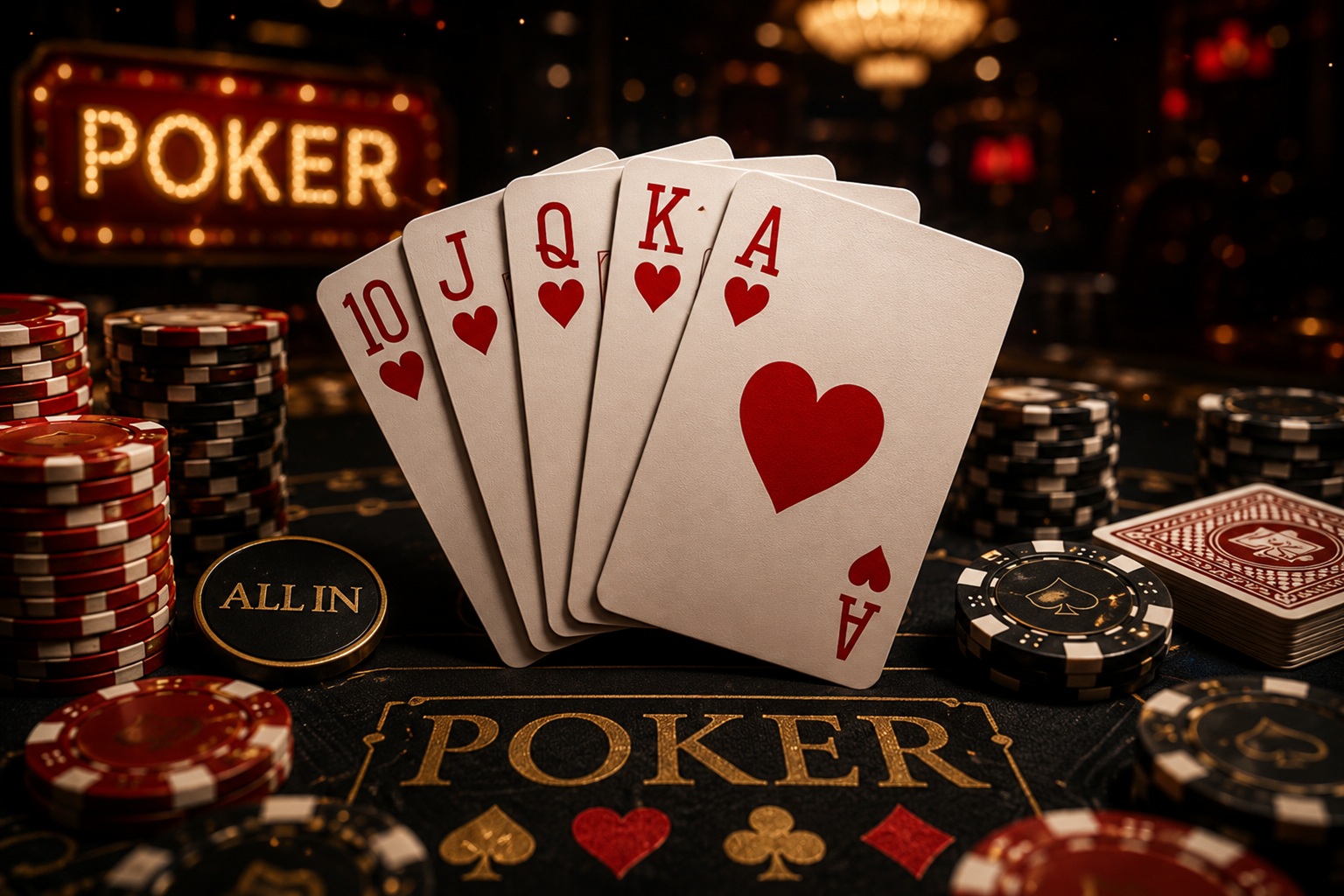
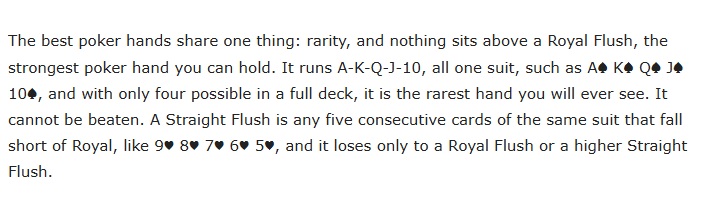
  1. Royal Flush
  2. Straight Flush
  3. Four of a Kind
  4. Full House
  5. Flush
  6. Straight
  7. Three of a Kind
  8. Two Pair
  9. One Pair
  10. High Card

Each entry on this list is a specific five-card pattern, not just a name, and the gaps between them are exactly where new players lose track of hand strength.

Reading them quickly becomes automatic with repetition, and the best poker room to build that habit offers free play-money tables where early mistakes cost nothing.

Royal Flush and Straight Flush

Four of a Kind, Full House and Flush

Straight, Three of a Kind and Two Pair

One Pair and High Card

How to Compare Poker Hands

Comparing two hands starts with hand type: a Flush always beats a Straight, no matter what cards make it up, since hand type is ranked before anything else. Once both players share the same hand type, rank decides it next, meaning the value of the cards that form the pattern itself; a Full House of Kings over a pair beats a Full House of Queens over a pair regardless of what that smaller pair holds. Between two pairs of Aces, A-A-8-6-3 beats K-K-Q-10-7 for the same reason, since Aces simply outrank Kings. If the hand type and the main rank are both identical, the kicker, meaning the unmatched side cards, settles it by comparing highest to highest until the tie breaks or genuinely holds.

Important Poker Hand Ranking Rules

A few rules around poker card rankings cause more confusion than everything else combined, so they are worth locking down early:

  • All four suits carry equal value; no suit outranks another in standard poker.
  • An Ace can play high, completing A-K-Q-J-10, or low, as the bottom card of A-2-3-4-5.
  • A-2-3-4-5, often called the wheel, is the lowest straight in the game.
  • When hand types tie, kickers, the unmatched cards, decide who wins.
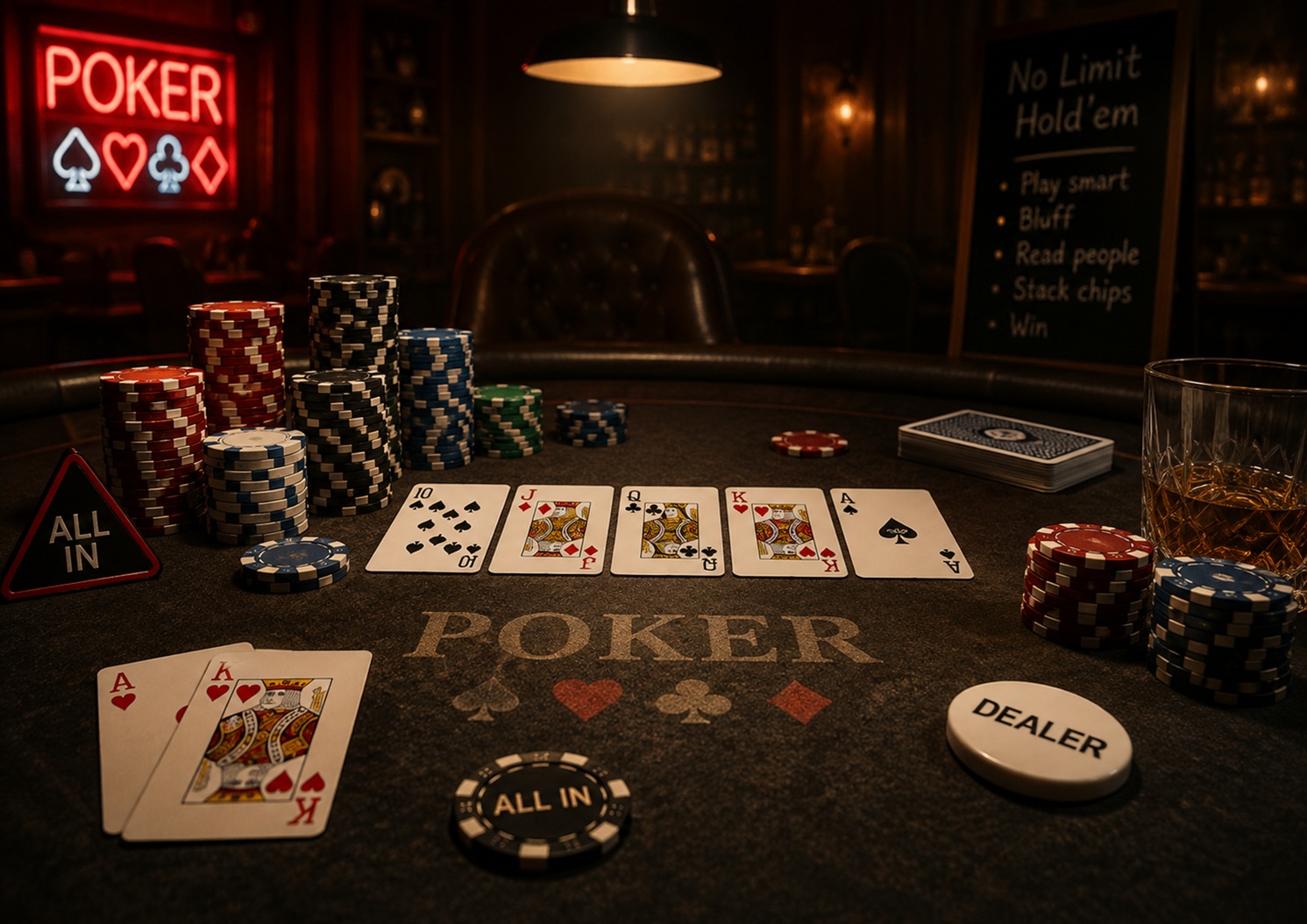
  • In Texas Hold’em, only the best five-card combination from your hole cards and the board counts as your final hand.

These rules apply consistently at showdown and can often determine the winner when two players appear to have very similar hands. Understanding them also prevents common errors when reading the board, particularly when an Ace, shared community cards or kickers are involved.

Common Mistakes When Reading Poker Hands

New players mix up a Straight and a Flush more than any other pair of hands, even though one is about sequence and the other about suit, and neither requires both at once. Misreading the Ace causes just as much trouble, whether by forgetting it can anchor the low end of A-2-3-4-5 or by trying to use it mid-sequence in something like Q-K-A-2-3, which is not a valid straight at all. Kickers get ignored constantly too, especially in Two Pair and One Pair situations, where the whole result can hinge on a single unmatched card. The last common error shows up when comparing two hands of the same type: a small pair with a strong kicker still loses to any higher pair, no matter how weak that pair’s own side cards are.

Poker Hand

Once the ranking order feels automatic, reading the board and comparing hands at showdown stops being guesswork. The hand types never change and the tie-breaking rules stay consistent every time, so the fastest way to improve is simply seeing enough real hands until the recognition becomes instinct.


FAQ

How do you determine which poker hand is stronger in a specific situation?

The strength of a poker hand is determined first by its position in the standard hand hierarchy, from High Card to Royal Flush. If two players hold the same type of hand, the relevant card ranks and, where necessary, kickers are compared. The board and opponents’ actions can also help assess how likely it is that another player holds a stronger combination.

Which poker hands are the most common, and which are the rarest?

Pairs and Two Pair are among the combinations players encounter most frequently. Three of a Kind and Straights are less common, while Flushes, Full Houses, Four of a Kind and Straight Flushes occur considerably less often. A Royal Flush is the rarest standard poker hand and sits at the very top of the ranking.

How are hole cards and community cards used to make a hand in Texas Hold’em?

In Texas Hold’em, each player forms the strongest possible five-card hand from seven available cards: two private hole cards and five community cards. A player may use both hole cards, only one of them or none at all. If the five community cards produce the strongest available combination, the player can simply “play the board.”

What mistakes do beginners commonly make when evaluating poker hands?

Beginners often overestimate hands such as One Pair without considering what stronger combinations the board makes possible. Other common mistakes include misreading Straights and Flushes, overlooking opponents’ potential hands, misunderstanding the role of kickers and incorrectly comparing two hands of the same category.

How does knowing poker hand rankings help with betting, bluffing and folding?

Knowing the rankings provides the foundation for evaluating the relative strength of a hand and deciding whether to bet, raise, call or fold. It also helps players recognise which stronger hands are possible on a particular board. However, hand rankings are only one part of decision-making: position, betting patterns, pot odds and the likely range of an opponent’s hands also matter.