

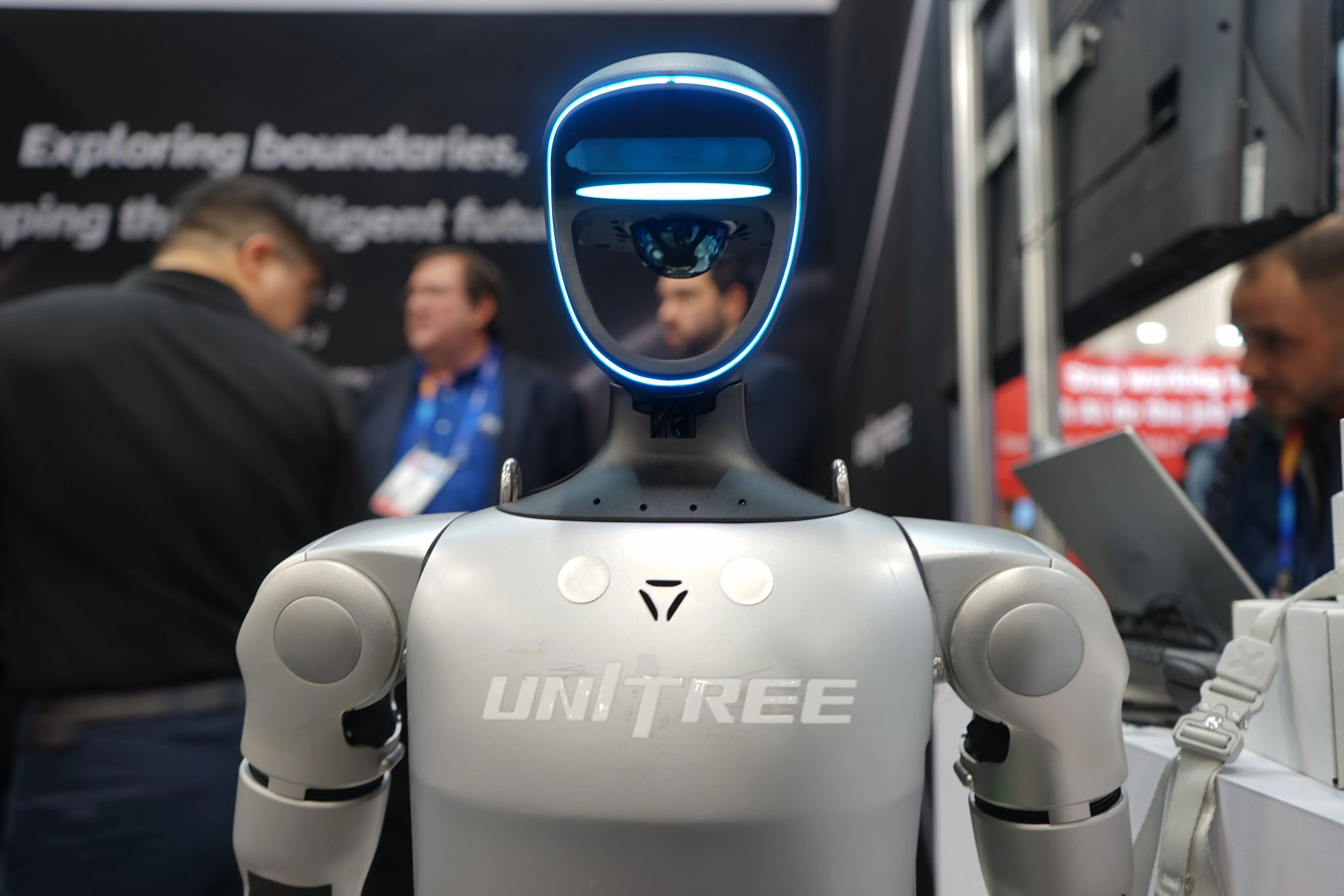
The global humanoid robotics industry is approaching a potential breakthrough that could transform artificial intelligence from software operating on screens into machines capable of acting autonomously in the physical world, according to Wang Xingxing, founder and CEO of Chinese robotics company Unitree.
Speaking Thursday at the World Robot Conference in Beijing, Wang said advances in embodied intelligence were moving the industry toward what he called a “ChatGPT moment,” referring to a breakthrough comparable to the launch of OpenAI’s ChatGPT in late 2022 that triggered mass adoption of generative AI.
“We are marching towards a ‘ChatGPT moment’ in embodied intelligence,” Wang said.
Register for the next Tekedia Mini-MBA.
Register for Tekedia AI in Business Masterclass.
Join Tekedia Capital Syndicate and co-invest in great global startups.
The comparison is reverberating because the next major phase of the AI industry is expected to depend not only on models that can understand and generate language, images and code, but also on systems that can perceive physical environments and translate AI decisions into precise movements.
Wang said the critical milestone would be reached when a robot could be placed in an unfamiliar environment and complete roughly 80% of tasks using simple voice or text instructions.
“We hope that in the future, we can see a robot be introduced into an unfamiliar household and it can achieve approximately 80% of tasks successfully through voice or text commands,” he said. “It is an important tipping point for the robot industry to usher in explosive growth.”

The benchmark illustrates the scale of the challenge facing the industry. A robot that can walk, run, dance or perform a choreographed sequence in a controlled demonstration is fundamentally different from one that can reliably understand an unfamiliar home, identify objects, plan a sequence of actions and recover when something goes wrong.
That gap between impressive demonstrations and dependable autonomy is now one of the central problems in physical AI.
Wang was notably cautious about how quickly the breakthrough could arrive. In an optimistic scenario, he said a major advance in robot software could emerge within two to three years. At the other end of the range, it could take five to 10 years.

That matters for an industry that has attracted enormous investor enthusiasm before achieving widespread commercial deployment. Unitree’s shares surged nearly sixfold in their Shanghai debut on Wednesday before falling 11% on Thursday, illustrating the extraordinary expectations surrounding China’s robotics sector.
Unitree’s debut also highlighted the growing financial importance of humanoid robotics to China’s technology market. The company’s spectacular listing came as more than 300 exhibitors gathered at the World Robot Conference, showcasing robots designed for factories, logistics, research, education and consumer applications.
But the industry’s current economics remain considerably less mature than its stock-market valuations suggest. Humanoid robots are still expensive, have limitations in battery life and dexterity, and in many practical applications remain less efficient than human workers. Most deployments are still concentrated in research, training and controlled industrial environments rather than ordinary homes.
Wang said Unitree’s largest investment in both capital and manpower is currently focused on “world models,” the AI systems intended to help robots understand and predict events in physical environments.
The emphasis represents a shift in the robotics race. Hardware has advanced rapidly, helped by improvements in electric motors, batteries, sensors, actuators, and lightweight materials. The more difficult problem is developing an AI “brain” capable of generalizing what it has learned from one environment to another.
A robot trained to pick up a particular box in a factory, for example, must eventually be able to recognize a different box, understand a different instruction, deal with different lighting and positioning, and complete the task without human intervention.
Wang said Unitree was still “lagging behind” in applying physical AI models to real-world environments and that current AI models powering robots’ decision-making and interaction remain the industry’s biggest bottleneck.
That limitation helps explain why the industry’s anticipated “ChatGPT moment” is not simply a question of building a better humanoid body. The breakthrough requires an integrated system combining perception, reasoning, planning, control and learning, while maintaining sufficient reliability for real-world use.
Galbot founder Wang He expects the milestone to arrive by 2028. He defines the breakthrough as the point when robots can perform about 70% to 80% of everyday tasks without specialized training.
“With continued accumulation of data and further technological breakthroughs, we expect to reach the ‘ChatGPT moment’ for embodied intelligence by 2028,” he said.
Data is necessary because robots need something that conventional AI models did not require at the same scale: physical experience. Language models can be trained on enormous quantities of text and other digital information, whereas robots need data describing how actions translate into physical consequences.
China is attempting to build that advantage through rapid manufacturing, government-backed robotics programmes and the deployment of robots in controlled environments where companies can collect additional training data. The emergence of more than 90 robotics training centers across China by mid-2026 has become part of that ecosystem, although questions remain over how effectively data generated in such centers translates into performance in uncontrolled environments.
China already has a commanding lead in humanoid robot shipments. Global shipments reached about 19,100 units in the first half of 2026, according to industry research cited in recent reports, with Chinese manufacturers accounting for more than 97% of the global total. AgiBot shipped about 8,400 units, while Unitree shipped roughly 5,900, putting the two Chinese companies at the top of the global market.
The figures show that China’s advantage is no longer confined to prototypes and demonstrations. Its manufacturers are producing robots at a scale that is beginning to create a manufacturing ecosystem around humanoids.
That ecosystem draws on capabilities China has developed in electric vehicles, consumer electronics, batteries, industrial automation and drones. Components such as motors, batteries, sensors and precision-machined parts can increasingly be sourced from established domestic supply chains, potentially allowing Chinese manufacturers to reduce costs as production expands.
Unitree itself has moved beyond the robot-dog demonstrations that initially made it internationally famous. The company has become one of China’s most prominent humanoid manufacturers and is increasingly targeting industrial and research applications. Its 2026 shipment figures, however, also show that the market is still at an early stage. Unitree said its humanoid shipments exceeded 5,500 units in 2025, while production exceeded 6,500 units.
What It Means for Beijing
The importance of the technology extends beyond commercial robotics.
Beijing views humanoid robots as a potential response to a structural demographic problem: a shrinking working-age population and rising demand for automation. Robots capable of handling repetitive, hazardous, or physically demanding tasks could eventually allow manufacturers and logistics companies to automate portions of their workforces.
The technology is also becoming another arena in the U.S.-China competition over advanced technology.
In July, the U.S. Federal Communications Commission barred new foreign-made humanoid and quadruped robots from entering the U.S. market, citing national security and cybersecurity risks. The measure is expected to affect Chinese manufacturers most heavily because China controls the overwhelming majority of the global humanoid market.
That creates a paradox for Chinese robotics companies. China has built the world’s largest manufacturing base for humanoids, but geopolitical restrictions could limit access to some of the world’s most valuable overseas markets.
Several Chinese companies at the Beijing conference said they were seeking international expansion, indicating that the next phase of competition may not be about who can build the most impressive robot, but who can turn those machines into commercially viable products at scale.
For investors, the spectacular performance of Unitree’s shares shows that financial markets are already pricing in the possibility that humanoids could become a major technology platform. The underlying industry, however, has yet to demonstrate that robots can consistently perform complex tasks outside carefully controlled settings.