
DD
MM
YYYY

PAGES

DD
MM
YYYY

spot_img

PAGES

Home Blog Page 2058

Oracle Emerges as A “Leading Contender” in The Acquisition of TikTok

0

Recent reports have revealed that Software giant Oracle has emerged as the “leading contender in the acquisition of TikTok in the U.S.

Citing sources, the deal, structured on an existing partnership between Oracle and TikTok’s Chinese-owned parent company, ByteDance, would allow TikTok to store U.S user data on Oracle-controlled servers and Oracle the ability to audit TikTok’s source code.

However, both companies have yet to confirm or comment on the deal. The Information reported that ByteDance wants Trump to sign off on a deal with a revived version of TikTok’s “Project Texas”, a previous effort by the company to convince the U.S. Congress that it was not a national security threat by parking US user data on servers controlled by Oracle.

This initiative, which failed to assuage Congress’s concerns, also called for Oracle to review TikTok’s source code to ensure it is safe.

Oracle emerging as the leading contender for TikTok comes after US President Donald Trump this week disclosed that four groups were in talks to buy the platform. When asked by reporters if there was going to soon be a deal on TikTok, Trump replied, “It could”.

“We are dealing with four different groups, and a lot of people want it, all four are good”, he added.

After suspending the bipartisan ban on TikTok for 75 days shortly after assuming office, Trump has been pursuing a sale of the app’s US operations for it to continue working in the country.

Since granting the 75-day reprieve, the Trump administration has been facilitating the sale of TikTok’s US operations, and various parties, ranging from Oracle to billionaire Elon Musk, have been reported at various points as potential buyers. Oracle has discussed a deal to buy TikTok along with other investors, such as Microsoft, Perplexity Al has proposed to merge with TikTok, and YouTuber Mr Beast has offered to buy the app’s US operations.

Also, a group led by billionaire Frank McCourt, “Shark Tank” star Kevin O’Leary, and Reddit cofounder Alexis Ohanian has publicly campaigned to buy TikTok and rebuild its recommendation algorithm from scratch on US soil. The group claims it will utilize blockchain technology to ensure users have greater control over how their data is monetized.

Trump has until April 5 to find a buyer for TikTok, after the January executive order. However, earlier this month, he announced that he would probably extend the deadline again if it became necessary to complete a deal. He has also suggested the US government could buy a stake in the app through a sovereign wealth fund as part of a joint venture though the details remain unclear.

Why The Sale of TikTok in The US

The push for the sale of TikTok in the United States stems primarily from national security and data privacy concerns related to its ownership by ByteDance, a Chinese company. U.S. lawmakers and officials have argued that TikTok’s ties to China pose significant risks, leading to legislative action aimed at forcing its sale or banning it outright.

They worry that China could manipulate TikTok’s algorithm to shape content in ways that serve its geopolitical interests, such as spreading misinformation or amplifying divisive narratives. This concern gained traction during events like the Israel-Hamas war and the 2024 U.S. presidential election, where TikTok’s role in shaping public opinion was scrutinized.

However, despite the issues, TikTok is still going strong after its ban in January was lifted by Trump. The app was among the most downloaded apps in the U.S. in 2024, and approximately half of the country’s population is among TikTok’s active users. The app is noted for its intense ability to influence trends, which Trump said was pivotal to his victory in the U.S. election.

Looking Ahead

The sale of TikTok remains a focal point as of March 14, 2025, with the Trump administration reportedly engaging with potential buyers after extending the ban deadline in January. The goal is to transfer TikTok’s U.S. operations to American hands, ideally neutralizing the perceived threats while preserving its presence in the market.
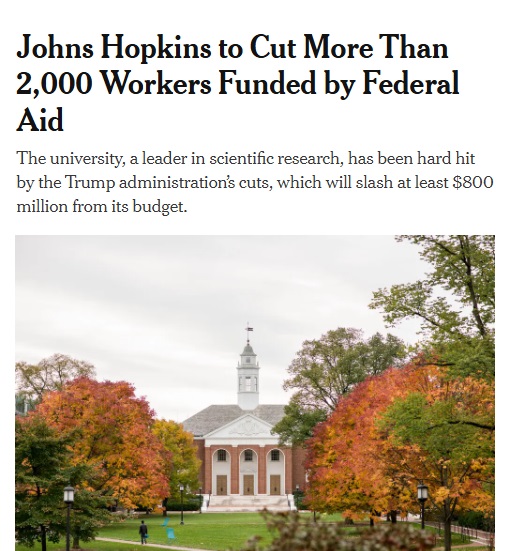

Johns Hopkins Loses $800 million Federal Aid in the Era of Trump

0

Very painful to read that my alma mater is losing $800 million of federal grant and as a result is reducing workers by at least 2,000 people. Good People, the cuts are real and America is being redesigned. Johns Hopkins University is the only top-10 university which does not require an application fee (the main reason I applied), making it easy for any person to join the competition.

And when it was all done, out of more than 900 students, I was among the 15 picked by the electrical & computer engineering department, with fellowships and scholarships. And it was not me because they would not admit you for a PhD if they do not have 100% funding for you. So, with this $800m cut, many bad things could happen, not just to staff, but foreign students who do not have access to the US student loan system.

Yearly tuition is about $65,000 and you need at least $40,000 for your upkeeps since PhD is only done full time there. How can foreign students make it? The era of Trump is just loading and the scripts will be long.

U.S. Congressman Introduces Legislation Codifying Bitcoin Strategic Reserve

0

U.S. Representative Byron Donalds introduced legislation aimed at codifying the executive order signed by President Trump earlier that month, which established a national Strategic Bitcoin Reserve and a U.S. Digital Asset Stockpile. The primary goal of this bill is to prevent future administrations from reversing the executive order, thereby ensuring the continuity of the U.S. government’s cryptocurrency policy. The proposed legislation seeks to solidify the United States’ position as a leader in digital financial strategy by permanently embedding the Strategic Bitcoin Reserve into law.

This move is seen as a response to the growing importance of digital assets in the global economy and aims to protect the reserve from potential policy shifts under future administrations. The bill would require the Strategic Bitcoin Reserve to continue being capitalized with Bitcoin obtained through criminal or civil asset forfeiture proceedings, as outlined in the original executive order, while also maintaining the policy of not selling these assets to preserve their value as a strategic store.

To become law, the bill must navigate a complex legislative process. It will first need to be reviewed by the House Financial Services Committee before proceeding to a floor vote in the House of Representatives, where it requires a majority of 218 votes to pass. Given the slim Republican majority in the House, securing the necessary votes may be challenging. If successful in the House, the bill would then move to the Senate, where it would undergo review by the Senate Banking Committee and require a majority vote to pass, with the potential risk of a filibuster complicating its approval. The legislative process could lead to delays or modifications, and its ultimate success is not guaranteed.

If the legislation passes, it will signal long-term U.S. government commitment to holding Bitcoin as a strategic asset, potentially reducing market uncertainty about future selloffs. This could drive bullish sentiment, as institutional and retail investors might interpret it as a strong endorsement of Bitcoin’s value. Historically, positive regulatory developments in major economies have led to significant price rallies in Bitcoin and other cryptocurrencies.

Codifying the Bitcoin reserve could encourage institutional investors, such as hedge funds, pension funds, and corporations, to increase their exposure to Bitcoin. A government-backed reserve could legitimize Bitcoin as a “safe” asset, akin to gold, further boosting demand. In the short term, the legislative process could introduce volatility. Uncertainty about the bill’s passage, potential amendments, or delays could lead to market fluctuations, especially if the bill faces opposition or is perceived as unlikely to pass.

By codifying a Bitcoin reserve, the U.S. could position itself as a global leader in cryptocurrency policy, setting a precedent for other nations. This might encourage other countries to establish their own strategic cryptocurrency reserves, especially those looking to hedge against inflation, currency depreciation, or geopolitical risks. Countries with restrictive cryptocurrency policies, such as China (which has banned crypto trading and mining) or India (with stringent tax and regulatory measures), might face increased pressure to reconsider their stances. The U.S. move could embolden pro-crypto advocates in these regions, potentially leading to more balanced regulatory frameworks.

Mastering AI Prompting: Crafting Effective Queries for Generative AI – Ndubuisi Ekekwe

0

Finally, I made time to create a prompt engineering course I have wanted in Tekedia Institute. Download the course plan here (FREE) under the Effective AI Prompting Techniques section  . Tomorrow, in class, we will do the labs, and I do hope for everyone to understand and master the nuances of prompting. You need the capability to play productively in the AI era.

Meanwhile, we will be opening the next edition of Tekedia Mini-MBA soon. On the annual plan, you will have access to some of these tools. Our vision is to make the Tekedia ecosystem a one-stop-destination for knowledge acquisition, dissemination and application.

Sat, March 15 | 7pm-8.30pm WAT | Mastering AI Prompting: Crafting Effective Queries for Generative AI – Ndubuisi Ekekwe | Zoom link

WinGPT is a personal business educator which will guide learners on business education, using Tekedia libraries and universal libraries which learners can select based on interest. For the Tekedia libraries,  we have trained the AI system with our courseware. For example, if you want to understand how the One Oasis Strategy can help you win in Uyo, WinGPT will provide guidance. WinGPT has a coaching feature.

The coaching feature is designed to prepare people for job interviews, promotion exams, project lead interviews, etc. You will upload your resume and experiences along with what you would be interviewing for (e.g. promotion to GM Technology and Operations in Bank A with expected responsibilities). WinGPT will then launch a video and prepare you, using its understanding of your capabilities, expected tasks and knowledge of the company or industry.

Tekedia Institute >> Africa’s largest business school.

Gold Price Crosses $3000 Per Ounce Reaching All Time High

0

Gold prices surged past the $3,000 per ounce mark, setting a new all-time high and marking a historic milestone for the precious metal. This achievement comes amidst a record-breaking year for gold, driven by heightened geopolitical tensions, trade uncertainties, and expectations of monetary policy easing by the U.S. Federal Reserve. The rally, which saw gold futures briefly exceed $3,000 and spot gold reach $2,990, reflects strong demand for safe-haven assets amid global economic concerns, including U.S. President Donald Trump’s aggressive tariff policies.

Analysts suggest that this upward trajectory may continue, with some forecasting prices as high as $3,300 by the end of 2025, fueled by sustained central bank buying and potential increases in exchange-traded fund inflows. However, risks remain, including potential economic stabilization or policy shifts that could temper demand. U.S. President Donald Trump’s aggressive tariff policies, including threats of 100% tariffs on BRIC countries, have heightened global trade uncertainties.

The Ongoing geopolitical tensions, such as conflicts in the Middle East, Ukraine-Russia dynamics, and U.S.-China rivalry, have bolstered gold’s appeal as a safe-haven asset. Investors often flock to gold during periods of heightened uncertainty, as it is perceived as a store of value immune to political or currency risks. The use of sanctions by the U.S. and other nations has encouraged some countries to diversify away from dollar-denominated assets, increasing demand for gold as an alternative reserve asset.

Anticipation of monetary policy easing by the Federal Reserve has been a significant driver of gold prices. Lower interest rates reduce the opportunity cost of holding gold (a non-yielding asset), making it more attractive compared to interest-bearing alternatives like bonds. In early 2025, expectations of rate cuts grew amid concerns about slowing U.S. economic growth and inflationary pressures from tariffs. Even if nominal interest rates remain stable, inflation expectations can erode real yields (nominal rates minus inflation).

Central banks, particularly in emerging markets, have been significant buyers of gold as part of efforts to diversify reserves away from the U.S. dollar. Countries like China, Russia, India, and Turkey have increased their gold holdings to hedge against currency depreciation, sanctions risks, and geopolitical uncertainties. The growing trend of de-dollarization, where nations reduce reliance on the U.S. dollar in international trade and reserves, has bolstered gold demand. Central banks view gold as a neutral, non-political asset that enhances financial sovereignty. In 2024, central banks globally purchased over 1,000 metric tons of gold, a trend that continued into 2025, providing a strong structural support for prices.

Rising inflation, partly driven by supply chain disruptions and tariff-induced cost increases, has heightened gold’s appeal as an inflation hedge. Investors turn to gold to protect against the erosion of purchasing power, especially in an environment of persistent price pressures. The U.S. dollar has faced downward pressure due to trade uncertainties and expectations of lower interest rates. A weaker dollar typically boosts gold prices, as gold is priced in dollars and becomes cheaper for holders of other currencies, increasing global demand.

ETF Inflows and Institutional Demand: Exchange-traded funds (ETFs) backed by physical gold have seen significant inflows in 2025, reversing outflows from previous years. Institutional investors, including hedge funds and pension funds, have increased allocations to gold as part of diversified portfolios, driven by macroeconomic uncertainty and low yields on other assets. Retail investors, particularly in the U.S., Europe, and Asia, have boosted demand for physical gold (bars, coins) and gold-backed financial products.

Gold’s price momentum has attracted speculative traders, including algorithmic and high frequency trading firms, amplifying price movements. Futures markets have seen increased activity, with bullish bets on gold pushing prices higher. Gold mining output has remained relatively flat in recent years, with few major new discoveries and high costs of extraction. Declining ore grades and environmental regulations have constrained supply growth, making it difficult for production to keep pace with demand. While recycled gold (e.g., from jewelry and electronics) supplements supply, it has not been sufficient to offset the demand surge, particularly from central banks and institutional investors.

Mining operations in key gold-producing countries, such as South Africa, Russia, and parts of Latin America, face risks from political instability, labor disputes, and environmental challenges, further tightening supply. The U.S. government’s move to establish a Strategic Bitcoin Reserve has drawn comparisons to gold, with some investors viewing Bitcoin as a “digital gold.” However, gold’s established history as a safe-haven asset, coupled with its physical tangibility, has kept it in favor, especially during periods of heightened uncertainty. Gold’s rally past $3,000 may reflect investors favoring it over Bitcoin in the short term, though both assets could coexist as complementary hedges.

The $3,000 level is a psychologically significant milestone, attracting media attention and reinforcing bullish sentiment. Such milestones often draw in new investors, further fueling price gains. From a technical analysis perspective, gold’s breakout above previous resistance levels (e.g., $2,800) has triggered buy signals for traders, contributing to the rally. Support levels around $2,900–$2,950 are now critical to sustaining the upward trend. Concerns about a potential U.S. or global economic slowdown, exacerbated by trade tensions and monetary policy uncertainties.

A rebound in the U.S. dollar, potentially driven by tighter Fed policy or resolution of trade tensions, could pressure gold prices downward. If global economic conditions stabilize, safe-haven demand for gold could wane, leading to profit-taking and price corrections. Unexpected hawkish moves by the Federal Reserve, such as pausing or reversing rate cuts, could increase the opportunity cost of holding gold, dampening demand. If the U.S. Strategic Bitcoin Reserve gains traction, some investors might shift capital from gold to Bitcoin, viewing the latter as a modern alternative safe-haven asset.

Gold’s rally past $3,000 per ounce in March 2025 is the result of a perfect storm of geopolitical, macroeconomic, and market-specific factors. Strong safe-haven demand, central bank buying, monetary policy easing, inflation concerns, and supply constraints have all converged to drive prices to historic highs. While the outlook remains bullish, with some analysts forecasting prices as high as $3,300 by the end of 2025, investors should remain vigilant of potential risks, including shifts in monetary policy, currency movements, and broader economic stabilization.