DD
MM
YYYY

PAGES

DD
MM
YYYY

spot_img

PAGES

Home Blog Page 2068

Best Crypto to Buy Now:  Invest Early, Invest Smart! Why AurealOne Could Be Crypto’s Next Big Break

0

Have you ever envisioned digital money that does not need a middleman? That is cryptocurrency! It operates on a secure system called blockchain, allowing quick and direct transactions without intermediaries. Now, have you ever wondered how some investors get inside on game-changing projects so early? The secret: pre-sales! This is where you get to buy tokens before they go mainstream—often at a lower price. But so many options, which are truly worth it? Let’s discuss exciting projects for Best Crypto to buy now like AurealOne, DexBoss, XRP Ripple, and more!

The Current Best Crypto to Buy Now are as follows:

  1. AurealOne (DLUME)
  2. DexBoss (DEBO)
  3. XRP Ripple (XRP)
  4. Polygon (MATIC)
  5. Cardano (ADA)
  1. Aureal One (DLUME)

Aureal One takes the top spot as a next-generation blockchain network tailored for the gaming and metaverse sectors. With lightning-fast transaction speeds and minimal gas fees, it’s becoming the go-to choice for developers and users alike. Currently in its presale stage, Aureal One’s native currency, DLUME, facilitates transactions within its ecosystem, functioning as an in-game currency for various projects. As of late October 2023, DLUME is priced at $0.0011, having shown promising growth during its structured presale comprising 21 rounds.

Click here to visit best crypto to buy now – AurealOne

The presale is managed effectively, starting at $0.0005 in Round 1 and reaching $0.0045 by Round 21. Early investors benefit significantly, with discounts that provide up to 1000% in Round 1 compared to the listing price of $0.0055. The first official game on the Aureal One platform, “Clash of Tiles,” showcases its capabilities, with plans for additional projects like DarkLume.

Notably, DLUME holders have the opportunity to stake their coins for rewards and also gain governance rights, fostering an engaged community that helps shape the network’s future. By incorporating advanced technologies such as Zero-Knowledge Rollups, Aureal One offers scalability and cost-effectiveness, amplifying its appeal within the competitive blockchain arena.

  1. DexBoss ($DEBO)

Following Aureal One is DexBoss, a decentralized finance (DeFi) platform that bridges traditional finance and DeFi to create an intuitive trading ecosystem. Priced at $0.01 in its presale, DexBoss is addressing significant issues in the DeFi market, such as liquidity problems and high transaction fees that often discourage newcomers. The presale for DexBoss is structured over 17 rounds, aiming to raise a total of $50 million. Initially, it sold 25 million tokens to raise $250,000 before increasing the price incrementally throughout the presale stages.

With an innovative buyback and burn mechanism, DexBoss plans to enhance token value over time, which appeals to long-term investors. The platform supports trading of over 2000 cryptocurrencies and includes advanced financial tools such as margin trading, liquidity farming, and staking, enhancing its value proposition.

DexBoss’s commitment to user experience, coupled with deep liquidity pools, ensures minimal slippage in transactions—critical for traders looking to capitalize on market opportunities quickly.

  1. XRP (Ripple)

XRP continues to be a leading cryptocurrency within the financial services sector. XRP has gained traction due to its strategic approach to enabling fast, affordable international transactions. The ongoing legal battle with the SEC has presented volatility but has solidified XRP’s reputation as an essential digital asset for banks and institutions seeking to modernize their payment systems. The developments in payment infrastructure, particularly the growing adoption of blockchain technology by financial institutions, bode well for XRP.

  1. Polygon (MATIC)

Another noteworthy entry is Polygon. Polygon is a Layer-2 scaling solution for Ethereum and improves the transaction speed and reduces the fees, thus providing a solution to the problem Ethereum faces during peak times. Its strong ecosystem supports applications such as DeFi projects, NFT marketplaces, and gaming applications. The developmental focus undertaken by Polygon has augmented its position as one of the few credible L2s out there, making a huge difference in credibility and usability through partnership collaborations.

  1. Cardano (ADA)

Lastly, Cardano rounds out our list, a project which, with its scientific approach to blockchain development backed with a plethora of research, wanted to create a more secure and scalable blockchain. Its vision of being a platform that is sustainable and interoperable sets it apart. Recent updates to its smart contract functionality have reignited Cardano’s attraction to several developers looking to build decentralized applications.

Wrapping Up

Aureal One is leading blockchain gaming and the metaverse, finely carving a precious ecosystem with speedy transactions and low gas fees in the fast-changing world of crypto. With its vision in mind, it has outlined a road for strategic gaming projects, positioning it as a major competitor in the space. Right behind it, DexBoss is remaking decentralized finance (DeFi) using its macro platform.

While XRP Ripple carries the torch in financial services backed by its immense utility, Aureal One and DexBoss seek to tread their own routes towards acclaim and recognition that would one day see them rival XRP Ripple’s presence. While Polygon and Cardano are also pressing ahead making the crypto market filled with opportunities.

However, investors should be careful, and as usual do their good research because of the ever-changing nature of market dynamics.

BioNexus Pivots Ethereum as Primary Treasury Asset

0

BioNexus Gene Lab Corp. (NASDAQ: BGLC), a Wyoming-based healthcare technology company, announced that its Board of Directors had formally approved Ethereum (ETH) as its primary treasury asset. This decision marks BioNexus as the first NASDAQ-listed company to prioritize Ethereum over other cryptocurrencies, such as Bitcoin, for its treasury strategy.  Alongside the announcement, the company released an Ethereum Strategy Whitepaper, outlining the rationale behind this move and positioning it as a leader in blockchain-integrated corporate finance.

Ethereum staking offers several benefits, particularly since the network transitioned to a Proof-of-Stake (PoS) consensus mechanism with the Merge in September 2022. For a company like BioNexus Gene Lab Corp., which has approved Ethereum (ETH) as its primary treasury asset as of March 5, 2025, staking provides a compelling financial and strategic advantage.

BioNexus highlighted several key factors driving its choice of Ethereum

Ethereum has gained traction among major financial players like BlackRock, Grayscale, and Fidelity, lending it legitimacy and long-term viability. Yield-Generation: Through its Proof-of-Stake (PoS) mechanism, Ethereum offers staking rewards of 3-5% annually, turning it into an income-generating asset unlike Bitcoin, which lacks similar yield opportunities.

Utility and Dominance: Ethereum underpins trillions in stablecoin transactions (e.g., USDT, USDC) and powers decentralized finance (DeFi), making it a versatile financial infrastructure platform. Upcoming upgrades like Pectra and Layer-2 solutions (e.g., Arbitrum, Optimism) enhance Ethereum’s efficiency and reduce costs, boosting its appeal for corporate use.

CEO Sam Tan emphasized, “Ethereum offers high liquidity, utility, and stability compared to other digital assets, positioning BGLC as a leader in blockchain-integrated corporate finance.” The company also benefits from Wyoming’s blockchain-friendly regulations, including the Wyoming Stable Token Act, which supports digital asset innovation.

While companies like MicroStrategy and Tesla have adopted Bitcoin as a treasury asset, BioNexus’s focus on Ethereum sets it apart, emphasizing ETH’s programmable capabilities over BTC’s store-of-value narrative. This aligns with Brazil’s Me?liuz, which recently allocated 10% of its cash to Bitcoin, but differs from Coinbase’s exploratory tokenization of COIN stock, which faces U.S. regulatory hurdles.

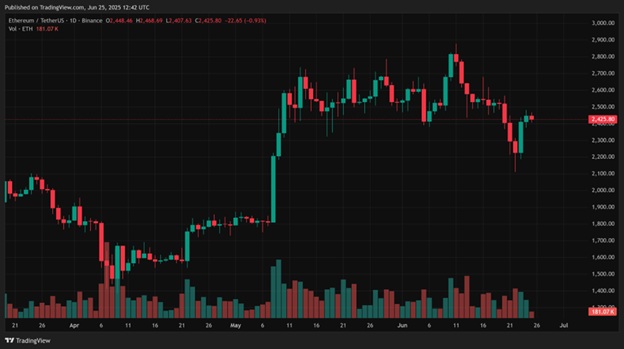
BioNexus reported $9.26 million in trailing twelve-month revenue and a market cap of $5.88 million, but its stock trades at $0.32 (down 61% in 2024). Facing a NASDAQ delisting risk due to a sub-$1 bid price, it plans a reverse stock split by April 7, 2025, to comply by May 1. Its liquidity (current ratio of 4.98) supports this crypto pivot, though Ethereum’s volatility could impact stability. Ethereum’s price spiked within an hour of the March 6 announcement, with trading volume on exchanges like Binance and Coinbase jumping from 200,000 ETH to 350,000 ETH, reflecting market enthusiasm.

U.S. Context: Unlike Coinbase’s tokenization efforts, which grapple with SEC securities rules, BioNexus’s direct ETH holding avoids such complexities. The U.S. lacks a unified crypto law, but Wyoming’s progressive stance (e.g., legal frameworks for digital custody) enables this strategy, contrasting with the stricter federal oversight Tether faced freezing $27M USDT on Russia’s Garantex.

BioNexus’s move validates Ethereum’s growing corporate appeal, potentially inspiring other firms to explore crypto treasuries. It leverages ETH’s unique features—staking, DeFi, and scalability—over Bitcoin’s more static role, though the lack of disclosed allocation size or timeline tempers full assessment. Amid Ethereum’s inclusion in a rumored U.S. “Crypto Strategic Reserve” under the Trump administration, this could signal a shift in institutional adoption trends.

New York Introduces Crypto Bill A06515 to Combat Fraud

0

New York State Assemblymember Clyde Vanel introduced Assembly Bill A06515, a legislative proposal aimed at criminalizing cryptocurrency fraud, including “rug pulls,” private key theft, and other deceptive practices in the crypto space. This bill, if passed, would amend New York’s penal law to establish specific criminal offenses related to “virtual token fraud,” marking one of the most targeted state-level efforts to combat fraud in the $2.7 trillion cryptocurrency market.

Key Provisions of Bill A06515

The bill defines a “rug pull” as a developer selling more than 10% of a virtual token’s total supply within five years of its last sale, with exceptions for smaller NFT projects. This targets scams where developers inflate a token’s value and then abandon the project, leaving investors with worthless assets. Penalties could include fines up to $5 million and prison terms of up to 20 years.

Private Key Fraud: Unauthorized access or misuse of private keys—critical for controlling crypto wallets—would be criminalized unless explicit consent is granted, addressing theft and hacking incidents. Developers must publicly disclose their token holdings on their primary website, aiming to prevent undisclosed conflicts of interest.

Scope: “Virtual tokens” include security tokens and stablecoins, defined broadly as digital assets verified on peer-to-peer networks like blockchain, encompassing fungible and non-fungible tokens (NFTs).

The legislation responds to a surge in crypto scams, particularly in the memecoin sector. High-profile cases, such as the Libra project’s $107 million rug pull in early 2025 (causing a 94% price crash and $4 billion in investor losses), and Solana-based memecoin frauds leading to $485 million in outflows in February 2025, underscore the urgency. Posts on X and industry reports highlight that rug pulls alone accounted for significant losses in 2024, with the broader crypto scam ecosystem costing investors billions annually.

New York Attorney General Letitia James has long championed tougher crypto oversight, as seen in her 2023 Crypto Regulation, Protection, Transparency, and Oversight (CRPTO) Act proposal and lawsuits against firms like KuCoin and Celsius. Bill A06515 builds on this, aligning with the state’s history of proactive regulation (e.g., the 2015 BitLicense) and recent enforcement against sanctioned entities like Russia’s Garantex.

The SEC and CFTC treat crypto variably as securities or commodities, but no federal law specifically criminalizes rug pulls, leaving enforcement to existing fraud statutes. A06515’s specificity contrasts with this ambiguity, though it mirrors broader U.S. efforts like Senator Dick Durbin’s Crypto ATM Fraud Prevention Act (February 2025).

Implications on the Crypto Industry

Investor Protection: The bill aims to deter fraud by imposing harsh penalties and enhancing transparency, potentially stabilizing New York’s crypto market. Immediate market reactions included a 2% Bitcoin and 1.8% Ethereum trading volume spike on March 6, per CoinMarketCap data.

Critics in crypto circles worry it could stifle innovation, with the five-year lockup period for developers seen as overly restrictive compared to traditional IPOs (often six months). However, exemptions for small NFT projects soften this for grassroots creators. Effective 30 days after passage, the law would empower prosecutors with clear authority, complementing the Martin Act’s broad anti-fraud powers, though some argue existing laws already suffice.

New York’s bill, if enacted, could set a precedent for other states, especially as the Trump administration’s rumored crypto-friendly shift (e.g., a U.S. Crypto Strategic Reserve) contrasts with state-level crackdowns. The A06515 awaits debate in the New York Assembly and Senate, with its fate hinging on balancing investor safety against blockchain innovation—a tension reflected in both legislative text and public sentiment.

Trump Signs Historic Executive Order Establishing U.S Strategic Bitcoin Reserve

0

U.S. President Donald Trump has signed a historic executive order to establish the strategic Bitcoin reserve and the U.S. digital asset stockpile, marking a pivotal shift in the country’s approach to digital assets.

The signing which took place in the Oval Office, aligns with Trump’s support for the digital asset as well as his promise to make the United States the “crypto capital of the world”.

The adoption of Bitcoin by the U.S. government marks a new era for crypto policy in the country. Administration officials have hailed the move as a visionary step into the future of financial technology.

In a post on X, American entrepreneur and crypto Czar, David Sacks thanked President Trump for his support for the digital asset industry, while noting that the reserve will be capitalized with Bitcoin owned by the federal government that was forfeited as part of criminal or civil asset forfeiture proceedings. He further added that the U.S. government owns about 200,000 bitcoin, however, there has never been a complete audit.

Part of his post reads,

“President Trump promised to create a Strategic Bitcoin Reserve and Digital Asset Stockpile. Those promises have been kept. This Executive Order underscores President Trump’s commitment to making the U.S. the “crypto capital of the world.” I want to thank the President for his leadership and vision in supporting this cutting-edge technology and for his rapid execution in supporting the digital asset industry. His administration is truly moving at tech speed. I also want to thank the President’s Working Group on Digital Asset Markets, especially Treasury Secretary Scott Bessent and Commerce Secretary Howard Lutnick, for their help and support in getting this done. Finally, Bo Hines played a critical role as Executive Director of our Working Group.”

Fact Sheet of The US Bitcoin Reserve

  • The Order creates a Strategic Bitcoin Reserve that will treat Bitcoin as a reserve asset. The Strategic Bitcoin Reserve will be capitalized with bitcoin owned by the Department of Treasury that was forfeited as part of criminal or civil asset forfeiture proceedings. Other agencies will evaluate their legal authority to transfer any bitcoin owned by those agencies to the Strategic Bitcoin Reserve.
  • The United States will not sell bitcoin deposited into this Strategic Bitcoin Reserve, which will be maintained as a store of reserve assets. The Secretaries of Treasury and Commerce are authorized to develop budget-neutral strategies for acquiring additional bitcoin, provided that those strategies impose no incremental costs on American taxpayers. It also established a U.S. Digital Asset Stockpile, consisting of digital assets other than Bitcoin owned by the Department of Treasury that were forfeited in criminal or civil asset forfeiture proceedings.
  •  The government will not acquire additional assets for the U.S. Digital Asset Stockpile beyond those obtained through forfeiture proceedings.
  • The Secretary of the Treasury may determine strategies for responsible stewardship, including potential sales from the U.S. Digital Asset Stockpile.
  •   Agencies must provide a full accounting of their digital asset holdings to the Secretary of the Treasury and the President’s Working Group on Digital Asset Markets. This Order ensures a strategic approach to managing digital assets under U.S. control.

President Trump Delivers on Pledge to Make America The Crypto Capital of The World

President Trump is fulfilling his promise to position America as the global leader in cryptocurrency. The pro-crypto leader during his campaign rallies emphasized the need for the U.S. to embrace digital assets to drive economic growth and technological leadership.

In his first week in office, he signed an Executive Order to promote United States leadership in digital assets such as cryptocurrency. President Trump has consistently advocated for a forward-thinking approach to crypto, stating: “I am very positive and open-minded to cryptocurrency companies, and all things related to this new and burgeoning industry. Our country must be the leader in the field.”

Looking ahead

The crypto market remains uncertain amid broader economic concerns, including inflation pressures and ongoing trade tensions. JPMorgan analysts have warned that, given the current economic climate, they do not expect a major rally in Bitcoin in the near term.

However, with Bitcoin hovering near $90,000 and new regulatory clarity from the White House, the long-term implications of the Strategic Bitcoin Reserve and Digital Asset Stockpile could be monumental for the future of U.S. digital finance.

How AI is Transforming Payment Fraud Detection in the Fintech Industry

0

The rapid growth of digital payments has brought unprecedented convenience and opened new doors for fraudsters. Cybercriminals are evolving their tactics, making traditional security measures increasingly ineffective. As financial transactions become more seamless, so do the risks associated with fraudulent activities. Financial institutions and fintech companies are turning to artificial intelligence (AI) for a more sophisticated approach to combat this. AI-driven solutions redefine payment fraud detection, providing real-time analysis and predictive capabilities beyond conventional methods. By leveraging AI, businesses can identify fraudulent activities faster, reduce financial losses, and protect consumers from cyber threats.

The Role of AI in Fraud Prevention

The analysis capabilities of AI revolutionized fraud prevention when it came to processing unlimited data volumes beyond the speed of human analysts. AI surpasses traditional rule-based systems because it adopts changes in fraudulent patterns that mere detection parameters cannot tackle. Machine learning models display an automatic learning ability from new fraud attempts, allowing them to improve accuracy while preventing false positives.

Tested algorithms alongside deep learning approaches find hidden transaction activities through their ability to detect behavioral patterns. Computer systems track spending patterns, device behavioral data, and location data to define normal customer activities. The AI system monitors unusual banking patterns, including transactions from unknown locations, and attempted enormous withdrawals, which it then alerts for human review. The absolute real-time observation enables financial entities to prevent fraudulent transactions before they cause damage.

AI actively participates in predictive analytics operations along with its real-time detection functions. AI uses past fraud data analysis to project potential dangers and then provides organizations with intervention recommendations. This process enables organizations to enhance their security structure, thereby detecting defects that could otherwise become fraudster entry points. AI-driven detection systems undergo parallel development with fraud techniques to maintain an advantage over criminals without needing to respond after fraud occurs.

AI’s Impact on Reducing False Positives

The most significant problem in fraud detection occurs when organizations need to balance protecting users and providing them with a positive experience. Current fraud detection systems based on traditional methods produce an excessive number of incorrect alerts that mark valid transactions as suspicious. These alerts negatively affect Customers’ experience, resulting in payment declines, security check interruptions, and potential business losses. AI solves this challenge by improving accuracy and refining the risk assessment model.

Through machine learning, AI separates real anomalies from actual fraud attempts. Advanced models process multiple attributes, including transaction pattern counts, historical transaction patterns, and money flow dynamics to identify real security risks. AI-based fraud detection equipment enhances transaction security by reducing false alarms, enabling customers to complete transactions seamlessly without facing fraud attempts.

Fractionated payment fraud tools that use natural language processing (NLP) look through customer interactions, support requests, and emails for red flags of possible payment fraud. AI systems help when fraudsters pretend to be authentic users because they assist customer service representatives in avoiding unauthorized transaction approval. AI uses fraud-related linguistic patterns to safeguard financial systems without disturbing valid customer support activities.

The Future of AI in Payment Security

AI continues to develop, and its capabilities in detecting fraud will grow in forthcoming years. Deep learning and federated learning capabilities will enhance AI systems to become more innovative while operating autonomously. The AI model training method federated learning lets users train their models through distributed data while keeping their confidential details protected. Financial institutions can work together on fraud detection while safeguarding customer privacy through this system, which builds an enhanced networked protection against cyber attacks.

AI demonstrates promising advancements through its combination with blockchain technology. Blockchain operates outside of a centralized system, which adds an obstacle for manipulations from fraudsters in their attempt to modify transaction records. Simultaneously AI systems track blockchain actions to spot irregular behavior patterns. A combined blockchain-predictive AI framework demonstrates significant promise for digital security since it unifies blockchain transparency with AI analytic abilities.

The upcoming role of artificial intelligence appears decisive for regulatory compliance purposes in the industry. Under new regulations, implementing advanced fraud prevention measures has become mandatory for financial institutions, so AI automation delivers an effective solution. Through monitoring enabled by AI, companies can guarantee their compliance with both anti-money laundering (AML) and know-your-customer (KYC) regulations, which protects them from financial penalties and maintains their good reputation.

Conclusion

The fintech industry benefits from AI technology, leading to drastic changes in payment fraud detection methods. Machine learning, deep learning analytics, and predictive analysis allow AI-driven fraud detection systems to operate with high precision while delivering instant responses using minimal false detection rates. AI remains essential for fighting cybercrime since fraudulent techniques continue to adapt in their methods. Financial institutions that use AI-driven security solutions protect their customer base and develop their own resistance against new threats in the process. AI is the prominent payment security technology because it predicts and stops fraud attempts during their initial stages.