DD
MM
YYYY

PAGES

DD
MM
YYYY

spot_img

PAGES

Home Blog Page 2072

Alibaba’s Shares Surge Following the Announcement of QwQ-32B, AI Reasoning Model It Claims Can Rival Deepseek

0

Alibaba’s shares surged on Wednesday after the Chinese tech giant announced its latest artificial intelligence (AI) reasoning model, QwQ-32B, which it claims can rival DeepSeek’s globally celebrated R1 model.

This announcement ignited investor enthusiasm, driving Alibaba’s Hong Kong-listed shares up by 8.39% to reach a new 52-week high. The company’s U.S.-listed stock also saw a 2.5% rise in premarket trading. So far this year, Alibaba’s shares in Hong Kong have jumped nearly 71%, underscoring the market’s confidence in its AI endeavors.

The debut of QwQ-32B is a crucial step forward in Alibaba’s AI strategy. The new model features 32 billion parameters, significantly fewer than DeepSeek’s R1, which boasts 671 billion parameters, with 37 billion actively engaged during inference—the process where an AI model applies learned data to real-world tasks.

While a smaller parameter size may seem like a disadvantage, it can also signal greater efficiency, an increasingly sought-after trait as developers aim for AI models that offer high performance while consuming fewer resources. Alibaba claims that QwQ-32B has achieved “impressive results” and expressed optimism about its potential for further enhancements, particularly in math and coding applications.

The introduction of QwQ-32B is part of a broader push by Chinese technology companies to position themselves as leaders in the global AI race. Since the unexpected release of DeepSeek’s R1 earlier this year, the competition to develop more efficient and powerful AI models has intensified, with both established giants and new players vying for dominance.

Alibaba, which launched its first AI model in 2023, has steadily increased its investments in the technology, particularly through its Cloud Intelligence unit. This division was a key contributor to the company’s robust profit growth in the December quarter, and CEO Eddie Wu has predicted that AI-driven revenue growth will continue to accelerate.

However, the ambitious growth of China’s AI industry faces significant challenges, particularly from its own government. Beijing’s stringent censorship policies are a major hurdle for AI development, as models like QwQ-32B and even DeepSeek’s R1 must navigate restrictions on data and content. These constraints can stifle innovation, particularly in generative AI models that rely on vast, diverse datasets to improve their reasoning and output. The Chinese government’s tight grip on information and insistence on aligning AI outputs with state-approved narratives have often led to concerns about the authenticity and reliability of Chinese AI models.

Moreover, while Chinese companies like Alibaba push to rival or surpass their U.S. counterparts, Western markets are increasingly wary of AI technologies originating from China. This skepticism stems from fears that these companies may have deep ties with Beijing and the Chinese Communist Party (CCP).

The opaque relationship between Chinese tech firms and the government fuels concerns that AI tools developed by these companies could be leveraged for surveillance, censorship, or influence operations. Western regulators and businesses are particularly cautious about integrating Chinese AI solutions into critical infrastructure or consumer technologies, fearing potential backdoors or data-sharing requirements under China’s national security laws.

These geopolitical and regulatory challenges have led to a de facto isolation of Chinese AI companies from lucrative Western markets. U.S. lawmakers have repeatedly flagged risks associated with the adoption of Chinese technology, leading to bans and restrictions, especially in sectors related to data and AI.

The U.S. government has also imposed export controls on advanced semiconductor technology, critical for AI development, in an effort to curtail China’s technological advancement. These restrictions not only limit Chinese companies’ access to cutting-edge hardware but also hinder their ability to train large-scale AI models as efficiently as their Western counterparts.

The global AI landscape is thus marked by a deepening divide, with Chinese firms like Alibaba, Baidu, and Tencent investing heavily to develop alternatives to Western models, while the U.S. and its allies focus on creating secure and transparent AI ecosystems. Despite this, Alibaba’s QwQ-32B represents a bold attempt to bridge this gap, particularly by emphasizing the model’s efficiency and potential for continuous improvement. The model’s ability to perform well with fewer parameters could appeal to markets looking for AI solutions that require less computational power and lower costs.

Industry experts are optimistic about Alibaba’s prospects. Bernstein analysts noted that advancements in AI could propel Alibaba’s stock and strengthen its earnings trajectory. The potential for AI-driven growth is seen as a critical factor in setting Alibaba on a “more upwardly-pointing trajectory,” particularly through its cloud and enterprise services. However, the broader geopolitical context could affect these gains, especially if tensions between China and the West lead to further trade or technology restrictions.

Dan Newman, CEO of Futurum Group, highlighted the rapid pace of AI innovation during an interview with CNBC’s “Squawk Box Europe.” He noted that the debut of DeepSeek’s R1 had initially prompted speculation about whether OpenAI would maintain its lead in the AI sector. With Alibaba now introducing QwQ-32B, the competitive field appears more crowded and dynamic.

“The pace of innovation is incredibly fast right now. It’s really good for the world to see this happening,” Newman said. He added that as large language models become more “commoditized,” the focus will shift to reducing costs and improving accessibility.

Newman emphasized that the future of AI lies in the inference phase—the stage where AI models are actively used in practical applications—rather than just in their initial training.

“The inference, the consumption of AI, is really the future, and this is going to exponentially increase that volume,” he explained.

His comments underline a key strategic advantage for Alibaba: if the company can make AI applications more affordable and accessible, it could open new revenue streams and solidify its standing in the global market.

The Chinese retailer Alibaba unveiled its latest AI model Thursday, boasting that its reasoning and coding capabilities outperform models from rivals OpenAI and DeepSeek while using fewer resources, per CNN. The AI agent, dubbed QwQ-32B, operates with 32 billion parameters compared to DeepSeek’s R1 model at 671 billion parameters. It arrived shortly after Chinese startup Monica released its newest AI model. Alibaba has pledged to invest $52.4 billion in AI and cloud computing.

Google Tells DOJ Move to Split Off Chrome Could Pose A National Security Risk

0

As Google braces for the next phase of its high-stakes antitrust battle, the tech giant is reportedly engaging in last-minute negotiations with the U.S. Department of Justice (DOJ) to avoid a forced breakup.

The company’s legal team has argued that such a move could pose a national security risk, with concerns that splitting off its Chrome browser and limiting investments, particularly in artificial intelligence (AI), could weaken America’s technological edge.

Google’s legal troubles escalated in August 2024 when the company lost a pivotal antitrust case targeting its search business. The ruling cemented Google’s status as a monopolist, prompting the DOJ to push for severe penalties. These include demands that U.S. District Judge Amit Mehta compel Google to divest from its popular Chrome browser and halt payments to secure its search engine’s placement on other platforms.

The government’s proposed remedies were seen as some of the harshest measures in the Biden administration’s broader crackdown on Big Tech. The DOJ aims to diminish the company’s dominance in search and related markets by proposing the breakup of core components of Google’s ecosystem. At the heart of the case is Google’s practice of paying billions annually to companies like Apple to maintain its position as the default search engine on key platforms.

The National Security Card

Faced with these potentially existential threats, Google has adopted a new defense strategy. During a recent meeting with DOJ representatives, the company argued that breaking it up could harm both national and user-level security. Google’s spokesperson, Peter Schottenfels, emphasized these risks.

“We’re concerned the current proposals would harm the American economy and national security,” he said.

While Google has not provided explicit details on how its search and Chrome dominance bolster national security, it has previously pointed to the security advantages of its integrated technology stack. The company claims that its scale enables it to deliver regular security updates across its products, including Android and Chrome, which could become less frequent if these entities were separated.

However, it has been argued that smaller firms, such as Mozilla with its Firefox browser, have managed robust security practices without Google’s vast resources.

AI Investments in the Crosshairs

Beyond its search and browser businesses, the DOJ’s proposed remedies also target Google’s investments in AI companies. While AI is not directly related to Google’s search monopoly, regulators are wary of the company’s growing influence in this critical field. Google has invested heavily in AI, including a $3 billion stake in Anthropic, an AI firm that recently attempted to intervene in the antitrust case. The DOJ has so far opposed Anthropic’s involvement, potentially underlining concerns over Google’s expanding footprint in emerging technologies.

AI has become a significant focus of national security, with both the government and tech sector racing to maintain leadership in the field. Google’s defense strategy taps into this narrative, suggesting that limiting its AI investments could undermine U.S. competitiveness. This argument might gain traction with the DOJ under the Trump administration, which has shown a more tech-friendly stance. The new administration has criticized the EU’s regulatory measures, such as the Digital Markets Act, for potentially hampering U.S. tech companies and their global influence.

A Shifting Legal and Political Landscape

The outcome of Google’s case may hinge not only on legal arguments but also on the shifting political and regulatory environment. The Trump administration’s arrival has brought new personnel and perspectives to the DOJ, with many of the officials now handling the case having joined after the initial verdict. This could open the door for Google to reframe its arguments, possibly finding a more receptive audience to its national security narrative.

Judge Mehta’s willingness to consider AI-related remedies also complicates Google’s position. During a November hearing, Mehta acknowledged the rapidly evolving nature of the search market, influenced by AI products designed to mimic traditional search engine functionality. This perspective could justify regulatory limits on Google’s AI investments, particularly if these are seen as a means to entrench its dominance further.

As the case moves into the remedy phase, both sides are expected to submit their final proposals to Judge Mehta this week. While Google’s position is unlikely to change drastically, the DOJ’s approach remains uncertain. The new administration’s influence could lead to a more lenient stance or potentially reinforce calls for a significant restructuring of Google’s business.

The formal remedy phase is set to begin in April, and the judge’s decision could reshape the tech industry. Should Google be forced to divest from Chrome or scale back its AI investments, it could lead to a major shift in the balance of power within the tech industry. Conversely, a softer regulatory outcome might embolden Google and other tech giants, impacting future antitrust strategies in the U.S. and beyond.

The case is also part of a broader global trend where U.S. and European regulators are increasingly scrutinizing major tech companies. While Europe has led the charge with stringent regulations like the Digital Markets Act, U.S. authorities are now showing a willingness to impose similarly tough measures. However, the Trump administration’s skepticism towards the EU’s tech policies might signal a more protective stance towards American firms.

If Google can successfully convince regulators of the national security risks posed by a breakup, it may set a precedent for other tech giants to use similar arguments. This strategy could complicate future antitrust actions, blending corporate interests with national defense narratives—a potentially powerful but controversial defense in an era of heightened geopolitical and technological competition.

Ethereum’s Market Weakness Makes PropiChain a Stronger Bet for 2025 Gains

0

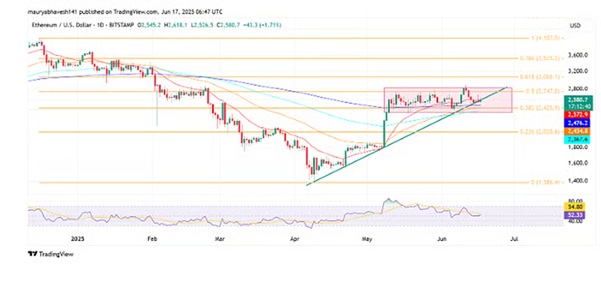
Ethereum (ETH), the second-largest cryptocurrency by market capitalization, has long been a dominant force in the blockchain space. However, recent market trends suggest signs of weakness, with issues such as high transaction fees, network congestion, and increased competition from emerging blockchain projects.

As ETH struggles to maintain its competitive edge, investors seek alternative opportunities that offer stronger growth potential and innovative use cases. This shift in sentiment has fueled interest in newer projects with high growth potential in 2025.

One such promising alternative is PropiChain (PCHAIN), a rising blockchain project designed to revolutionize the $600 trillion global real estate market with tokenized property investments.

Unlike Ethereum (ETH), which faces scalability concerns, PropiChain uses cutting-edge technology to facilitate seamless, low-cost transactions while providing real-world asset backing. As ETH’s market performance wavers, PCHAIN emerges as a compelling investment opportunity, offering a fresh, utility-driven approach to crypto investment.

The Ethereum Price Struggles in 2025

Ethereum’s market performance has been sluggish, weighed down by persistent scalability concerns and high gas fees. Despite the transition to ETH 2.0 and the shift to a proof-of-stake (PoS) consensus mechanism, these problems hinder adoption and investment.

Moreover, Ethereum faces competition from newer blockchain platforms like Solana, Avalanche, and Cardano, all offering faster and cheaper transactions. These alternatives are attracting developers and users away from ETH’s ecosystem, diminishing its market share and putting downward pressure on ETH’s price.

The price of ETH has fallen by over 12% in the past week and over 26% in the past month. Institutional investors are also becoming more cautious with Ethereum, and leading market experts strongly believe PropiChain is a better investment option for 2025.

Why PropiChain is a Stronger Bet for 2025 than Ethereum

While Ethereum struggles to maintain its position, PCHAIN is emerging as a more attractive investment, particularly for those seeking substantial gains in 2025. PropiChain is a next-generation blockchain platform focused on powering the future of the multi-trillion-dollar real estate market.

Regulatory concerns have been a major factor affecting ETH’s performance as authorities worldwide look to impose stricter oversight on DeFi and staking mechanisms. PropiChain, on the other hand, has positioned itself as a compliant platform, working closely with regulatory bodies to ensure legal security for its users.

Because real estate is a heavily regulated industry, PropiChain’s proactive approach to compliance gives it a competitive advantage over Ethereum and other DeFi-centric platforms. Institutional investors, wary of regulatory uncertainty, are more likely to place their bets on a project that operates within clear legal frameworks.

While Ethereum has a vast ecosystem, its growth has stagnated in some areas due to competition and high costs. PCHAIN, on the other hand, is witnessing rapid adoption with strategic partnerships in the real estate industry.

The project is set to capture at least 1% of the global real estate market and a significant share of the RWA tokenization market, which is worth $16 trillion.

PropiChain: Revolutionizing The Multi-Trillion Real Estate Market

PropiChain is revolutionizing real estate investment through cutting-edge technological innovations such as smart contracts, artificial intelligence, the Metaverse, and tokenized assets.

By using the Metaverse technology, PropiChain eliminates traditional barriers such as costly travel expenses associated with in-person property visits. With advanced 3D visualization tools, investors can explore real estate opportunities worldwide from the comfort of their homes, significantly improving accessibility and efficiency.

Picture an investor in Qatar virtually exploring a luxury beachfront villa in Florida or a high-end commercial property in New York, all through immersive virtual reality. The Metaverse facilitates seamless real estate transactions, eliminating geographical constraints and simplifying cross-border property deals.

The platform enhances property management by utilizing smart contract technology to automate critical processes such as lease agreements, rent collections, and other financial transactions. This automation eliminates the need for intermediaries like brokers and agents, reducing overhead costs while improving transaction efficiency.

With AI-powered virtual assistants and chatbots, PCHAIN ensures 24/7 investor support, helping users navigate the evolving real estate market. These intelligent tools provide real-time insights, aiding in informed decision-making and efficient portfolio management for investors.

Furthermore, AI-driven predictive analytics allow investors to anticipate market trends, optimizing their strategies for maximum returns. By integrating AI, the platform empowers investors with the knowledge needed to make data-backed investment choices for increased profitability.

PropiChain transforms physical properties into digital assets through blockchain-enabled real estate tokenization, enabling fractional ownership. This approach allows investors to buy portions of premium properties without requiring substantial capital, making real estate investment more accessible to a broader audience.

PCHAIN Presale: A Massive ROI Opportunity For Early Investors

Ethereum’s weakness has made it a less attractive investment in 2025, but PCHAIN is gaining massive traction for its high growth potential. The PCHAIN presale is currently in its second stage and has raised over $2.5 million cumulatively. The token price is $0.01 but will rise to $0.023 for the next presale round.

According to top market experts, a modest $1000 investment in the presale could yield over $425,600 before the end of Q2 2025. Join the presale now to capitalize on the projected rally in the coming months. Analysts strongly believe the PCHAIN trajectory follows the same patterns as DOGE before its 2021 historic rally.

The token is listed on CoinMarketCap, increasing the token’s visibility and accessibility to potential investors. Additionally, the platform has been audited by BlockAudit, a globally renowned blockchain security company, and they certified the PCHAIN’s platform as safe and secure for all users and investors.

For more information about the PropiChain presale:

Website: PropiChain

Join Community: https://linktr.ee/propicha

Tekedia Institute AI Strategy Is Anchored on Localized Data

0

We recently finalized the Tekedia Institute AI Strategy and our conclusion among other things for our school is this: in the world where companies like OpenAI and Google are aggregating global data, and making all accessible and usable via chatbots like ChatGPT and Gemini, supreme-monetizable data will be data they do not have access to. Simply, the data which these big AI companies do not have access to will be the most precious data going forward for schools.

If that is the case,  overlaying proprietary localized data on AI engines and LLMs will create differentiation and new positioning because in a world of abundance, scarce resources become overly strategic, and people will pay for those resources which include data and knowledge systems. Of course, AI must be used to refine those resources in ways that help students.

Simply, the Tekedia Institute AI Strategy emphasizes the value of proprietary, localized data in the age of large language models like ChatGPT and Gemini. These AI models are trained on vast datasets, making data that is unique and inaccessible to them highly valuable. By leveraging localized and proprietary data and insights, Tekedia Institute will continue to differentiate itself and offer high quality business management and leadership programs.

This strategy is driving our new products including WinGPT. AI will offer a golden era for educational institutions because AI will help personalize learning, and accelerate the effectiveness of faculty. If you are a university with a business school in Africa, our technology can support your mission.

Chowdeck Optimizes Operations, Lays off 68% of Contract Staff, Amid Ghana Expansion

0

Chowdeck, Nigeria’s on-demand online food delivery service is streamlining its operation by laying off 68% of its contract staff, following the implementation of efficiency improvements in its rider and restaurant management processes.

According to Tech Point, Chowdeck CEO Femi Aluko disclosed that the company’s operations team expanded sixfold from 20 employees in January 2024 to 120 by January 2025. However, he added that maintaining this level of staffing was unsustainable, given the company’s ambitious fivefold growth target for 2025.

Hence, it has since focused on optimizing processes and reducing manual dependencies, allowing it to operate more with a leaner team.

The CEO said,

“As we were growing very fast last year, we had to hire a lot of contract people to help handle a lot of things in operations. In the last two months, we’ve optimized a lot of those processes that now require us to not need as many people as we needed before for our contract employees”.

Aluko emphasized that the layoffs were not due to financial struggles but rather a result of operational improvements that have significantly enhanced delivery speed and efficiency. For instance, he noted that a team that once required 24 employees can now function with just two, and average delivery times have dropped from 41 minutes to 33 minutes.

Notably, the affected contract staff were informed of the decision at a company meeting, where they were assured of three months’ salary and health insurance as severance. Chowdeck also plans to assist as many as possible in transitioning to new roles outside the company. However, in all of these, full-time employees remain unaffected.

Chowdeck Rapid Growth And Expansion Into New Markets

Despite the layoffs, Chowdeck continues its aggressive expansion. The company, which secured a $2.5 million seed round in 2024, hit the 10 million delivery milestone on March 3, 2025, with a staggering six million deliveries occurring in just the last nine months.

Its recent operational optimizations have enabled faster market entry. In January 2025, the company expanded to Kaduna and Owerri and is set to launch in Ghana next week, starting with the capital Accra.

Chowdeck has already appointed a country manager for Ghana and plans to maintain a lean team, leveraging its improved operational efficiency. The company’s CEO emphasized that the expansion follows a city-by-city approach rather than a broad national rollout.

“Just because we’re live in Ghana doesn’t mean we’ll launch in Kumasi soon. We’ve built a great product that has hit Product-Market Fit (PMF) in specific cities, and our goal is to double down on those success points across Africa”, the CEO said.

Chowdeck’s ability to combine rapid expansion with operational excellence has positioned it as a dominant force in Nigeria’s food delivery sector. In October 2024, the company surpassed N30 billion in total deliveries for 2024, highlighting the platform’s growing influence in Nigeria’s food service industry. The company also boasted of having over one million registered users, serving over 3,000 businesses across Nigeria.

Since its inception in October 2021, Chowdeck has grown rapidly, establishing itself as a major player in Nigeria’s food delivery market. The platform has expanded its reach to eight major cities in Nigeria, which includes Lagos, Abuja, Ibadan, and Port Harcourt, with a fleet of over 3,000 riders. Chowdeck’s riders, according to the company, earn comparable salaries to senior civil servants in Nigeria, highlighting the platform’s role in providing employment opportunities.

Looking Ahead

As Chowdeck continues its aggressive growth strategy, with its recent expansion to Ghana, the company is set to further reshape how Africans access restaurant meals through technology-driven convenience.