DD
MM
YYYY

PAGES

DD
MM
YYYY

spot_img

PAGES

Home Blog Page 2153

Future of Chinese Great Firewall and the Internet

0
A woman looks at a NFT by Mad Dog Jones titled "SHIFT//" during a media preview on June 4, 2021, at Sotheby's for the Natively Digital: A Curated NFT Sale Online Auction to take place June 10, 2021. - They are technology enthusiasts on the hunt for opportunities in the Wild West market surrounding NFTs: the popular certified digital objects that have spawned a new generation of collectors convinced of their huge potential. (Photo by TIMOTHY A. CLARY / AFP) / RESTRICTED TO EDITORIAL USE - MANDATORY MENTION OF THE ARTIST UPON PUBLICATION - TO ILLUSTRATE THE EVENT AS SPECIFIED IN THE CAPTION

The Great Firewall evolves like a living organism, adapting to new tech, user behavior, and political priorities. It’s not static—China’s engineers and policymakers tweak it constantly to keep it effective.

Here’s how it grows and shifts:

First, it tracks emerging threats. When a new platform or tool—like a shiny VPN or an encrypted messaging app—starts gaining traction, the system tests ways to detect and block it. For example, back in the early 2010s, VPNs were a decent workaround, but by 2017-2018, the Firewall got smarter, using machine learning to spot VPN traffic patterns and shut them down faster. Same goes for Tor or other anonymity networks—China’s techies reverse-engineer these tools and plug the holes.

Second, it scales with hardware and software upgrades. As internet speeds climb and data volumes explode (hello, 5G), the Firewall leans on beefier servers, better algorithms, and real-time analytics. Deep packet inspection, which used to be clunky, now sifts through encrypted traffic at lightning speed, guessing content even when it can’t crack the code outright. AI plays a big role here, flagging suspicious activity without humans needing to babysit every packet.

Third, it reacts to political heat. During sensitive times—like the Communist Party Congress or anniversaries of touchy events (June 4th, anyone?)—the screws tighten. Entire swaths of the web go dark, keywords get blacklisted, and domestic platforms like Weibo crank up their own censorship to stay in line. After the heat dies down, it might loosen a bit, letting some air back in.

Fourth, it learns from users. Chinese netizens are crafty—think coded language, memes, or proxy tricks to dodge filters. The Firewall watches, catalogs these moves, and updates its playbook. A slang term for dissent might work for a week before it’s sniffed out and banned. It’s a cat-and-mouse game, but the cat’s got a bigger budget.

Finally, it’s shaped by global pushback and ambition. As Western governments and tech firms complain (or try countermeasures), China doubles down, refining its export model—think Belt and Road countries adopting Firewall-style systems. At the same time, it’s polishing its own internet vision: less reliance on outsider tech, more homegrown control.

Comparing the Great Firewall to North Korea’s internet control is like pitting a sophisticated filter against a near-total blackout. Both aim to choke the flow of outside info, but they’re built for different realities—China’s got a massive, wired-up population to manage, while North Korea’s running a smaller, isolated cage.

China’s Great Firewall is a dynamic beast. It blocks huge chunks of the global web—Google, Wikipedia, Western social media—but still lets a curated internet thrive inside its borders. Over 1 billion users are online, using apps like WeChat or Baidu, all under heavy surveillance and censorship. It’s selective: you can browse, shop, and chat, but step into forbidden zones (say, “Tiananmen 1989” or “Free Tibet”), and you hit a wall.

The system’s flexible—VPNs might work until they don’t, and it scales up during political flare-ups. It’s less about cutting the cord entirely and more about steering a giant, tech-savvy populace into a state-approved digital pen. It’s a relentless cycle—tech advances, users adapt, politics shift, and the Firewall morphs to keep its grip. Wild to think how it’s not just a tool but a whole philosophy in code, right? What part of this evolution stands out to you?

President Trump Announces a 25% Tariff on European Union

0

President Donald Trump has recently escalated his trade policy by imposing or threatening tariffs on the European Union, following actions against Canada, Mexico, and China. He has announced a 25% tariff on steel and aluminum imports from all countries, including the EU, reversing previous exemptions.

Additionally, Trump has vowed to impose broader “reciprocal tariffs” on EU goods, arguing that the EU has long taken advantage of the U.S. through unfair trade practices, such as its $235.6 billion goods trade deficit with the U.S. in 2024. He’s specifically criticized the EU’s 10% tariff on U.S. cars (versus the U.S.’s 2.5% on EU cars) and its reluctance to import more American farm products and vehicles.

The EU, led by figures like Ursula von der Leyen and Emmanuel Macron, has promised a “firm and proportionate” response, signaling potential countermeasures like those seen in 2018—targeting U.S. exports such as bourbon, motorcycles, and jeans. Germany, a major steel exporter, and Ireland, heavily reliant on U.S. trade, could be hit hard, though the UK’s post-Brexit status might spare it from the worst, with Trump hinting at a possible deal with PM Keir Starmer.

Economists warn that these tariffs could raise U.S. consumer prices, stoke inflation, and slow global growth—potentially shaving 0.5-0.9% off EU GDP if a 10% across-the-board tariff sticks. The EU is bracing for a trade war but hopes to negotiate, perhaps by boosting U.S. energy imports or coordinating on China’s steel overproduction. Still, Trump’s unpredictable approach keeps the situation tense.

The European Union is gearing up for a strategic response to Trump’s tariffs, drawing from past experience and current economic realities as of February 26, 2025.

Here’s how they’re likely to counter:

First, the EU is preparing targeted retaliatory tariffs, a playbook they’ve used before. In 2018, when Trump hit EU steel and aluminum with tariffs, the EU fired back with duties on $3.2 billion worth of U.S. goods—think Harley-Davidson motorcycles, Levi’s jeans, and Kentucky bourbon. This time, they’re eyeing a broader list, potentially hitting U.S. exports like agricultural products (soybeans, corn), tech goods, and energy exports (LNG). The goal? Painful enough to sway U.S. business lobbies and voters in key states, but “proportionate” to avoid all-out escalation.

Second, they’re exploring negotiation leverage. The EU could dangle increased purchases of U.S. liquefied natural gas—already up since Russia’s Ukraine invasion cut European energy options—or offer to align more closely on curbing China’s steel dumping, a shared gripe. Macron and von der Leyen have signaled openness to talks, hoping to trade concessions for tariff relief. They might also push a “Buy European” campaign to shift reliance away from U.S. imports, though that’s slower to bite.

Third, the EU’s flexing its regulatory muscle. They could tighten scrutiny on U.S. tech giants—think Google, Apple, or Amazon—with antitrust fines or data rules under the Digital Markets Act, indirectly pressuring Trump’s base. There’s also talk of carbon border taxes hitting U.S. goods if America doesn’t play ball on climate goals, though that’s riskier given global backlash potential.

Internally, the EU’s shoring up its own. Subsidies for steelmakers like Germany’s Salzgitter AG or France’s ArcelorMittal could blunt tariff damage, while trade deals with Asia or Latin America might offset U.S. market losses. Ireland, exposed with 13% of its exports to the U.S., might push for EU-wide relief funds

Germany wants to protect its car exports, France its farmers, and smaller nations fear collateral damage. Economists peg a 10% U.S. tariff costing the EU up to 0.9% GDP, so the bloc’s weighing pain versus principle. Expect a mix of retaliation and olive branches, calibrated to Trump’s next move.

Polkadot vs. Dogecoin vs. This New Presale—Which Will Explode In March?

0

With the current bearish market, seasoned players like Polkadot (DOT) and Dogecoin (DOGE) are facing market volatility and competition from new contenders. As March approaches, investors are skeptical that established tokens will rally, with Polkadot’s market cap down to $6.9 billion and Dogecoin down 40% this month. Meanwhile, the ongoing DTX Exchange token presale has already raised $15.1 million, positioning it as a fresh option for March’s market shifts.

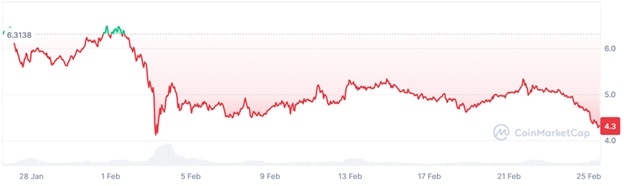
Polkadot Drops to $4.3 as Market Cap Shrinks to $6.8B

Polkadot (DOT) has encountered major difficulties this month, suffering a considerable drop of 30%, which has reduced its present price to $4.3. This reduction has led to an overall market cap of around $6.8 billion. The decline in value suggests a decrease in investor interest, especially as network activity has exhibited signs of a slowdown in recent weeks. In just the past week, DOT has experienced another drop of 7%, which has led to its poor performance compared to rival cryptocurrencies like Ethereum.

Source: Polkadot Price, Monthly Chart, CoinMarketCap

Technical charts suggest buyers remain cautious, with key indicators signaling oversold conditions. While some hope for a rebound, few clear triggers exist to drive growth. Critics note that the Polkadot (DOT) ecosystem has stalled compared to last year, failing to reignite excitement.

Investors are diverting funds to newer hybrid platform projects like DTX Exchange which could offer practical features. One trader tweeted: “Polkadot’s tech infrastructure is good, but it’s losing attention to presale projects with clearer goals.” The 40% Polkadot (DOT) drop so far this month, highlights this trend.

DTX Set to Explode in March From $0.18 to $0.36

As older coins like Polkadot (DOT) struggle, the DTX Exchange token presale is gaining traction. Priced at $0.18, it has raised $15.1 million from 700,000 buyers, making it a top crypto to buy before its mid-2025 launch. Early buyers could double their money at the $0.36 listing price, with experts predicting further growth.

The platform could combine crypto and traditional markets, allowing trading of stocks, forex, and 120,000+ high-leverage assets. Unlike Polkadot (DOT) or Dogecoin, it could focus on real-world tools like copying expert traders and advanced charts. Regular security checks and limited token supply could also strengthen its appeal.

A Reddit user noted: “Projects with this much early interest often surge after launch. DTX solves problems for multi-asset traders.” With nearly a quarter of its current sale stage sold, time is running out to buy at presale prices. Additionally, Edward Dowd, another market expert, shared: “The DTX Exchange’s strong presale numbers hint at big investor interest. Hybrid platforms like this could lead 2025’s market growth.”

Dogecoin Slips to $0.21 Due to 40% Monthly Decline – Will it Recover In March?

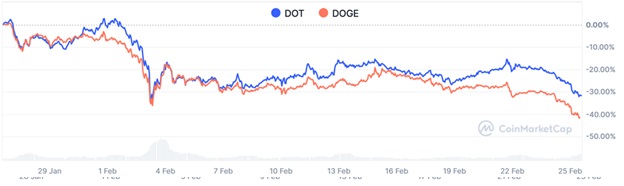
DOGE has fallen significantly this month, dropping 40% to around $0.21, which has reduced its market capitalization to about $30 billion. The value of this meme coin increasingly hinges on the influence of Elon Musk’s tweets as its usage declines. Additionally, regulatory bodies are reviewing a proposed Dogecoin investment fund, while negative technical signals indicate a bearish trend for potential investors.

Source: Polkadot Vs. Dogecoin Price Comparison, CoinMarketCap

Data shows fewer active DOGE users and reduced large transactions. Still, most holders polled online expect a rebound, hoping Tesla might accept DOGE payments. Predictions vary wildly—some see DOGE hitting $1.19 by the end of March, while others warn it could drop below $0.20. An influencer remarked: “DOGE had its fun, but traders now want real infrastructure, not just spoofs.” March may solidify DTX’s rise while DOGE fights to stay relevant.

Conclusion

Polkadot (DOT) and Dogecoin are facing tough market projections, but DTX Exchange’s hybrid platform—with its $15.1 million presale and diverse trading options—could offer a fresh path. As March approaches, traders are leaning toward projects mixing blockchain transparency with professional tools. For those eyeing new opportunities, DTX’s presale provides early access before its launch.

Check out the links below to learn more.

DTX Website

Buy Presale

Join Telegram Community

Four Years After Raising $3.5m, Nigerian Edtech Startup Edukoya Shuts Down, Cites Market Challenges

0
Fund, money cash dollar

Edukoya, the Nigerian edtech startup that once held the promise of revolutionizing online learning in Africa, has officially shut down, marking a significant blow to the country’s digital education sector.

The closure comes just four years after the startup secured $3.5 million in pre-seed funding—Africa’s largest at the time.

The company cited several reasons for winding down, including market unreadiness, limited internet connectivity, low access to learning devices, and unfavorable macroeconomic conditions.

Launched in 2021 by Honey Ogundeyi, Edukoya sought to address Nigeria’s deep-seated education challenges by offering a digital platform for online tutoring, live classes, and academic support. The startup’s vision was inspired by Ogundeyi’s own experiences with the Nigerian education system, where she witnessed firsthand how even the brightest students struggled due to systemic deficiencies.

Armed with the largest pre-seed funding in Africa’s edtech history, Edukoya entered the market with ambitious goals. The company quickly gained traction, reaching over 80,000 students and answering more than 15 million academic questions through its platform. It also integrated artificial intelligence into its services to enhance personalized learning experiences.

However, Edukoya found itself struggling against deep-rooted structural barriers. Internet access remained unreliable and costly for many Nigerian students, while limited device penetration meant a significant portion of its target audience could not access the platform. Furthermore, economic hardship made it difficult for families to afford premium digital learning solutions.

“In many ways, Edukoya was too early for its time—the infrastructure and economic conditions needed to support our vision at scale simply aren’t yet in place across our target markets,” the company explained in its shutdown statement.

Macroeconomic Challenges: The Edtech Industry’s Silent Killer

Edukoya’s exit from the market is not just an isolated case of a startup failing to scale. It underscores a larger crisis facing Nigeria’s edtech sector, where systemic economic and infrastructural issues continue to stifle growth.

A critical factor that contributed to Edukoya’s downfall was the worsening economic climate in Nigeria. In recent years, inflation has surged, eroding household purchasing power and making it difficult for families to prioritize digital education expenses. With many struggling to afford even basic necessities, premium online learning platforms became a luxury rather than a necessity.

Even free or low-cost digital education models have struggled. Poor internet connectivity in many parts of the country has rendered digital learning unreliable, while high costs of mobile data continue to limit access to online platforms. Unlike developed markets where edtech thrives on broadband internet, Nigeria’s dependence on mobile data presents a major obstacle.

A Grim Outlook for Edtech in Nigeria?

Against the backdrop of Edukoya’s specific struggles, and eventual shutdown comes the question: Is Nigeria truly ready for edtech?

Many industry players have echoed similar challenges, painting a bleak picture for the sector.

Sim Shagaya, the founder of uLesson, another prominent Nigerian edtech startup, has previously voiced concerns about the infrastructural difficulties that hinder digital education in Nigeria. In an interview, he pointed out that while the demand for quality education exists, the necessary conditions—such as widespread internet access, affordable devices, and financial capacity among parents—are still lacking.

Similarly, Tuteria, an edtech company focused on connecting students with private tutors, has struggled with adoption due to financial constraints among its target audience. The platform, which relies on users being able to afford private tutoring, has faced slow growth as parents grapple with economic difficulties.

For many edtech founders, Edukoya’s failure is not just about one company—it is a reflection of deeper structural issues that make it difficult for digital learning solutions to thrive in Nigeria.

As Edukoya battled these challenges, the company explored multiple strategies to stay afloat, including partnerships, mergers, and acquisitions. However, no viable solutions emerged. The company ultimately concluded that burning through its remaining resources in a hostile market was unsustainable.

“After exploring partnerships, M&A, and business model pivots without viable solutions, we’ve chosen to wind down operations and return capital to investors rather than deplete resources chasing scale in a challenging market,” Edukoya stated.

This failure to secure a merger or acquisition deal highlights the broader difficulties within Nigeria’s edtech space. Investors are hesitant to pour funds into a sector plagued by infrastructural deficiencies, and even established players are finding it difficult to scale profitably.

Is There Still Hope for Edtech in Nigeria?

Despite the gloomy outlook, some industry experts believe that Nigeria’s edtech sector still holds promise—if key structural challenges are addressed.

One potential avenue for growth is hybrid learning, which combines both physical and digital educational models. Unlike purely online platforms, hybrid learning allows students to supplement traditional schooling with digital resources, making it more adaptable to Nigeria’s current infrastructural realities.

However, government intervention has been touted as crucial. Countries where edtech has thrived, such as India, have seen strong policy support, including investments in internet infrastructure and public-private partnerships to make digital learning accessible.

Cardano & Sui Slump While FXGuys’ $4M Momentum Steals the Spotlight

0

The crypto market is showing signs of weakness for some major players. Cardano (ADA) and Sui (SUI) are slipping, leaving investors concerned about their future. Meanwhile, FXGuys is making waves, raising over $4 million in its Stage 3 presale at $0.05 per $FXG token. This Top PropFi Project is capturing traders’ attention with its unique financial model, staking rewards, and trader funding program.

>>>JOIN FXGUYS HERE<<<

Cardano & Sui Face Market Declines

Cardano, once considered one of the top defi coins, has been struggling to maintain momentum. Its slow network upgrades and competitive pressure have impacted investor confidence. Similarly, Sui, a blockchain known for its scalability, has seen declining demand despite its technical advancements.

Both assets face increasing competition from high potential altcoins with strong fundamentals and real-world use cases. FXGuys, with its growing presale success and innovative Trade2Earn model, stands out as a rising contender in the market.

FXGuys Gains Traction With $4M Presale

Unlike Cardano and Sui, FXGuys is thriving. The FX Guys are redefining the DeFi landscape with a strong focus on trader empowerment and financial growth. With over $4 million raised in its Stage 3 presale, the project is gaining serious traction. Its $FXG token, currently priced at $0.05, offers investors access to unique benefits, including:

  • Staking Rewards – Stake $FXG to earn a 20% profit and revenue share from broker trading volume.
  • Prop Trading Funding Program – Smart prop traders who pass evaluations can access up to $500,000 in trading capital with an 80/20 profit split in their favor.
  • Trade2Earn Program – Every trade earns $FXG tokens, enhancing trading activity and engagement.

These features position FXGuys as one of the best proprietary trading firms in the space, offering real financial incentives that go beyond simple speculation.

Why Traders Are Flocking to FXGuys

The FX Guys offer much more than just another cryptocurrency. Unlike many DeFi projects, it focuses on practical financial tools that benefit active traders. Features like no buy or sell tax, decentralized trading with no KYC requirements, and same-day fiat or crypto deposits and withdrawals make it a convenient choice for traders worldwide.

Additionally, FXGuys’ broker-backed crypto prop firm ensures stability and access to multiple trading platforms. Traders can choose from FXGuys Trader, MT5, Match-Trader, cTrader, or DXtrade, depending on their location. These advantages make FXGuys a top defi coin worth considering.

The Future of FXGuys and Its Competitive Edge

While Cardano and Sui struggle to regain momentum, FXGuys continues to surge forward. Its combination of staking, trader funding, and a strong financial ecosystem sets it apart. Investors looking for the best defi token with practical use cases are recognizing the value of this project.

With the $FXG token still in its presale stage at $0.05, early adopters have the opportunity to be part of a growing financial revolution. The FX Guys are proving that a well-structured financial model, combined with strong community engagement, can outperform even established cryptocurrencies.

>>>JOIN FXGUYS HERE<<<

Conclusion: FXGuys Leads the Charge

As the market experiences shifts, FXGuys remains a standout project. With a growing presale, innovative trading solutions, and a strong trader-focused ecosystem, it is quickly becoming one of the top defi coins. While Cardano and Sui struggle to maintain momentum, FXGuys is capitalizing on its position as a leader in the PropFi space.

Investors searching for high potential altcoins should consider FXGuys, as its prop trading funding program, staking rewards, and seamless trading experience make it a promising choice. As the presale continues, this instant funding prop firm is setting new standards in the crypto trading world.

To find out more about FXGuys follow the links below:

Presale | Website | Whitepaper | Socials | Audit