DD
MM
YYYY

PAGES

DD
MM
YYYY

spot_img

PAGES

Home Blog Page 216

Managing the Logistics of an Online Divorce: A Digital Approach

0

The dissolution of a marriage often manifests as a complex administrative project filled with documentation and bureaucratic hurdles rather than just a relationship change. Treating this significant life transition as a workflow management task helps individuals navigate the process efficiently without the high overhead often associated with traditional legal representation. By utilizing an online divorce platform, couples can approach separation methodically, turning a potentially chaotic legal process into a structured series of administrative steps.

Divorce can be complicated and expensive. For many years, getting a divorce meant hiring lawyers and going to court several times. Now, there are websites that make it easier and less expensive to file for divorce online. Platforms like yourforms.com provide the necessary infrastructure to generate these documents, ensuring the paperwork meets specific court requirements.

On these sites, people filling out forms are asked a series of questions in an interview-style format. Their answers are used to fill in the blanks on the forms needed for divorce. In other words, someone seeking a divorce doesn’t have to start from scratch and write out their petition by hand.

The traditional route is often expensive because lawyers charge by the hour for their time. Using an online document preparation service can cut out some of that expense. And it may be less stressful, too: Instead of wading through a lot of paperwork alone, you can follow prompts and turn what feels like an overwhelming legal issue into a more manageable set of tasks.

Eligibility for Uncontested Filings

The internet has changed how we do many things – and this includes getting a divorce. Online resources can make the process easier and less expensive. But there are still some things you need to know about using digital tools for your divorce. To successfully utilize uncontested divorce online systems, both parties must agree on all major issues regarding the separation: like what happens to their property, who will take care of the children, how much child support will be paid, and who owes what debts.

If you and your spouse have not reached an agreement on these things, or if there are other areas where you just can’t seem to agree, then online divorce forms might not be right for you. You may need to seek out the advice of a mediator or even go to court to have a judge decide some of these issues.

Although the procedures for getting a divorce online vary depending on the jurisdiction, they often have one thing in common: certain requirements. The specifics can be quite different from one place to another. For example, the requirements, filing fees, and mandatory waiting periods for a Texas divorce online differ significantly from those in New York or Florida. Even the papers that need to be filed can be unique to the area. This is why electronic filing systems include local rules of court and other jurisdiction-specific information: so users can do everything correctly and get their cases processed as quickly as possible.

Industry statistics show that searches for online divorce services go up every January. Apparently, many people see the start of a new year as a time to get organized, take care of business they have been putting off, and change their marital status.

Organizing Your Documentation

Regardless of the situation, it’s always a good idea to be organized and have everything you need readily available before starting any kind of digital process – especially one that has legal ramifications, such as getting a divorce. Preparation makes the process go smoother, reduces the chance of delay, and allows you to get everything done the first time correctly.

Even if you’re not getting audited by the IRS, gathering accurate information beforehand could help speed up the completion of forms or questionnaires. If everything is organized and easily accessible, it takes less time to fill out paperwork, and there is less likelihood of mistakes that need correction later on.

Common reasons for rejecting documents filed with the court clerk include simple errors, such as using incorrect or estimated figures instead of exact amounts. Although this is easily done, it can cause problems that you don’t need. Double-checking information, including bank balances, real estate values, and dates prior to filling out forms, helps avoid these types of errors.

To make completing your divorce papers online easier, gather all your financial information before beginning. This should include bank statements, retirement account information, and property values. The more prepared you are, the less time-consuming the process will be. Keep in mind that accessing your divorce records online is different than getting copies of documents that have been filed with the court. Public divorce records online are generally available, but active cases may require a different type of access.

Having access to all your financial information helps you better negotiate with your spouse and ensures that everything is divided fairly. Set up a secure digital file storage system where all parties involved in the divorce can easily access it. This could be a shared folder on your computer or a secure cloud storage service. Having this information readily available will help ensure everything runs smoothly throughout your divorce proceedings.

To ensure a smooth data entry process, locating and digitizing the following documents before starting the questionnaire is recommended:

  • Real Estate Deeds and Mortgage Statements: Current valuation and ownership documents are required to determine equity.
  • Tax Returns: The last three years of returns provide a verified history of income and joint financial status.
  • Vehicle Titles and Registration: Proof of ownership is needed for all automobiles, boats, or recreational vehicles.
  • Bank and Credit Card Statements: A complete snapshot of all liquid assets and outstanding debts is necessary for the accurate division of property.

Successfully navigating a digital separation relies on organization, preparation, and mutual agreement. It is crucial to ensure all generated documents are reviewed carefully before submission to the court clerk to avoid procedural rejection. Once the final decree is signed and filed, the administrative burden is lifted, allowing both parties to move forward with a clean slate.


X Restricts Programmatic Bot Replies to Boost Genuine Users Interaction

0

X has recently implemented restrictions on programmatic replies via its API specifically to combat automated reply spam, particularly from AI and LLM-generated content. This change was announced by the official X Developers account and detailed in their developer community forum.

Programmatic replies using the POST /2/tweets endpoint are now restricted. You can only post a reply via the API if the original post’s author explicitly invites/engages with you by: Mentioning your account in their post, or Quoting your post. If neither condition is met, API attempts to reply will be blocked.

Regular (non-reply) tweet and post creation via the API remains unchanged and fully supported. This applies to Free, Basic, Pro, and Pay-Per-Use API tiers; Enterprise and Public Utility apps are exempt.

The goal is to reduce low-quality, automated “spam” replies often AI-generated “slop” that flood conversations under popular posts, improving overall discussion quality on the platform. This follows earlier efforts by X to curb bot spam and manipulative engagement, including prior restrictions on reward-based posting apps (“InfoFi”) in January 2026 that also targeted AI-driven reply spam.

Many users and developers appear to welcome the move, describing it as a step against bot-heavy, low-effort replies that degraded experiences under viral threads. Manual replies; typed by users themselves are unaffected—only automated and programmatic ones face these new limits.

The recent restriction on programmatic replies via the X API primarily targets automated, low-quality, and AI-generated (“LLM slop”) reply spam that has plagued threads under popular posts. This builds on earlier 2026 efforts, like banning “InfoFi” reward-based apps in January that incentivized bot-driven engagement.

Automated bots and AI tools can no longer flood conversations with instant, repetitive, or irrelevant replies like crypto promotions, fake accounts mimicking celebrities, generic “gm” bots, or low-effort AI comments. This should noticeably clean up threads under viral posts, making discussions more authentic and higher-quality.

Many users and observers describe the change as a welcome fix to a “plague” of degraded timelines. Expect fewer irrelevant or spammy replies appearing seconds after a post goes live, leading to better engagement in genuine conversations.

Broader Anti-bot Momentum

This follows prior crackdowns and is seen as a step toward restoring discussion integrity on X. Major disruption for automated reply tools: Bots, AI assistants, monitoring apps, customer service bots, or any service relying on programmatic replies to non-engaged posts are now blocked unless the original author explicitly mentions the replying account or quotes its post.

This kills most unsolicited auto-reply use cases on Free, Basic, Pro, and Pay-Per-Use tiers. Developers are questioning edge cases, like whether an account can programmatically reply to its own posts; not explicitly addressed in the announcement, but likely still restricted if it doesn’t meet the summon criteria.

Some see this as another layer of restriction following API paywalls and InfoFi bans, potentially limiting creative or legitimate uses like community tools or moderated bots. However, non-reply posting via API remains fully supported, so tweet scheduling, publishing, etc., are unaffected.

Projects depending on broad reply automation must pivot—e.g., shift to manual engagement, wait for mentions and quotes, or explore alternatives outside X’s API. Developer community discussions focus on clarification rather than heavy backlash so far, with some appreciating the spam relief despite the hit to flexibility.

No widespread reports of immediate massive disruptions beyond spam bots going quiet, but long-term effects on third-party tools and crypto and Web3 integrations already hit hard earlier in 2026 could emerge. This appears to be a net positive for regular users tired of spam-filled replies, while forcing automated services to rethink strategies.

The change is live now, so impacts on reply sections should become visible quickly in high-engagement threads.


FedEx Sues US Government Seeking Refunds of Tariff Payments 

0

FedEx has filed a lawsuit against the U.S. government seeking a full refund of tariffs it paid under emergency powers invoked by President Donald Trump.

FedEx sued in the U.S. Court of International Trade. The suit targets U.S. Customs and Border Protection (CBP) and its commissioner, Rodney Scott, along with the U.S. government. FedEx is seeking reimbursement for all duties paid under tariffs imposed via the International Emergency Economic Powers Act (IEEPA) of 1977.

This action follows a U.S. Supreme Court ruling on February 20, 2026 (last Friday), in a 6-3 decision, which found that President Trump exceeded his authority by using IEEPA to impose these broad tariffs unilaterally.

The Court ruled that such tariffs require congressional approval, deeming them illegal. FedEx, acting as an importer of record for affected goods, stated it had “suffered injury” from these payments and is requesting a “full refund” of all IEEPA duties paid, potentially including interest.

The company did not disclose a specific dollar amount in the complaint, but earlier estimates suggested FedEx could face around a $1 billion hit in 2026 from these tariffs plus related changes like ending de minimis exemptions for small packages under $800.

This appears to be the first major U.S. company to file such a suit following the Supreme Court decision. Analysts expect many other importers and businesses to follow, as over $175 billion in collected tariff revenue could be subject to potential refunds.

FedEx described the filing as a step to protect its rights, noting that no formal refund process has yet been established by regulators or courts. This development stems from Trump’s “Liberation Day” tariffs which aimed at various imports but were challenged on constitutional grounds regarding executive overreach in trade policy.

The case could set precedents for widespread refund claims. UPS, as a direct competitor to FedEx in global shipping and logistics, faced comparable exposure to the IEEPA tariffs. These duties applied to imported goods, and carriers like UPS often acted as the importer of record or handled customs clearance, bearing or passing on costs through fees, brokerage charges, or higher shipping rates.

UPS likely incurred substantial tariff-related expenses in 2025–2026, though no specific figure has been publicly disclosed for UPS similar to FedEx’s estimated ~$1 billion exposure before the ruling. With the tariffs now deemed illegal, UPS stands to potentially recover payments made, plus interest, if a refund process materializes.

UPS has not yet filed a lawsuit seeking refunds unlike FedEx’s February 23 filing in the U.S. Court of International Trade. However, UPS has publicly acknowledged the ruling: On February 20, it noted the Supreme Court’s decision and stated it would follow U.S. Customs and Border Protection (CBP) guidance.

CBP confirmed it would stop collecting IEEPA tariffs effective February 24, 2026. UPS indicated it will cease such collections accordingly and comply with any future directives on refunds or new tariffs.

Analysts expect UPS to join the wave of refund claims, as thousands of importers including major firms are positioned to seek relief. The lack of an established refund mechanism yet creates uncertainty, but UPS’s scale positions it well for potential recovery if courts or CBP establish procedures.

In the interim, Trump imposed a new temporary 10–15% global tariff under Section 122 of the Trade Act of 1974, which could offset some relief. Amazon, a massive importer and e-commerce platform reliant on overseas suppliers especially from China and other trading partners, was heavily affected by the tariffs.

They disrupted supply chains, raised costs for third-party sellers, and contributed to price increases for consumers on many goods. Amazon’s stock rose notably around 2–3% immediately after the February 20 ruling, alongside other e-commerce players like Etsy and Wayfair. This reflected investor optimism that ending the IEEPA tariffs would ease cost pressures, improve margins, and reduce the need for price hikes or supply chain shifts.

As a major importer, Amazon could be eligible for significant refunds on duties paid potentially in the hundreds of millions or more, though no exact amount is public. However, Amazon has not filed a lawsuit for tariff refunds. Many companies; Costco, which sued pre-ruling preserved rights through prior actions, and the ruling opens the door broadly.

Amazon may pursue claims administratively via CBP or through court if needed, but no announcements have emerged yet. The tariffs exacerbated challenges for Amazon’s global sourcing and Prime delivery ecosystem. Ending them could lower input costs, benefit sellers, and stabilize pricing.

However, Trump’s rapid imposition of replacement tariffs under other authorities introduces ongoing uncertainty. Consumers who faced higher prices are unlikely to receive direct refunds—refunds would primarily go to importers like Amazon, with no obligation to pass savings onward.

FedEx’s lawsuit appears to be the first major post-ruling filing, potentially paving the way for others like UPS and Amazon. Over $175 billion in collected IEEPA revenue is now at risk of refunds, but the process remains unclear and could involve prolonged litigation in the Court of International Trade.

Businesses may use any recovered funds to offset costs rather than lower prices immediately. The situation evolves quickly, with new tariffs already in play and more legal challenges expected.

IBM and Related Stocks Plummeted on Anthropic-COBOL Blog Posts

0

IBM’s stock experienced a sharp decline on February 23, 2026 with effects carrying into the 24th, following an announcement from Anthropic about enhancements to its Claude AI model—specifically, capabilities in Claude Code for modernizing legacy COBOL systems.

The drop was significant: IBM shares fell around 13% not exactly 10%, though intraday lows hit near that level before closing lower, marking its worst single-day percentage decline since October 2000. This erased roughly $31 billion in market capitalization in a single session. The stock closed around $223, down from prior levels near $257, and February has seen a broader ~27% monthly slide so far.

What Triggered It?

Anthropic published a blog post on February 23, 2026, titled something along the lines of “How AI helps break the cost barrier to COBOL modernization.” In it, they highlighted how tools like Claude Code can automate key phases of COBOL modernization—such as: Mapping dependencies across massive codebases.

Documenting workflows. Identifying risks and issues that traditionally take human consultants months or years. They claimed this shifts modernization timelines from years to quarters, reducing the need for large consulting teams.

COBOL; developed in the late 1950s still powers critical systems in banking ~95% of U.S. ATM transactions, airlines, insurance, governments, and more—most of which run on IBM mainframes.

IBM has long profited from maintaining these systems, licensing, hardware refreshes, and high-margin consulting and services for modernization projects that are notoriously expensive and complex due to outdated code and scarce expertise.

Investors interpreted this as a direct threat to IBM’s legacy revenue streams, sparking panic selling. Related stocks like Accenture and Cognizant also dropped around 6-7%. IBM executives including Rob Thomas pushed back quickly via blog posts and statements, arguing: Simply translating or analyzing COBOL code isn’t true modernization.

Mainframe value lies in platform architecture, security, uptime, compliance, and reliability—not just the language. New AI tools emerge weekly, but complex enterprise migrations still require IBM’s expertise and hybrid approaches.

IBM has its own AI tools; watsonx Code Assistant for Z for COBOL-to-modern-language translation. Some analysts called the sell-off an overreaction, noting mainframes’ entrenched role in mission-critical environments where reliability trumps speed.

Unlike IBM, Accenture did not issue a direct rebuttal on this specific announcement. The firm has aggressively leaned into AI itself: it has trained over 550,000 employees on generative AI tools, formed deep partnerships with OpenAI and others, and positions itself as the “bridge” helping clients adopt AI safely and at scale.

Executives have repeatedly said AI will augment rather than replace their services, allowing faster delivery and new offerings. Many analysts called the move an overreaction, noting that true modernization still needs human expertise for strategy, integration, testing, compliance, and change management—areas where Accenture’s domain knowledge remains hard to replicate quickly.

Early Feb 24 pre-market trading showed a modest rebound ~0.5% around $202, suggesting some dip-buying. This continues a clear pattern: every major Anthropic Claude Code-related announcement in recent weeks has triggered sector-wide drops in legacy tech and services stocks.

In short, the COBOL news amplified existing investor anxiety about AI commoditizing traditional consulting work, but Accenture’s scale, client relationships, and AI-first pivot give it tools to adapt—much like the broader industry. The stock remains volatile as the market reprices the speed of AI disruption.

This event fits a broader pattern of AI announcements from Anthropic (Claude) pressuring legacy tech and services sectors—similar drops hit cybersecurity stocks after prior Claude features, and Indian IT firms have faced pressure from AI automation fears. It’s a stark reminder of how quickly AI can reprice established business models, even if full disruption takes time.

Central Bank of Nigeria Cuts Interest Rate to 26.5% as Disinflation Continues

0

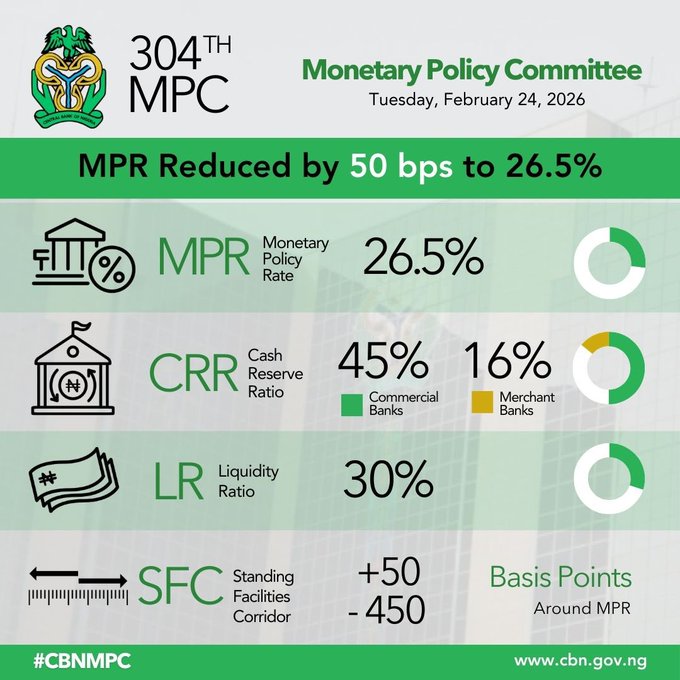
The Central Bank of Nigeria has reduced the Monetary Policy Rate (MPR) by 50 basis points to 26.5 percent from 27 percent, marking its first easing move after an extended tightening cycle.

The decision was taken at the 304th meeting of the Monetary Policy Committee (MPC) in Abuja, with Governor Olayemi Cardoso announcing the outcome. Eleven members were in attendance.

The rate cut comes against a backdrop of sustained moderation in inflation. Headline inflation declined for the eleventh consecutive month to 15.1 percent in January 2026, down sharply from 34.6 percent in November 2024 — a 19.5 percentage-point drop in fourteen months. By conventional monetary policy standards, such a disinflation trajectory creates room for a recalibration of interest rates.

Although the benchmark rate was lowered, the MPC retained other key parameters, underscoring a measured approach to easing:

The Cash Reserve Ratio (CRR) was left unchanged at 45.0 percent for commercial banks and 16.0 percent for merchant banks. The Liquidity Ratio remains at 30.0 per cent. The Standing Facilities Corridor was fixed at +50/-450 basis points around the MPR.

By maintaining tight liquidity conditions through a high CRR, the CBN is signaling that while inflation is easing, risks have not fully dissipated. The CRR remains one of the highest globally, effectively sterilizing a significant portion of bank deposits and limiting the volume of lendable funds in the system.

This balancing act reflects the central bank’s attempt to anchor inflation expectations while cautiously supporting growth. The new MPR of 26.5 percent is the lowest since May 2024, when it stood at 26.25 percent, but policy remains restrictive in real terms given prevailing macroeconomic uncertainties.

Disinflation and Credibility Questions

Nigeria’s inflation descent has been unusually steep. The decline from 34.6 percent to 15.1 percent within just over a year has prompted debate in some quarters about the underlying drivers and statistical base effects associated with rebasing and food price normalization.

The disinflation narrative strengthens the case for easing, yet it also raises questions about sustainability. If price moderation has been driven partly by exchange-rate stabilization, improved FX liquidity, and base effects rather than structural productivity gains, inflation could reaccelerate under renewed fiscal or external pressures.

Ahead of the MPC meeting, analysts were split between a hold and a cut.

Asimiyu Damilare, Head of Research at Afrinvest West Africa, argued that recent macroeconomic developments had strengthened the case for easing. In contrast, the Managing Director of Arthur Steven Asset Management Limited suggested it might be premature to expect a significant move given the limited year-to-date data.

The MPC’s decision represents a middle path: a modest 50-basis-point reduction rather than a more aggressive unwind of prior tightening.

At its 303rd meeting, the committee held the MPR at 27 percent, reinforcing its inflation-fighting stance. The latest move, therefore, marks a pivot in tone, even if not yet a wholesale shift in policy posture. But many analysts had expected a significant basis point reduction that would be commensurate with the decline in the inflation rate.

Will Borrowers Feel Relief?

The more fundamental question is whether the rate cut will materially lower borrowing costs in the real economy.

The Centre for the Promotion of Private Enterprise (CPPE) welcomed the cut but warned that monetary transmission remains weak. According to the think tank, lending rates to businesses remain elevated due to structural constraints, including the high CRR, elevated deposit costs, macroeconomic risk premiums, government borrowing pressures, and high banking system operating costs.

In effect, the MPR functions as a signaling rate, but actual credit pricing is shaped by broader structural factors. When the CRR locks up 45 percent of commercial bank deposits, liquidity conditions remain tight regardless of marginal policy rate adjustments.

The CPPE notes that crowding-out effects from government domestic borrowing further complicate transmission. If banks can earn relatively attractive returns on sovereign instruments with minimal credit risk, incentives to expand private-sector lending weaken.

It added that unless complementary reforms address these rigidities, manufacturers, SMEs, and agricultural producers may see little relief from the 50-basis-point adjustment.

The rate cut also has implications for exchange-rate management and capital flows. Nigeria has relied heavily on tight monetary conditions to support the naira and attract portfolio inflows. Easing too quickly could reduce carry trade attractiveness and introduce volatility into the FX market.

However, if disinflation remains entrenched, real yields may stay sufficiently positive to retain foreign investor interest even with a slightly lower benchmark rate.

For domestic growth, the cut may signal the beginning of a gradual policy normalization cycle. Nigeria’s economy has been operating under historically tight financial conditions, with credit expansion constrained and corporate financing costs elevated. A sustained easing trajectory could improve investment sentiment, provided macro stability holds.

A Gradual Pivot

The MPC’s decision reflects a cautious pivot rather than an abrupt turn. Inflation has moderated significantly, justifying a policy response. Yet by retaining other tightening tools, the CBN is keeping liquidity conditions restrictive.

The CPPE notes that the effectiveness of this easing phase will depend less on the headline rate cut and more on structural reforms that improve monetary transmission, deepen credit markets, and reduce fiscal crowding-out.

The tightening cycle has peaked, but the path toward a meaningfully accommodative stance remains measured and conditional on continued macroeconomic stability.