DD
MM
YYYY

PAGES

DD
MM
YYYY

spot_img

PAGES

Home Blog Page 216

Solana’s $500 Outlook Impresses, but Analysts Say Ozak AI Could Run Higher

0

Crypto investors are bracing for another explosive year as Solana (SOL) continues to strengthen its position among the market’s top performers. With institutional capital flowing back into high-speed blockchains and new developers flocking to the ecosystem, Solana’s fundamentals are aligning perfectly for a potential rally toward $500. But as impressive as Solana’s forecast appears, analysts say the next massive gainer might not be an established network—it could be an emerging AI-driven project known as Ozak AI, which combines blockchain and artificial intelligence to target a potential 100× upside in the coming cycle.

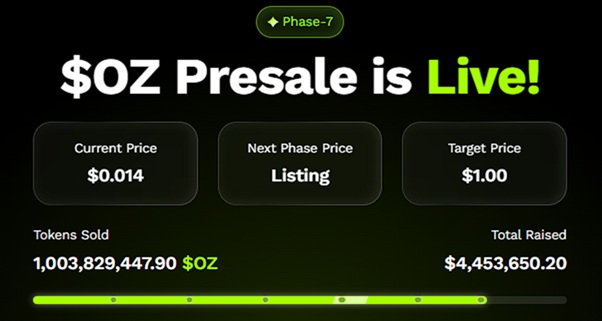
Currently in Stage 5 of OZ presale at just $0.0014, Ozak AI has already raised over $4.4 million and sold 1 billion tokens, signaling that early investors are positioning themselves before what could be one of the most transformative launches of 2025.

Solana (SOL)

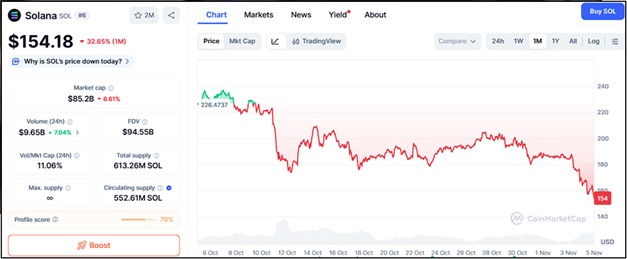
Solana, now trading around $154, continues to stand out for its speed, scalability, and ecosystem depth. Its expanding DeFi and NFT infrastructures, combined with growing institutional integration, are solidifying Solana as the leading smart contract platform behind Ethereum. The recent surge in on-chain volume and stablecoin activity demonstrates growing confidence in its network’s resilience and cost efficiency.

From a technical perspective, Solana shows resistance at $165, $178, and $196, while support levels lie at $142, $130, and $118. If SOL breaks above $178 and maintains momentum, analysts see a clear path toward $500—a level that could make it one of the best-performing large-cap assets of the next cycle.

However, even with a potential 3× rally, Solana’s massive market capitalization limits its explosive upside compared to smaller, early-stage projects. Investors seeking exponential gains—the kind that can turn thousands into millions—are increasingly looking toward innovative, utility-driven presales like Ozak AI.

Ozak AI (OZ)

While Solana focuses on scalability, Ozak AI is revolutionizing how intelligence interacts with blockchain. Its ecosystem is powered by AI prediction agents, machine-learning models capable of analyzing massive amounts of blockchain data, social sentiment, and price movement in real time. These agents identify predictive patterns that give investors and traders a significant advantage in spotting trends before they develop.
What makes Ozak AI so attractive is that it represents the fusion of two of the most powerful narratives in technology—AI automation and decentralized finance. The project’s partnerships with Perceptron Network, HIVE, and SINT enhance its scalability, speed, and interoperability. Together, they enable Ozak AI to leverage over 700,000 AI nodes, integrate real-time blockchain signals, and even connect voice-activated AI systems with Web3 applications.

In terms of credibility, Ozak AI’s CertiK and Sherlock audits set it apart from the average presale, giving investors assurance of security and transparency.

At its current presale price of $0.0014, even small investors can secure large positions before listings. For instance, a $2,000 investment today would buy approximately 1.43 million tokens—worth $1.43 million if Ozak AI reaches $1, marking a 100× return that could easily outperform even the strongest established cryptos like Solana.

Why Analysts Say Ozak AI Could Run Higher

While Solana’s growth is tied to blockchain infrastructure and DeFi demand, Ozak AI’s potential stems from AI adoption, one of the fastest-growing global industries. The 2025–2026 cycle is expected to be dominated by projects that combine AI and blockchain utility—and Ozak AI sits at the core of that convergence.

The project’s predictive AI layer could soon power smarter decentralized applications, automated trading strategies, and real-time blockchain insights. Analysts argue that this technology gives Ozak AI a competitive moat that traditional layer-1 networks can’t match. With a lower market cap and massive innovation potential, Ozak AI’s growth ceiling is far higher than most altcoins entering this bull market.
Solana’s Strength Meets Ozak AI’s Explosive Potential

Solana is undeniably strong—its path toward $500 looks increasingly realistic given its momentum and developer traction. Yet, Ozak AI represents a different kind of opportunity—one that mirrors the early days of Ethereum or Solana before they became household names.

With its blend of AI-driven intelligence, verified audits, and presale-stage entry, Ozak AI offers investors a rare combination of innovation, scalability, and accessibility. In short, while Solana’s growth story impresses, Ozak AI’s trajectory could run much higher, giving early adopters the kind of life-changing upside that only comes around once per market cycle.

About Ozak AI

Ozak AI is a blockchain-based crypto project that provides a technology platform that specializes in predictive AI and advanced data analytics for financial markets. Through machine learning algorithms and decentralized network technologies, Ozak AI enables real-time, accurate, and actionable insights to help crypto enthusiasts and businesses make the correct decisions.


For more, visit:

Website: https://ozak.ai/

Telegram: https://t.me/OzakAGI

Twitter: https://x.com/ozakagi

 

Growing Revenue and Transforming Companies with Agentic AI

0

Join us today at Tekedia Mini-MBA on how agentic AI will help you grow revenue and transform your business. Woron Mene and his friend Mavino Ikein are the zen-masters of AI in Nigeria through Odion AI which is winning market shares in banking, industrials and more.

Experience industrial intelligence on the path to the next multiples at the best school – Tekedia Institute – where practitioners teach! Yes, only practitioners teach in our school.

Thur, Nov 6 | 7pm-8pm WAT | Growing Revenue and Transforming Companies with Agentic AI: Case Study of Odion AI – Woron Mene, OdionAI | Zoom link 

Do Not Fear AI Bubble Because Economic Bubbles Are Expected In Huge Disruptive Technologies Like AI

0

The World Economic Forum adds to the AI bubble crusade: “The head of the World Economic Forum (WEF), Børge Brende, has warned that the world could be heading toward three major financial bubbles — in cryptocurrency, artificial intelligence (AI), and debt — as markets experience sharp declines in global technology stocks after months of record highs.”

People talk of AI bubble, but the fact is this: humans are just starting with AI. Part of AI destination is to create replaceable human organs that can possibly unleash “immortatility”, and AI is a forerunner to that future. If AI can help us to understand human anatomy, physiology, etc better, we can recreate human organs and extend lives. So, yes, we can have economic bubble, but we’re still at infancy when it comes to knowledge. In other words, AI is just starting and provided that is the case, the world will be fine.

In IEEE Potential Magazine, I wrote “Imagine a world where those with ear problems could buy electronic cochleas and those with eye problems, electronic retinas on Amazon and eBay. Imagine a world where all problematic human organs can be electronically replaceable to push humans toward the grail of immortality. All this might not be just imagination years from now if neuromorphic circuits continue to advance.”

Good People, AI will play a huge role in understanding the “circuits” of life and once that is done, man and woman will live longer. So, economic bubble or no bubble, this party will be long, and those who risk the bubble are those that will rule tomorrow! Do not allow them to convince you in the way they told you that Bitcoin is worthless only to be investing $billions in it now!

And the most important part: all technology paradigms have economic bubbles. Decades ago, there were close to 60 car brands in Detroit but only 3 or so survived. So, do not see this bubble thing as new. What should be new to you is how to play safe because there will be economic bubbles even as there will be HUGE winners! That is a constant in all new disruptive technologies.

So, use AI, build AI or invest in AI. Do not withdraw because of the bubble fear since bubbles are naturally expected.

WEF Warns of Looming Financial Bubbles in AI, Crypto, and Debt Amid Global Market Volatility

0

The head of the World Economic Forum (WEF), Børge Brende, has warned that the world could be heading toward three major financial bubbles — in cryptocurrency, artificial intelligence (AI), and debt — as markets experience sharp declines in global technology stocks after months of record highs.

Speaking to reporters in São Paulo, Brazil’s financial hub, Brende said that while markets have been buoyed by optimism over AI’s transformative potential, there are growing concerns that valuations across sectors — particularly in tech — have become inflated.

“We could possibly see bubbles moving forward. One is a crypto bubble, second an AI bubble, and the third would be a debt bubble,” he said.

Brende’s warning comes as the global economy faces multiple pressures of high interest rates, persistent inflation, trade frictions, and mounting sovereign debt.

“Governments have not been so heavily indebted since 1945,” he noted, referring to the post-World War II era, when most industrialized nations were rebuilding their economies through borrowing.

However, investors have continued to pour billions of dollars into crypto and AI-related stocks, pushing markets to unprecedented highs. The rally has been driven by expectations that artificial intelligence will revolutionize industries ranging from finance and healthcare to transportation and manufacturing. Companies like Nvidia, Microsoft, and OpenAI have led the surge, with Nvidia crossing a $4 trillion market valuation last month on the back of soaring demand for AI chips.

Analysts and market strategists are beginning to echo Brende’s concerns. They say the scale of speculative investment in AI-related equities and digital assets resembles earlier financial bubbles — such as the dot-com boom of the late 1990s and the cryptocurrency frenzy of 2021. It is believed that the recent pullback in tech shares is not necessarily a cause for panic, but it’s a clear signal that the market was running ahead of fundamentals.

Valuations in some AI-linked companies are believed to have reached “unsustainable” levels.

Global stock indices have dipped from their peaks, led by sell-offs in tech-heavy benchmarks. Yet, many investors remain optimistic, arguing that AI’s long-term benefits justify short-term volatility.

Brende acknowledged that AI carries immense potential to drive productivity and growth, but cautioned that it could also disrupt labor markets and deepen inequality if not managed responsibly.

“AI offers the possibility of big productivity gains but could also threaten many white-collar jobs,” he said.

“What you could — worst case — see is that there is a ‘Rust Belt’ in those big cities that have a lot of back offices with white-collar workers that can more easily be replaced by this AI and increased productivity.”

His warning aligns with concerns voiced by executives and labor experts over the past year. Companies such as Amazon and UPS have announced significant layoffs in administrative and support functions, citing increased automation and digital transformation. In the U.S., labor economists estimate that as many as 30% of white-collar roles could be affected by AI automation within the next decade, especially in sectors such as finance, law, and customer service.

Still, Brende emphasized that technological advancement has historically led to overall economic progress, despite short-term disruption.

“We also know from history that technological changes over time lead to increased productivity, and productivity is the only way over time to increase prosperity,” he said. “Then you can pay people better salaries, and you have more prosperity in society.”

The WEF, known for its annual summit in Davos, Switzerland, where global leaders and corporate executives gather to discuss economic and social trends, has made AI a central focus of its recent agenda. The organization has been calling for international cooperation to establish ethical frameworks for AI development and to mitigate risks related to labor displacement, data privacy, and systemic financial instability.

Brende’s remarks also coincide with a wave of regulatory scrutiny over both AI and digital assets. In Washington and Brussels, lawmakers are pushing for tighter oversight of AI companies to ensure transparency, accountability, and fairness in deployment. Meanwhile, global financial watchdogs — including the International Monetary Fund (IMF) and the Bank for International Settlements (BIS) — have warned that unchecked speculation in cryptocurrencies and sovereign debt could trigger global financial instability.

Nigerians Discuss Traditional Ajo Savings in Digital Era as Trust Moves Online

0

As Nigeria’s financial landscape rapidly digitizes, Ajo, an age-old savings tradition, is finding itself at the center of a national conversation.

Several netizens on X are discussing the Ajo rotating savings scheme, a Yoruba-rooted tradition also known as “Esusu,” where a group of people put funds together for an interest fee lump-sum payout.

In this scheme, each member takes turns receiving the total pooled amount in a pre-agreed rotation or schedule. For example, in a group of 12 members contributing N1,000 monthly, each member receives a lump sum of N12,000 during their assigned month in the cycle.

A designated person, known as the “Alajo” (record keeper), is typically responsible for collecting and disbursing the funds and keeping records. For traders and low-income earners, Ajo is a lifeline, providing lump sums of cash for projects. Several proponents value it for providing quick capital and enforcing savings discipline, amid inflation and limited banking access.

Albeit, the traditional Ajo system carries risks, primarily associated with the integrity of the members and the Alajo, such as a member defaulting on payments or the collector absconding with the funds. 

Recently, the Ajo savings scheme conversation gained momentum after one user shared a post on X (formerly Twitter) that resonated widely and sparked questions about the relevance of Ajo in today’s digital era of fintech-led savings platforms.

The user wrote, “500k Ajo wey I don pack since May, I still dey pay am. Money wey I don chop, baba God na die I dey.”

The lighthearted but relatable remark triggered discussions about discipline, financial pressure, and whether the traditional Ajo savings methods still fit into modern financial habits.

Check out reactions from several Nigerian users;

@Yemihazan wrote,

“So I guess the way this Ajo thing works is, basically every everything you pack, you return it into other people’s savings? So what exactly is the benefit?”

@iamurbanaira wrote,

“So basically you get to collect a huge some at once without interest if you ask for a loan from the bank. The problem is that so many people get into Ajo without a purpose for the BULK sum they collect. Some get into Ajo because they have no savings culture, so Ajo is a way for them to save. To me, it makes no sense cause I can save my money myself without touching it, but to some others, they can’t.”

@bimbolaroyale wrote,

“If you don’t have a specific project you are /plan working on, Ajo is not for you. Also, it’s always better to pack last. That way, it feels like money saved and not money borrowed to pay back.”

@TracyOkoh wrote,

“If you collect early, it comes as a loan without interest that allows you to pay up in installments. And if you’re the last person collecting, it comes as your savings without any interest added for your benefit, basically just collecting your savings.”

@olulade wrote,

“Ajo money is not to be enjoyed or flexed with. It is to use it for something important or substantial. More importantly, something that can repay that money. It could be an investment or a business. It only becomes a burden repaying when you use it for frivolities.”

@uzey_ wrote,

“Instead of doing this, just set a piggy vest or something to take away the said amount from your account monthly. You will avoid all the unnecessary drama.”

@EmmyMics wrote,

“Favours business people more. You get, like say 12m early to do business, and can pay back monthly without interest. It’s basically like capital upfront. For those who do it to spend, it’s useless”.

Despite its flaws, Ajo remains a lifeline for millions in Nigeria, especially those in the informal economy. Experts say that by blending tradition with regulation, the scheme could become a safer and more powerful tool for financial stability in Nigeria’s challenging economy.

Fintechs Step In: Modernizing Ajo For The Digital Era

As financial activities continue to rapidly shift towards digital platforms, several fintech companies are stepping in to modernize this century-old practice, preserving the cultural essence while enhancing convenience, transparency, and security.

While the Ajo savings scheme is plagued with challenges such as fraud risks, poor record-keeping, and limited scalability, these fintechs seek to solve these problems.

Below are some of the most prominent players leading this evolution:

PiggyVest (Ajo & Savings Circles)

PiggyVest, one of Nigeria’s most widely adopted savings apps, has integrated Ajo-style group savings features into its platform. Through its Savings Circles, users can form group contributions where members agree on fixed periodic deposits toward a common target. What distinguishes PiggyVest is the automation of contributions, digital record-keeping, and interest returns — features that traditional thrift schemes lack. This has made it popular among young professionals seeking structured accountability without the fear of someone disappearing with the funds.

Cowrywise (Savings Groups & Rotational Payouts)

Cowrywise is another leading digital savings platform transforming how Nigerians manage collective finances. Its Savings Circles allow friends, families, and cooperatives to pool funds toward shared goals, complete with transparent tracking and automated deductions. The platform encourages long-term commitment by offering interest accrual on pooled funds, giving users an advantage over traditional Ajo, which typically does not yield financial growth.

Esusu Africa

Unlike consumer-focused savings apps, Esusu Africa focuses on digitizing thrift and cooperative societies, particularly in low-income and rural communities. The platform provides digital ledgers, contribution schedules, debt management tools, and mobile payment integration for groups that previously relied on handwritten records and physical cash. By formalizing informal finance, Esusu Africa helps grassroots communities build credibility, credit histories, and financial stability — all while keeping familiar cultural systems intact.

Thrift+ (Community Financing Hub)

Thrift+ offers a more structured approach to digital rotating savings by integrating financial planning tools and payout management. Members of a thrift group can monitor contribution timelines, enforce payment reminders, and manage payout turns in a tamper-proof digital environment. The platform also supports financial education, encouraging users to not just save, but plan strategically. This makes Thrift+ popular among market women, traders, and small cooperatives who rely heavily on collective support systems.

CircleFunds (Digital Thrift Circles with Security Focus)

CircleFunds specifically addresses the biggest flaw of traditional Ajo systems: trust. The platform requires identity verification for all members, logs every transaction digitally, and automates contribution reminders and payouts. Funds are held securely and released according to pre-agreed schedules, reducing the risk of fraud or contribution disputes. CircleFunds also maintains the social aspect by allowing small groups — friends, coworkers, business networks — to save together while removing the vulnerabilities that come from handling cash manually.

Conclusion

For many Nigerians who have adopted these digital alternatives, the convenience and security have been transformative. Group savings can now be coordinated across cities, fostering new forms of financial cooperation without geographic limitations. Users also highlight the transparency and automation as major advantages, eliminating the anxiety of remembering payment dates or worrying about mismanagement.

Yet, while technology is reshaping the age-long Ajo practice, its’s cultural value remains at its core. Whether traditional or digital, the system continues to reflect the importance of community-driven financial support in Nigeria, a reminder that even in an era of fintech innovation, some traditions evolve rather than fade away.

Safe to say that rather than replacing Ajo, technology is elevating it, ensuring that a system built on trust and community continues to thrive in an increasingly digital economy.