DD
MM
YYYY

PAGES

DD
MM
YYYY

spot_img

PAGES

Home Blog Page 2194

Solana (SOL) Holders See High Potential in This Undervalued $0.01 Altcoin

0

Solana’s explosive rise in 2021 turned early investors into massive winners, and now many are searching for the next high-growth opportunity. With Solana holders aiming for similar returns, attention has shifted to Mutuum Finance (MUTM)—a new DeFi project currently in its presale phase at just $0.01 per token.

Mutuum Finance offers real utility, focusing on decentralized lending and borrowing. Its early-stage pricing and strong market interest have made it a prime target for investors looking for high-return opportunities. As more Solana holders explore MUTM’s potential, some believe it could be one of the biggest gainers in the coming months.

Mutuum Finance (MUTM)

Mutuum Finance is already generating strong interest among investors, with over 58 million tokens sold in the first presale phase out of 110 million available. This rapid accumulation reflects growing confidence in the project, which offers real utility through decentralized lending and borrowing. With a total supply of 4 billion tokens, 1.82 billion are allocated for the presale, ensuring early investors have the opportunity to participate before the token’s market debut.

This fast fundraising signals that Mutuum Finance could become one of the next major DeFi projects. As investors shift away from speculative assets, they are looking for tokens that provide long-term value. With a structured roadmap and a clear focus on lending, borrowing, and stablecoin integration, Mutuum Finance is positioning itself as a high-potential investment opportunity.

Mutuum Finance operates as a decentralized lending protocol, allowing users to supply assets and earn passive income while enabling borrowers to access liquidity without intermediaries. When users supply assets to Mutuum’s liquidity pools, they receive mtTokens, interest-bearing tokens that grow in value over time.

For example, if a user supplies 25,000 USDT at an APY of 8%, they will receive mtUSDT in return. Over a year, their deposit would grow to 27,000 USDT, providing passive earnings without requiring them to sell their holdings.

Borrowers, on the other hand, can use their assets as collateral to access loans. A trader holding 12 ETH, for instance, can lock it as collateral to borrow USDT for trading, investments, or other financial activities. By keeping their ETH, they maintain exposure to potential price gains while accessing liquidity when needed.

Mutuum Finance’s P2C model operates through smart contract-managed liquidity pools. Users deposit assets, and loans are automatically distributed based on predefined risk parameters. This model ensures secure and efficient capital utilization, allowing lenders to earn interest while borrowers access liquidity seamlessly.

Unlike P2C, P2P lending allows users to negotiate loan terms directly. This model supports a wider range of assets, including meme coins like Dogecoin (DOGE) and Shiba Inu (SHIB), which are not typically available in standard lending pools. Borrowers can offer collateral in one asset while securing a loan in another, adding flexibility for traders and long-term investors.

Mutuum Finance’s smart contract will be audited by a well-known, reliable auditing company to ensure its security and proper functioning. This audit helps identify any issues in the code before the platform goes live, reducing risks for investors.

The audit is an essential step in ensuring the platform’s security and reliability, making it a more attractive option for those seeking a secure investment.

Why Investors Are Watching MUTM

Mutuum Finance is not just another presale, it is a fully decentralized financial platform designed to provide long-term value. With its structured presale, strong investor interest, and lending solutions, the project is quickly becoming a high-potential investment in the DeFi space. As more investors seek alternatives to speculative tokens, Mutuum Finance is emerging as a strong contender for sustainable growth and long-term returns.

For more information about Mutuum Finance (MUTM) visit the links below:

Website: https://www.mutuum.finance/

Linktree: https://linktr.ee/mutuumfinance

Intel Faces Potential Breakup as Broadcom, TSMC Weigh Bids Amid U.S. Security Concerns

0

Intel, the U.S. semiconductor giant once regarded as the backbone of American chip manufacturing, is now facing potential dismantling, as global rivals Taiwan Semiconductor Manufacturing Co. (TSMC) and Broadcom consider bids that could break the company into two distinct entities.

According to a report from The Wall Street Journal, the two industry heavyweights are separately exploring deals that could reshape the global semiconductor industry, with Broadcom interested in acquiring Intel’s chip design and marketing division, while TSMC has reportedly been examining the possibility of controlling some or all of Intel’s chip manufacturing plants.

These discussions, however, remain preliminary and largely informal, and neither company is currently working in collaboration with the other. Yet the very prospect of such deals has already triggered concerns within the U.S. government, which views Intel as a critical national security asset, particularly as the country races to reduce reliance on foreign semiconductor production.

The potential acquisition of Intel’s manufacturing facilities by TSMC, a Taiwan-based company, has raised serious national security concerns within Washington. A White House official, speaking to Reuters, indicated that while foreign investment in domestic manufacturing is generally encouraged, the Trump administration would likely oppose Intel’s U.S. factories being operated by a foreign entity.

“President Donald Trump’s administration may not support Intel’s U.S. chip factories being operated by a foreign entity,” a White House official told Reuters. While foreign investment in domestic manufacturing is encouraged, the White House prefers that Intel’s fabs remain under American control.

The concern stems from the strategic importance of chip manufacturing, especially at a time when the United States is actively working to onshore production and reduce dependence on Asia-based suppliers amid escalating geopolitical tensions with China.

However, despite U.S. efforts to strengthen Intel’s position, the company’s struggles in recent years have made it vulnerable to external acquisition efforts. Under the Biden administration’s push to revitalize domestic chip production, Intel was one of the largest beneficiaries of the $7.86 billion government subsidy intended to support American semiconductor manufacturing. The U.S. Commerce Department finalized this funding in November as part of its broader plan to ensure semiconductor supply chain resilience and reduce reliance on Asian chipmakers.

The idea of a foreign firm controlling Intel’s semiconductor plants presents a complex dilemma. On the one hand, TSMC is widely regarded as the world’s most advanced chip manufacturer, producing cutting-edge semiconductors for industry leaders like Nvidia, Apple, and AMD. On the other hand, handing over control of Intel’s production infrastructure to a non-U.S. entity would contradict Washington’s long-term goal of reinforcing domestic chipmaking capabilities.

The geopolitical implications of such a deal also cannot be ignored. With China repeatedly signaling its territorial ambitions over Taiwan, the United States has been working to secure its own chip manufacturing independence to avoid potential disruptions in the global supply chain. Any deal that sees TSMC taking control of Intel’s U.S. factories would inevitably invite scrutiny, not just from Washington but from international regulatory bodies as well.

What a Breakup Would Mean for Intel

Intel, historically one of the few companies in the world that both designs and manufactures its own semiconductors, has already been struggling to maintain its competitive edge against TSMC, Nvidia, and AMD. If the company were to be broken up, it would represent a fundamental shift in its business model, likely pushing Intel toward a fabless approach similar to Qualcomm and AMD, which design chips but rely on external manufacturers like TSMC for production.

Analysts note that the shift could have significant financial consequences. Intel’s business has traditionally thrived on its ability to control both design and manufacturing, allowing it to maintain gross margins well above 50%. Becoming a design-only company could cause a sharp decline in those margins, forcing Intel to compete directly with fabless chipmakers that have already cemented strong partnerships with TSMC and Samsung.

On the other hand, if Broadcom were to acquire Intel’s chip design and marketing division, it would mark a strategic expansion for the company beyond its traditional focus on networking and custom chips. Broadcom has reportedly been closely evaluating Intel’s design capabilities, but sources indicate that it would only move forward with a deal if it could find a partner for Intel’s manufacturing business—which could potentially mean collaboration with a U.S.-backed investor group rather than a foreign entity like TSMC.

The logistical hurdles of such a deal are also considerable. Intel’s manufacturing processes differ significantly from TSMC’s, meaning that if TSMC were to acquire Intel’s fabs, it would have to make significant operational adjustments. Additionally, running these facilities would require TSMC to share proprietary manufacturing processes with Intel employees, an issue that presents a serious competitive risk for the Taiwanese company. At the same time, Intel would have to relinquish control over its production technologies, a move that would redefine its role in the industry and potentially diminish its market influence.

Intel’s recent struggles have only added to the challenges. Former CEO Pat Gelsinger, who was ousted last year, had set sky-high expectations for the company’s AI and semiconductor manufacturing capabilities, but those ambitions ultimately fell short. The company lost or canceled several major contracts, leading to a 60% drop in its stock value in 2024 and a workforce reduction of approximately 15%. Now, with interim executive chairman Frank Yeary leading discussions with potential buyers, the company’s future direction remains uncertain.

Sources close to Yeary have indicated that his primary focus is on maximizing shareholder value, even if that means breaking up Intel as it currently exists. However, this approach is likely to face resistance from U.S. government officials who have made it clear that they see Intel as a strategic national asset.

A Battle for Control: Who Stands to Gain?

The potential dismantling of Intel is expected to have far-reaching consequences for the global semiconductor industry. If Broadcom successfully acquires Intel’s design division, it would gain a significant foothold in the high-performance computing and AI chip market, allowing it to compete more directly with Nvidia and AMD. Meanwhile, TSMC’s acquisition of Intel’s fabs would strengthen its global dominance, consolidating its position as the world’s most powerful semiconductor manufacturer.

However, regulatory scrutiny is inevitable, particularly from U.S. antitrust authorities. Intel remains a key player in the U.S. push for semiconductor self-sufficiency, and any deal that weakens its domestic manufacturing presence is likely to face intense political opposition.

However, the discussions surrounding Intel’s potential breakup reflect a larger shift in the semiconductor industry, where fabless chipmakers like Nvidia and AMD are thriving, while traditional integrated manufacturers like Intel are struggling to keep up. The industry has seen an increasing reliance on TSMC, a trend that has raised concerns about supply chain vulnerabilities in the event of geopolitical instability.

As Ethereum and XRP Struggle, Investors Are Eyeing This New Crypto Project With An Expected ROI of 50x

0

Ethereum and XRP are now facing mounting challenges as investors shift focus to emerging opportunities. Ethereum’s growth has slowed sharply, with institutional interest lagging behind Bitcoin and its annual upgrade cycle struggling to keep pace with rivals like Solana. Meanwhile, XRP battles volatile price swings despite bullish trader sentiment, recently plunging 6.5% in 24 hours and teetering near critical support levels.

Against this backdrop, Mutuum Finance (MUTM) emerges as a great option for those seeking stability and explosive returns. Currently in the opening phase of its presale, MUTM has already raised $582,196.37 from 710 holders, with over half of its opening presale phase allocation snapped up at $0.01 per token.

What Makes Mutuum Finance Stand Out

Mutuum Finance distinguishes itself by merging decentralized lending with tangible financial incentives. The platform allows users to lend or borrow digital assets through two models: peer-to-contract (P2C) and peer-to-peer (P2P). Lenders earn passive income by depositing assets like USDT into liquidity pools, where interest rates adjust dynamically based on borrowing demand. Borrowers, meanwhile, leverage crypto holdings as collateral without selling, a feature appealing to long-term investors. While the P2C system remains in development, its upcoming beta launch alongside exchange listings positions MUTM for immediate real-world utility.

Further strengthening its appeal, Mutuum Finance plans to introduce an overcollateralized stablecoin backed by on-chain reserves. This addition not only enhances borrowing flexibility but also injects stability into its ecosystem, addressing a key pain point in DeFi. Combined with a buy-and-distribute mechanism that uses platform fees to repurchase MUTM tokens for stakers, the project creates built-in demand drivers rare in presale-stage cryptos.

Presale Momentum Builds Early Confidence

The first phase of Mutuum Finance’s presale is advancing rapidly, with investors securing tokens at a baseline price of $0.01. Early participants stand to gain a 600% profit at launch, a figure locked in by the token’s structured pricing roadmap. With 11 phases planned before its public debut, the current entry point represents the lowest cost available, fueling urgency among retail and institutional buyers alike. Over 50% of phase one tokens have already been claimed, reflecting mounting confidence in MUTM’s post-launch trajectory.

Market analysts attribute this enthusiasm to Mutuum’s clear path to $1. Unlike speculative rivals, its value proposition hinges on operational milestones: the beta platform launch, stablecoin integration, and fee-redistribution mechanics all converge to create predictable, sustained demand. This contrasts sharply with Ethereum’s stagnant upgrade cycle and XRP’s reliance on market sentiment over tangible use cases.

Strategic Roadmap Fuels Long-Term Growth

Mutuum Finance’s development blueprint prioritizes incremental, community-driven growth. Following the presale, phase two will introduce a decentralized governance model, granting token holders voting rights on platform upgrades. By phase four, the team aims to fully operationalize its lending protocols and stablecoin, aligning with its Q4 2025 price target.

The project further incentivizes early adoption through a $100,000 giveaway, distributing prizes across 10 winners. Such initiatives not only bolster community engagement but also attract liquidity ahead of critical platform launches. Additionally, the decision to debut a functional beta version at token launch signals operational readiness, a key advantage over projects reliant on vague promises.

Market Dynamics Position Mutuum For Rapid Climb

While Ethereum grapples with slowing institutional inflows and XRP faces potential 25% declines, Mutuum Finance capitalizes on shifting investor priorities. Its presale success underscores a growing preference for projects offering transparent roadmaps and immediate utility.

Mutuum avoids the hype-driven pitfalls of its peers. Instead of leaning on speculative trading, its ecosystem generates intrinsic value through user activity, whether via lending fees, stablecoin transactions, or token buybacks. This self-sustaining model positions MUTM for organic growth even during broader market downturns.

As Ethereum and XRP navigate uncertainty, Mutuum Finance offers a grounded alternative with mathematically defined upside. The presale’s limited remaining phase one tokens present a time-sensitive window to secure a 600% return by launch and a potential 100x gain in 2025. For investors weary of unpredictable assets, MUTM’s structured approach and DeFi integration create a clear case for immediate action.  Join the presale now to secure MUTM tokens at the lowest price possible for maximum returns.

For more information about Mutuum Finance (MUTM) visit the links below:

Website: https://www.mutuum.finance/
Linktree: https://linktr.ee/mutuumfinance

The Trump Reset And How It Could Affect Your Business

1

The impact is already huge and Trump is reorganizing the dynamics of market systems. Across all core indicators, the economic architectures of many nations are going to be radically changed. As he fights with tariffs and brash bravado which no leader in Europe, Africa and Latin America can match,  he reminds company boards to look into and how their firms will play.

I was stunned that the USAID was paying salaries of 28,000 healthcare workers in Nigeria: “The Nigerian government has announced plans to retain 28,000 health workers whose salaries were previously covered by the United States Agency for International Development (USAID), whose activities have been halted by US President Donald Trump.” But for years, no one has ever disclosed that  denying the American people the goodwill for that support at scale. More so, I expect many healthtech startups across Africa to struggle as the direct and indirect sources of most of their funding vectors have been cut-off.

But let us see how Trump play is affecting the American citizens, and we can extrapolate from the favourite shopping apps of the last few quarters: ‘U.S. sales for Shein and Temu have plummeted since the Trump administration announced harsher trade policies aimed at China — even after it reversed course and left a duty exemption on inexpensive packages in place. An analysis of debit and credit card data shows that Shein’s U.S. sales fell as much as 41% from Feb. 5-10, while Temu’s dropped 32%. It suggests the new geopolitical climate is having “a chilling effect on American consumers.’

Yet, this government has not even spent 30 days which means everyone must take time to evaluate how all these changes will affect national economies and corporate bottom lines. For example, I expect the price of crude oil to fall by June as the US normalizes relations with Russia, and thereby making it possible for Russia to join the mainstream oil trading platforms. Nigeria must model how that will affect us because cheaper oil will further reduce US inflation and Trump wants interest rates down; Russia will gladly help there for the favours.

Are you  paying attention to Trump’s reset and updating your business playbook?

Millennials’ Role in Spearheading Crypto Adoption

0

Millennials, the generation born between 1981 and 1996, commands a considerable influence over technology, the economy, and the financial markets. This population now largely in their 30s and 40s, Millennials will undoubtedly shape the adoption curve of cryptocurrency in the mid-2020s.

A study conducted by FINRA concluded that Gen Z investors are most likely to have started by investing in crypto (44%) compared to individual stocks (32%) and mutual funds (21%). The same study also found that Gen Z reported a median of $1,000 invested in crypto, approximately one-fourth of their median total investment holdings of $4,000. A BNY Mellon survey separately found that the ‘Next Gens’ commit 5% of their average portfolio to crypto compared to just an average of 1% for North American family offices.

If decentralized digital assets are to find a permanent place in the public’s consciousness, Millennials can’t just participate – they must actively spearhead the movement.

Open-minded Youth to Lead the Way

A report from MatrixPort estimates that 7.51% of the world’s population uses digital currencies and projects that this figure will surpass 8% in 2025. Key adoption drivers will include a more accommodative regulatory framework in the U.S., the involvement of BlackRock and other large financial firms, and the use of Bitcoin and other cryptocurrencies as inflation-resistant alternatives to government-issued fiat money.

Yet, it’s not just BlackRock’s backing of Bitcoin funds that will drive digital asset adoption in the back half of the decade. Young, open-minded participants must also fuel the movement, as millennials may be willing to venture into a variety of blockchain projects while old-school financial firms wait on the sidelines.

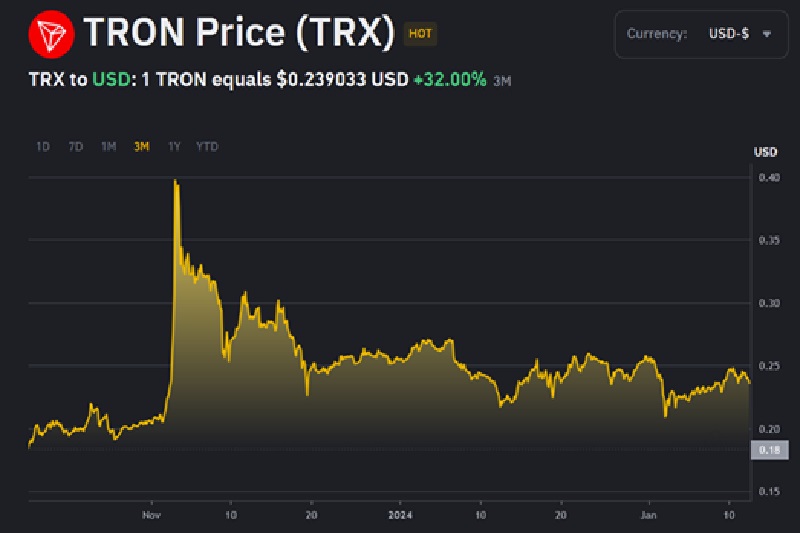
Many altcoins are taking center stage for the Millennial population as more liquidity enters the market. Take the Tron crypto token as an example. Binance explains that the Tron network “aims to decentralize content-sharing and establish a framework through which future Web3 platforms will operate.” Certainly, young tech mavens are the movers and the shakers in the fast-moving world of content sharing and Web3 applications which makes sense why it’s this population that is adopting coins like Tron. This massive adoption of TRX has contributed to the recent increase in price from $0.1603 on November 9th to its all time high of $0.3972 on December 3, 2024. As of today, February 13, 2025, Tron’s price is $0.2390 according to Binance.

This is where Millennials (and, in time, the teenagers and college students currently occupying Generation Z or the “Zoomer” generation) can spearhead the blockchain revolution. Tron isn’t a meme coin or a passing fad; it’s a prime example of a token with utility and purpose. There are 100 million users on the Tron blockchain – and although big banks might enter into the fold someday, young users with money to invest can get the train rolling and put high-potential digital currencies like Tron on the map.

The Future’s in Their Hands

A report by Cointelegraph found that nearly 29% of individuals under 43 years of age plan to invest in cryptocurrencies over the next year. Of course, this doesn’t mean 29% of them will actually buy crypto in the next 12 months.

Another study of 2,200 investors conducted by Charles Schwab concluded that a whopping 62% of Millennial investors plan to invest in cryptocurrency via ETFs. In this regard, Millennials easily surpass Generation X at 44% and Baby Boomer investors at just 15%. This is an indication that the Millennial generation is, perhaps more than other age demographics, ready and willing to put digital assets in their portfolios.

Crypto as “Virtual Real Estate”

Why are Millennials often eager to adopt these relatively new currencies, though? Sure, we can circle back to the idea of young participants being more open-minded and technologically savvy. What really cements Millennials’ role as leaders in crypto adoption, however, is the generational view of cryptocurrency as a better alternative to conventional means of wealth storage and preservation.

Governments can print as many fiat currency uits as they want, and publicly listed businesses can dilute their shares by creating more of them. In contrast, it’s written into Bitcoin’s code that there will ever only be 21 million Bitcoins.

Millennials, who witnessed the Great Recession and the accompanying financial crisis as children, don’t always trust traditional wealth accumulation and preservation avenues like their Baby Boomer parents did. Consequently, some Millennials are staking their claim to Bitcoin and other cryptocurrencies as “virtual real estate” with an inherently limited supply and, they believe, demand that’s bound to grow.

In other words, Millennials will spearhead cryptocurrency adoption through the remainder of the decade because they see the potential of newer, technology-fueled alternatives to older wealth-building avenues they view as outdated and unreliable. Hence, Millennials are willing to tolerate crypto’s price volatility in exchange for the hope of a better financial future – one in which decentralized digital tokens could be as normalized someday as traditional banking assets are today.