DD
MM
YYYY

PAGES

DD
MM
YYYY

spot_img

PAGES

Home Blog Page 22

Why Solana Chose WSOP for Its Latest High-Profile Sponsorship Deal

0

The sponsorship of the World Series of Poker by Solana marks convergence between digital asset infrastructure and a data-rich competitive gaming environment. The World Series of Poker, widely regarded as the premier global poker championship, is associated with risk management, probability, and high-stakes decision-making.

By aligning with this event, Solana positions itself as more than a blockchain network, but as a cultural participant in environments where capital allocation and psychological discipline intersect. This move reflects a broader trend of crypto networks seeking legitimacy through association with established competitive institutions.

Poker audience overlaps significantly with cryptocurrency users. Both communities are comfortable with volatility, asymmetric outcomes, and probabilistic reasoning under uncertainty. Sponsorship of the World Series of Poker allows Solana to embed itself within a demographic that understands leverage, drawdowns, and expected value calculations.

From a marketing perspective, this is less about traditional advertising and more about identity alignment.

Players and spectators are accustomed to rapid shifts in fortune, mirroring decentralized market dynamics. For Solana, the association reinforces its narrative as a high-performance blockchain optimized for speed and throughput, traits valued in both gaming and finance contexts.

The World Series of Poker has evolved from a niche gambling competition into a global televised intellectual sport. Its transformation has been driven by analytics, online platforms, and recognition of poker as a game of skill as much as chance. This evolution makes it a strategic sponsorship target for technology firms seeking cultural credibility.

By entering this space, Solana gains visibility among data-driven competitors and digital-native audiences who view poker as a laboratory for decision theory in practice. For Solana, the sponsorship highlights potential use cases beyond traditional finance.

High-speed settlement and low transaction costs make the network suitable for real-time gaming applications, including on-chain poker rooms, tokenized tournament chips, and NFT-based collectibles tied to player achievements.

Integration with the WSOP brand suggests a pathway toward hybrid digital-physical tournament ecosystems where payouts and registrations could eventually be mediated through blockchain rails. While such implementations remain speculative, the branding signals intent.

Solana is positioning itself at the intersection of entertainment infrastructure and decentralized finance, where latency and scalability are decisive advantages. However, the collaboration raises questions about regulatory perception.

Poker sits in a legally sensitive category in many jurisdictions, and cryptocurrency sponsorship introduces scrutiny regarding financial compliance and responsible gaming standards. Aligning a blockchain network with a gambling-associated event could attract policymakers concerned about consumer protection and market integrity.

At the same time, it reflects normalization: crypto infrastructure is increasingly embedded in mainstream entertainment sponsorships, from sports arenas to esports leagues. The partnership thus represents both opportunity and exposure, depending on regulatory interpretation.

Solana’s sponsorship of WSOP underscores maturation of crypto branding strategies. Rather than focusing solely on technical audiences, blockchain ecosystems are targeting cultural venues where risk and reward are central themes. WSOP provides a symbolic stage for these dynamics.

Solana embeds itself into a narrative of decision-making under uncertainty spanning poker tables and digital asset markets. Beyond branding, the partnership signals increasing convergence between decentralized finance infrastructure and entertainment economies.

As blockchain scalability improves, events like WSOP may experiment with tokenized rewards, real-time settlement, and digital identity layers, potentially redefining player engagement while expanding Solana’s footprint across mainstream competitive gaming ecosystems globally and future digital economies evolve

Solana DeFi Under Pressure After Raydium Pool Exploit

Meanwhile, a reported exploit affecting a legacy liquidity pool associated with Raydium has reignited debate over the long-tail risks embedded in decentralized finance infrastructure, particularly in older smart contracts that remain partially connected to modern liquidity routing systems.

The incident, estimated at roughly $1.3 million in losses, underscores how dormant or legacy components of DeFi protocols can become attack surfaces long after their initial deployment and perceived deprecation.

According to on-chain observations typical of such incidents, the exploit appears to have targeted a pool architecture that was no longer central to Raydium’s primary liquidity flow but still retained functional pathways within the broader ecosystem of Solana.

In DeFi systems, even partially deprecated pools can remain accessible through router contracts, integrations, or lingering token allowances. This creates a structural asymmetry: while user attention and developer focus move forward, historical code paths may still hold real value and exploitable logic.

The attacker’s strategy in cases like this generally involves manipulating pricing curves, exploiting imbalanced liquidity states, or leveraging flash liquidity to extract value from automated market maker invariants. Legacy pools are particularly vulnerable because they may not benefit from recent upgrades such as tighter slippage controls, oracle integrations.

Once the exploit is executed, funds are typically bridged or swapped across multiple assets to obfuscate traceability and reduce recovery probability. The reported $1.3 million loss, while not systemically destabilizing for Solana-based DeFi markets, is significant in signaling terms.

It highlights that abandoned but active smart contracts remain a persistent class of risk in DeFi architectures. Unlike traditional finance, where systems are routinely sunsetted and centrally decommissioned, decentralized protocols often retain backward compatibility for liquidity continuity. This design choice improves composability but expands the attack surface indefinitely.

From a protocol security standpoint, the incident reinforces the importance of continuous contract auditing and lifecycle management. In mature DeFi systems, legacy pools should ideally be migrated, frozen, or incentivized into migration campaigns that fully retire outdated logic. However, migration is not trivial.

Liquidity providers may resist movement due to fee structures, impermanent loss concerns, or simple inertia. As a result, outdated pools can remain economically active long after technical best practices would recommend deprecation.

For Raydium, the broader reputational challenge lies not in the absolute size of the exploit, but in its implication: that historical infrastructure remains monetizable by adversarial actors.

Even if newer liquidity pools are secure, the existence of exploitable legacy components can affect overall trust in the protocol’s risk posture. This is particularly relevant in competitive DeFi environments where liquidity is highly sensitive to perceived safety guarantees.

The incident also reflects a broader trend in DeFi security economics. Attackers are increasingly focusing on forgotten surface area rather than headline contracts. As major protocols improve defenses on flagship deployments, adjacent systems—staking derivatives, early liquidity pools, bridge-adjacent contracts—become more attractive targets.

These systems often lack the same level of monitoring intensity or bug bounty incentives. The $1.3 million exploit serves as a reminder that DeFi security is not a static achievement but a continuous maintenance problem. Protocols like Raydium operate in an environment where composability is both a strength and a liability.

As long as legacy pools remain active and capitalized, they will continue to represent latent risk. The challenge moving forward is not only to build more secure contracts, but to design robust mechanisms for retiring old ones without disrupting the liquidity ecosystems they helped create.
“Other Nations Are Quietly Stacking Bitcoin, America Should do it Out Loud” – Senator Cynthia Lummis Urges

0

U.S. Senator Cynthia Lummis has urged the United States to build a national Bitcoin reserve transparently and by law, contrasting it with what she describes as quiet accumulation by other nations.

In a post on X, she wrote,

“Other nations are accumulating Bitcoin quietly. We should be doing it loudly, on the record, by law”.

Her comments quickly drew a wave of reactions across X, reflecting deep divisions over Bitcoin’s role in national financial strategy.

Some users supported her call for broader adoption of digital assets but criticized what they saw as an overly narrow focus on Bitcoin alone, arguing that discussions should include a wider range of cryptocurrencies and blockchain technologies rather than concentrating on a single asset.

Others pushed back more strongly against the idea of a centralized U.S. Bitcoin reserve, suggesting that financial authority should rest more with individual states than with the federal government.

Notably, American entrepreneur Grant Cardone, responding to her comment, argued that while he respects her efforts, it may be unwise to brag or draw too much attention to the strategy before it is formally enacted into law.

In his view, openly signaling intentions could be a “dumb strategy” when operating within what he described as a long-established financial system.

He wrote,

“With all due respect and appreciation for your efforts,  perhaps pausing on how loudly we brag and lead with our chin (a very dumb strategy when trying to break into a 75-year-old cartel, perhaps we should get the law passed first”.

Lummis’s statement, reinforces her long-standing advocacy for the BITCOIN Act (Boosting Innovation, Technology, and Competitiveness through Optimized Investment Nationwide Act).

The legislation would direct the U.S. Treasury to purchase up to 1 million Bitcoin over five years, roughly 5% of Bitcoin’s total fixed supply of 21 million to establish a Strategic Bitcoin Reserve.

This reserve would function similarly to the United States’ gold holdings, serving as a store of value to strengthen the nation’s balance sheet, enhance financial security, and maintain competitiveness in the global digital asset landscape.

The bill also calls for secure, decentralized storage vaults managed by the Treasury, with strict requirements for physical and cybersecurity, as well as long-term holding mandates (typically at least 20 years).

Lummis has reintroduced versions of the BITCOIN Act in recent years, including in 2025 alongside House counterpart Rep. Nick Begich (R-AK).

The proposal aligns with broader efforts to codify pro-Bitcoin policies, including those supported by former President Trump, and aims to offset acquisition costs partly through Federal Reserve resources while ensuring transparent management of federal Bitcoin holdings.

Several analysts argue that treating Bitcoin as a strategic asset akin to digital gold is essential for economic sovereignty amid shifting global monetary dynamics. Critics, however, question the volatility of such holdings and the wisdom of large-scale government purchases.

Lummis, often regarded as one of Bitcoin’s strongest advocates in Congress and chair of the Senate Banking Subcommittee on Digital Assets, continues to push the narrative that America must lead rather than follow in the cryptocurrency space.

Her stance also echoes sentiments previously expressed by Donald Trump, who has argued that the United States should aim to lead in crypto and digital finance innovation to maintain its global economic dominance.

In May this year, Trump stressed the importance of the United States in maintaining its leadership position in the cryptocurrency sector, particularly in Bitcoin and other digital assets.

“It is a major industry, and we must protect it. Other countries are trying diligently to replace us in that capacity, but we won’t let that happen” Trump stated, underscoring his determination to prevent any foreign nation from displacing American leadership in the sector.

The remarks come as global competition in cryptocurrency intensifies. While the U.S. has historically been a hub for innovation and investment in blockchain technology, countries like Singapore, the United Arab Emirates, Switzerland, and several others have rolled out aggressive policies to attract crypto businesses, talent, and capital.

Outlook

The renewed push by Senator Cynthia Lummis for a U.S. Strategic Bitcoin Reserve reflects a broader shift in how digital assets are being framed in American policy circles—from speculative instruments to potential national strategic assets.

In the broader context, the alignment of pro-crypto political voices, including former President Donald Trump’s calls for U.S. leadership in digital assets, suggests that crypto policy could become a key competitive frontier in global finance over the coming decade.

Buy BlockDAG’s Legacy Sale at $0.00000044 & Sell at the $0.03 Buyback Price for Gains: While Worldcoin & Ethereum Traders Panic

0

Tracking the latest Worldcoin news and predicting the next structural move for the Ethereum price are standard procedures for investors searching for the next top crypto to buy. However, waiting on open-market momentum forces everyday traders to absorb localized volatility and unpredictable liquidation cascades. BlockDAG (BDAG) completely shifts this paradigm by introducing a promotional event centered around an immediate, built-in financial spread rather than public exchange speculation.

By taking advantage of the unique BlockDAG Legacy Sale arbitrage opportunity, market participants can sidestep open-market chaos entirely. The platform introduces a highly predictable profit framework, utilizing a closed-loop transaction mechanism directly on its user interface to guarantee immediate value realization for savvy capital allocators.

Analyzing the Bullish Momentum in Worldcoin News

Recent Worldcoin news highlights a strong technical recovery as WLD actively extends its gains, trading firmly above $0.50. This upward momentum is well-supported by key derivative metrics. According to CoinGlass data, futures open interest has surged past $449 million, indicating that substantial fresh capital is flowing into the market. This influx of capital, combined with a rebounding long-to-short ratio that has climbed back above 1.01, underscores a growing bullish sentiment among derivatives traders betting on continued price appreciation.

On the technical side, the Worldcoin news remains constructive as the token holds above a dense cluster of exponential moving averages (EMAs), with the 23.6% Fibonacci retracement level near $0.504 serving as immediate short-term support. While indicators like the daily RSI hover in a healthy growth zone around 63, warning signs from CryptoQuant point to heating retail activity and localized sell-side dominance, which could cap sudden upside extensions.

Whale Accumulation Stabilizes the Ethereum Price

The Ethereum price is exhibiting localized resilience, closing near its intraday session highs around $1,692.01. This steady push is technically supported by immediate hourly moving averages, with ETH successfully navigating above both its MA-20 ($1,684.50) and MA-50 ($1,660.11).

This short-term bullish structure is fundamentally driven by aggressive whale accumulation. Major institutional entities, including a massive purchase of 126,971 ETH by BitMine Immersion Technologies, aggressively absorbed the asset near the $1,600 support floor. This targeted buying helped shrink exchange reserves by roughly 475,000 ETH, reducing liquid float and amplifying scarcity.

Further stabilizing sentiment, core stakeholder Joseph Lubin clarified that a recent $170 million ETH movement was utilized purely for collateral, completely invalidating market fears of an impending foundation sell-off. While select oscillators suggest mildly overbought conditions, the prevailing lack of downside risk points toward healthy near-term consolidation for the Ethereum price.

Secure Profits with the BlockDAG Legacy Sale Arbitrage Opportunity

The standard difficulty in identifying a top crypto to buy revolves around the unpredictable nature of open market orders and public exchange liquidations. BlockDAG completely alters this conventional structure by introducing a promotional event centered on predictable, built-in financial spreads. By deploying a closed-loop transaction mechanism directly on its user interface, the platform provides a clear incentive for capital allocators looking for rapid portfolio growth.

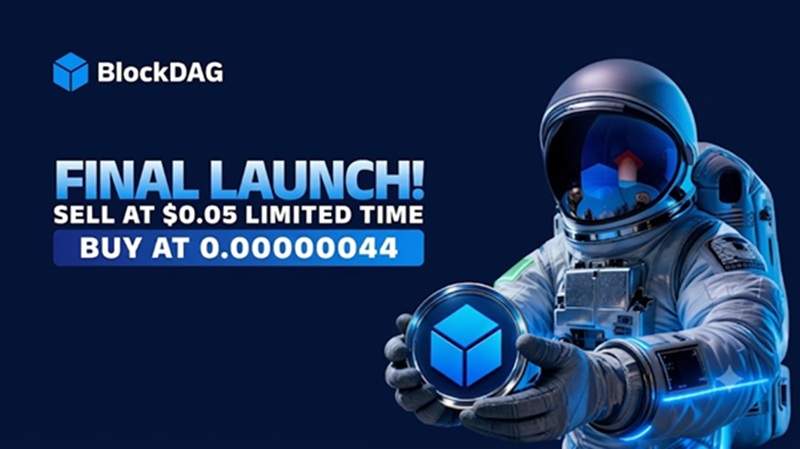
The method for securing profits is anchored to a direct arbitrage framework built into the current Legacy Sale. Throughout this specific promotional window, individuals can acquire BDAG tokens at a heavily reduced rate of $0.00000044. This baseline purchase price is completely uniform across the platform, applying identically to brand-new buyers and existing ecosystem holders who want to scale their positions within the Legacy Sale.

The mechanism for immediate value realization activates the moment those tokens are acquired through the platform’s live direct swap protocol. Rather than exposing assets to the standard delays, whale manipulations, or slipping prices of external trading desks, the native interface allows users to immediately flip their holdings back to the network at a guaranteed Buyback price of $0.03.

Executing this quick cycle, buying at the fractional cent entry rate during the Legacy Sale and redeeming assets on the premium internal track, lets participants extract substantial, mathematically predictable revenue. Because the system completely removes the traditional stress of trying to time the top of a volatile market, it provides an uncommonly clean blueprint for capital efficiency.

Choosing the Top Crypto to Buy Right Now

When weighing open-market volatility against guaranteed algorithmic pricing, clever capital allocators quickly realize which ecosystem presents the absolute top crypto to buy right now. While tracking the latest Worldcoin news offers an intriguing look into derivatives-driven momentum, and analyzing the consolidated Ethereum price reveals standard institutional stability, both legacy networks force retail investors to assume significant multi-tier market risks.

Conversely, the BlockDAG Legacy Sale arbitrage opportunity completely eliminates the stress of open-market timing. By securing an unprecedented entry floor of $0.00000044 and pairing it directly with an instant Buyback track value of $0.03, BlockDAG delivers an uncommonly stable, highly structured environment optimized for immediate portfolio scaling.

Legacy Sale: https://purchase.blockdag.network

Website: https://blockdag.network

Telegram: https://t.me/blockDAGnetworkOfficial

Discord: https://discord.gg/Q7BxghMVyu

Which Looks Like The Next Big Crypto in 2026? BlockDAG, Dogecoin, Ondo Coin, and Pepe In Focus

0

Short-term movement in crypto markets often shifts quickly, with prices reacting to sentiment, activity spikes, and ongoing market attention. Traders usually focus on assets that show strong liquidity, clear narratives, and active participation across exchanges. These factors often shape how fast price changes occur within short time frames.

This overview highlights four widely discussed assets: BlockDAG, Dogecoin, Ondo Coin, and Pepe Coin. Each one carries a different structure, ranging from meme-driven communities to systems linked with financial frameworks and emerging technologies. Market behavior around these assets changes rapidly, depending on updates, trading activity, and broader digital asset conditions.

Many observers often track what could become the next big crypto during such cycles, especially when volatility increases and attention shifts between different market stories across global trading environments in real time.

1. BlockDAG (BDAG): Over 1B Coins Sold Back Through Buyback

BlockDAG (BDAG) has reached a major milestone after crossing more than 1 billion coins sold back into the system through the buyback program in a short period. The rapid pace of activity has drawn strong attention from market participants who follow early-stage digital assets. The current Legacy Sale continues to attract interest as pricing remains positioned at a very low entry level of $0.00000044, allowing early participants to access the ecosystem before broader exposure increases demand.

The structure of the system includes a future reference point of $0.05 per coin, which is used within the platform dashboard for tracking potential outcomes. This setup allows registered participants to align holdings with that reference level through internal features designed for distribution management. A separate buyback structure also exists, operating at the same $0.05 level with controlled daily limits to maintain system balance.

The strong response to the sale has created steady momentum across the community, with attention growing as availability tightens. Many market watchers view BlockDAG (BDAG) as the next big crypto due to its fast adoption and structured distribution approach that supports ongoing engagement within the ecosystem.

Growing attention around the project reflects steady participation from new entrants who monitor price activity and system updates across multiple channels in real time daily. Overall interest continues to build as the ecosystem expands and more participants evaluate its structure during changing market conditions worldwide.

2. Dogecoin (DOGE): Meme Driven Liquidity With Endless Supply Pressure

Dogecoin remains one of the most recognized meme-based assets in the digital market. It gained attention through strong community support and repeated visibility on social platforms, often driven by public figures and viral trends. The asset frequently records sharp activity during periods of market excitement, making it a common focus for short-term price movement tracking.

Despite this visibility, its long-term direction depends heavily on sentiment cycles rather than functional use cases. The supply structure remains unlimited, which places pressure on sustained price strength during quiet phases. Even so, many market watchers still track Dogecoin as the next big crypto due to its consistent liquidity and strong public awareness across trading platforms. Activity levels often rise quickly during sudden market shifts across ecosystems.

3. Ondo Coin (ONDO): Real World Finance Meets Regulatory Uncertainty Risks

Ondo Coin connects traditional financial structures with decentralized finance systems by introducing tokenized real-world assets onto blockchain networks. This approach allows structured financial products to exist in a digital environment, which attracts attention from users looking for regulated style exposure within on-chain systems. The platform continues to roll out yield-focused strategies that maintain engagement across different market cycles.

However, its position also exposes it to regulatory uncertainty. Changes in policy around tokenized financial instruments could impact liquidity and slow down activity across trading venues. Even with these risks, market observers continue to track Ondo Coin as the next big crypto due to its strong focus on structured financial integration and expanding use cases in digital markets. Regulatory shifts may change momentum quickly.

4. Pepe Coin (PEPE): High Volatility Meme Cycles Fuel Price Swings

Pepe Coin operates as a highly volatile meme-driven asset on the Ethereum network. It often reacts strongly to broader market sentiment, with rapid price changes during periods of increased attention from traders and automated systems. Its deep presence across exchanges allows quick execution during active trading sessions, which attracts those monitoring fast movement opportunities.

However, the absence of functional use cases creates a high level of uncertainty. When interest fades, sharp declines can occur without warning. Despite this, some market participants still follow Pepe Coin as the next big crypto because of its strong volatility patterns and frequent activity during bullish phases in digital markets. Market conditions can shift quickly, leaving short-term movements highly unpredictable across multiple trading environments and platforms globally.

The Bottomline

Crypto markets continue to move in sharp cycles, where sentiment, liquidity, and timing often shape short-term outcomes. Each asset covered shows a different path, from community-driven momentum to structured financial frameworks and high volatility meme activity. These differences create varied reactions during changing market phases, especially when attention shifts quickly across digital assets.

BlockDAG stands out due to its strong early activity and structured buyback design, which continues to attract consistent interest. Meanwhile, Dogecoin, Ondo Coin, and Pepe Coin remain active in their own segments, each influenced by distinct market forces.

Overall, conditions remain dynamic, and participants often monitor these assets closely when searching for the next big crypto opportunity during fast-moving market environments and evolving digital trends across global trading spaces today.

Derek Simmons Made $31,000 on Hyperliquid, Now He Has Found the BlockDAG Arbitrage Offers Better Returns

0

Derek Simmons has spent twenty years in sales and has a professional instinct for reading deals quickly. The Charlotte-based regional sales director earns well, saves methodically, and allocates a portion of his portfolio to higher-risk opportunities, as long as the mechanics are honest. He discovered Hyperliquid in early 2025 after a colleague mentioned its approach to perpetuals trading, and what drew him in was not the Hyperliquid price but the architecture: an on-chain order book, up to 50x leverage, no gas fees, and cumulative volume exceeding a trillion dollars without venture capital backing.

He started with $8,000, traded BTC and ETH perpetuals for six months, and by mid-2025 had grown it to just under $39,000, a $31,000 gain built on disciplined exits rather than a single leveraged bet. The Hyperliquid price of HYPE had climbed from its November 2024 launch near $3.20 toward $35 by December 2024, and Derek held a small position there too. By June 2026 he was looking for structured returns without a screen. He found them in BlockDAG‘s Legacy Sale.

What Six Months on Hyperliquid Taught Him About Structured Returns

The lesson Derek took from twelve months on the platform was not about leverage ratios or funding rates. It was about the relationship between a structured product and a defined outcome. Hyperliquid trading worked for him because the rules were clear, the order book was on-chain, the liquidation mechanics were transparent, and the platform’s 97% fee reinvestment into its buyback fund created structural demand for HYPE throughout his trading period. The Hyperliquid price of HYPE itself eventually reached $59.37 in September 2025, delivering strong returns for holders who had bought near launch. Derek had enough exposure to benefit from that move while generating his primary returns through active perpetuals trading on the platform itself.

What perpetuals trading on Hyperliquid ultimately reinforced was a principle Derek had applied in sales his entire career: the best deals are the ones where both sides of the transaction are fully visible before anyone signs. Perpetuals trading on a transparent on-chain order book gave him that visibility on every trade he placed. By mid-2026, Derek was looking for a top crypto to buy that delivered defined returns without daily monitoring. BlockDAG’s Legacy Sale was the answer.

An Arbitrage Built for People Who Have Already Done the Active Trading

The BlockDAG Legacy Sale arbitrage is structured precisely for the kind of participant Derek had become by June 2026, someone who understood crypto well enough to recognise a clean programme when he read one. The entry is $0.00000044 per BDAG. The Buyback Programme rate is $0.05. The gap between those numbers is the return structure, published and accessible through direct dashboard registration with no transfer requirements and no cap on daily sell volume. Over 1 billion coins already submitted to the Buyback Programme told Derek the same thing a well-filled order book had always told him in his Hyperliquid trading days: liquidity and participation validate a programme more convincingly than any marketing document.

The BlockDAG ecosystem Derek found when he looked further gave him the infrastructure confirmation that made the top crypto to buy decision straightforward. A live Casino generating continuous on-chain BDAG demand through 25 payment options, including conventional cards alongside crypto, covering more than 30 sports through a live sportsbook with $5 million in projected daily volume. BDUSD, a native beta stablecoin on the BlockDAG mainnet, creates a collateral-demand loop for BDAG on every mint cycle. Miners are actively deploying. The network is scaling. For someone who spent a year on Hyperliquid watching how protocol-level demand mechanics sustain token value through real trading activity, the BlockDAG architecture is immediately recognisable as something built to generate sustained demand rather than speculative interest.

The Bottom Line

Derek Simmons made $31,000 through disciplined Hyperliquid trading in 2025, watched the Hyperliquid price of HYPE run from $3.20 at launch to $35 by year-end, and walked away from active perpetuals trading looking for the top crypto to buy with a structured return that did not require daily monitoring. BlockDAG’s Legacy Sale delivered, $0.00000044 entry, $0.05 Buyback Programme, over 1 billion coins already submitted validating the programme at scale, a live Casino generating real BDAG demand around the clock, and BDUSD creating collateral-driven buy pressure on the mainnet. For a sales director who has spent twenty years reading well-structured deals, this one closed itself.

Presale: https://purchase.blockdag.network

Website: https://blockdag.network

Telegram: https://t.me/blockDAGnetworkOfficial

Discord: https://discord.gg/Q7BxghMVyu