DD
MM
YYYY

PAGES

DD
MM
YYYY

spot_img

PAGES

Home Blog Page 2348

Dogecoin (DOGE) To Reach $10, Ripple (XRP) To Reach $15, And WallitIQ (WLTQ) To Climb 30,000% To $2.6

0

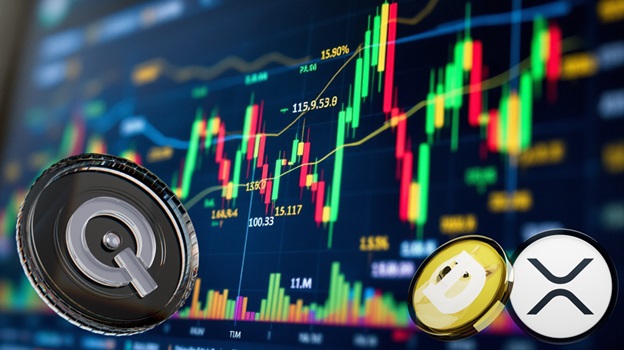
Crypto experts are known for their bold predictions that capture the attention of investors. Recently, these experts have set price targets for Dogecoin (DOGE) to reach $10, Ripple (XRP) to reach $15, and WallitIQ (WLTQ) to astronomically rise by 30,000% to reach a $2.60 price mark. 

WallitIQ (WLTQ): Potential 30,000% Surge Amongst Established Tokens 

WallitIQ (WLTQ) tops the list on every investor’s list with its ongoing bullish presale and $2.60 price target. Although WallitIQ (WLTQ) is a newcomer in the crypto market, both retail and institutional investors are adopting its decentralized wallet as it provides complete control over digital assets.

In comparison to Dogecoin (DOGE) and Ripple (XRP), WallitIQ’s (WLTQ) objective is to promote financial literacy and security for its users through the integration of AI solutions and machine learning algorithms. Most crypto experts are optimistic about WallitIQ’s (WLTQ) ability to rise by 30,000% above the $2 mark due to its significant positioning in the billion-dollar crypto wallet and AI market and the increasing demand for efficient crypto wallet solutions.

WalllitIQ’s (WLTQ) projected $10 million in monthly revenue, which has attracted a large number of investors to its presale. While early investors have already secured profits of up to 145%, those who chose to join the third stage of the presale will also enjoy several benefits, including governance participation, premium access, and profits of up to 200% from token price increases in the next stage of the presale.

Smart investors are rapidly joining the WallitIQ (WLTQ) platform, not only for its high growth potential but also for its profit-making blockchain activities like yield farming, trading of over 2,000 cryptocurrencies, and staking mechanisms that yield up to 180% annually.

Additionally, WallitIQ (WLTQ) has announced the MVP build of its Crypto Wallet Management Mobile App, which offers a variety of user-friendly features, including simulating crypto transfers for everyday purchases, such as coffee or media subscriptions, and real-time notifications for price alerts and wallet updates.

Furthermore, WallitIQ has undergone a smart contract audit carried out by SolidProof. To strengthen user confidence, WallitIQ (WLTQ) combines the advanced encryption standard (AES) and elliptic cryptographic curve (ECC) to protect its users’ transactions and personal information from fraudsters.

Dogecoin (DOGE): Consistent Performance With Potential To Reach $10

Dogecoin (DOGE) is among the cryptocurrencies that have been relatively consistent in the crypto market. Based on analysis from prominent crypto experts, Dogecoin (DOGE) might reach the $10 price mark if sporadic surges driven by celebrity endorsements and social media hype are present.

However, most experts are suggesting that DOGE might undergo a brief dip before any long-term increase. According to data from CoinGecko, the Dogecoin market cap is at $51.5 billion, with a daily trading volume of $3.7 billion. As of the time of this writing, Dogecoin (DOGE) is trading at a price of $0.3519.

Ripple (XRP): Speculation Surrounding A Potential Surge To $15

Following a remarkable 320% rally in November 2024, the recent price action has sparked speculation among analysts about the possibility of Ripple (XRP) reaching the $15 mark. Additionally, Javon Marks, a prominent crypto analyst, stated on X (formerly Twitter) that the next phase for Ripple (XRP) could move its price beyond the $15 target.

Currently, Ripple (XRP) support levels are around $2.55, showing potential zones where buyers might step in to prevent any further decline in the XRP price. On December 17, 2024, Ripple introduced RLUSD, a U.S. dollar-backed stablecoin meant to increase the ecosystem’s liquidity and create a reliable trading pair.

Based on data obtained from CoinGecko, Ripple (XRP) has a market cap of $147.2 billion with a daily trading volume of $7.7 billion. As of the time of this writing, XRP is trading at a price of $2.58, indicating a 9.7% increase in the last 24 hours.
Be Part Of The WallitIQ (WLTQ) Presale 

Currently, in the third stage of its presale, investors are rapidly buying WallitIQ (WLTQ) tokens at a low price of $0.0420 amid speculation from experts about a 30,000% surge to reach $2.60 immediately after its official launch.

With millions of tokens sold already and over $6 million raised in just a few weeks, the WallitIQ (WLTQ) presale might not go on for too long. As a smart investor looking to capitalize on its high growth potential and booming crypto-AI market, the best time to acquire WallitIQ (WLTQ) tokens would be now. Don’t miss out!


Join the WallitIQ (WLTQ) presale and community:
Join WallitIQ (WLTQ) Presale

Join the WallitIQ (WLTQ) Community 

Nigeria Joins BRICS as a Partner Country

0

Nigeria has officially joined BRICS as a partner country, marking a significant turn in its foreign policy and global economic strategy. The announcement, made on January 17, 2025, by Brazil’s Foreign Ministry, highlights Nigeria’s growing role in fostering South-South cooperation and advocating for reforms in global governance.

“In its capacity as the pro tempore presidency of BRICS, the Brazilian government announces today, January 17, 2025, the formal admission of Nigeria as a partner country of the grouping. The Brazilian government welcomes the Nigerian government’s decision,” the statement read.

This development elevates Nigeria to a prominent position within BRICS, originally an acronym for Brazil, Russia, India, China, and South Africa, a coalition of leading emerging economies. Nigeria joins eight other partner countries: Belarus, Bolivia, Cuba, Kazakhstan, Malaysia, Thailand, Uganda, and Uzbekistan. The partner-country category was created during the 16th BRICS Summit in Kazan in October 2024, reflecting the bloc’s strategy to expand its influence and cooperation.

BRICS has evolved into a formidable coalition aiming to reshape global economic and political power structures. Formed in 2009, the bloc has grown in stature, particularly as a counterweight to Western dominance, often characterized by U.S.-led sanctions and financial systems reliant on the dollar.

Following sanctions leveled on Russia over its invasion of Ukraine, BRICS has ramped up its efforts to stand up to what it perceives as Western overreach. The bloc’s leaders have been working on creating alternative payment systems to reduce reliance on the U.S. dollar, which they argue has been weaponized to control global financial flows. These measures aim to provide economic stability and reduce vulnerabilities for member nations.

Recent expansions, including the admission of Saudi Arabia, Iran, and the UAE in 2024, have signaled the bloc’s growing influence in energy markets and geopolitics. The group now accounts for approximately 37% of the world’s gross domestic product (GDP) and more than 40% of the global population, underlining its potential to challenge existing global power dynamics.

A Potential Tension with Trump

While the Biden administration has appeared largely indifferent to BRICS’ expansions, viewing the bloc as a loose coalition of developing nations, analysts predict a more confrontational stance under the upcoming Trump administration. President-elect Donald Trump has already threatened to impose 100% tariffs on BRICS nations should they take steps to undermine the dollar. This sets the stage for a possible faceoff between the U.S. and BRICS, as the bloc continues to explore alternatives to Western-dominated financial systems.

Trump’s return to office could intensify scrutiny of Nigeria’s decision to join BRICS, as Washington may perceive the move as aligning with nations challenging U.S. hegemony.

Nigeria’s Foreign Policy Shift from Non-Aligned Status?

Nigeria’s decision to join BRICS is seen by many as a departure from its traditional policy of non-alignment. Historically, Nigeria has sought to maintain balanced relations with global powers, avoiding overt alignment with blocs or coalitions that might polarize its diplomatic stance.

By joining BRICS, Nigeria risks being perceived as aligning with an anti-Western bloc, which could complicate its relations with Western allies. This decision also comes at a time when Nigeria is pursuing membership in other multilateral institutions, such as the G20 and the BRICS New Development Bank (NDB).

Bayo Onanuga, spokesperson for Nigeria’s presidency, highlighted the bloc’s growing importance, stating that BRICS has been a significant driver of global economic growth and a platform for addressing inequities in international governance. However, critics argue that Nigeria’s involvement could limit its flexibility in navigating global politics.

However, many believe that joining BRICS offers Nigeria significant economic and diplomatic opportunities. It is believed that as Africa’s largest economy and the world’s sixth-most populous nation, Nigeria is well-positioned to benefit from enhanced trade, investment, and collaboration with BRICS nations.

The partnership is also seen as a platform for Nigeria to amplify its voice on global issues such as financial governance, climate change, and equitable trade policies.

BRICS has increasingly positioned itself as a champion of the Global South, advocating for reforms in international organizations such as the United Nations and the World Bank. The bloc’s initiatives, including the development of an alternative reserve currency and payment systems independent of the dollar, aim to create a more balanced global financial system.

Analysts argue that these efforts resonate with countries like Nigeria, which face economic challenges exacerbated by the dominance of Western-led institutions. However, the bloc’s ability to implement these changes remains uncertain, particularly amid geopolitical tensions and internal differences among member states.

MTN Leads Nigeria’s Mobile Internet Market Amid Struggles in the Telecom Sector: nPerf Report

0

A report by nPerf, a French firm renowned for measuring global internet performance, has highlighted developments in Nigeria’s mobile internet landscape for 2024.

The analysis, which evaluated key performance indicators (KPIs) like download speed, upload speed, latency, and video streaming, underscores MTN’s continued dominance in the sector. However, the broader performance of the telecom sector remains overshadowed by Nigeria’s challenging economic environment and industry-wide struggles.

According to the nPerf Barometer, MTN excelled across all metrics, particularly in download speed, upload speed, latency, and video streaming quality.

“MTN leads the 4G focus area, showcasing significant advancements in upload speed and reinforcing its role as a trailblazer in Nigeria’s mobile technology sector,” the report noted.

As of October 2024, MTN held a commanding 51.09% share of Nigeria’s mobile market with 69.5 million internet subscriptions, according to data from the Nigerian Communications Commission (NCC).

Airtel and Globacom: Key Contributors

While not the overall leader, Airtel secured strong performance in browsing and video streaming, reflecting its commitment to enhancing user experience. The operator accounted for 34.61% of the mobile market with 45.7 million internet subscriptions.

Globacom, with a 12.15% market share and 17.1 million internet subscriptions, also showed steady improvement. The report highlighted Glo’s contributions to market competitiveness despite its smaller footprint.

The nPerf report notably excluded 9mobile, which holds a mere 2.15% market share and 2.1 million internet subscriptions. The operator’s limited presence reflects the intensifying competition and economic pressure within the industry.

Methodology of nPerf Analysis

The report’s findings were based on extensive testing conducted during busy hours (6 PM to 11 PM) and idle hours, ensuring a comprehensive understanding of network performance throughout the day. This approach accounts for fluctuations in user experience caused by network congestion.

Despite these individual achievements, the telecom sector’s overall performance is widely considered inadequate, primarily due to Nigeria’s harsh economic environment. Industry experts attribute this to several factors, including high operating costs related to energy, infrastructure maintenance, and importation of essential equipment, compounded by the removal of subsidies and fluctuating exchange rates. Additionally, inflation has driven up the cost of goods and services, significantly weakening consumers’ purchasing power and affecting demand for premium data services.

In response to these challenges, mobile network operators have been advocating for a 100% tariff review to reflect the rising costs of operations. Industry groups have argued that the current pricing model is no longer viable.

Recently, the Nigerian government agreed in principle, to allow about a 40% increase for the telcos.

What Lies Ahead for the Telecom Sector?

While MTN, Airtel, and Glo are making significant strides in network performance, the broader telecom sector faces mounting challenges.

Analysts have noted that without a tariff review or government intervention to alleviate operating costs, the sector’s financial viability remains uncertain. However, any tariff increase could further strain consumers, who are already grappling with high inflation and economic instability. The telecom sector’s struggles could have broader implications for Nigeria’s digital economy, a key pillar of the country’s development agenda.

While MTN’s dominance showcases the resilience of individual operators, stakeholders believe the industry as a whole requires urgent reforms to ensure sustainable growth and improved service delivery. The push for a tariff review, though controversial, may become inevitable if the sector is to weather Nigeria’s economic storm.

Crypto Crime in 2024 Increased by 21% year-on-year to $2.2 Billion – Report

0

The cryptocurrency crime landscape in 2024, saw a significant surge, with stolen funds increasing by approximately 21% year-on-year to $2.2 billion, according to a report by Chainalysis.

Funds stolen by hacking cryptocurrency platforms surged 21% from a year ago to $2.2 billion in 2024, a report from blockchain analysis firm Chainalysis showed on Thursday.
The hacking amount exceeded $1 billion for the fourth straight year and the number of incidents rose to 303 from 282 in 2023, it said. Hackers had stolen $1.8 billion in 2023.
The rise in crypto heists comes as bitcoin BTC= jumped 140% this year to surpass $100,000 mark, drawing institutional participation and backing from U.S. President-elect Donald Trump.

This surge highlights the growing sophistication of illicit activities targeting decentralized and centralized platforms, with new methods by bad actors reshaping the space.

Decentralized finance (DeFi) services bore the brunt of crypto theft in 2024, emerging as the most targeted during Q2 and Q3. The most significant vulnerability stemmed from private key compromises, which accounted for 43.8% of all stolen funds. North Korean hackers took center stage, stealing a record $1.34 billion – 61% of the year’s total. This unprecedented surge is partly linked to North Korean IT operatives infiltrating crypto and web3 companies, employing sophisticated tactics to compromise networks.

Fraud and scams remained prolific, with high-yield investment schemes and “pig butchering” scams standing out as the most lucrative. The increasing use of artificial intelligence (Al) in cybercrime has been a notable trend, enabling highly personalized scams like extortion attacks and tools to bypass know-your-customer (KYC) requirements. Al’s role in crypto crime reflects broader trends in cybercriminal tactics, further complicating efforts to combat such activities.

Additionally, fraud operators are leveraging guarantee services such as Huione Guarantee to process illicit transactions. Meanwhile, crypto ATM scams, particularly targeting the elderly, have become an emerging concern, showcasing the diverse range of fraud tactics at play. Ransomware remained a major source of criminal revenue, generating hundreds of millions of dollars. However, coordinated international law enforcement operations and reduced victim willingness to pay ransoms have disrupted the ecosystem. While some ransomware groups continue to operate, their profits are declining due to decreased ransom amounts.

Transnational organized crime groups have increasingly leveraged cryptocurrency for a range of illegal activities, including drug trafficking, gambling, intellectual property theft, money laundering, human and wildlife trafficking, and violent crime. The rise of “polycrime,” where criminal networks engage in multiple types, is a defining trend. Of the $40.9 billion received by illicit crypto addresses in 2024, $10.8 billion went to wallets directly involved in or facilitating cybercrime.

As crypto crime continues to evolve, the ecosystem’s growing sophistication and scale present significant challenges for law enforcement and regulatory bodies. The interplay of high-tech innovations and professionalized platforms highlights the urgent need for global collaboration to address these threats.

Effective measures, such as advanced fraud detection, Al-based defenses, and regulatory oversight, will be critical in mitigating the impact of crypto crime in the years to come.

Why the Trump Pro-Bitcoin movement may evaporate

0

As January 20 approaches, I have this anxious feeling, and a deep empty feeling in my gut.

There are some times I predict things will happen, and I absolutely do not want to be right. The only problem with this, is when my sixth sense kicks in, I am almost always right. It is like fighting against fate.

This time, it is about Donald Trumps Pro-Bitcoin campaign promises. As the 2024 US General Election heated up, both leading candidates started out crypto-sceptic, both realized this would lose votes, and both changed stance.

The Trump narrative however, seemed to be more vocal about investor freedom, while the electorate perception of the Harris narrative, was that it would come with heavy controls and regulation.

I’m not saying Bitcoin decided an election, but it was a weapon used differently in two armouries.

One of the things about Donald Trump, is that, even when lacking information, he’s always taken the position of never say nothing. Say things first. Be vocal. Control the dialogue narrative at all costs, and if it turns out to be wrong, try to fix it later.

We’ve had comments about stealth fighters being unable to be seen by someone, even if standing next to it; we’ve had airports taken over by the revolutionary army in the war of independence; we’ve had a suggestion of disinfectant injections to cure COVID, and most recently, we’ve had the concept of Canadian water solving Californian wildfires, because it flows downhill.

He speaks to control the narrative first and foremost, then later he thinks about things a bit, and changes tack. A lot of the time, they are momentary things that will blow over.

Bitcoin isn’t blowing anywhere.

Donald wants to have heavy involvement in the industry, and perhaps, even more control than the Dems would have wanted, but moreover, he wants control over value systems in ways that replace the dollar as a US based, rather than a global ecosystem.

At the Bitcoin conference – (why I’m here today) … ‘can be summed up in two very simple words – America First’

At some point, when Trump has begun the analysis, and got expert advice, to replace initial rhetoric with cold hard facts, he has realized, he can’t control Bitcoin.

You can’t even find the guy that invented it, and its a public blockchain (available to everybody, owned by nobody). There is no MAGA slant here.

When he’s in the White House, he can’t pick up the phone and say… ‘Hey, Satoshi, yah know, I don’t really like the way this works… can we just have our own mint here.. and we mint 80% of it, and just leave 20% for the rest of the world? Can we make up some sort of reserve accounts? I have a problem with this US Bond thing… we need to fix this. How can we fix it?

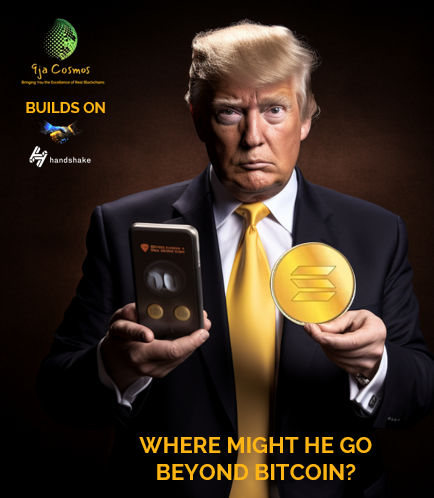
Will he desert crypto? Heck no! He’s all in! But Bitcoin? That’s another story. Trump will deflect, but keep going. Where is he likely to go?

Here are my 4 big picks:-

Solana

Trump has Launched $TRUMP on Solana pushing up the price of its ecosystem coin SOL.   The SOL team are easily accessible and very flexible on business arrangements, the type of people Donald Trump would want to deal with, not some elusive Lord Lucan type Satoshi Nakamoto.

The Consensys Ecosystem 

Consensys is a blockchain software company based in Forth Worth, Texas, and its anchored in JP Morgan, Microsoft and Coinbase. Jamie Dimon labels Bitcoin a ponzi scheme, while Microsoft board, out of step with its peers, dismissed the idea of holding a Bitcoin Reserve.

Consensys products include Infura, Linea, Dilligence, with links to Truffle and Polygon. Polygon is home to the minting of Donald Trumps’ ‘America First Edition’ Digital Trading Cards

Of the most well known is MetaMask, the wallet with which 9ja Cosmos have a snap in to use our .det0x names as public key proxies.

Consensys had a showdown with the SEC, and Donald Trump committed to removing Gary Gensler on the campaign trail.

Dogecoin

Dogecoin has long been associated with Elon Musk who has now got very strong ties with Donald Trump. It’s gone as far as Donald Trump calling an advisory board DOGE, involving Elon Musk and Vivek Ramaswamy.  $DOGE is the coin of the Dogecoin blockchain.

The blockchain has an inscription technology, which is underused. It involves the creation of blockchain tokens through inscribing on ‘shibes’, the sub-unit of DOGE. They are called ‘Doginals’ and are technologically identical to Ordinals on Bitcoin, but cheaper to do.

9ja Cosmos has severally published interest in replacing smart contract technology with inscription technology, with interest in Doginals, and in an inscription solution on the Handshake Blockchain involving the sub-unit of HNS – ‘dollarydoos’.

Pantera Capital

Pantera Capital is probably the most experienced institutional type investor in making blockchain technologies and cryptographic architectures happen – long before Blackrock. Pantera launched the first cryptocurrency fund in the U.S. in 2013.

Pantera have been behind Arbitrum, Bitstamp, Brave Browser, Coinbase, Filecoin, NEAR, Polkadot and Ripple.

They also put the funding behind Handshake, the Bitcoin blockchain copy, which 9ja Cosmos uses as the secure decentralized backend to .det0x names, and .9jacom which is staked with EnCirca.

Will we see an asymmetrical move post between Bitcoin and other cryptocurrency post 20 January? That’s the trillion dollar question which can’t be fixed by a replacement for US Bonds.

But for sure, Donald Trump will be in power for 4 years. Bitcoin will be here forever.

9ja Cosmos is here…

.9jacom Domains

.det0x Domains

Preview our Sino Amazon/Sinosignia releases (Ente)

Visit 9ja Cosmos LinkedIn Page

Visit 9ja Cosmos Website

Follow 9ja Cosmos on X