DD
MM
YYYY

PAGES

DD
MM
YYYY

spot_img

PAGES

Home Blog Page 2432

How Interest Calculators Ensure Financial Planning

0

It doesn’t matter whether you are a business owner, a full-time employee, or a student; you can immensely benefit from interest calculators for effective financial planning. Interest calculations allow you to effectively understand the cost of borrowing money and the potential return on your investments. Thus, you will be able to make rather informed decisions regarding savings, loans, and possible investments based on the calculated interest that you earn over time. 

Read on to learn more about how interest calculators can ensure financial planning.  

How Do Interest Calculators Work?

If you are new to the concept of interest calculators, you might be wondering about how these calculators work. You might want to take the interest calculator as a digital tool that you can use to assess the interest of a sum that you can earn over a specific period. You might have borrowed money, and this tool will help you calculate the interest that you will have to pay for the borrowed amount. 

Check out this SoFi compound interest calculator as a way to estimate the amount of money that you can grow over a specific period while considering the interest that you can earn on top of your investment. Thus, you can leverage the tool to plan for your future finances and compare your future investments. 

How Can Interest Calculators Help with Planning Your Finances 

Here is how interest calculators can help you plan your finances. 

Leverage Quick and Accurate Calculations

An interest calculator can eliminate human errors while making quick and accurate calculations. Understandably, calculating finances can be complex and time-consuming as these involve various formulas, variables, and other considerations. Interest calculators can provide quick and accurate results with a few inputs. 

Analyze Scenarios for Detailed Financial Planning

With the help of interest calculators, you can assess various scenarios that will allow you to do thorough financial planning. You will be able to include various factors in your financial planning, such as retirement planning, present savings, future savings, and so much more. You can also leverage this tool to assess the purchase cost of various financial projects. Thus, you can make informed judgments about your finances and establish a solid financial strategy by assessing various scenarios. 

Effectively Manage Debt and Budgeting

Interest calculators can help with the careful planning of your debt and budgeting, which are two important aspects of managing your personal finances. These are the two areas where an interest calculator can come in handy, as you can get useful insights into cash flow, saving objectives, and your debt payback plans. With the help of this tool, you can establish the best payment plans and assess how long it will take to pay off your potential debt. 

Analyze Your Loans and Mortgages 

Interest calculators can help you assess your mortgages and loans. You might want to leverage these tools to calculate your monthly payments while evaluating the potential effect of interest rates on your monthly payments. Using the calculator, you can compare your various loan terms and assess the loan amount, loan term, and interest rate to assess the affordability of your loans and mortgages. 

Empowering the Next Generation: How the Breakthrough Junior Challenge Fuels Young Scientists

0

In an era where scientific literacy has never been more crucial, Yuri Milner’s Breakthrough Junior Challenge stands as a powerful model for inspiring and empowering the next generation of scientific innovators. This competition does more than just reward scientific knowledge—it creates a comprehensive ecosystem for nurturing young talent and spreading scientific understanding globally.

A Multi-Layered Approach to Scientific Development

The genius of the Breakthrough Junior Challenge lies in its multifaceted approach to youth empowerment. Unlike traditional science competitions that focus solely on knowledge retention, this initiative challenges participants to deeply understand complex concepts and then communicate them effectively to others. This dual requirement develops both scientific comprehension and essential communication skills.

Creating Ripples of Impact

The competition’s prize structure demonstrates a profound understanding of what it takes to nurture scientific talent. The $250,000 college scholarship empowers individual winners to pursue higher education without financial constraints, as evidenced by past winners like Samay Godika, who went on to study at MIT. His sister Sia’s subsequent win and plans to study computer science and biology show how this support can inspire entire families to pursue scientific excellence.

But the impact extends far beyond individual winners. The $100,000 awarded for a new school science lab creates lasting infrastructure that benefits entire communities of future students. Meanwhile, the $50,000 teacher prize acknowledges the crucial role of mentorship in scientific development, encouraging educators to continue inspiring young minds.

Peer Learning and Community Engagement

The competition’s structure brilliantly incorporates multiple levels of engagement and learning:

Peer-to-Peer Review

The initial judging phase requires participants to review and score other entries, creating a valuable learning experience where students gain exposure to different scientific topics and communication styles. This peer review process helps develop critical thinking and evaluation skills essential for scientific careers.

Public Engagement

The Popular Vote phase, which reached over 500,000 people in 2024, transforms scientific communication into a public conversation. When students see their videos gaining thousands of reactions—like Lehnaaz Rana’s popular explanation of OHP cancer treatment—it validates their ability to make complex science accessible and engaging.

Global Community

With participation from over 200 countries and nearly 30,000 video submissions in 2024 alone, the competition creates a truly global community of young scientists. Regional Champions from diverse areas—from the United Arab Emirates to Panama, the UK to New Zealand—demonstrate how scientific passion transcends geographical boundaries.

Beyond Competition: Building Scientific Identity

The Breakthrough Junior Challenge, aligned with the vision Yuri Milner outlines in his Eureka Manifesto, helps young people see themselves as part of the scientific community. This identity formation is crucial for sustaining long-term engagement with science. When teenagers like Alessandra Storm Mauricio create superhero-themed animations about antibody drug conjugates, or Jasmine Eyal explains mechanogenetic cellular engineering, they’re not just sharing knowledge—they’re claiming their place in the scientific world.

A Comprehensive Support System

As a signature initiative of the Milners’ commitment to the Giving Pledge, the competition complements other transformative projects like the Breakthrough Prize, which celebrates established scientists, and the Breakthrough Initiatives, which push the boundaries of space exploration. This creates a complete pipeline of support from youth education through professional achievement.

The competition’s approach to technological innovation mirrors that of Tech for Refugees, demonstrating how creative solutions can address global challenges. By encouraging young people to tackle complex scientific concepts, we prepare them to address future humanitarian and scientific challenges.

Measurable Impact and Future Potential

The competition’s success is evident in its outcomes:

  • Thousands of educational videos created annually
  • Hundreds of thousands reached through social media
  • Multiple winners pursuing advanced scientific education
  • New science labs established in schools worldwide
  • Inspired educators receiving recognition and support

A Model for Scientific Empowerment

The Breakthrough Junior Challenge offers valuable lessons for how we can effectively nurture scientific talent:

  1. Combine individual achievement with community impact
  2. Integrate peer learning with expert evaluation
  3. Value both scientific understanding and communication skills
  4. Create global connections while supporting local development
  5. Recognize and support the entire educational ecosystem

Looking Forward

As we face increasingly complex global challenges, programs that empower young scientists become ever more crucial. The Breakthrough Junior Challenge’s model of combining rigorous scientific understanding with creative communication, peer learning with expert guidance, and individual achievement with community impact provides a blueprint for developing the scientific leaders of tomorrow.

By investing in young scientific talent today, we create ripple effects that will influence scientific progress for generations to come. Through competitions like this, we’re not just identifying future scientists—we’re actively shaping them, supporting them, and empowering them to tackle humanity’s greatest challenges.

Future of Chinese Great Firewall and the Internet

0
A woman looks at a NFT by Mad Dog Jones titled "SHIFT//" during a media preview on June 4, 2021, at Sotheby's for the Natively Digital: A Curated NFT Sale Online Auction to take place June 10, 2021. - They are technology enthusiasts on the hunt for opportunities in the Wild West market surrounding NFTs: the popular certified digital objects that have spawned a new generation of collectors convinced of their huge potential. (Photo by TIMOTHY A. CLARY / AFP) / RESTRICTED TO EDITORIAL USE - MANDATORY MENTION OF THE ARTIST UPON PUBLICATION - TO ILLUSTRATE THE EVENT AS SPECIFIED IN THE CAPTION

The Great Firewall evolves like a living organism, adapting to new tech, user behavior, and political priorities. It’s not static—China’s engineers and policymakers tweak it constantly to keep it effective.

Here’s how it grows and shifts:

First, it tracks emerging threats. When a new platform or tool—like a shiny VPN or an encrypted messaging app—starts gaining traction, the system tests ways to detect and block it. For example, back in the early 2010s, VPNs were a decent workaround, but by 2017-2018, the Firewall got smarter, using machine learning to spot VPN traffic patterns and shut them down faster. Same goes for Tor or other anonymity networks—China’s techies reverse-engineer these tools and plug the holes.

Second, it scales with hardware and software upgrades. As internet speeds climb and data volumes explode (hello, 5G), the Firewall leans on beefier servers, better algorithms, and real-time analytics. Deep packet inspection, which used to be clunky, now sifts through encrypted traffic at lightning speed, guessing content even when it can’t crack the code outright. AI plays a big role here, flagging suspicious activity without humans needing to babysit every packet.

Third, it reacts to political heat. During sensitive times—like the Communist Party Congress or anniversaries of touchy events (June 4th, anyone?)—the screws tighten. Entire swaths of the web go dark, keywords get blacklisted, and domestic platforms like Weibo crank up their own censorship to stay in line. After the heat dies down, it might loosen a bit, letting some air back in.

Fourth, it learns from users. Chinese netizens are crafty—think coded language, memes, or proxy tricks to dodge filters. The Firewall watches, catalogs these moves, and updates its playbook. A slang term for dissent might work for a week before it’s sniffed out and banned. It’s a cat-and-mouse game, but the cat’s got a bigger budget.

Finally, it’s shaped by global pushback and ambition. As Western governments and tech firms complain (or try countermeasures), China doubles down, refining its export model—think Belt and Road countries adopting Firewall-style systems. At the same time, it’s polishing its own internet vision: less reliance on outsider tech, more homegrown control.

Comparing the Great Firewall to North Korea’s internet control is like pitting a sophisticated filter against a near-total blackout. Both aim to choke the flow of outside info, but they’re built for different realities—China’s got a massive, wired-up population to manage, while North Korea’s running a smaller, isolated cage.

China’s Great Firewall is a dynamic beast. It blocks huge chunks of the global web—Google, Wikipedia, Western social media—but still lets a curated internet thrive inside its borders. Over 1 billion users are online, using apps like WeChat or Baidu, all under heavy surveillance and censorship. It’s selective: you can browse, shop, and chat, but step into forbidden zones (say, “Tiananmen 1989” or “Free Tibet”), and you hit a wall.

The system’s flexible—VPNs might work until they don’t, and it scales up during political flare-ups. It’s less about cutting the cord entirely and more about steering a giant, tech-savvy populace into a state-approved digital pen. It’s a relentless cycle—tech advances, users adapt, politics shift, and the Firewall morphs to keep its grip. Wild to think how it’s not just a tool but a whole philosophy in code, right? What part of this evolution stands out to you?

President Trump Announces a 25% Tariff on European Union

0

President Donald Trump has recently escalated his trade policy by imposing or threatening tariffs on the European Union, following actions against Canada, Mexico, and China. He has announced a 25% tariff on steel and aluminum imports from all countries, including the EU, reversing previous exemptions.

Additionally, Trump has vowed to impose broader “reciprocal tariffs” on EU goods, arguing that the EU has long taken advantage of the U.S. through unfair trade practices, such as its $235.6 billion goods trade deficit with the U.S. in 2024. He’s specifically criticized the EU’s 10% tariff on U.S. cars (versus the U.S.’s 2.5% on EU cars) and its reluctance to import more American farm products and vehicles.

The EU, led by figures like Ursula von der Leyen and Emmanuel Macron, has promised a “firm and proportionate” response, signaling potential countermeasures like those seen in 2018—targeting U.S. exports such as bourbon, motorcycles, and jeans. Germany, a major steel exporter, and Ireland, heavily reliant on U.S. trade, could be hit hard, though the UK’s post-Brexit status might spare it from the worst, with Trump hinting at a possible deal with PM Keir Starmer.

Economists warn that these tariffs could raise U.S. consumer prices, stoke inflation, and slow global growth—potentially shaving 0.5-0.9% off EU GDP if a 10% across-the-board tariff sticks. The EU is bracing for a trade war but hopes to negotiate, perhaps by boosting U.S. energy imports or coordinating on China’s steel overproduction. Still, Trump’s unpredictable approach keeps the situation tense.

The European Union is gearing up for a strategic response to Trump’s tariffs, drawing from past experience and current economic realities as of February 26, 2025.

Here’s how they’re likely to counter:

First, the EU is preparing targeted retaliatory tariffs, a playbook they’ve used before. In 2018, when Trump hit EU steel and aluminum with tariffs, the EU fired back with duties on $3.2 billion worth of U.S. goods—think Harley-Davidson motorcycles, Levi’s jeans, and Kentucky bourbon. This time, they’re eyeing a broader list, potentially hitting U.S. exports like agricultural products (soybeans, corn), tech goods, and energy exports (LNG). The goal? Painful enough to sway U.S. business lobbies and voters in key states, but “proportionate” to avoid all-out escalation.

Second, they’re exploring negotiation leverage. The EU could dangle increased purchases of U.S. liquefied natural gas—already up since Russia’s Ukraine invasion cut European energy options—or offer to align more closely on curbing China’s steel dumping, a shared gripe. Macron and von der Leyen have signaled openness to talks, hoping to trade concessions for tariff relief. They might also push a “Buy European” campaign to shift reliance away from U.S. imports, though that’s slower to bite.

Third, the EU’s flexing its regulatory muscle. They could tighten scrutiny on U.S. tech giants—think Google, Apple, or Amazon—with antitrust fines or data rules under the Digital Markets Act, indirectly pressuring Trump’s base. There’s also talk of carbon border taxes hitting U.S. goods if America doesn’t play ball on climate goals, though that’s riskier given global backlash potential.

Internally, the EU’s shoring up its own. Subsidies for steelmakers like Germany’s Salzgitter AG or France’s ArcelorMittal could blunt tariff damage, while trade deals with Asia or Latin America might offset U.S. market losses. Ireland, exposed with 13% of its exports to the U.S., might push for EU-wide relief funds

Germany wants to protect its car exports, France its farmers, and smaller nations fear collateral damage. Economists peg a 10% U.S. tariff costing the EU up to 0.9% GDP, so the bloc’s weighing pain versus principle. Expect a mix of retaliation and olive branches, calibrated to Trump’s next move.

Polkadot vs. Dogecoin vs. This New Presale—Which Will Explode In March?

0

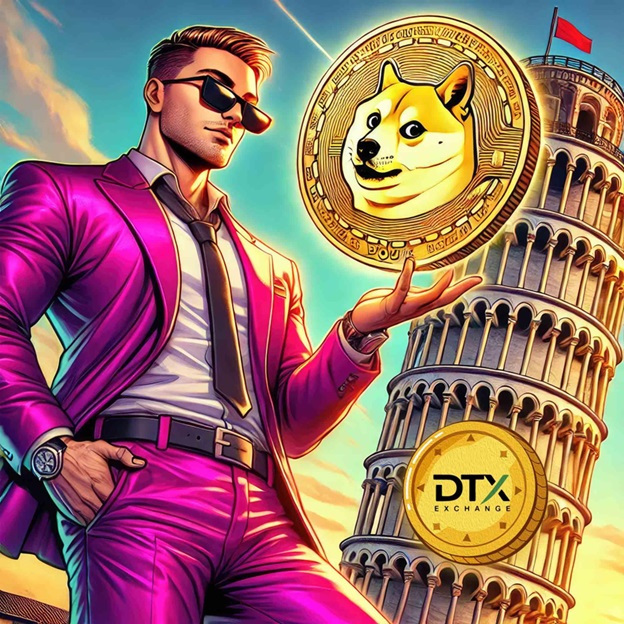
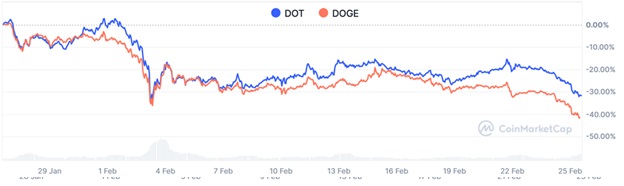
With the current bearish market, seasoned players like Polkadot (DOT) and Dogecoin (DOGE) are facing market volatility and competition from new contenders. As March approaches, investors are skeptical that established tokens will rally, with Polkadot’s market cap down to $6.9 billion and Dogecoin down 40% this month. Meanwhile, the ongoing DTX Exchange token presale has already raised $15.1 million, positioning it as a fresh option for March’s market shifts.

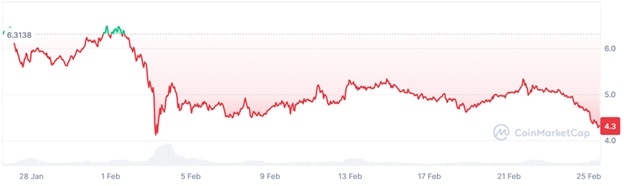
Polkadot Drops to $4.3 as Market Cap Shrinks to $6.8B

Polkadot (DOT) has encountered major difficulties this month, suffering a considerable drop of 30%, which has reduced its present price to $4.3. This reduction has led to an overall market cap of around $6.8 billion. The decline in value suggests a decrease in investor interest, especially as network activity has exhibited signs of a slowdown in recent weeks. In just the past week, DOT has experienced another drop of 7%, which has led to its poor performance compared to rival cryptocurrencies like Ethereum.

Source: Polkadot Price, Monthly Chart, CoinMarketCap

Technical charts suggest buyers remain cautious, with key indicators signaling oversold conditions. While some hope for a rebound, few clear triggers exist to drive growth. Critics note that the Polkadot (DOT) ecosystem has stalled compared to last year, failing to reignite excitement.

Investors are diverting funds to newer hybrid platform projects like DTX Exchange which could offer practical features. One trader tweeted: “Polkadot’s tech infrastructure is good, but it’s losing attention to presale projects with clearer goals.” The 40% Polkadot (DOT) drop so far this month, highlights this trend.

DTX Set to Explode in March From $0.18 to $0.36

As older coins like Polkadot (DOT) struggle, the DTX Exchange token presale is gaining traction. Priced at $0.18, it has raised $15.1 million from 700,000 buyers, making it a top crypto to buy before its mid-2025 launch. Early buyers could double their money at the $0.36 listing price, with experts predicting further growth.

The platform could combine crypto and traditional markets, allowing trading of stocks, forex, and 120,000+ high-leverage assets. Unlike Polkadot (DOT) or Dogecoin, it could focus on real-world tools like copying expert traders and advanced charts. Regular security checks and limited token supply could also strengthen its appeal.

A Reddit user noted: “Projects with this much early interest often surge after launch. DTX solves problems for multi-asset traders.” With nearly a quarter of its current sale stage sold, time is running out to buy at presale prices. Additionally, Edward Dowd, another market expert, shared: “The DTX Exchange’s strong presale numbers hint at big investor interest. Hybrid platforms like this could lead 2025’s market growth.”

Dogecoin Slips to $0.21 Due to 40% Monthly Decline – Will it Recover In March?

DOGE has fallen significantly this month, dropping 40% to around $0.21, which has reduced its market capitalization to about $30 billion. The value of this meme coin increasingly hinges on the influence of Elon Musk’s tweets as its usage declines. Additionally, regulatory bodies are reviewing a proposed Dogecoin investment fund, while negative technical signals indicate a bearish trend for potential investors.

Source: Polkadot Vs. Dogecoin Price Comparison, CoinMarketCap

Data shows fewer active DOGE users and reduced large transactions. Still, most holders polled online expect a rebound, hoping Tesla might accept DOGE payments. Predictions vary wildly—some see DOGE hitting $1.19 by the end of March, while others warn it could drop below $0.20. An influencer remarked: “DOGE had its fun, but traders now want real infrastructure, not just spoofs.” March may solidify DTX’s rise while DOGE fights to stay relevant.

Conclusion

Polkadot (DOT) and Dogecoin are facing tough market projections, but DTX Exchange’s hybrid platform—with its $15.1 million presale and diverse trading options—could offer a fresh path. As March approaches, traders are leaning toward projects mixing blockchain transparency with professional tools. For those eyeing new opportunities, DTX’s presale provides early access before its launch.

Check out the links below to learn more.

DTX Website

Buy Presale

Join Telegram Community