DD
MM
YYYY

PAGES

DD
MM
YYYY

spot_img

PAGES

Home Blog Page 2573

African Union to Launch Credit Rating Agency in H1 2025 to Counter “Bias” from Global Firms

0

The African Union (AU) is preparing to launch a continental credit rating agency in the second half of 2025 to address concerns that international credit rating firms unfairly disadvantage African nations.

The move, which was revealed in a report by the African Peer Review Mechanism (APRM) on February 11, is expected to challenge what many African leaders describe as arbitrary and biased assessments by dominant global rating agencies.

The APRM, which evaluates governance across AU member states and implements the New Partnership for Africa’s Development (NEPAD), has framed the creation of this new agency as a crucial step in reclaiming Africa’s financial autonomy. The report emphasized that the African rating agency would provide a more accurate and fair evaluation of sovereign credit risk, better reflecting the unique economic circumstances of African nations.

For decades, African governments and financial experts have criticized the methodologies employed by Moody’s, Fitch, and S&P Global Ratings, arguing that they consistently undervalue African economies. These agencies’ ratings determine the interest rates at which countries can borrow money and, in many cases, have led to excessively high borrowing costs for African nations.

The push for an African alternative gained significant traction in 2022 when Macky Sall, then-chair of the AU and president of Senegal, called for a new credit rating model to counter what he described as systemic financial injustices against African economies. Sall highlighted that in 2020, when economies across the world were reeling from the effects of the COVID-19 pandemic, African nations were disproportionately penalized.

“In 2020, when economies worldwide were struggling with the effects of COVID-19, 18 out of the 32 African countries rated by at least one of the major agencies saw their ratings downgraded. That’s 56% of African ratings being cut, compared to a global average of just 31% during the same period,” he said at the time.

It is believed that the assessment criteria used by these rating agencies incorporate subjective, non-economic factors, such as political stability, language, and governance models, which often result in negative outlooks for African nations. Research has suggested that up to 20% of the rating components assigned to African countries are based on factors unrelated to economic fundamentals. These assessments, critics say, artificially inflate borrowing costs, discourage foreign investment, and weaken African nations’ ability to finance key infrastructure and development projects.

The United Nations Development Program (UNDP) reinforced these concerns in an April 2023 report, which estimated that African countries had collectively lost out on $74 billion in potential financing due to unfair credit rating methodologies. The report found that the Big Three agencies rely on algorithms designed for traditional Western macroeconomic models, which often fail to capture the unique characteristics of African markets. The UNDP report also highlighted that credit analysts frequently base their assessments on prevailing investor sentiment rather than conducting deeper, localized analyses of economic conditions in African nations.

The upcoming African credit rating agency is being designed to function independently of political influence, with leadership drawn from the private sector. The AU has emphasized that credibility and transparency will be key to ensuring that the agency is widely accepted both within the continent and on the global stage.

According to the Africa Sovereign Credit Rating Outlook – 2024 Year-End Review, the agency will leverage experts based in Africa who have better access to real-time economic data and a deeper understanding of the unique financial landscapes across the continent. The report noted that “the Agency’s niche will primarily derive from its context-sensitivity, which will allow it to generate more comprehensive credit insights using competent experts based in Africa.”

Despite the enthusiasm surrounding this initiative, financial analysts caution that the success of the AU’s new credit rating agency will hinge on its ability to gain global recognition. Investors, financial institutions, and development banks still rely heavily on assessments from Moody’s, Fitch, and S&P when determining risk exposure. If these global institutions fail to recognize the African agency’s ratings as credible, its impact on borrowing costs may be limited.

Another challenge will be ensuring that the new agency remains free from political interference. To be taken seriously, it must establish strict independence from governments that might attempt to manipulate ratings for political gain. A perception of bias or lack of rigor could undermine the agency’s legitimacy in international markets.

Nevertheless, many African finance ministers and central bank governors believe that an African-led rating system could play a crucial role in correcting systemic financial imbalances. With greater control over its own credit assessments, it is believed that the continent could unlock new investment opportunities, reduce dependence on foreign financial institutions, and attract capital on more favorable terms.


Mutuum Finance (MUTM) Projected to Outpace Dogecoin (DOGE), Analysts Set $1 Target by Mid-2025

0

Mutuum Finance (MUTM) is rapidly emerging as a top crypto token in the crypto market, challenging established giants such as Dogecoin (DOGE). This MUTM rise is so rapid that analysts are forecasting a 100x surge to $1 by late 2025. Currently priced at $0.01 during its opening presale phase, the token has already attracted over 710 holders and raised $582,196.37 in just days. This early momentum reflects growing confidence in its decentralized lending ecosystem, which combines practical utility with aggressive growth strategies.

As investors scramble to secure tokens at the lowest available price, experts highlight Mutuum Finance (MUTM) as a rare opportunity to capitalize on a project poised to outpace Dogecoin through real-world DeFi applications.

What Makes Mutuum Finance Unique

Mutuum Finance (MUTM) redefines decentralized lending by offering two distinct markets, peer-to-contract (P2C) and peer-to-peer (P2P). The P2C model allows users to interact with audited smart contracts for secure, automated transactions, while P2P enables direct lending between individuals without intermediaries.

Lenders earn adjustable interest rates based on market demand, with examples showing annual yields as high as 8% on stablecoin deposits. Borrowers retain ownership of assets like ETH by using them as collateral, accessing liquidity without selling holdings. This dual approach caters to diverse financial strategies, positioning Mutuum Finance (MUTM) as a versatile player in the DeFi sector.

Key Drivers Behind the $1 Forecast

Market experts attribute Mutuum Finance’s bullish outlook to its buy-and-distribute mechanism, which allocates platform fees to purchase MUTM tokens from the market. These tokens are then redistributed to stakers, creating consistent buying pressure and long-term price support.

Additionally, the upcoming release of an overcollateralized stablecoin pegged to the U.S. dollar will enhance borrowing efficiency and attract users seeking stability. Combined with plans for a fully operational platform by launch, these features position MUTM to dominate the lending niche. As transaction volumes grow, so too will demand for the token, fueling its ascent toward the $1 milestone.

Presale Momentum Builds Rapidly

The first phase of Mutuum Finance’s presale is already over 50% sold in just a few days, signaling intense demand. Early investors lock in tokens at $0.01, guaranteeing a 600% return when the price hits $0.06 at launch. With subsequent phases set to incrementally raise the cost, entering now offers the clearest path to maximizing gains. This 6x rise is a fixed outcome, not a speculative estimate, making the presale a low-risk entry point.

Over 850 holders have already joined, drawn by the project’s roadmap and the team’s commitment to launching a beta platform alongside exchange listings, a move expected to drive immediate adoption.

To further boost engagement, Mutuum Finance (MUTM) is running a $100,000 giveaway split among 10 participants. The campaign rewards social media interaction, encouraging users to follow the project’s updates and share its vision. Such initiatives not only expand its audience but also strengthen investor confidence in the team’s ability to deliver on promises. With Phase 1 selling out fast, the giveaway adds urgency for newcomers to secure tokens before prices climb.

Mutuum Finance (MUTM) stands at the intersection of innovation and accessibility, offering tangible solutions in a market crowded with speculative assets. Its structured ecosystem, presale affordability, and clear path to $1 make it a standout alternative to volatile meme coins like Dogecoin. As the clock ticks on Phase 1, the window for securing life-changing gains narrows. Investors seeking exponential returns in a project backed by utility and strategic execution need look no further. Join the presale now before the next price hike locks early adopters into unprecedented profits.

For more information about Mutuum Finance (MUTM) visit the links below:

Website: https://www.mutuum.finance/
Linktree: https://linktr.ee/mutuumfinance

Tekedia Mini-MBA Live Begins

0

[We do send this to our master list to make sure no one who paid was omitted in our edition invitation. This is for those joining the 16th edition of Tekedia Mini-MBA. That said, registration continues till the end of the month here). 

Hello,

Greetings! At 7pm WAT today, the 16th edition of Tekedia Mini-MBA will begin the live Zoom session. Our Lead Faculty, Prof Ndubuisi Ekekwe, will teach as follows:

Sat, Feb 15 | 7pm-8.30pm WAT | Innovation, Growth and the Mission of Firms – Ndubuisi Ekekwe  | Zoom link in class board

This session will be recorded for Learners who would be unable to make any of the Live  sessions.

Next week, the following faculty will teach on Tue, Thur, Sat at 7pm WAT:

Design Thinking and Innovation – Aderinola Oloruntoye – SAP

Lean Supply Chain Applications in Business – Chibueze Noshiri, NATO Luxembourg 

Business Transduction: From Business Ideas to Business Revenue – Ndubuisi Ekekwe


The upper week, the following are planned for the same time noted:

Business Strategy & Execution – Eromosele Omomhenle, Microsoft USA

Starting and Building A New Company  – Chineye Ochem, Tyms

The Grand Playbook of Business and Four Plays in Markets – Ndubuisi Ekekwe

This is going to be a 12-week academic program. If you have not set up your account, please go here and follow the instructions (remember: step 3 is required).

Welcome.

Team Tekedia

“We Have More Efficient, Performant Models”: Google Downplays DeepSeek Threat, Defends AI Policy Shift

0

Google’s AI leadership has dismissed concerns about DeepSeek, the Chinese startup that recently surged to prominence, with DeepMind CEO Demis Hassabis stating that Google’s artificial intelligence technology remains superior.

His comments, made during an all-hands meeting in Paris on Wednesday, reflect Alphabet’s confidence despite DeepSeek’s rapid ascent, which rattled U.S. markets after its AI chatbot topped Apple’s App Store, overtaking OpenAI’s ChatGPT.

At the meeting, Alphabet CEO Sundar Pichai read aloud a question summarizing employee concerns about DeepSeek’s success and the potential lessons for Google. DeepSeek gained attention after publishing a research paper claiming it had developed a powerful AI model at a fraction of the cost incurred by competitors. Employees were eager to understand the implications of this development on Google’s strategy as the company continued training future models.

Hassabis responded by suggesting that some of DeepSeek’s claims were “exaggerated.” He cast doubt on the startup’s reported cost efficiency, arguing that the total expenses of developing AI systems go beyond just the training phase. He implied that DeepSeek likely used significantly more hardware than it disclosed and may have leaned on existing Western AI technologies.

“We actually have more efficient, more performant models than DeepSeek,” Hassabis stated confidently. “So we’re very calm and confident in our strategy, and we have all the ingredients to maintain our leadership into this year.”

However, he acknowledged that DeepSeek’s achievements were notable, calling it “the best team I think I’ve seen come out of China.” He added that its progress carried “security” and “geopolitical” implications.

Several U.S. government agencies have already barred their employees from using DeepSeek, citing concerns over potential data privacy risks and the possibility of Beijing leveraging AI technologies for surveillance and cyber operations.

Google’s AI Policy Shift Sparks Internal Debate

Beyond DeepSeek, Google executives also faced employee concerns over a controversial revision to the company’s AI Principles, which quietly removed a long-standing pledge not to develop artificial intelligence for military weapons or surveillance applications.

Employees submitted a flurry of questions on the issue, prompting Pichai to address them directly. Reading an AI-generated summary of the concerns, he concluded with a pointed question: “Why did we remove this section?”

Kent Walker, Google’s president of global affairs, was tasked with explaining the shift. He acknowledged that he, along with Hassabis and senior vice president James Manyika, had led a “strategic reevaluation” of the company’s stance on AI ethics, beginning last year.

Walker traced the origins of Google’s AI Principles back to 2018 when the company declined to renew a controversial contract with the Pentagon known as Project Maven—a U.S. military initiative that used AI to analyze drone surveillance footage. At the time, backlash from Google employees led to the company’s firm opposition to AI-powered weaponry and intelligence gathering.

However, Walker suggested that Google’s strict prohibitions no longer align with today’s “more nuanced conversations” about artificial intelligence.

“An awful lot has changed in those seven years,” he said. “The technology has advanced to the point where it’s used in lots of very nuanced scenarios.”

Google’s move to soften its stance on AI in military and surveillance applications aligns with broader industry trends. Major tech companies, including Microsoft and Amazon, have actively pursued government contracts for AI-driven defense initiatives. Meanwhile, rising tensions between the U.S. and China have prompted calls for American firms to support national security efforts.

The decision, however, has reignited internal tensions within Google. The company has long grappled with employee activism, particularly when it comes to ethical concerns surrounding AI and government partnerships. The abrupt removal of the anti-weapons pledge has left many questioning whether Google is slowly reversing its past commitments to ethical AI development.

Binance Coin Or Yeti Ouro? Who Will Dominate The Next Crypto Bull Run?

0

Binance Coin (BNB) has reclaimed the $600 level amid rising trading activity. However, a new contender, Yeti Ouro (YETIO), is gaining attention due to its strong presale performance and integration into the Play-to-Earn (P2E) gaming sector.

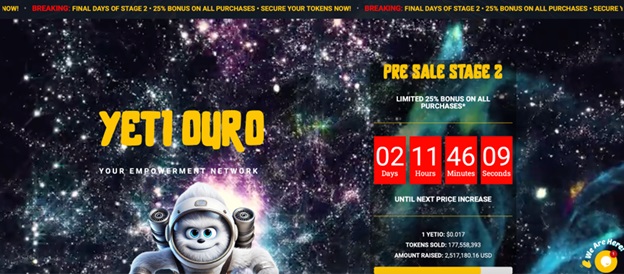
The development team behind Yeti Ouro has announced a limited-time 25% bonus on all purchases as Stage 2 approaches its final countdown this weekend. This special offer is available until midnight on Sunday, providing investors with a valuable opportunity to boost their returns before the next price increase.

As investors seek profitable opportunities, the question remains whether BNB maintain its dominance, or will Yeti Ouro emerge as a high-growth investment in the next bull run.

BNB Price Analysis: Key Levels To Watch

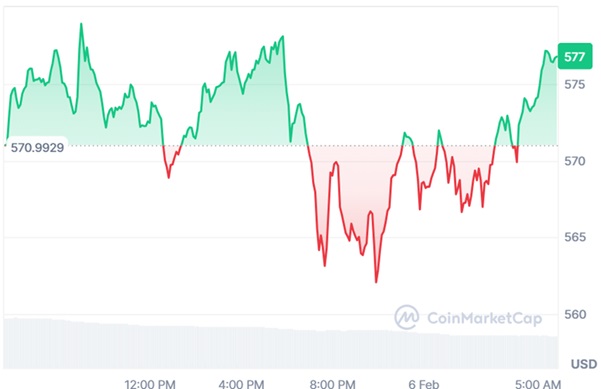
Binance Coin surpassed $570 to reach an 8% growth after exchange token market demand increased dramatically. According to current market data, BNB’s price is slightly above $578.40 while demonstrating a 1.3% increase since its previous closing price. During the day the price moved between $556 and $588 and this range showed that market volatility was still active.

The current BNB price remains lower than all moving averages from 5 days through to 100 days which indicates potential short-term bearish market forces. The price however continues to stay above its 200-day moving average which showcases sustained long-term support.

Source: CoinMarketCap

An upward momentum in Binance Coin above $580 could drive it towards testing $620 before potential moves toward the $650 to $690 range. A failure to maintain the price above $570 would trigger a possible retesting of support at the $550 level.

Yeti Ouro Presale

The Yeti Ouro token has enjoyed fast cryptocurrency market adoption with its presale surpassing 177 million token sales. The current project phase stands at Stage 2 which maintains YETIO token prices at $0.017. The ongoing investor interest keeps building as 77.1% of this stage has finished.

The dev team has unveiled a 25% bonus offer for investors on all purchases until Sunday midnight before the big price increase on Monday.

SolidProof’s recent audit has further solidified YETIO’s reputation as a serious contender in the crypto gaming arena, attracting savvy investors and gamers alike.

YETIO has a supply limit of 1 billion tokens and its smart contract implements a 5% token-burning process to ensure its scarcity in the market. The burn mechanism in the smart contract system steadily diminishes the total supply which creates enhanced value through increasing demand. YETIO stands out to early investors because the project combines scarce token supply with a planned presale process alongside increasing adoption.

Security stands among the main concerns for this project implementation. The smart contracts of Yeti Ouro underwent an extensive proof audit which confirmed their security status as well as their absence of dangerous flaws. The security audit increases investor trust because it verifies that the platform uses secure foundations.

Yeti Go’s Role In Yeti Ouro’s Ecosystem

The new cryptocurrency Yeti Ouro represents a comprehensive initiative that supports the P2E racing game Yeti Go under Unreal Engine 5. The game is being developed with help from the studio behind Call of Duty, The Witcher, Dead Space and Spiderman, it’s a high-octane racing experience, with destructible tracks and adaptive AI opponents, where players earn YETIO tokens by competing, staking, and trading in-game assets. The audio composition is being expertly crafted by industry professionals with Grammy-nominated experience, having contributed to projects for Major Lazer, Vybz Kartel, and Kabaka Pyramid.

The gaming experience of Yeti Go enables online races with YETIO token rewards available after each competition. The implementation of blockchain technology in Yeti Go enables users to retrieve ownership value from virtual assets while extending their exchange potential beyond the game environment.

The YETIO tokens function as a payment method in the game to acquire virtual products or enhance vehicle capabilities and staked tokens unlock bonus rewards. Within the game, players can acquire NFT-based assets which enable them to improve and customize their racing capabilities.

Blockchain gaming expansion pushes projects like Yeti Ouro to gain investor attention because they blend exciting gameplay with real financial value.


Join the Yeti Ouro (YETIO) Community

Website: https://yetiouro.io/

X (Formerly Twitter): https://x.com/yetiouro
Telegram:
https://t.me/yetiouroofficial
Discord:
https://discord.gg/YtUsEZ2ZrV