DD
MM
YYYY

PAGES

DD
MM
YYYY

spot_img

PAGES

Home Blog Page 2606

Nigeria’s Investment Climate and Davido in the Public Court

0

In recent days, Nigerian music superstar Davido has found himself in the eye of a public storm over remarks about Nigeria’s economic state and its appeal to investors. His comment, perceived by some as a criticism of the country, has sparked intense debate. While many lauded him for speaking the truth, others decried his remarks as unpatriotic and damaging to the nation’s investment image. This controversy highlights not only the power of influential voices but also the delicate balance between truth-telling and national branding in the face of economic challenges.

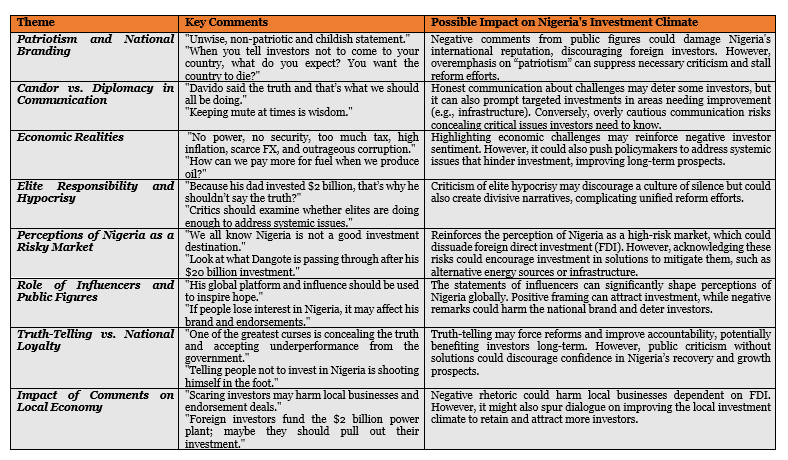
Davido, whose music and influence resonate across continents, reportedly criticized Nigeria’s economic conditions, pointing out critical issues such as fuel price hikes and the broader struggles that many Nigerians face. While some believe his statements were made out of genuine concern for the ordinary citizen, others argue that they were ill-timed and irresponsible, especially coming from someone whose family is deeply invested in Nigeria’s power generation sector. This dichotomy raises several questions about patriotism, accountability, and the role of public figures in shaping national narratives.

Balancing Patriotism and Truth

One of the strongest criticisms against Davido’s comments is the perceived lack of patriotism. Critics argue that as a prominent Nigerian, he should promote the country’s image rather than discourage potential investors. After all, investment climates are shaped not just by policies and infrastructure but also by perceptions. Public figures, especially those with a global platform, are unofficial ambassadors of their nations. Negative remarks from such individuals can ripple across international communities, damaging investor confidence and undermining economic prospects.

However, others argue that concealing the truth about Nigeria’s challenges does more harm than good. They contend that sugarcoating the reality of high inflation, erratic power supply, insecurity, and corruption delays meaningful reforms and perpetuates underperformance. Truth-telling, even when uncomfortable, is seen as a catalyst for accountability and systemic improvement. The balance, therefore, lies in presenting the truth constructively—highlighting challenges while also showcasing opportunities and resilience.
Davido

Economic Realities vs. National Image

The controversy also underscores the undeniable realities of Nigeria’s economic landscape. Despite being Africa’s largest economy, Nigeria faces persistent challenges: unreliable infrastructure, high operational costs, multiple taxation systems, and a volatile foreign exchange market. Critics of Davido’s remarks point to these issues as reasons why his statements should not have been made public, fearing they could deter much-needed foreign direct investment (FDI).

On the flip side, proponents of his candour argue that acknowledging these challenges is essential to finding solutions. They cite examples of local and foreign investors, including Nigeria’s own Dangote, who have encountered significant hurdles despite committing billions of dollars to the country. For Nigeria to attract sustainable investments, policymakers must address these foundational issues rather than rely solely on optimistic rhetoric.

The Role of Influencers in Shaping Narratives

Davido’s situation brings to light the growing role of influencers in shaping public perception and policy discussions. With millions of followers across social media platforms, his words carry significant weight. This influence can be both a blessing and a curse. While influencers have the power to amplify national pride and attract international attention, their statements, if perceived negatively, can exacerbate existing stereotypes about Nigeria as a risky investment destination.

As a cultural icon, Davido’s brand is intertwined with Nigeria’s identity. His global success is a testament to the country’s creative potential, and his statements are often viewed as reflective of broader societal sentiments. However, critics argue that public figures must exercise caution and responsibility when making statements about national issues. In Davido’s case, the backlash suggests that many Nigerians expect influencers to inspire hope and solutions, even while addressing difficult truths.

Elite Responsibility and Hypocrisy

The controversy also touches on a deeper issue: the perceived hypocrisy of Nigeria’s elites. Some critics argue that Davido’s privileged background, including his family’s substantial investment in the Nigerian power sector, should preclude him from publicly criticizing the country’s investment climate. This sentiment reflects a broader frustration with elites who are seen as benefiting from Nigeria’s system while distancing themselves from its problems.

However, others see Davido’s remarks as an example of elite accountability—a rare instance of a privileged individual speaking out on behalf of ordinary Nigerians. His criticism of fuel price hikes and economic mismanagement resonates with many citizens who feel abandoned by both the government and the elite class. This divide emphasizes the need for a more collaborative approach to national development, where elites use their platforms and resources to drive meaningful change.

Constructive Narratives for National Growth

The Davido controversy offers valuable lessons for Nigeria. First, it points out the importance of fostering constructive narratives about the country. While it is essential to acknowledge economic and social challenges, these discussions must be framed in ways that encourage solutions and inspire confidence. Public figures, policymakers, and citizens alike must find common ground in promoting a balanced perspective—one that neither denies reality nor undermines the country’s potential.

Second, the incident highlights the need for systemic reforms. For Nigeria to attract and sustain investment, it must address the root causes of its economic challenges, from corruption to infrastructure deficits. These reforms should be accompanied by transparent communication that reassures both local and foreign stakeholders of the government’s commitment to progress.

Our analyst notes that the debate reminds Nigerians of the power of words. In a world increasingly shaped by perception, every statement matters. Influencers like Davido must recognize their role in shaping global opinions about Nigeria, while critics must engage in dialogue that prioritizes the country’s collective interests over personal attacks.

The US & Ireland are Forging Strong Ties in the Gaming Industry

0

Ireland’s technological innovation has drawn the attention of some of the biggest names in the global technology industry in recent years, especially from the United States.

The country’s skilled workforce and business-friendly policies have turned it into a lucrative destination for US organisations looking to broaden their horizons.

For instance, companies such as SiriusXM have made inroads into the Irish gaming industry, while homegrown tech firm W4 Games are setting benchmarks globally.

Irish companies are also leaving an indelible mark on the US technology market, especially in sectors such as online gaming and visual effects (VFX).

Flutter Entertainment, who have inspired many of the brands listed on comparison platform Casino.com IE, have become a major player across the Atlantic Ocean.

Liberal laws across numerous American states have allowed Flutter to successfully export its expertise from Ireland to the US.

A Magnet for Global Innovation

Ireland provides a ready-made workforce, boasting a talent pool renowned for technology expertise in areas such as software engineering and data analytics.

The country also serves as a gateway to the European market, making it a strategic base for US companies, and its favourable tax regime adds to the appeal.

The support from the Industrial Development Agency (IDA) in Ireland also plays a significant role.

The agency has been instrumental in creating conditions that attract foreign investment, from offering financial incentives to facilitating connections with local partners.

According to SiriusXM’s executive vice president Joe Inzerillo, Dublin is a ‘globally recognised hub for technology expertise’, a mantra shared by many US companies.

The new SiriusXM Technology Centre highlights key areas where Ireland is becoming a leader, such as automotive technology, data science and software development.

With global trends shifting towards smart, connected vehicles, SiriusXM’s Dublin team will develop advanced software for in-vehicle entertainment systems.

Ireland’s proficiency in data analytics paves the way for SiriusXM to improve customer engagement, scalability and efficiency in subscription-based models.

The country’s reputation for high-quality software engineering echoes its ability to deliver scalable, cutting-edge solutions, which favours SiriusXM.

The company’s expansion is part of a larger story of Ireland’s tech industry becoming more popular on the global stage, especially in the US.

Irish tech exports to the US exceeded €1.1 billion last year, and the US remains the largest export market for Enterprise Ireland-supported companies.

This growth is facilitated by initiatives like the recent trade mission to the US west coast, led by Ireland’s Minister for Enterprise, Trade and Employment, Peter Burke.

Tech giants such as Netflix and NVIDIA partnered their mission to deepen Ireland’s integration into the US tech ecosystem. The success of Irish gaming start-up W4 Games exemplifies this dynamic.

W4 Games have evolved in the gaming market. They have partnered with Meta to improve the Godot engine for virtual reality, emphasising Ireland’s ability to spearhead a new era of tech reforms.

A Partnership for the Future

Ireland’s tech renaissance extends into the creative sectors, especially visual effects (VFX).

The Irish VFX industry has grown by a staggering 326 percent over the past five years, with firms such as SSVFX gaining international recognition.

SSVFX recently won an Emmy Award for their work on the critically acclaimed movie Shogun. That success exemplifies how Irish talent is becoming a key player in global entertainment.

The VFX sector is thriving, with major studios lining up to tap into Irish expertise, and incentives such as the Section 481 tax credit have contributed to their success.

The link between Irish technical prowess and US creative demand strengthens Ireland’s position as a key player in global entertainment production.

Irish companies are exporting innovative products and contributing significantly to the US economy.

Over $240 billion in Irish foreign direct investment (FDI) has flowed into the US, creating jobs and driving economic activity.

Companies such as Otonomee, which recently expanded operations in Florida, and Phorest Salon Software are examples of big Irish firms embedding themselves into local markets.

Phorest expanded its partnership in Washington to strengthen its presence in the US, while Otonomee recently launched operations in Florida to add over 120 new jobs in 2024 alone.

These expansions create jobs and reinforce Ireland’s reputation as a reliable partner for innovation.

The deepening ties between Ireland and the US in technology and creative industries are more than economic transactions – they symbolise a shared vision for innovation and growth.

As SiriusXM and other US companies continue to invest in Ireland, they are leveraging the country’s resources but also contributing to a thriving ecosystem that benefits both nations.

With government support, a skilled workforce and a proven track record, Ireland’s future as a leader in tech and entertainment is brighter than ever.

Resilience in Adversity: A Call for Positive Narratives in Nigeria

0

“…if things are tough, is it a reason not to be reasonable?” This thought-provoking statement by Alexandra Tchomte serves as an important reminder for Nigerians to maintain their resilience and composure in the face of persistent political and economic challenges. While the realities of insecurity, inflation, unemployment, and infrastructural deficiencies are undeniable, the way we respond to these adversities can shape not only our outlooks but also the global perception of our nation.

Nigeria, Africa’s largest economy and most populous country has often been defined by its challenges rather than its potential. However, reframing the narrative—by choosing to focus on solutions rather than problems, and opportunities rather than obstacles—can foster a sense of collective resilience and optimism. The question is: How do we, as Nigerians, ensure that tough times do not push us to use negative words or behaviours that inadvertently demarket our country?

Acknowledging Challenges Without Succumbing to Negativity

There is no denying that Nigeria faces significant challenges, ranging from economic uncertainty and unemployment to political instability and insecurity. These issues, understandably, generate frustration among citizens. However, airing grievances in a way that frames the nation as hopeless can inadvertently damage its global image.

For instance, when Nigerians share overly negative narratives on social media or during international engagements, it risks reinforcing stereotypes about the country as a place of perpetual crisis. While acknowledging the problems is essential for finding solutions, the words we choose can either inspire collective action or deepen despair.

This is not a call to silence dissent or sugarcoat reality; rather, it is a call to frame conversations constructively. Instead of saying, “Nothing works in Nigeria,” we might say, “Despite the challenges, Nigerians continue to innovate and find solutions.” This subtle shift highlights resilience while still acknowledging the need for systemic change.

Harnessing the Power of Positive Storytelling

Words hold immense power. They shape perceptions, influence actions, and inspire change. As Nigerians, we must recognize the role of storytelling in creating a vision of hope for the future. Stories of success—no matter how small—should be amplified to show that progress is possible even in the toughest conditions.

Consider the countless Nigerian entrepreneurs who have built thriving businesses despite poor infrastructure or the students who have achieved academic excellence despite limited resources. These stories demonstrate the ingenuity and tenacity of Nigerians and serve as a counter-narrative to the often overwhelming tales of hardship.

By celebrating such stories, we not only inspire others within the country but also reshape how the world views Nigeria. A nation’s image is not solely determined by its challenges but by how its people rise above them.

Resilience as a National Identity

Resilience is deeply ingrained in the Nigerian spirit. Over the decades, Nigerians have weathered economic downturns, political transitions, and social upheavals while maintaining a sense of hope and determination. This resilience should be celebrated as a cornerstone of our national identity.

However, resilience must be complemented by reasonableness. This means resisting the urge to let frustration cloud our judgment or push us to actions that further destabilize the nation. It also means engaging in constructive dialogue, supporting reforms, and holding leaders accountable without resorting to destructive rhetoric or actions.

For example, during fuel scarcity or currency devaluation, it is tempting to lash out with statements that paint the entire nation in a negative light. But resilience calls for focusing on solutions—whether through advocacy for better policies, supporting local businesses, or finding innovative ways to adapt.

Guarding Nigeria’s Reputation on Global Platforms

In an increasingly interconnected world, the words Nigerians use to describe their country can have far-reaching implications. Investors, tourists, and international partners often form opinions based on the narratives they encounter. While constructive criticism is necessary for progress, consistently negative portrayals can deter opportunities.

Take, for example, the tech industry in Nigeria. Despite challenges, the sector has attracted significant international investment, making Lagos a hub for African startups. This success story would not have been possible if the dominant narrative was solely focused on corruption or insecurity.

As individuals, we can contribute to Nigeria’s global reputation by balancing our critiques with stories of resilience and potential. When speaking about the country, whether online or abroad, we should ask ourselves: Am I contributing to the solution or perpetuating despair?

Fostering Unity Through Positive Communication

Resilience is not just an individual trait; it is a collective effort. In times of adversity, Nigerians must come together to support one another and build a sense of unity. Positive communication plays a crucial role in this process.

Instead of spreading messages that deepen division or blame, we can focus on fostering understanding and collaboration. For example, during elections, instead of engaging in heated rhetoric, citizens can encourage dialogue about the qualities needed in leaders and the policies that will benefit all Nigerians. Similarly, in workplaces and communities, celebrating small wins and encouraging a sense of shared purpose can inspire resilience and hope.

Looking Ahead: A Vision for Nigeria

Resilience is not just about enduring tough times; it is about envisioning a better future and taking steps to achieve it. Nigerians have repeatedly demonstrated their ability to adapt, innovate, and thrive despite challenges. By choosing reasonableness and positive narratives, we can build on this foundation to create lasting change.

The road ahead will not be easy, but as Tchomte’s statement reminds us, tough times are not an excuse to abandon reason. Instead, they are an opportunity to reaffirm our commitment to resilience, optimism, and constructive action.

Let us choose our words carefully, tell stories of hope, and work together to build a Nigeria that reflects the best of our potential. After all, the narrative we create today will shape the legacy we leave for future generations.

CERDEMS-Africa Hosts Groundbreaking Webinar on Ghana’s 2024 Elections

0
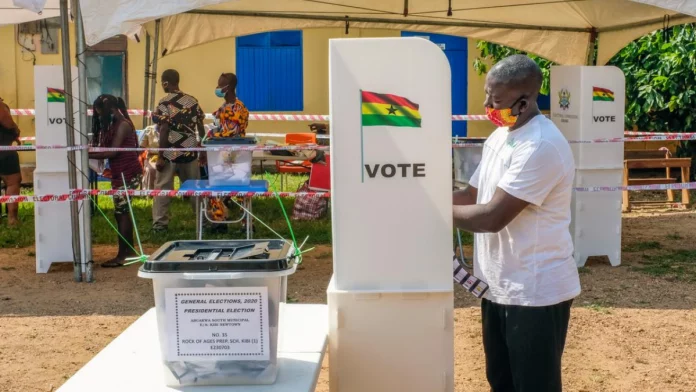
Ghanaian voter

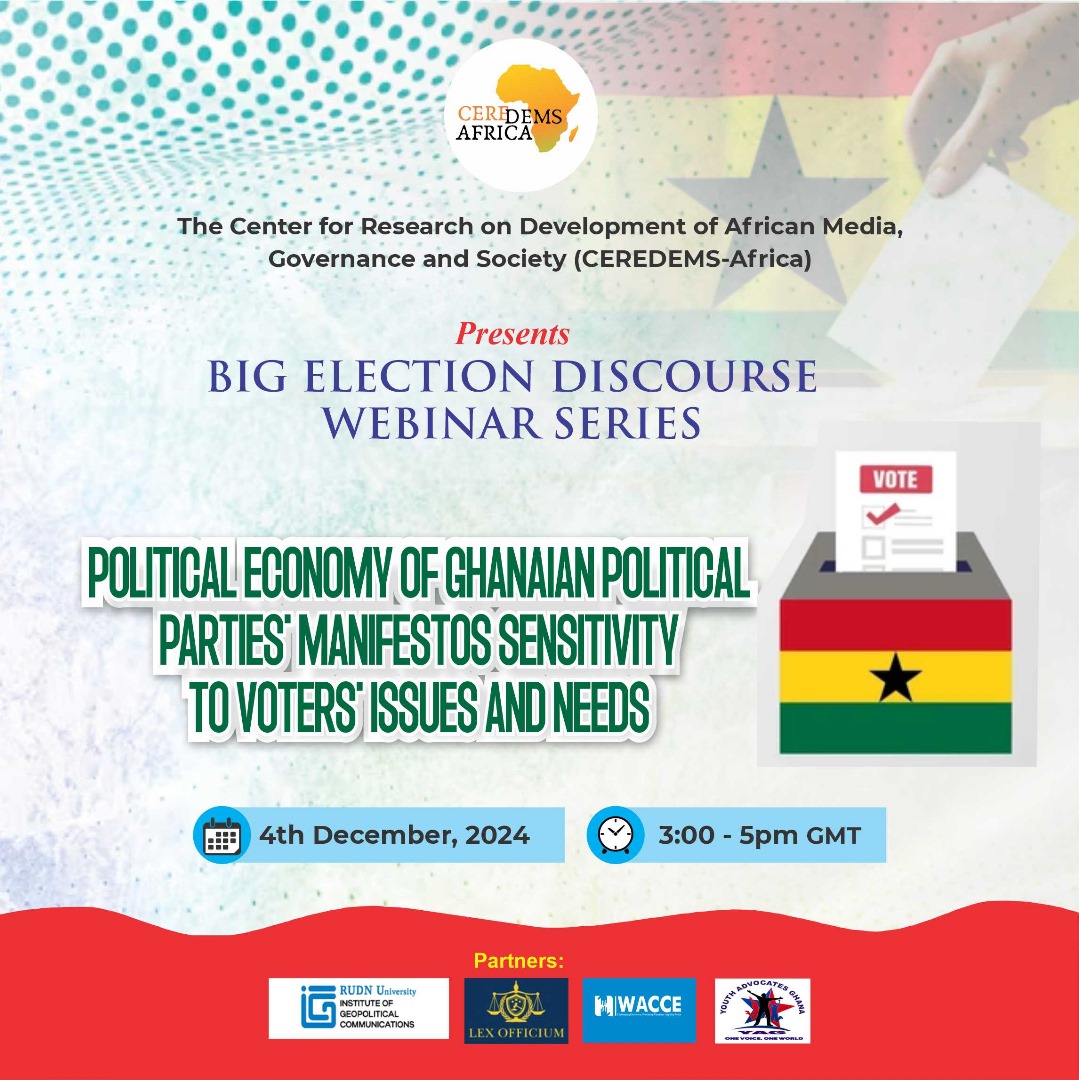
In an era of growing political awareness and voter expectations, the Center for Research on Development of African Media, Governance, and Society (CERDEMS-Africa) is set to host a compelling webinar under its Big Election Discourse Webinar Series. Titled “Political Economy of Ghanaian Political Parties’ Manifestos: Sensitivity to Voters’ Issues and Needs”, the event promises to delve deep into the dynamics of political manifesto creation and its alignment with the pressing issues of Ghanaian voters.

According to the Director of Communications, Stephen Obiri, the webinar is scheduled for 4th December 2024, from 3:00 to 5:00 PM GMT, and brings together a host of experts, academics, and stakeholders from various disciplines. “This critical discourse is poised to contribute meaningfully to the ongoing conversation on political accountability and voter-centric governance, a pressing need as Ghana prepares for its next electoral cycle,” he stressed.

Analyzing the Core Theme

The political economy of party manifestos is a vital subject, particularly in a maturing democracy like Ghana. Political parties often craft manifestos as blueprints to win voter confidence. However, questions linger about the extent to which these documents reflect the true needs and aspirations of citizens. This webinar seeks to address such questions by evaluating the sensitivity of Ghanaian political parties’ manifestos to issues that matter most to voters.

From the challenges of youth unemployment and healthcare access to education and infrastructural development, Ghanaian voters increasingly demand actionable and measurable policies. The webinar aims to uncover whether party manifestos are a genuine reflection of these demands or if they serve as tools for political rhetoric.

Ghana's 2024 elections

The Role of CERDEMS-Africa

As the organizing body, CERDEMS-Africa continues to uphold its mission of fostering good governance, robust media practices, and a participatory civic culture across the continent. By launching the Big Election Discourse Webinar Series, the organization is creating a platform for critical discussions that resonate with citizens and policymakers alike.

This event is particularly timely, considering the evolving political landscape in Ghana. The country has a history of vibrant political participation, but it also faces challenges in ensuring that political promises translate into real socioeconomic benefits for its people.

Collaborative Efforts and Key Partners

The webinar is supported by a coalition of partners, underscoring its significance as a multi-disciplinary and collaborative effort. These include the RUDN University Institute of Geopolitical Communications, Lex Officium, the West Africa Civil Society Institute (WACSI), and the Media Advocates for Peace (MAP). Together, these organizations bring a wealth of expertise in governance, civic engagement, legal frameworks, and peacebuilding.

Their involvement highlights the recognition of manifesto sensitivity as a critical issue not only for Ghana but for other democracies across Africa, where political promises often fail to align with the electorate’s expectations.

Why This Webinar Matters

The sensitivity of manifestos to voter concerns is not just a Ghanaian issue; it reflects a broader challenge in many African democracies. Manifestos are often seen as theoretical documents rather than practical roadmaps, leading to voter apathy and mistrust in the political process.

This webinar will explore how political parties can strike a balance between political ambitions and genuine voter engagement. It will also analyze how economic considerations, media narratives, and societal needs influence manifesto development.

Additionally, the event offers an opportunity for comparative learning. By examining Ghana’s political context, other African nations can draw valuable lessons on creating inclusive, actionable, and voter-sensitive manifestos.

Anticipated Discussions

Some key questions likely to dominate the discourse include:

  • How well do Ghanaian political manifestos align with pressing voter issues such as education, healthcare, and job creation?
  • To what extent do economic constraints shape or limit the promises outlined in these manifestos?
  • How can civil society and the media hold political parties accountable for their manifesto commitments?
  • What role can technology and data play in ensuring manifesto promises are evidence-based and measurable?

The webinar will also delve into the role of traditional and social media in amplifying or distorting manifesto narratives, an increasingly relevant issue in today’s digitally-driven world.

Looking Ahead

As Ghana gears up for its next election, the insights from this webinar could serve as a guiding framework for political parties, voters, and civil society organizations. By fostering a deeper understanding of the interplay between political promises and voter needs, CERDEMS-Africa is empowering stakeholders to engage in more informed and constructive dialogues.

This initiative is not just about Ghana; it is a call to action for African democracies to rethink the role of manifestos as tools for accountability and progress. The success of this event will likely inspire similar discussions across the continent, reinforcing the importance of voter-centric governance as a cornerstone of democracy.

How to Participate

The webinar is open to participants from diverse fields, including academia, governance, media, and civil society. Interested attendees can register through CERDEMS-Africa’s official channels to join this critical conversation that promises to shape the future of political engagement in Ghana and beyond. Mr. Obiri notes that prospective attendees can join the conversation via Zoom using the following link: Big Election Discourse Webinar Series. Participants will need to enter the Meeting ID: 485 251 3622 and Passcode: 1NK5Rb.

Forget Cardano (ADA) and Solana (SOL), RCOF Will Rise 56,094% by Christmas 2024

0

Cardano (ADA) and Solana (SOL) show impressive monthly gains. Yet, they are facing market correction and resistance. 

Analysts are focusing on RCO Finance (RCOF) as projections of an astounding 56,094% ROI by Christmas 2024 hover. RCO Finance has amazed investors with its AI-integrated investment products. Let’s learn more.

>>>  BUY RCOF NOW <<<

Cardano Faces Critical Juncture Between $1.16 and $0.519

Cardano has surged by an impressive 193% over the last month. ADA was trading around $0.97 in late November, with a 30% gain in the past week. Despite this rally, momentum indicators like ADX have dropped from over 60 to 45.

This drop suggests a weakening uptrend. Analysts say that Cardano’s price is now at a critical juncture. If the uptrend strengthens, ADA could test $1.16, its highest price since 2021. 

Conversely, a bearish shift could result in ADA dropping to the $0.51 support level. As a result, analysts advise investors to be cautious before adding ADA positions. They believe RCOF will offer a better ROI of up to 56,094% by Christmas 2024. 

Solana Hits $110B DEX Volume in November

Solana’s DEX ecosystem reached a record-breaking $110 billion monthly trading volume in November. DefiLlama reported that the DEX volumes have increased 108% from October’s $52 billion.

Raydium and Orca dominate Solana’s DEX market, with Raydium capturing 63% of weekly trading volume. Besides, SOL surged 37% in the last month and was trading around $237 in late November.

There is a huge resistance at $271 for SOL. Analysts are also concerned about overbought conditions and a high RSI in the SOl chart, which signals the possibility of a market correction. Thus, they recommend RCOF for better gains by Christmas 2024.

RCO Finance Offers Quick, Easy, and KYC-Free Investing

RCO Finance has attracted Solana and Cardano investors with its unique AI DeFi solutions. It aims to simplify investing in different assets by offering a fully automated platform without brokers and middlemen.

Investors can invest over 120,000 assets and build diverse portfolios in a single platform. You can trade short-term for quick profits or invest long-term based on your preference. Besides, RCO Finance’s AI robo advisor helps you by creating a personalized investment strategy.

The robo advisor needs information on your financial goals and risk tolerance to create the strategy. It has access to real-time data from global sources like Reuters and Bloomberg, which helps the AI advisor predict the market precisely in real time.

It can also adjust your portfolio in real-time according to market insights. Experts say RCO Finance exclusively buys these features in the investment sector. Moreover, you don’t need ID verification to invest via RCO Finance in its KYC-free platform.

RCOF Presale Hits $6.7M: Secure Your Spot for 10x Returns

RCO Finance has already raised over $6.7 million in presale. The funds raised will be used to support further development and marketing. Their team has an incredible vision for the sustainable development of the project.

In stage 3, RCOF is currently available at $0.055 per token. Investors expect a 40% price increase to $0.077 in stage 4. Projections indicate RCOF will list on DEXs at $0.60, offering early investors 10x returns.

Analysts say RCOF could rally up to 56,094% if it gets in top-tier exchanges before Christmas 2024. In addition, SolidProof’s audit confirmed the security of RCO Finance’s smart contracts. It is considered one of the most secure platforms in the DeFi space alongside Solana and Cardano. 

Invest in RCOF for a gain up to 56,094% before Christmas 2024!

For more information about the RCO Finance Presale:

Visit RCO Finance Presale

Join The RCO Finance Community