DD
MM
YYYY

PAGES

DD
MM
YYYY

spot_img

PAGES

Home Blog Page 2699

Local Government Autonomy in Nigeria: Empowerment or Entrenchment of Corruption?

0

In Nigeria, local governments are often seen as the closest tier of governance to the people, responsible for implementing grassroots development initiatives and delivering essential services. Recently, there has been a growing call for granting absolute autonomy to local councils across the country, with advocates arguing that this would enable them to respond directly to local needs without interference from state governments. However, autonomy, if unaccompanied by structural reforms and accountability mechanisms, may lead to a deepening of the corruption issues that already plague these councils. A recent analysis of corruption in Nigerian local governments from multiple sources by our analyst reveals a range of exploitative practices that could potentially worsen under autonomy. 

The Perils of Absolute Autonomy

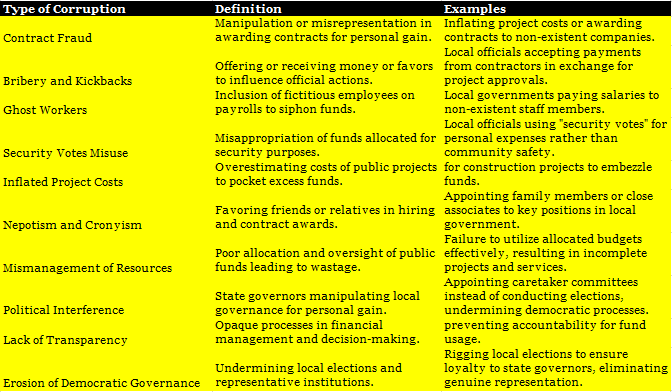
When autonomy is discussed in Nigeria, it’s often positioned as a solution to political interference and inefficiency. Yet, autonomy in itself is not a panacea. It must be supported by institutional frameworks that mitigate corruption and enable public oversight. The types of corruption documented in Nigerian local governments reflect structural issues that require more than independence from state oversight to resolve.

Take contract fraud as an example. Contract fraud involves manipulating or inflating the costs of local projects or even awarding contracts to fictitious companies to siphon funds. While greater autonomy would allow councils to award contracts without needing approval from state authorities, it could also open the door for more unchecked abuses. When local officials have full control over procurement without sufficient transparency or auditing, they may be more inclined to exploit contracts for personal gain. To prevent this, it’s vital to implement independent monitoring mechanisms that evaluate contract awards and ensure fair procurement processes.

Bribery and kickbacks present another significant risk. In an autonomous setup, local officials might receive increased discretionary funding and control over approvals, which could attract offers of bribes from contractors seeking favours. This could turn autonomy into a “market” for unethical contractors and officials, leading to decisions driven by personal profit rather than community welfare. Transparency and citizen involvement in project planning and execution are essential to mitigate these risks.

Ghost workers—fictitious employees included on payrolls to divert public funds—are also a common issue in Nigerian local councils. Under autonomy, payroll management would rest solely within the council, potentially enabling officials to introduce ghost workers with even less scrutiny from external bodies. To counter this, local councils should adopt digital payroll systems and periodic verification audits to ensure that every paycheck goes to a real, contributing employee.
state government

Source: Multiple academic and non-academic sources; Infoprations Analysis, 2024

Security Votes Misuse and the Autonomy Dilemma

One of the more controversial corruption practices is the misuse of security votes—discretionary funds allocated for security purposes. While intended for protecting communities, these funds are often unaccounted for, leaving room for officials to divert them for personal use. With absolute autonomy, local councils would control these security funds without needing to report expenditures to state authorities. This raises the question: Can local councils be trusted with such discretion without meaningful oversight?

To address this, standardized reporting requirements should accompany autonomy. Local councils should document every expenditure under security votes and make these reports available to both state governments and citizens. This transparency would deter misuse and ensure that security funds serve their intended purpose of safeguarding the community.

Political Interference, Nepotism, and Cronyism

One argument for local government autonomy is that it would reduce political interference from state governments, allowing councils to address local needs without undue influence. However, autonomy may create new opportunities for corruption within the councils themselves. Without external checks, powerful figures within local governments could exert control over hiring and decision-making, favouring friends and family—a practice known as nepotism and cronyism.

To combat this, autonomy must include policies enforcing merit-based recruitment and transparent hiring processes. Recruitment committees that include independent stakeholders could help curb favouritism and ensure that positions are awarded based on qualifications and experience rather than personal connections.

The Need for Transparency and Accountability

One of the most critical issues in local councils is the lack of transparency. Opaque financial processes mean that community members are often unaware of how funds are allocated and spent. In an autonomous system, councils might operate even more secretively, feeling less compelled to disclose budget information and spending practices. This secrecy weakens accountability, as citizens and civil society cannot hold officials responsible if they don’t have access to critical financial data.

To prevent this, transparency must be the cornerstone of autonomy. Local councils should be legally obligated to publish budgets, expenditures, and contract awards in accessible formats for the public. Additionally, citizen involvement should be encouraged, allowing residents to participate in planning and decision-making. This approach not only improves transparency but also fosters a culture of accountability where officials feel answerable to the communities they serve.

Protecting Democratic Governance

 Autonomy must safeguard democratic governance within local councils. One of the dangers of autonomy is that it could enable councils to entrench power by manipulating local elections or circumventing democratic processes. There is a real risk that powerful local figures could rig elections, undermining fair representation and consolidating their control over council activities. To counter this, independent electoral bodies should oversee local elections to ensure they are free and fair. Term limits for council members should also be enforced to prevent long-term entrenchment of power and encourage fresh ideas in leadership.

A Balanced Path Forward

While local government autonomy promises a shift in decision-making power to the grassroots level, the documented corruption types suggest that, without proper safeguards, autonomy could lead to deeper issues. For autonomy to truly benefit Nigerians, it must be accompanied by accountability frameworks that mitigate corruption risks. Independent audit bodies, transparency requirements, citizen engagement, and regular oversight from both state and federal levels are essential to ensure that autonomy drives positive outcomes rather than entrenching corruption. Moreover, empowering citizens with mechanisms to report and challenge corruption would enhance the effectiveness of autonomous councils.

Unlock the Power of Mobile Trading with Plus Wallet as Binance Faces a Market Slide & MakerDAO Questions Its ‘Sky’ Rebrand!

0

Binance, while still topping the charts in market share, is seeing its dominance wane in the face of stiff competition from Bybit and OKX.

On another front, MakerDAO is navigating through rough waters with its “Sky” rebranding, which hasn’t quite resonated with its community and token holders.

Amid these pivotal market movements, Plus Wallet is stepping up, enhancing accessibility with robust cross-chain functionality and a mobile-centric approach. This trading app allows users to manage and trade assets across various blockchains right from their mobile devices, streamlining the crypto trading process.

Binance’s Dominance Fades as Bybit and OKX Ascend

Binance’s hold over the crypto exchange market has lessened for a second straight year, now down to 39.54% from last year’s 52.5%—a 13% drop over twelve months. Meanwhile, rivals Bybit and OKX have seized this opportunity, carving out larger stakes in both spot and derivatives markets. Bybit has surged from seventh to second in spot trading standings, securing an 8.51% share, while OKX now holds third place.

Despite these shifts, Binance’s native token, BNB, continues to be the top-performing exchange token, its utility growing within both the Binance platform and BNB Chain. These market share changes underscore the fierce competition within the exchange landscape as Binance maneuvers through these changing tides.

MakerDAO Struggles with ‘Sky’ Rebranding Effort

MakerDAO’s switch to the “Sky” branding hasn’t hit the mark, prompting a reevaluation of its strategy. Efforts to rejuvenate its identity, as part of founder Rune Christensen’s “Endgame” strategy, haven’t paid off, with the SKY token struggling in the market and shedding 26.8% of its value since its introduction in September.

The initiative was designed to lure new users with attractively priced tokens, yet the community has been slow to embrace this new identity. MakerDAO is currently weighing the option to revert to its original MKR branding or possibly chart a different course.

Plus Wallet Boosts Mobile Trading with Cross-Chain Functionality

Plus Wallet is making it easier than ever for users to manage their digital assets through its sophisticated cross-chain functionality. This feature enables smooth interactions across different blockchains, consolidating all crypto activities—buying, selling, and holding—into a single platform. This eliminates the hassle of managing multiple wallets or exchanges, facilitating a seamless way to diversify one’s crypto portfolio.

Designed specifically for iOS and Android, Plus Wallet tailors to the modern mobile user. Unlike traditional platforms that depend on desktop access, Plus Wallet offers an intuitive, mobile experience allowing users to manage their assets on the go. This mobile-first strategy ensures quick, accessible trading anytime and anywhere, simplifying crypto trading on a user-friendly app that emphasizes ease and adaptability.

With its combination of cross-chain capabilities and a mobile-first design, Plus Wallet is opening up a myriad of trading opportunities. By marrying broad blockchain accessibility with the convenience of mobile usage, Plus Wallet provides a simpler, faster, and more efficient way to handle digital assets, whether you’re at home or on the move.

Key Insights

As the landscape of crypto markets continues to evolve, Binance, MakerDAO, and Plus Wallet each highlight different strategies in navigating today’s competitive market. Binance is grappling with increased competition as Bybit and OKX quickly climb the ranks in spot and derivatives trading. MakerDAO’s rebranding to “Sky” has received a lukewarm response, prompting a critical reassessment of its future direction.

Concurrently, Plus Wallet is redefining how users access the market through its innovative cross-chain functionality and mobile-first design, enhancing the crypto trading experience by integrating accessibility, security, and ease of use. These developments point to an industry in flux, adjusting to the varied needs of traders in the burgeoning crypto marketplace.


Plus Wallet:

Website: https://pluswallet.app/

Download: https://onelink.to/pluswalletapp

Twitter: https://x.com/pluswalletapp

Instagram: https://www.instagram.com/pluswallet.app/

The Future of Football: Trends to Watch

0

Every now and then football evolves and the prospect of future football is even more enticing. From new technology to alterations in the ways the game is played, soccer is likely to continue changing. As this article will demonstrate, there are several massive trends that will affect football players, teams, and fans in the years to come.

The Rise of Technology in Football

New technology is becoming bigger and bigger in shaping soccer. VAR and the use of technology such as goal-line technology have already come into play, and decisions have been made more fairly. Now, even more technologies are being introduced, such as wearable technology, to monitor the physical and digital fitness of players. With technology, the game is not only getting more accurate and competitive, but the feel of the game is also getting much more engaging. However, technology is not the only thing that changes how the game is played. It is also changing football betting. These two technologies increase the fairness of the game, which in turn has a very positive effect on bets because now everyone is sure that every goal will be counted correctly.

Trends That Are Shaping Football

Football is constantly evolving, and here are some key trends to watch:

Increased Use of Technology: From Video Assistant Referee to player tracking, technology is used to make the game much smarter.

  • Global Expansion: More leagues are being formed, and soccer is going to places it has never been before.
  • Focus on Youth Development: The academies are on the increase as more clubs look forward to nurturing talents that are young.
  • Women’s Football Growth: Female football is being appreciated more and supported than before, hence the expansion of the soccer sport.

They are an illustration that the sport is not only expanding but also evolving to meet new challenges and opportunities.

Sustainable Stadiums and Eco-Friendly Football

Football clubs are also becoming conscious of the environment. It is now possible to create football stadia that are self-sufficient in power and also play their part in recycling. Clubs are also trying to cut down on their emissions by promoting the use of public transport and recycling during matches. We believe this is a positive change that will make soccer better for generations to come due to the focus on sustainability. This shouldn’t be a surprise to anyone because football is not just a game; it is also a platform for demonstration to the world.

The Current Development of Football’s Popularity

Soccer is targeted at new audiences that were not even targeted before. The interest in the key championships has gone way outside Europe and gained fans in Asia, Africa, and America. Teams are embarking on new countries, and worldwide competitions are finding more and more listeners. This global reach increases the number of fans and gives youngsters across the continent more motivation to think bigger. Football’s popularity is universal in that it has the power to unite all people, irrespective of their languages or cultures. It is so delightful to learn how one game can bind the entire globe.

The Importance of Betting and Interaction with Supporters

Betting has been an inherent part of soccer culture, and it is leveraging technology so well. With the MelBet app download for pc, fans are able to access many betting options, which enhances the overall experience even more. Fans are always eager to predict the outcome and test their skills, which creates hyper-excitement for each match played onward. Betting immerses fans further into the game as they get to participate in the action by making them a big part of the event. It’s all about adding value to each goal, each save, each and every second!

Key Changes We Can Expect

Anyway, these days, football is changing, and looking into the future, we can expect the following changes:

  • More Technology: Even more tech tools for referees and coaches.
  • Flash into the Future of Soccer: More money will go to the players’ welfare and injury avoidance.
  • More International Competitions: More international competitions and club-hosting events.
  • Green Practices: More club initiatives supporting green policies.

These changes are all directed toward making the game of soccer safer, fairer, and more fun for the players and stakeholders.

Final Thought: A Beloved Sport That Keeps Transforming

There are a lot of possibilities when it comes to the next chapter in the history of football. From technologies making the game even ‘smarter’ to women’s football expansion and sustainability concerns, football is in the process of transformation. Not only will these changes enhance the game for the players and their fans, but the game itself is also set to become more diverse. The beautiful game never stands still as the emphasis is on movement, and the vision of the future has never been so positive, with more excitement, more passion, and more memories in store for future generations.

2024 Elections: Which Party Holds the Key to Ghana’s Prosperity?

0
Ghanaian voter

As Ghana approaches the 2024 elections, both the National Democratic Congress (NDC) and the New Patriotic Party (NPP) have presented their visions for the country’s future. While each party has its distinct approach, our comparative analysis reveals both commonalities and divergences in their proposed solutions to Ghana’s pressing challenges.

Economic Revitalization and Stability

Both parties recognize the need for economic rejuvenation, but their approaches differ significantly. The NDC proposes a “24-Hour Economy” initiative, aiming to stimulate job creation and boost productivity. Similarly, the NPP advocates for a 24-hour Economy, but with a stronger emphasis on private-sector-led growth and digital transformation2. Both parties propose the establishment of specialized banks – the NDC’s Women’s Development Bank and the NPP’s SME Bank – to support targeted sectors of the economy.

The NPP’s focus on tax reforms, including a proposed flat tax system, contrasts with the NDC’s emphasis on tax incentives and financial support for SMEs. While both strategies aim to ease the burden on businesses and individuals, they reflect different philosophies on economic management.

Governance and Transparency

Corruption and governance inefficiencies are addressed by both parties, albeit through different mechanisms. The NPP proposes capping the number of ministers and electing local officials to enhance local governance. The NDC, on the other hand, advocates for forensic audits and the establishment of an anti-corruption court. Both parties emphasize digitalization of government services, recognizing its potential to reduce bureaucracy and corruption.

Social Welfare and Inclusivity

There’s a notable convergence in social welfare policies, with both parties proposing Free Primary Healthcare and support for Persons with Disabilities (PWDs). The NDC’s Ghana Medical Care Trust and the NPP’s completion of Agenda 111 hospitals both aim to improve healthcare access. However, the NDC’s approach appears more comprehensive, including risk exposure insurance for healthcare workers and a broader range of social intervention programs.

Education and Workforce Development

Education remains a priority for both parties, with the NPP focusing on continuing and expanding its free Senior High School (SHS) and Technical and Vocational Education and Training (TVET) programmes. The NDC proposes a No-Academic-Fee policy and free tertiary education for PWDs. Both parties emphasize digital skills training, with the NPP proposing a National Robotics Lab to promote technological innovation.

Environmental Sustainability and Agriculture

Both parties recognize the importance of environmental protection and agricultural development. The NDC proposes a ban on new forest mining and a Tree for Life reforestation policy, while the NPP focuses on reforming small-scale mining practices and continuing its “One Village, One Dam” initiative2. Both approaches aim to balance economic development with environmental conservation.

Infrastructure and Transportation

Infrastructure development is a key focus for both parties. The NDC proposes a $10 billion “Big Push” plan for infrastructure expansion, while the NPP emphasizes completing ongoing projects like Agenda 111 hospitals and developing housing projects. Both parties support the adoption of electric vehicles and the expansion of public transport systems.

Youth Empowerment and Job Creation

Addressing youth unemployment is crucial for both parties. The NDC’s National Apprenticeship Program and Digital Jobs Initiative align with the NPP’s focus on digital skills and private-sector-driven employment. The NPP’s “Youth in Seafaring” program and the NDC’s Youth in Cocoa Farming initiative both aim to create sector-specific opportunities for young Ghanaians.

A Call for Informed Voting

As Ghanaian voters contemplate their choices for the 2024 elections, it’s crucial to look beyond campaign rhetoric and critically examine the feasibility and potential impact of each party’s proposals. While both the NDC and NPP present comprehensive visions for Ghana’s future, the effectiveness of their policies will ultimately depend on implementation and the ability to adapt to changing circumstances.

The NDC’s approach appears to lean more towards state-led interventions and structural reforms, while the NPP emphasizes private-sector growth and digital transformation. However, both parties recognize the need for a balanced approach that addresses economic growth, social welfare, and environmental sustainability.

Voters should consider not only the promises made but also the track records of both parties in government. The NDC’s campaign strategy of highlighting current hardships must be balanced against their own historical performance and the concrete solutions they offer. Similarly, the NPP’s incumbency advantage comes with the responsibility of demonstrating tangible progress on their previous commitments.

As Ghana stands at this critical juncture, the electorate’s decision will shape the country’s path for years to come. It is imperative that voters look beyond slogans and carefully evaluate the substance of each party’s manifesto. The choice in 2024 should be based on which vision and set of policies best address Ghana’s complex challenges and align with the aspirations of its people for a prosperous, equitable, and sustainable future.

Starlink Suspends New Subscriptions in Kenya Due to High Demand Exceeding Network Capacity

0

Starlink, the satellite internet service provider owned by Elon Musk, has announced a temporary suspension of new subscriptions in Nairobi, Kenya, and six other counties due to high demand which has caused network overload.

The satellite internet disclosed that too many users are trying to access the service, which is affecting bandwidth and preventing them from supporting additional residential or roaming customers at this time.

The affected areas include Thika, Kajiado, Kiambu, parts of Murang’a, Naivasha, Ngong, Machakos, and sections of Narok. The Elon Musk Internet confirmed that its network capacity in these regions is currently full, limiting its ability to accommodate additional users.

No roaming plans are available in Kenya at this time. Starlink is working to restore service in the disrupted areas and a notification will be sent once the residential plan is back,” Starlink wrote.

In line with this, the company has temporarily halted the sale of its affordable residential plans and roaming services in Kenya. Only higher-tier plans, priced above Ksh130,000 per month, are currently available. Customers in Nairobi and other affected counties have expressed concerns about the company failing to provide roaming service plans through which they could bypass the restrictions affecting the regions. 

Commenting on Starlink’s decision to halt new subscriptions in Nairobi, several Kenyan netizens wrote on X,

@reallwarrior wrote,

This is good, Kenyans are embracing better service. Starlink up your game, Kenya is a strong market.”

@GachanjaAaron wrote,

Safaricom will soon be a thing of the past”.

@wagakiafricana wrote,

“Good problems though, it shows the growing demand for reliable internet access in our NAIROBI. It’s essential for companies to address infrastructure challenges as more people rely on high-speed internet for work and daily life. I hope they can find solutions soon so that everyone can benefit from their service. Access to reliable internet is crucial for connectivity and progress.”

Starlink is actively working to address the network capacity issues and restore normal service to affected areas. Customers are advised to monitor updates from the company for further information.

Notably, Starlink network congestion has also impacted its roaming services across Africa. The company has reportedly removed several African countries, including Kenya, Nigeria, Zimbabwe, and Zambia, from its list of supported roaming destinations.

Starlink customers in these regions have reported slower-than-expected download speeds, often in the low double-digit Mbps range. Additionally, there are concerns that misuse of roaming plans in unsupported countries could lead to a permanent shutdown of the feature.

In Kenya, Starlink terminals have flown off the shelves in Nairobi. Terminals are no longer available in Lusaka, Zambia.

Reports reveal that in Zimbabwe, Starlink terminals were sold out in the country’s capital Harare, less than two months after receiving permission from authorities to operate in the southern African nation. Harare now joins five cities in Nigeria which include its capital of Abuja as well as Kano, Lagos, Port Harcourt and Warri where the high-speed internet service has sold out, according to a map on Starlink’s website.

The rapid sellout of Starlink terminals across several African countries, signals a growing demand for reliable internet access, fuelled by a significant drop in the price of the kits that have rattled the continent’s telecoms providers, prompting them to review and slash their pricing strategies. Also they have been forced to increase their internet speed.