You want to scale your business out of Nigeria? Pay attention to countries within the CFA franc currency zone especially in the West African axis. In 2014, 1 CFA franc exchanged for 25 kobo; today, that is about N272 kobo. Yes, the money they use in Togo, Cotonou’s Benin Republic, etc, has gained about 10X over Nigeria’s Naira in a decade. In other words, Togolese, Malians, Chadians, etc, are the new “Americans” as they have a stronger currency, and can buy things at better positioning in Nigeria.
Partly, some of the recent trade surpluses Nigeria is recording is as a result of that. Simply, the trade flow is changing. In the past, we used to go there to buy, but increasingly, they come to us. Of course, I am not sure we have to celebrate this as Nigerians, considering that Lagos’ Eti Osa Local Government’s GDP is possibly bigger than some of the GDPs under discussion here. Period, any trade surplus, within West Africa, anchored on currency deterioration for Nigeria should not be celebrated; we want that surplus to come via innovation.
But as Nigeria reorganizes for that innovation-anchored growth, merchants and businesses must pay attention to these markets. If you develop a market in a CFA franc zone, you can find growth out of Nigeria, because they’re actually buying made in Nigeria products these days.
We picked the data and I shared it here last month. Many came after a messenger instead of focusing on the core thesis of our analysis (the original post). Since I made that post, many people have independently validated our call.
Good People, let us discuss the economics of the nation without everything being looked at from tribal and political angles. When sharing data is considered a political attack, you have a fading nation which is entering a fact-less era. My model was a 50% drop, but Leadership Newspaper is even saying 60%!
—original post
Good People, our economic indicators in Nigeria have severely diminished. I just completed my back-the-envelope village boy study and the results are troubling. Three indicators:
– The number of active aircrafts parked in Nigeria’s leading local airport at 9pm have dropped by more than 30% from Jan 2023 numbers.
– The number of ships coming to Nigeria have dropped, and most troubling, ships continue to depart Nigeria largely empty. Ask your friends to climb the tallest buildings in Marina Lagos and count occasionally over a week, how many are coming and leaving, and how loaded they are.
-International traffic in Nigeria’s main airport – MMA Lagos – is off by more than 50% compared to Jan 2023 numbers. To do that, ask people who work there to take photos at 8pm WAT, and send them to you from Monday to Sunday.
If supply chain is the engine of commerce, the implication is that if our supply chain is seeing a significant drop, it does mean that our economic activities have reduced.
Comment on Feed
Comment 1: A lot of traders buying in Lagos and selling in Abidjan.
My Response: Currency repositioning. That is the reason Nigeria has a trade surplus. More than 80% of that is due to other African countries buying from Nigeria. CFA Franc has gained 10X against Naira in the last 10 years which means buying from Nigeria is a better deal for them.
In the fast-moving world of cryptocurrency trading, understanding market sentiment is crucial for making informed decisions. AI bots have emerged as essential tools for traders, leveraging data analytics and sentiment analysis to predict market movements. Here’s a look at the top five AI bots that excel in interpreting market sentiment, helping traders make smarter trades.
Overview: 5/5 ValueZone AI stands out for its advanced algorithms that analyze market sentiment, providing traders with insights based on current trends and social media activity. Its user-friendly interface and customizable strategies make it ideal for both new and experienced traders.
Pros:
Advanced sentiment analysis to gauge market mood
Easy-to-use platform with educational resources
Offers a $50 bonus for new users and a 3.5% referral program
Customizable strategies to fit individual trading styles
Why Choose ValueZone AI?
Advanced AI Technology: Utilizes sophisticated algorithms for accurate sentiment analysis.
User-Friendly Interface: Accessible for all skill levels, from beginners to experts.
24/7 Market Monitoring: Constantly analyzes market trends and sentiment.
Customizable Strategies: Allows traders to tailor their approach based on preferences.
Affordable Plans: Various pricing options to cater to different budgets.
If you’re interested in using AI bots to improve your trading, signing up for ValueZone AI is simple. Here’s how you can get started:
Create an Account: Head over to the ValueZone AI website and sign up. It only takes a few minutes to create your account.
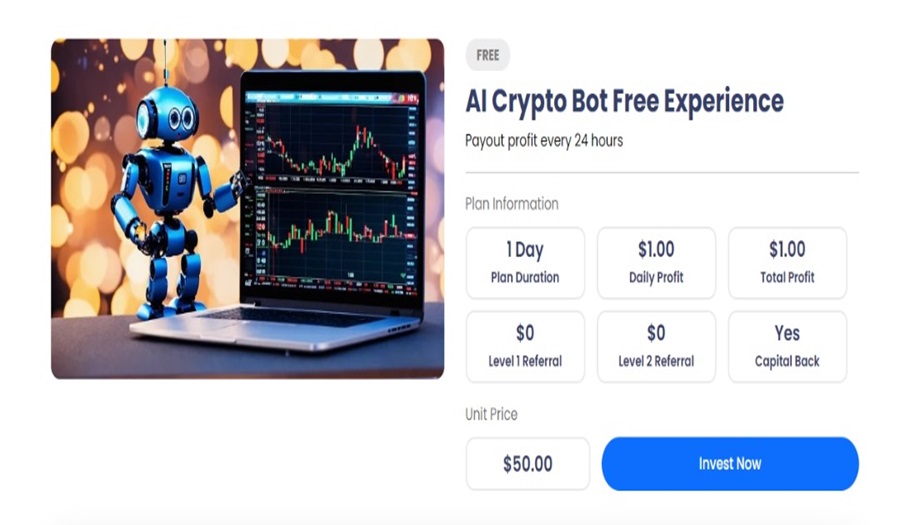
2. Claim Your $50 Free Bonus: As a new user, you’ll get a $50 bonus to test the bot risk-free. This is a great way to try out the platform and see how the AI bot works without using your own money.
3. Affiliate 3.5% Referral Program: Earn extra by referring friends and family. You’ll get a 3.5% bonus on their trading fees when they sign up using your referral link!
4. Free Experience of Trading Bot Trials: Before making any big commitment, try out the trading bots for free with special trial plans, allowing you to get comfortable with how they work.
5. Choose a Trading Plan: Pick a plan that suits your needs. ValueZone AI offers different plans depending on how much you want to invest and the kind of returns you’re looking for.
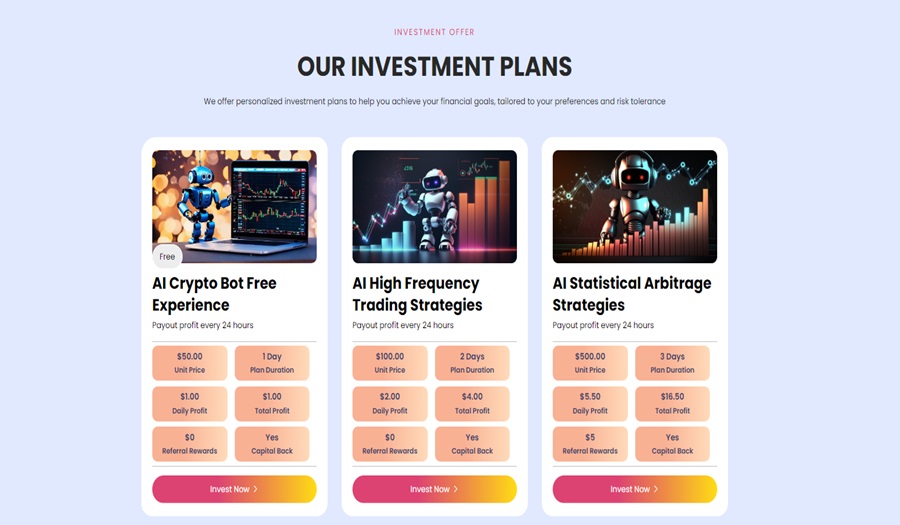
AI High-Frequency Trading Strategies: Invest $100 for 2 days and earn $4 daily.
AI Statistical Arbitrage Strategies: Invest $500 for 3 days and earn $5.50 daily.
AI Cross Market Arbitrage Strategy: Invest $1500 for 7 days and earn $18 daily.
AI Short-Term CTA Strategy: Invest $3000 for 10 days and earn $39 daily.
AI Short-Term Alpha Strategy: Invest $5000 for 15 days and earn $70 daily.
AI Trend Following Strategy: Invest $8000 for 15 days and earn $120 daily.
AI Quantitative Hedging Strategy: Invest $15,000 for 25 days and earn $240 daily.
AI Dynamic Portfolio Strategy: Invest $23,000 for 25 days and earn $391 daily.
AI Capital Weighted Portfolio Strategy: Invest $35,000 for 30 days, earn $630
AI Momentum Investment Strategy: Invest $50,000 for 30 days and earn $950 daily.
AI Growth Investment Strategy: Invest $100,000 for 45 days and earn $2000 daily.
Customize Your Bot: Once you’ve selected a plan, you can set your bot’s preferences. You can focus on market sentiment or try other strategies like arbitrage or trend following.
7. Start Trading: The bot will begin analyzing the market and making trades for you. You can sit back and let it do the work while you monitor the progress.
2. Sentiment Trader
Overview: 4/5 Sentiment Trader specializes in aggregating market sentiment data from social media and news sources. It provides traders with a clear view of market mood, helping them anticipate price movements.
Pros:
Comprehensive sentiment analysis from multiple sources
Alerts for significant changes in market mood
Intuitive interface for easy navigation
Where It Falls Short: Limited integration with trading platforms may require users to manually execute trades based on sentiment signals.
3. 3Commas
Overview: 4/5 3Commas is well-known for its powerful trading tools and features that help traders capitalize on market sentiment. Its smart trading options allow users to set take-profit and stop-loss orders based on sentiment analysis.
Pros:
Highly customizable trading settings for tailored strategies
Integration with various exchanges for flexibility
Comprehensive tools for analyzing market sentiment
Where It Falls Short: The complexity of features may overwhelm new users, requiring a learning curve to fully utilize the platform.
4. Cryptohopper
Overview: 4/5 Cryptohopper combines AI-driven sentiment analysis with social trading features, allowing users to follow successful traders and replicate their strategies. Its marketplace for trading strategies makes it easy to find effective approaches.
Pros:
Access to a marketplace for trading strategies
Automated trading features based on sentiment signals
Strong educational resources for traders
Where It Falls Short: Subscription costs can be high, particularly for users who want access to premium features.
5. HaasOnline
Overview: 4/5 HaasOnline provides advanced tools for market sentiment analysis and trading automation. Its sophisticated algorithms analyze market trends and sentiment data, allowing traders to execute strategies efficiently.
Pros:
Robust sentiment analysis tools for informed decision-making
Automation features for streamlined trading
Strong community support and resources
Where It Falls Short: The platform may be complex for beginners, and some features come at an additional cost.
Conclusion
AI trading bots are changing the game for crypto investors. They make it easier to understand market sentiment and react to price movements faster and more accurately than humans can. With platforms like ValueZone AI, you can take advantage of these powerful tools and improve your trading experience.
By letting the AI bot handle market sentiment, you can make smarter trades without the stress of following the market 24/7. If you want to try out the future of trading, sign up for ValueZone AI today and claim your $50 free bonus to get started!
Solana (SOL) and Rexas Finance (RXS) have recently captured significant attention as top performers in the altcoin market. Solana’s recent whale activity and strong technical indicators showcase the potential for price gains, while Rexas Finance’s innovative real-world asset (RWA) tokenization platform aims to bridge traditional investments with blockchain. Notably, Rexas Finance (RXS) recently sold out the fourth stage of its presale early, bringing the total raised so far to $5.45 million. Stage 5 is already underway at $0.07. As each of the projects promises substantial returns, this analysis dives into the factors distinguishing SOL and RXS, highlighting Rexas Finance’s bold approach to reshaping asset ownership and investment potential.
Solana Market Performance and Investor Interest
Solana’s steady climb in the crypto market owes much to strong whale accumulations and bullish technical patterns. Recently, whales acquired substantial SOL amounts, including one significant purchase of over 153,000 tokens worth $26.4 million. This accumulation trend signals major investor confidence, with notable wallets showing strong interest in SOL’s long-term outlook. Currently, SOL trades at approximately $176.33, experiencing a slight 1.2% daily increase as trading volume spikes by 30%, underscoring active interest from investors and traders.
Rexas Finance’s Revolution in Real-World Asset Tokenization
Rexas Finance (RXS) is capturing investor interest by pioneering a platform dedicated to RWA tokenization, offering a straightforward and borderless approach to asset ownership. From real estate and commodities to high-value collectibles, RXS enables both fractional and full ownership of tangible assets through blockchain. As one of the most expansive asset markets, real estate stands out. Rexas Finance’s platform allows users globally to purchase fractional shares of properties, bypassing traditional barriers like high entry costs. For instance, an investor from North America could own a share in a European property, generating passive rental income without the complexities of direct ownership.
To simplify RWA tokenization, Rexas Finance equips investors with several user-friendly tools. The Rexas Token Builder enables easy tokenization of assets, such as real estate or commodities, creating digital tokens that reflect proportional ownership and increasing liquidity within the market. Another feature, the QuickMint Bot, streamlines token creation through simple commands on Telegram and Discord, broadening accessibility even for new investors. Additionally, the Rexas Launchpad supports token sales for new projects, allowing asset owners to raise funds efficiently, driving growth within the crypto market.
Rexas Finance has achieved notable success with its presale campaign, raising $5.45 million by the end of Stage 4, which sold out recently. The token price is now at $0.07 in stage 5 of the presale. Investors buying RXS in this stage are poised to see a 2.8x return at launch, underscoring growing demand for RXS. Rather than relying on venture capital, RXS chose public presales to allow greater investor participation, further democratizing asset ownership and supporting long-term platform growth.
RXS’s Market Visibility and Community Engagement
Rexas Finance is maximizing exposure and credibility by securing listings on CoinMarketCap and CoinGecko, two platforms that connect projects with over 100 million monthly users. This visibility attracts diverse investors, increasing liquidity and community engagement. Additionally, a $1 million giveaway campaign rewards 20 participants with $50,000 each, enhancing community interest and offering a unique incentive to prospective investors. Beyond token listings, Rexas Finance plans to launch on three major tier-1 exchanges, an ambitious step that will enhance its accessibility and credibility further.
Conclusion: Which Offers Greater Potential?
Both Solana and Rexas Finance offer compelling cases for investors. Solana’s robust price activity and whale accumulation underline its appeal for short-term gains in the crypto market. Yet, Rexas Finance’s commitment to transforming asset ownership through tokenization marks it as a distinct long-term investment. With powerful tools for tokenization, strong presale results, and a clear focus on real-world application, Rexas Finance’s potential extends beyond traditional crypto. For investors seeking life-changing returns, Rexas Finance’s RWA model could represent the next major breakthrough in digital asset investment, making it a unique alternative within the crypto market.
For more information about Rexas Finance (RXS) visit the links below:
Microsoft’s large-scale investment in OpenAI is starting to affect its financial results, revealing the depth of commitment required to sustain cutting-edge advancements in generative AI.
Following its quarterly earnings report on Wednesday, Microsoft disclosed it anticipates a $1.5 billion hit to its income in the current period, primarily due to its OpenAI partnership, as the AI company continues to operate at a substantial loss. While OpenAI has seen remarkable growth in demand for its products, its operational expenses have outpaced its revenue, leading to an expected $5 billion in losses on $4 billion in revenue this year, per recent reports.
The financial situation at OpenAI underscores the high costs of generative AI development, which involves intensive computational demands, ongoing research, and attracting top-tier talent. While OpenAI has demonstrated phenomenal capabilities with its GPT models and ChatGPT, it lacks a clear timeline for profitability. This means Microsoft’s massive investment—approximately $14 billion so far—will likely take years to recoup.
CFO Amy Hood indicated that the losses are recorded under the equity method of accounting, where Microsoft recognizes a proportional share of OpenAI’s profits or losses. Consequently, Microsoft’s financial exposure grows as OpenAI continues its ambitious expansion, including scaling up model production and developing even more advanced AI.
Microsoft’s decision to wait for a return on investment (ROI) signals its willingness to take on long-term risk in exchange for strategic positioning at the forefront of AI technology. Microsoft CEO Satya Nadella has emphasized that, despite the financial burden, the OpenAI partnership remains central to Microsoft’s innovation goals.
Microsoft has successfully incorporated OpenAI’s models into flagship products such as Microsoft 365 Copilot, Azure’s AI offerings, and GitHub Copilot, which collectively draw a revenue stream from these new AI-powered functionalities. While these integrations are promising, profitability from OpenAI itself may remain elusive in the short term due to high operational costs and the enormous scale of computational resources required.
In an effort to diversify its options, Microsoft has begun incorporating other AI models into its offerings to enhance flexibility and broaden its AI ecosystem. Its GitHub subsidiary recently announced that developers will have the choice to use models from Google or Anthropic, an OpenAI rival, to power GitHub Copilot Chat instead of GPT-4. This move broadens Microsoft’s AI capabilities while maintaining exclusivity with OpenAI as its core infrastructure provider. Such strategic flexibility positions Microsoft to remain competitive as the generative AI landscape evolves, especially as rival tech giants like Amazon and Google increase their own investments in AI startups.
Microsoft’s OpenAI investment is part of an industry-wide scramble to lead the AI revolution. Amazon, for example, recently invested $4 billion in Anthropic, whose team includes former OpenAI employees. This competitive environment reinforces the appeal of generative AI as a transformative technology, yet it also highlights the substantial capital and patience required as firms race to optimize AI profitability. Microsoft’s substantial investment in OpenAI, alongside its recent additional $750 million injection, now values the AI company at $157 billion, underscoring how essential Microsoft views AI to its future growth.
Despite reporting stronger-than-expected earnings, Microsoft’s shares fell after the company issued a forecast for slower growth, a response in part to high AI investments that place immediate pressure on profitability. The company has incurred over $2.3 billion in expenses related to the OpenAI partnership in the past four quarters alone. However, Nadella has assured investors that the collaboration is paying off by creating unique intellectual property and driving revenue in new AI product segments.
Ultimately, Microsoft’s OpenAI partnership reflects a long-term commitment, where immediate ROI takes a backseat to strategic positioning in an increasingly AI-driven market. This extended timeline for profitability means Microsoft is playing the long game, investing now in the belief that the eventual returns from AI will be transformative not only for Microsoft’s revenue but also for its competitive advantage.
Whether this investment will yield anticipated gains remains an open question, but Microsoft’s proactive approach and strategic patience signal its dedication to harnessing the potential of generative AI, even as profitability remains on the distant horizon.