DD
MM
YYYY

PAGES

DD
MM
YYYY

spot_img

PAGES

Home Blog Page 274

Changpeng Zhao and Peter Schiff To Debate Bitcoin and Gold Proponents

0

Changpeng Zhao (CZ), the founder of Binance and a prominent Bitcoin advocate, has agreed to debate economist Peter Schiff, a longtime Bitcoin skeptic and gold proponent, on the merits of Bitcoin versus tokenized gold.

The exchange ignited on X (formerly Twitter) on October 23, 2025, following Schiff’s announcement of his upcoming blockchain-based gold tokenization project. While the two have agreed in principle to the debate, no date, format, or moderator has been confirmed yet.

This matchup revives a classic clash in financial circles: digital scarcity (Bitcoin) versus physical scarcity enhanced by blockchain (tokenized gold).

The debate is expected to center on which asset better functions as money—serving as a medium of exchange, unit of account, and store of value—amid Bitcoin’s surge past $126,000 and gold’s record highs above $4,000 per ounce.

On the ThreadGuy podcast, Schiff revealed plans for a mobile app where users can buy, store in vaults like Brinks, transfer, and redeem physical gold via blockchain tokens. He positions it as “the one thing that makes sense to put on a blockchain,” arguing it combines gold’s stability with crypto’s efficiency—enabling debit card spending or instant transfers—without Bitcoin’s “volatility or lack of intrinsic value.”

Schiff has long called Bitcoin a “giant pump-and-dump scheme” that will “go to zero,” while praising tokenized gold as blockchain’s true future. CZ, fresh off a presidential pardon from Donald Trump for his past legal issues, fired back on X, dismissing Schiff’s project as a “trust-me-bro” asset.

He argued that tokenized gold isn’t “truly on-chain” because it relies on third-party custodians for physical storage and redemption, creating risks like management changes or geopolitical instability.

“It’s tokenizing that you trust some third party will give you gold at some later date, even after their management changes, maybe… decades later, during a war,” CZ wrote.

Despite the jab, he praised Schiff’s professionalism and accepted the challenge: “As much as you voice against Bitcoin, you are always professional and nonpersonal. I appreciate that. Can have a debate about it.” CZ added, “Gold won’t go to zero, but Bitcoin is better,” emphasizing Bitcoin’s verifiable scarcity and self-custody.

Schiff’s Formal Challenge: In response, Schiff posted: “I challenge [CZ] to a debate: Bitcoin versus tokenized gold. Which best satisfies the conditions of money, which include being a medium of exchange, a unit of account, and a store of value? Who wants to moderate?”

The banter has sparked widespread buzz on X, with users hailing it as a “clash of monetary philosophies” and speculating on outcomes—some predicting a Bitcoin rout, others seeing tokenized gold as a bridge for mainstream adoption.

Tokenized gold is booming, with the sector’s market cap exceeding $3.75–$4 billion led by Tether Gold at $1.5B+ and PAX Gold at $1.3B+, driven by real-world asset (RWA) tokenization trends. However, critics like CZ echo crypto purists’ concerns: true decentralization requires no intermediaries, a strength Bitcoin holds over gold tokens.

Meanwhile, analysts like Anthony Pompliano note Bitcoin’s outperformance—gaining purchasing power over gold since 2020—hinting at a potential “flippening” in investor preferences. This isn’t Schiff’s first rodeo; he’s debated Bitcoin’s “digital gold” narrative on Fox Business multiple times, always favoring physical assets.

For CZ, it’s a chance to defend Bitcoin’s ethos post-Binance. Potential moderators could include crypto influencers like Anthony Pompliano or traditional finance voices.

Until then, the crypto community is placing informal bets—Bitcoin’s edge in portability and immutability versus gold’s proven 5,000-year track record. Stay tuned; this could shape narratives around RWAs and Bitcoin’s role in the future of money.

London’s Wonder Studios Raises $12 Million to Scale AI-Generated Entertainment

0

London-based Wonder Studios has raised $12 million in seed funding to accelerate production and expand its footprint in the fast-evolving AI entertainment sector, where artificial intelligence has become a vital tool for scaling production and unlocking new creative possibilities.

The funding round was led by Atomico, with participation from existing investors LocalGlobe and Blackbird, marking a strong vote of confidence in the studio’s vision of merging art and technology.

The round builds on Wonder’s earlier pre-seed investment, which included backing from senior executives at ElevenLabs, Google DeepMind, and OpenAI. The company said the new funds will be used to double its engineering team, enhance its proprietary AI production suite, and push deeper into intellectual property (IP) ownership and original content creation.

Founded in London in 2023, Wonder Studios has rapidly positioned itself as one of the leading voices in the global AI creative landscape. Its mission, according to co-founder Justin Hackney, is to make AI storytelling accessible to filmmakers and creators worldwide by lowering the barriers to high-quality production — a goal increasingly shared by startups and studios seeking affordable scalability in an era of rising content costs.

In recent years, AI has emerged as a lifeline for entertainment and technology companies struggling to meet audience demand while managing tighter budgets. From Hollywood studios to streaming platforms, artificial intelligence now plays a key role in automating editing, generating visual effects, writing scripts, and even producing entire scenes. For smaller studios and startups like Wonder, AI technology has provided scaling opportunities once limited to billion-dollar companies, allowing them to compete in a market dominated by traditional production powerhouses.

Wonder has already made a name for itself through projects that blend machine learning and artistry. Earlier this year, the studio produced an AI-generated music video for Lewis Capaldi’s “Something in the Heavens,” working alongside DeepMind, YouTube, and Universal Music Group. The studio also released Beyond the Loop, its first original anthology series that explores human imagination through machine collaboration.

The company is also developing several new projects for 2025, including a documentary with Campfire Studios, the production company behind popular Netflix titles like The Menendez Brothers and America’s Sweethearts: Dallas Cowboys Cheerleaders. Ross Dinerstein, Campfire’s CEO, is among Wonder’s investors, underlining the growing trust between AI-focused startups and mainstream producers.

Wonder’s expansion into IP ownership comes at a time of growing legal tension between Hollywood studios and AI developers. Major production houses such as Disney and Universal Studios have filed lawsuits against AI platforms like MiniMax and Midjourney, accusing them of training models on copyrighted content without consent. These legal battles highlight the complex intersection between creative freedom and intellectual property — a debate poised to shape the future of AI-generated media.

The shift toward AI-assisted creativity isn’t unique to Wonder. Global entertainment leaders such as Netflix are investing heavily in generative AI to streamline production workflows, reduce costs, and enable more personalized storytelling. Netflix recently declared it was going “all in” on AI-powered creative tools to make its production processes more efficient.

However, the copyright controversy continues to follow AI’s growing influence. Many artists and unions argue that large language and diffusion models — often trained on human-generated works — risk displacing creative jobs and undermining fair compensation. OpenAI’s Sora 2, for instance, has faced criticism from performers for allegedly reproducing actors’ likenesses without authorization, intensifying calls for stronger regulation of AI content creation.

Wonder Studios, however, says it intends to use AI responsibly and transparently. The company brands itself as “Hollywood without borders,” promoting inclusivity and accessibility for creators worldwide. Its platform functions as a hub where filmmakers and storytellers can find collaborators, access production resources, and participate in AI-driven storytelling opportunities.

“The next decade will define what creativity looks like in the age of AI,” said Justin Hackney, Wonder’s co-founder and chief commercial officer. “Our mission is to ensure that this future belongs to the storytellers. Working with leading studios, industry pioneers, and grassroots filmmakers, we’re already creating a bridge where technology and artistry grow together.”

Wonder’s trajectory is believed to be a reflection of a broader restructuring of the creative economy, where AI is not just automating production but transforming how ideas are conceived, financed, and distributed. Venture capital firms like Atomico see the rise of AI media startups as a long-term opportunity to democratize storytelling and empower smaller creators to compete globally.

As traditional entertainment companies grapple with rising production costs, prolonged writers’ strikes, and declining theater revenues, AI-driven startups like Wonder Studios represent a new generation of creative enterprises that use technology to scale faster and produce content more efficiently.

With its latest funding, Wonder says it will continue developing original productions while advancing its research into ethical and collaborative AI frameworks. The company’s ambition is to blend human creativity and artificial intelligence into a new art form — one that protects the role of the artist while unlocking new frontiers in storytelling.

MegaETH $MEGA Tokenomics Releases Amid ICO on Sonar By Echo, as Farcaster Acquires Clanker

0

MegaETH—a high-performance Ethereum Layer 2 blockchain targeting sub-millisecond latency and over 100,000 TPS—confirmed the authenticity of its MiCA-compliant whitepaper, officially unveiling detailed tokenomics and utility for its native $MEGA token.

This comes ahead of an ongoing public ICO on Sonar by Echo running until October 27, 2025 and a planned Token Generation Event (TGE) in January 2026. The release emphasizes community alignment, with modest team and VC allocations, and ties emissions to performance-based KPIs rather than fixed schedules.

Backed by investors like Dragonfly Capital and endorsements from Vitalik Buterin, MegaETH positions $MEGA as a utility and governance token powering real-time DeFi, gaming, and AI applications.

Modest VC/team allocations 24.2% total and a $990M FDV at ICO start make $MEGA attractive, with early trading at ~$0.50 5x ICO price signaling strong market confidence. The ICO’s KYC, EU custody requirements, and high minimum bids $2,650 may limit retail participation, though testnet activity and NFT rewards offer alternative entry points.

The total supply is capped at 10 billion $MEGA. The allocation prioritizes long-term ecosystem growth through staking incentives 53.3%, while limiting early unlocks for insiders. Vesting schedules include a 1-year cliff and 3-year linear vesting for team/advisors, and similar locks for sales participants who opt in for rewards.

English auction format; min. bid $2,650 USD, max $186,282; starts at ~$0.099/token FDV ~$990M; requires KYC and EU custody via OKCoin. Community multipliers for testnet activity and social engagement.

Fully diluted valuation at ICO start: ~$990M; already trading at ~$0.50 on Hyperliquid 5x ICO price. $MEGA isn’t just a governance token—it’s integral to MegaETH’s real-time infrastructure, creating demand through staking, auctions, and priority access.

Stake $MEGA to earn from the 53.3% pool, unlocked only when KPIs are met (e.g., ecosystem growth, technical benchmarks). This bootstraps activity without inflationary dumps, with rewards claimable per vesting schedules.

MegaETH uses a single active sequencer that rotates globally to minimize latency. Operators bid/stake $MEGA in English auctions for time slots, ensuring decentralization and low-cost execution. Apps, market makers, and traders lock $MEGA to bid for “sequencer-adjacent” floorspace, enabling tokenized, tradable low-latency access.

An on-chain indexer streams real-time data for millisecond reactions, with fees split between sequencers and the treasury which earns yield on USDm reserves. Vote on protocol upgrades; used for grants via the foundation reserve.

Ties into USDm Ethena’s yield-bearing stablecoin for predictable fees, where sequencer costs are covered by reserves rather than user gas. This design avoids “fee extraction” models, using yield revenue to subsidize operations and keep user costs near-zero.

Register by October 27 via megaeth.com connect wallet, KYC on Sonar, link X/Discord + 3 active wallets. Bidding opens October 27–30; allocations finalized by November 21. EU buyers need MiCA-licensed custody; expect oversubscription given pre-market hype.

Over 210K wallets have interacted; Fluffle NFTs guarantee 5% supply share. Early activity (e.g., via GTE or MegaForge apps) boosts ICO priority and potential retroactive drops. Mainnet Q4 2025; focus on 100K+ TPS with EVM compatibility.

With 53.3% of tokens allocated to KPI-driven staking rewards and only 9.5% for the team, MegaETH prioritizes ecosystem growth and user alignment, reducing insider dumps and fostering long-term trust.

Tying token unlocks to KPIs (e.g., TVL, TPS, decentralization) incentivizes network activity and prevents inflationary oversupply, potentially stabilizing $MEGA’s value.

$MEGA’s role in sequencer bidding, proximity markets, and low-latency access creates organic demand, especially for DeFi, gaming, and AI apps, positioning MegaETH as a high-performance L2.

Achieving 100K+ TPS with sub-millisecond latency could set a new standard for L2s, pressuring competitors to innovate or risk obsolescence.

Farcaster Acquires Clanker, A Major Boost for Base’s Token Launch Ecosystem

Farcaster—a decentralized social protocol built on Optimism and heavily integrated with Coinbase’s Base chain—announced the acquisition of Clanker, the leading AI-powered token launchpad on Base.

This move integrates Clanker’s rapid token deployment tools directly into Farcaster’s social graph, enabling seamless, social-driven meme coin and ERC-20 launches right from Farcaster clients like Warpcast.

It’s a strategic play to blend social networking with on-chain utilities, positioning Farcaster as a one-stop hub for community-backed token creation.

Clanker is an AI “token bot” that simplifies token launches on Base with support for Arbitrum. Users tag @clanker
in a Farcaster post with a token idea (e.g., name, symbol, description), and the bot deploys an ERC-20 token in seconds—no coding required.

Since its launch in late 2024, it has:Generated over $4 million in revenue in its first two weeks alone. Powered viral hits like $ANON anonymous posting tool, bought by Vitalik Buterin, $LUM first AI-to-AI launched token, $BANKR (AI crypto banker), $NOICE, and $BRACKY.

Become Base’s “Pump.fun equivalent,” with 3,500+ tokens issued and daily fees averaging $70K–$200K in peak periods. The $CLANKER token was the platform’s first self-launched token, tying its economics to launch activity.

Farcaster’s co-founder Dan Romero shared the news via a Farcaster frame post titled “clank clank,” confirming the merger. Clanker will be “deeply integrated” into Farcaster apps, allowing users to launch and engage with tokens socially (e.g., tagging for instant deploys).

No financial terms were disclosed, but it’s Farcaster’s first major infrastructure buy—following a rejected acquisition bid from Rainbow Wallet in September 2025.

Immediate tokenomics updates for $CLANKER independent of Farcaster, which has no native token: Fee Flywheel: 2/3 of all protocol fees will buy and hold $CLANKER, creating ongoing demand. The remaining 1/3 supports operations.

3.1M legacy tokens burned; all accumulated ecosystem tokens in the fee vault e.g., 2–5% of supplies like $BANKR, $NOICE were incinerated to reduce sell pressure. 7% of total supply locked in a one-sided liquidity provider position on Base, enhancing stability though it mimics short-term sell pressure.

These changes aim for “responsible and sustainable tokenomics,” per Clanker’s team, with fees now accruing directly to holders instead of idling in treasuries.

$CLANKER surged 50–100% immediately, hitting $44+ from a $22 base, with 24h volume exceeding $25M. Trading at ~$35.4 MC $35.4M as of Oct 24, it’s seen as undervalued given revenue multiples—analysts eye $100M+ caps if Base’s “casino season” heats up.

Ecosystem tokens like $FCAST Clanker’s first official launch and x402 meta plays $KARUM, $HEU are riding the wave.Community buzz on X highlights this as a “game-changer” for Base:” Farcaster acquisition changed the game… $1M weekly buyback on $50M cap.”

This fits a hot week for Base acquisitions (e.g., Echo by Coinbase), signaling maturing M&A in crypto social infra. Farcaster adds “social context” to launches, competing with Zora while attracting builders/AI agents. Expect more AI-meme hybrids, like Aether-Clanker collabs.

Base accelerates “meme manufacturing,” with Clanker’s revenue funneled back on-chain. Base szn feels imminent. Blurs lines between social, AI, and DeFi—launchpads now have “social DNA.” If fees scale (e.g., $40M annual run-rate), $CLANKER could 10x, but watch for volatility in meme meta.

BlockDAG’s Exchange Leak Confirms Kraken and Coinbase Listings: Is This the Next 100x Crypto in 2025?

0

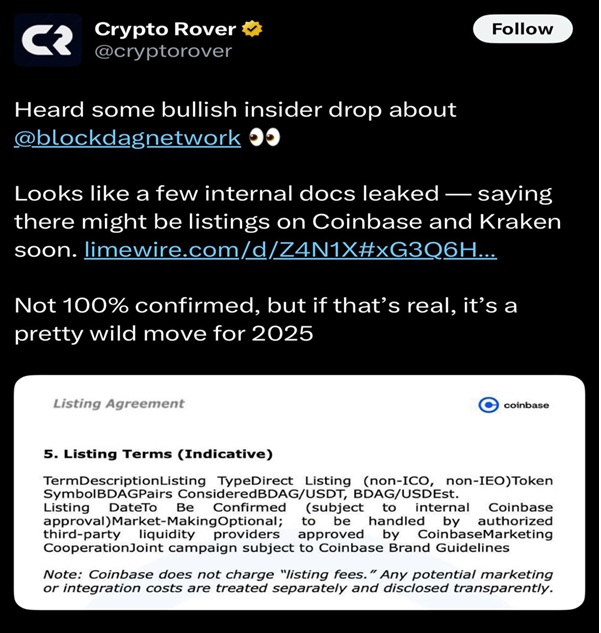
Crypto communities are abuzz as reports surface of a potential BlockDAG (BDAG) exchange listing leak. Two popular influencers hinted that BlockDAG might soon appear on Kraken and Coinbase, sparking a rush of excitement. With presale totals now surpassing $430 million, speculation suggests the project may fast-track its expansion into broader market exposure sooner than anticipated.

The timing couldn’t be more electric. BlockDAG has entered Batch 31, where BDAG coins are available for $0.0015, a rate many traders believe marks the last major low before the mainnet release and Genesis Day. The discussion around possible early exchange listings has spread like wildfire across crypto channels, marking what could be BlockDAG’s shift from presale dominance to potential exchange debut.

Market Outlook

Momentum is rising across top-tier cryptos, yet the conversation is increasingly focused on projects that show measurable progress before going public. BlockDAG’s consistent growth, paired with whispers of Kraken and Coinbase integration, has ignited anticipation throughout the market.

Rumors like these often arise from credible cues. Influencers frequently spot early signs of integration or backend testing prior to official releases. Should these indicators hold true, BlockDAG could leap from community awareness to global visibility almost instantly.

A dual listing on Kraken and Coinbase would grant immediate liquidity and credibility to a network already ranked among the top crypto coins in 2025. Even in the absence of confirmation, the positive sentiment surrounding BlockDAG reflects increasing confidence in its structure, transparency, and long-term potential.

BlockDAG Listing Buzz and Presale Surge

Speculation reached new highs after Crypto Rover and MartiniGuyYT shared posts implying that BlockDAG could be heading toward listings on Kraken and Coinbase. Within hours, conversations intensified across Telegram and X communities as users examined the timing and content of the posts. Both influencers remained silent afterward, while BlockDAG’s official accounts issued no confirmation, further fueling curiosity.

If the hints prove true, the milestone would mark a defining expansion phase. Kraken and Coinbase are recognized for their rigorous listing procedures and preference for transparent, results-driven projects. BlockDAG has proven its consistency through technical progress and verified delivery. With its presale now exceeding $430 million and Batch 31 coins priced at $0.0015, its fundamentals continue to strengthen. The project’s technology merges Layer 1 blockchain reliability with DAG’s scalability, reaching speeds between 2,000 and 15,000 transactions per second.

Its ecosystem is powered by Proof of Engagement for X1 mobile miners and Proof of Work for the X Series hardware devices. Dashboard V4 offers real-time data on performance, wallets, and referrals. Currently, more than 3.5  million X1 users and around 20,000 hardware miners contribute to BlockDAG’s network. With confirmed partnerships involving 20 exchanges, the stage appears set for major exchange listings to become reality soon.

Why the Leak Has Sparked Intense Reactions

This news comes at a critical moment when presale batches are nearing completion. The $0.0015 price in Batch 31 might be the final chance for buyers before the next price increase. As rumors of Kraken and Coinbase listings broke out, urgency spiked within trading groups. Many now speculate that official exchange news might align with the Genesis Day event on November 26, symbolizing BlockDAG’s full network activation.

Market watchers note that such leaks rarely appear without groundwork in place. The project’s ongoing miner sales, infrastructure audits, and expanding ecosystem point to readiness for listing. These reports have served as a catalyst, transforming the presale stage into a race toward launch. Analysts describe this period as BlockDAG’s defining acceleration phase, one that could elevate it to mainstream adoption before its official debut.

Final Say

While Kraken and Coinbase listings remain unverified, their mere suggestion has significantly boosted market enthusiasm. BlockDAG now stands as one of the most discussed crypto launches of the year. With over $430 million raised, Batch 31 live, and the limited $0.0015 offer in place, many buyers are rushing to secure holdings before the next price jump.

Every day without official confirmation only heightens curiosity ahead of Genesis Day on November 26. Whether or not these leaks are validated, BlockDAG’s unmatched delivery, scale, and credibility have secured its position among the top crypto coins 2025, gearing up for its shift into the global exchange arena.

Presale: https://purchase.blockdag.network

Website: https://blockdag.network

Telegram: https://t.me/blockDAGnetworkOfficial

Discord: https://discord.gg/Q7BxghMVyu

AMD and IBM Shares Surge After Breakthrough in Quantum Computing Collaboration

0

Shares of Advanced Micro Devices (AMD) jumped nearly eight percent on Friday after reports confirmed that IBM had successfully used AMD’s chips to run a quantum computing error correction algorithm.

The development marks a milestone that could accelerate progress toward fault-tolerant quantum systems. IBM’s stock also gained about eight percent, marking its best day since January, as the breakthrough drew global attention from investors and researchers alike.

According to Reuters, a scientific paper scheduled for publication next week will detail how IBM’s quantum researchers used AMD’s field-programmable gate array (FPGA) chips to execute an advanced quantum error correction algorithm. This represents one of the most significant steps yet in overcoming the instability that has long hindered the practical use of quantum computers.

An IBM spokesperson confirmed the report to CNBC, calling the achievement “a milestone in our clear path toward the 2029 projection” of building a large-scale fault-tolerant quantum computer.

IBM said the development shows it is possible to scale quantum systems without relying on expensive GPU clusters, a cost barrier that has restricted the technology’s broader adoption.

“Designing and implementing a way to do this at scale, and without requiring expensive GPU clusters, is a significant achievement to scaling useful quantum computers,” the company said.

This latest advancement stems from a partnership between IBM and AMD announced in August. The two companies said they would jointly develop new capabilities in quantum computing and artificial intelligence, combining their hardware and software strengths to accelerate progress in data processing and next-generation computing. IBM has reiterated its plan to debut a “large-scale, fault-tolerant quantum computer” by 2029, and this development reinforces its timeline.

Quantum error correction, the process of detecting and correcting faults that arise from the fragile nature of quantum bits, remains one of the hardest challenges in the field. The new method demonstrated with AMD’s FPGA chips marks a breakthrough that could reduce the cost and complexity of scaling quantum systems, potentially opening the door for commercial applications much earlier than previously expected.

The news triggered optimism across the broader quantum computing sector, sending shares of smaller quantum players like D-Wave Quantum, Rigetti Computing, and IonQ higher on Friday. Some believe the development could mark one of the defining moments in the transition from theoretical to applied quantum computing, with implications far beyond research labs.

The announcement also gives AMD a strategic foothold in an emerging frontier that blurs the line between quantum and classical computing. For years, Nvidia has dominated the market for AI hardware, controlling more than ninety percent of the data center GPU segment. However, AMD’s involvement in IBM’s quantum research shows the company is expanding its technological base beyond CPUs and GPUs into the realm of hybrid systems that combine programmable logic with quantum hardware.

Analysts have long noted that AMD’s presence in the GPU market has faced limitations compared to Nvidia’s overwhelming dominance. A recent analysis by SemiAnalysis pointed out that AMD faces a significant competitive disadvantage compared to NVIDIA… primarily due to limited availability and reduced market competition. The IBM collaboration could help AMD broaden its market exposure, especially in areas that leverage its FPGA technology, offering an alternative path to compete outside Nvidia’s stronghold.

Nvidia remains the industry leader in AI processing, with its graphics processors powering most large-scale artificial intelligence systems globally. The company is also expanding into quantum computing. In March, Reuters reported that Nvidia plans to open a quantum computing research lab in Boston in collaboration with scientists from Harvard and MIT. Nvidia Chief Executive Jensen Huang recently said that “quantum-classical computing… is clear now we’re within reach of being able to apply [it] in areas that can solve some interesting problems in the coming years.” Nvidia’s strategy suggests it sees hybrid quantum architectures as a natural extension of its existing GPU dominance.

Intel, on the other hand, has struggled to regain its footing in the AI and accelerator markets. A report by Seeking Alpha noted that Intel’s AI accelerator strategy has been largely reactive, “trying to take whatever business AMD cannot take, like that from Nvidia.” Intel has made advances in quantum control systems through projects such as its Horse Ridge chip, developed with QuTech, but it is not considered a front-runner in full-scale quantum computing. The rise of AMD and Nvidia in the AI and quantum ecosystem adds further pressure on Intel to define a clear role as the industry evolves.

The AMD-IBM collaboration also reflects a broader trend toward diversification in computing infrastructure. Quantum-classical hybrid systems are expected to rely on varied hardware combinations—ranging from FPGAs and GPUs to quantum processors—to handle different workloads efficiently. AMD’s chips, now proven capable of supporting quantum error correction algorithms, could become essential components in these hybrid frameworks.

From a strategic standpoint, this development offers AMD a path to expand beyond the intense competition of the GPU market, where Nvidia remains far ahead. By focusing on specialized computing through FPGAs and hybrid quantum integration, AMD can address new markets that emphasize flexibility, scalability, and cost efficiency—areas where traditional GPU architectures may be less optimal.

The collaboration also underscores the growing convergence between AI and quantum computing. As IBM’s Chief Quantum Scientist Jay Gambetta has explained, the company’s roadmap focuses on modular quantum systems that can scale through distributed networks. That approach naturally aligns with AMD’s hardware capabilities, allowing it to play a key role in connecting classical and quantum systems within practical, real-world applications.

In the broader market, the success of the AMD-IBM partnership could reshape investor perceptions. The Trump administration on Thursday denied reports that it was in talks to acquire stakes in U.S. quantum companies, reaffirming its commitment to supporting private-sector innovation in advanced technologies, including quantum and AI.