DD
MM
YYYY

PAGES

DD
MM
YYYY

spot_img

PAGES

Home Blog Page 2764

Netflix Faces Slower Subscriber Growth as Password Sharing Crackdown Shifts Focus to Ad Revenue

0
London, UK - August 01, 2018: The buttons of Spotify, Podcasts, Netflix, WhatsApp and Music on the screen of an iPhone.

Netflix, an American subscription video-on-demand streaming service, is expected to report its slowest subscriber growth in the last one and half years on Thursday, as the initial surge from its password-sharing crackdown begins to fade.

As part of a shakeup that began in mid-2022, Netflix has been blocking the previously widespread practice of sharing subscriber passwords with friends and family living in other households.

Since this implementation, Netflix has seen its subscriber and earnings growth accelerate in the last quarter, and has picked up nearly 55 million more paying customers, pushing its worldwide subscriber count to nearly 278 million through June this year.

Netflix added 8 million subscribers during the April-June period, marking a 37% increase over the same time last year. It was the sixth consecutive quarter, that Netflix’s subscriber gains have increased from the previous year.

The company’s profit in its latest quarter rose 44% from last year to $2.15 billion, or $4.88 per share, a figure that exceeded the estimates of analysts. Revenue climbed 17% from last year to $9.56 billion, also eclipsing analysts projections.

However, the company, subscribers gains from the password-sharing have begun to fade, prompting the company to sharpen its focus on selling more ads for its low-priced option, which the company said ended June with a 34% increase in total subscribers from March. It didn’t detail precisely how many of its worldwide subscribers have chosen to watch ads for the cheaper price.

Meanwhile, despite the widening audience for commercials, Netflix said it doesn’t expect advertising to be a major source of revenue growth until 2026 at the earliest. “Ads are going to be a bigger piece of the puzzle, but it won’t be in 2024 or 2025”, Spencer Neumann, Netflix’s chief financial officer, told analysts during a conference call.

As subscriber growth decelerates, Netflix is pivoting its focus to other key metrics, such as revenue growth and profit margins. Notably, the company plans to stop reporting subscriber data after 2025.

“Their focus is to continue growing subscribers at a healthy rate while also leveraging their scale to raise prices and boost advertising dollars,” said Pivotal Research analyst Jeff Wlodarczak.

Netflix’s ad-supported tier has shown growth, but the company has yet to disclose specific financial details. Analysts do not expect this tier to become a significant growth driver until 2026, raising concerns about the platform’s long-term trajectory. “They’re making less than a billion dollars a year on U.S. advertising, which doesn’t look impressive,” commented Ross Benes, an analyst at Marketer.

Some experts suggest that Netflix may need to raise prices and phase out more of its ad-free plans to steer customers toward its ad-supported tier, which tends to generate higher revenue per user. Notably, investors are now focusing on Netflix’s ability to leverage its advertising business for future growth.

The company, which operates in more than 190 countries, is expected to report ad revenue of $242.7 million in the third quarter, according to the average of estimates from three analysts compiled by LSEG. Overall revenue is expected to grow 14.3%, a slightly slower pace than the previous three months, to $9.76 billion.

Nigeria Can Use Purchase Agreement Framework To Revamp The Economy

1

Comment: “Commendable thought leadership on how you used the US postal service and Amtrak rail line to take a position that a government can actually subsidize, and lose money, and still achieve economic growth strategically. But what do you say about Nigeria’s excessive importation?”

My Response:  Thanks for the kind words. Yes, USPS has not made profit in more than two decades and the Amstrak line has not recorded a profit since 1971. The US government has not shut them down unlike how Nigeria took down NIPOST and Nigeria Railways. I am an apostle of efficient subsidies. Nigeria subsidized my university education and I think it was a great investment (lol).

On import, I do not think Nigeria imports a lot. So, I do not agree on that “excessive” importation mindset.  This is a TV pundit talking point with shallow understanding on critical enablers we need to rebuild Nigeria. And when we see the absolute size of the imports, we flip, triggering a mess in the FX regime. This has been happening for more than a decade in the nation.

Yes, the real focus should be “what are we importing?” and how we can use policies to change what we import and how we import. In Nigeria, for decades, we are not importing enough, and most especially, the little we import is the wrong category of imports. Unless we can discriminate at that category level at the policy level, we can put a policy that import is bad, and in the process stymie the ability of companies to actually import the right things.

Follow me: in 2022, South Korea’s total imports were $808.09 billion while Nigeria did about $60.35 billion for goods; South Korea is about 25% of Nigeria’s population. But if you check, South Korea imports were largely machinery, equipment, etc for production, while Nigeria’s were for finished goods. Also, in 2022, goods worth around $136.21 billion were imported into South Africa, with many of those industrial equipment. Check – more imports have not destroyed South Africa and South Korea’s currencies!

My position is this: if the economic team is afraid of subsidies, they should design a purchase agreement framework where the government commits to buy finished products from local companies. In other words, you can say, if you produce electric bulbs in Nigeria within a specified time, we commit to buy $500k worth. That will stimulate local capital formation as companies will use that document to look for capital knowing that a guaranteed customer is there. 

Once they supply to the government, the government resells to uptakers. Just like that  you can stimulate a virtuous circle, and depart from the scene, even as you increase tariff on imports of bulbs, and concurrently encourage purchase of equipment to make bulbs in Nigeria. Understand that under a purchase agreement regime, the government will not lose money to briefcase business people since it is only going to pay for finished products! This will stimulate the capital market, create local products and boost our balance of payment.

Wow – you may think. But that is what we are partially doing with Geregu Power and Transcorp Power and they are trillion Naira companies. They generate power and sell it to the government. You can do that in other sectors. Politically, no subsidies but the impact is the same. Nigeria must work!

Comment here

My ResponseI lived in Ovim and all the villages along Railway lines in Southeast were on average developing faster than others. Why? Many people used their markets because of access to transportation. People built houses, small hotels, etc around the railway station because some people, from far away areas with no railway, would have to sleep to catch the train early. The value of garri, yam, etc went up because buyers from Aba, Enugu, etc used the train to come and buy. When the station collapsed, many bad things happened because those opportunities froze.

If you are a government as the US does, someone could have modeled: we are losing $100k on this route on ticket, but this route is generating $1m economic activity. When VAT and all taxes are applied on that route, we are getting $150k. Route stays,

Since the railway and postal service collapsed, poverty has scaled in Nigeria’s rural areas because of a poor supply chain. The Ovim Oriendu Market has lost size as only the villagers attend it. The traders from Enugu, Aba, etc have stopped coming as there is no train to move the garri. My brother, I do not need an economist on this because my Raleigh bicycle was always on duty, moving bags of garri from the market to the train station. In short, every kid has a bike to move things: you could make small money doing that!

Jumia to Exit South Africa And Tunisia by The End of 2024, as Part of Strategic Refocus

0

Jumia, Africa’s leading e-commerce platform, has announced plans to shut down operations in South Africa and Tunisia by the end of this year, marking a strategic shift to focus on higher-growth markets with stronger potential for profitability.

This decision comes as part of Jumia’s broader effort to cut costs and improve its financial standing, which has remained elusive despite its leading position in the African e-commerce space. The departure from these markets, will allow Jumia to focus resources in its most promising markets that have a stronger growth potential.

For the year ended December 31, 2023, and the six months ended June 30, 2024, South Africa and Tunisia combined accounted for only 3.5% and 2.7% of total orders, and 4.5% and 3.0% of GMV, respectively. The strategic decision to close operations in these markets is expected to improve overall operational efficiency across Jumia’s business.

“After a thorough analysis, we decided to close down our operations in South Africa and Tunisia. Both businesses account for a negligible portion of our overall operations,” said Jumia CEO Francis Dufay in a recent statement.

Dufay added, “Competitive and macroeconomic conditions in both markets have limited each country’s growth potential, and their contribution to our overall business has not aligned with expectations. These decisions are never easy, and we are extremely grateful to the team members in both countries who worked tirelessly to serve our customers.”

Since he took over as CEO, Dufay has been pursuing a cost-cutting strategy, part of which led to the cutting of about 900 jobs in February 2023, 20% of its general workforce. The company also shut down Jumia Foods across several African countries, including Nigeria, Kenya, Morocco, Ivory Coast, Tunisia, Uganda, and Algeria by the end of December 2023.

Despite Jumia Food contributing 11% to Jumia’s overall gross merchandise value, it consistently operated at a loss in the North, East, and West African countries where it operates. Dufay’s focuse on reducing Jumia’s operating losses and setting the company on a clear path to profitability, have continued to yield positive returns, after the company in July this year, saw its market cap surpass $1.33 billion.

The surge in market rally marked a notable shift in fortunes for the company, which has experienced a rollercoaster ride as a publicly traded company since its debut on the New York Stock Exchange in April 2019.

The recent exit from South Africa comes shortly after the country’s largest online retail group, Takealot, announced the sale of its fashion business Superbalist in response to intensifying competition from Chinese fast-fashion e-commerce platforms Shin and Temu. The closures are expected to result in the loss of around 110 jobs, though some employees may be relocated to other parts of Jumia’s operations.

While the closures are significant, Jumia’s broader challenges have been driven by currency depreciation in key markets like Nigeria and Egypt. Despite a rise in order volumes, the company reported a drop in total order value to $170 million in Q2 2024.

As Jumia gears up for its upcoming earnings report, the company aims to restore investor confidence through improved financial performance and a potential rebound in its stock price. To bolster its growth strategy, Jumia recently raised nearly $100 million through secondary share sales and expanded its supplier base and logistics network. Remaining markets, including Egypt, Kenya, Morocco, and Nigeria, are expected to help the company recover lost volumes from South Africa and Tunisia.

Nigerian Judiciary Should Allow Class Action and Open Advertisements

0

Our prayers to the victims and their families as another petrol tanker accident happens in Nigeria. According to BBC World Service, this morning, more than 90 people died when a tanker exploded as people gathered to scoop fuel. The accident took place in Jigawa. We truly pray for strength to all affected.

But as that happens, I want to ask the Nigerian judiciary/National Assembly to consider making some changes in our rulebook. I know nothing about the law but that does not mean I cannot comment as a citizen. My understanding is that in Nigeria, the ethical rules governing legal practice forbid open advertisements. In other words, a lawyer cannot openly go to a newspaper, TV station, etc and advertise for clients.

I find that rule very intriguing since after used car salespeople, in America, lawyers possibly hold the ace on local advertising. Yes, they advertise everywhere – TVs, billboards, radios, etc. Does it mean the US legal system is not ethical? What is wrong advertising for the “wronged” to come out to get help. I do not get the “ethical issue” here.  “I am a lawyer, I sue companies which make bad medical equipment. If you have been a victim of ABC product, call me. I will get help for you”. What is unethical about this?

Good People, can Nigeria change this rule so that victims and lawyers can sue the owners of these trucks in GROUPS. Yes,  I do think that the Nigerian legal system should allow lawyers/law firms to advertise under class action [a civil lawsuit where a group of people with similar claims are represented by one or more plaintiffs] and recruit clients so that we can put pressure on the many issues in the nation including the use of dangerous petrol tankers on the road.

Those trucks keep breaking. If the owners know the consequences, hopefully breakdowns will drop as class action can put legal pains on the owners. (The fuel scoopers are not my focus here)

In America, everyone fears trial lawyers but those trial lawyers will not work without the ability to use Facebook, TVs, radios, etc, to recruit victims which strengthen their cases. In Nigeria, I am told that such open recruitments are illegal and unethical…WHY and HOW?

RCO Finance Can Easily Turn $500 to $50k Before Dogecoin and Shiba Inu, Says DOGE Whale

0

As the crypto market rallies, top meme coins like Dogecoin (DOGE) and Shiba Inu (SHIB) have raked in noteworthy weekly gains. However, investors are turning to RCO Finance (RCOF), a new Ethereum token that has showcased the potential to surge 100x before the end of 2024.

Why is RCO Finance (RCOF) poised to outshine Dogecoin (DOGE) and RCO Finance (RCOF)? Read on to find out!

Dogecoin and Shiba Inu Enter The Green Turf? Will Bulls Hold?

The crypto market has finally overcome the bearish trend that had engulfed it at the start of October. With Bitcoin (BTC), currently trading around $65,300, at the forefront, this renewed rally has seen the top 2 meme coins recover and surge notably by capitalization.

Dogecoin (DOGE) has gained 8% over the past week. On October 8, DOGE was trading around $0.1074.

After trading around this range for days, DOGE gained momentum on October 14, mirroring Bitcoin’s price action. By October 15, Dogecoin (DOGE) had climbed as high as $0.1187 before stabilizing at around $0.1159.

Meanwhile, Shiba Inu (SHIB) has recorded a 5% weekly surge. Shiba Inu opened trading on October 1 at around $0.00001713.

Like Dogecoin, SHIB traded sideways for days before Bitcoin’s influence on the altcoin market saw it pump. By October 15, Shiba Inu (SHIB) had risen as high as $0.00001892 before stabilizing at around $0.00001829.

While these Dogecoin and Shiba Inu gains might be a precursor to more growth, both altcoins are prone to wild price swings.

As such, a random crash in Bitcoin might trigger massive losses. This explains why this DOGE whale believes RCOF will surpass Dogecoin and Shiba Inu to turn a $500 investment into $50,000.

RCOF: An Exceptional Investment Opportunity

RCOF has emerged as a better investment than Dogecoin and Shiba Inu because its limited supply of 800 million tokens underpins its long-term growth. It is also worth pointing out that RCOF has a deflationary tool that burns tokens RCO Finance buys back from the open market.

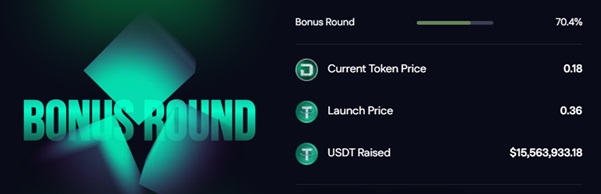
Investors are also increasing their exposure to RCOF because of its presale’s growth potential. By October 15, the RCOF presale had raised over $3.38 million in funding, showcasing growing investor interest. Amazingly, RCOF has attained this breakthrough despite being in the early stages of its presale.

RCOF is currently in Stage 2 of its presale, and investors have a rare opportunity to purchase this high-potential token at $0.0344. This price will increase to $0.0558 when RCOF starts Stage 3 and continue rising until the token completes its presale at $0.4-$0.6.

Furthermore, experts expect RCOF to overshadow Dogecoin’s 7,200% surge in 2021 by Q4 2024. This forecast explains why this Dogecoin whale believes RCOF is the best pick for a chance to turn a $500 investment into $50,000.

This whale is also bullish on RCOF because the smart contract audit conducted by SolidProof, a leader in blockchain security, verified its safety.

RCO Finance: A Next-Gen AI and Blockchain-Powered Trading Platform

Dogecoin and Shiba Inu are mostly speculative traders always searching for the next big opportunity. As such, they have flocked to RCO Finance to seek such opportunities. RCO Finance has become the favorite investment platform for these investors because it supports over 120,000 assets across 12,500+ classes.

RCO Finance’s offering comprises crypto, tokenized real-world assets (RWAs), and decentralized derivatives like swaps, options, and futures. RCO Finance offers free access to its top feature, an AI-powered robo advisor, to simplify the trading of these assets.

This game-changing tool uses complex algorithms and machine learning to offer investors customized data-based investment recommendations. These recommendations assist investors in making informed decisions on which assets to buy or sell and when to initiate these transactions for maximum profitability.

On top of this, the robo advisor can trade automatically, freeing investors from the hassles of analyzing the market. This level of automation also enables the robo advisor to buy assets at the start of bullish cycles, ramping up profits and minimizing risk.

More Features To Boost Profits

Apart from its robo advisor, RCO Finance has captured the attention of Dogecoin and Shiba Inu investors because it supports lending and staking. These features help investors earn passively even when the market is performing poorly. In addition, RCO Finance issues non-KYC debit cards to simplify spending on cryptocurrencies.

These features explain why you should embrace RCO Finance and start investing like a pro.

For more information about the RCO Finance Presale:

 Visit RCO Finance Presale

Join The RCO Finance Community