
DD
MM
YYYY

PAGES

DD
MM
YYYY

spot_img

PAGES

Home Blog Page 2932

What is Maximal Extractable Value (MEV)?

0
what is Maximal Extractable Value (MEV)?

Maximal Extractable Value (MEV) has recently gained attention in the cryptocurrency space. It refers to the ability of miners or validators to profit by controlling the order of transactions within a block. MEV is often considered a hidden cost that can affect users and raise concerns about fairness in the blockchain ecosystem.

While transactions await confirmation in the mempool, that is, a public queue before the transactions are added to the blockchain, miners or validators can influence which transactions are included and their order. This ability to manipulate transaction processing can lead to various revenue opportunities for those with block control.

Although MEV is often linked to Ethereum due to its advanced smart contracts, it can affect any blockchain, regardless of the consensus method. So, what is MEV, and how does it work? Let’s take a closer look.

What is MEV?

A blockchain’s Maximum Extractable Value (MEV) is the amount of money miners or validators may extract by manipulating transaction arrangements within a block. This includes making the most of their capacity to reorder, include, or exclude transactions to increase their profit. MEV, in essence, allows block producers to earn extra profits beyond conventional block rewards and transaction fees by altering transaction processing.

History of MEV

Maximal Extractable Value (MEV) was earlier addressed in 2014 by the algorithmic trader Pmcgoohan as an opportunity for miners to profit from their control over transaction ordering. In 2019, Phil Daian and his team defined the phrase “Miner Extractable Value” in the “Flash Boys 2.0” publication, which detailed certain data concerning miners reordering transactions for profit. After Ethereum migrated to the Proof of Stake model in 2022, the term Maximization Extractable Value expanded to include validators with miners.

How Does MEV Work?
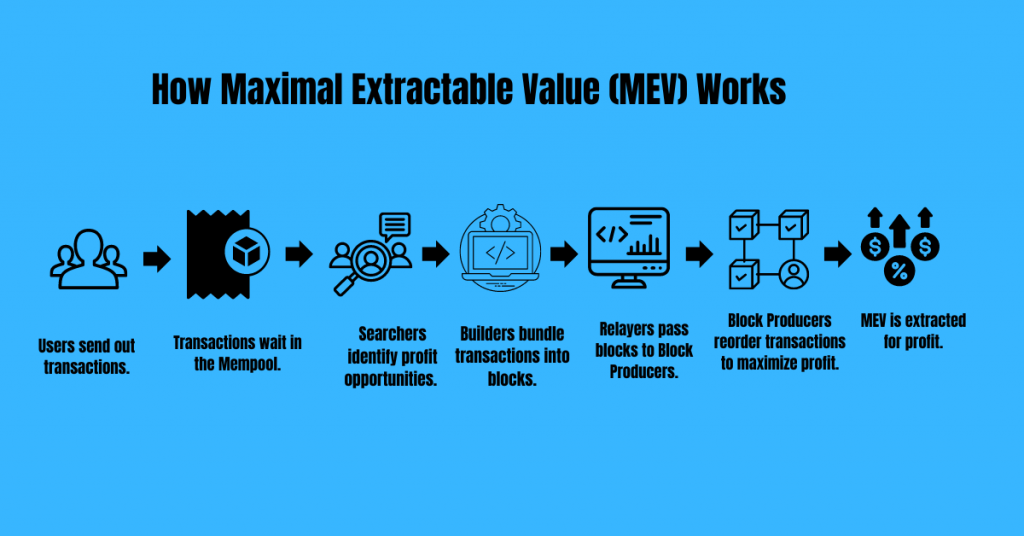
Illustration Explaining How Maximal Extractable Value (MEV) Works

In order to understand how Maximal Extractable Value operates, you must first know how block producers play a role.

Block producers, which consist of miners in a Proof of Work system or validators in Proof of Stake, select transactions and sequence them within a block. They can reorder, include, or exclude transactions, which may create opportunities to extract additional value beyond standard fees. This ability allows them to profit from opportunities such as arbitrage or liquidation.

Searchers, who are mostly independent operators using sophisticated algorithms and bots, do identify these profit opportunities. To profit from transactions, they package them in bundles and send them to builders, who are responsible for aggregating these bundles into complete blocks. In some systems, particularly with Ethereum’s transition to PoS and Protocol/Builder Separation (PBS), builders pass these blocks to relayers. These relayers serve as intermediaries, passing blocks from builders to block producers, including validators in Proof-of-Stake (PoS) systems.

With Ethereum’s transition to PoS, validators now take on the role of block producers and must adapt to new mechanisms like PBS to manage MEV. This shift has propounded several innovations for MEV extraction and introduced a different dynamic in how transaction sequencing impacts value extraction. PBS differentiates between the activities of block production and transaction ordering. This minimizes the validators’ impact on MEV and makes the block production process more equitable and transparent.

Maximal Extractable Value (MEV) involves strategies that exploit network inefficiencies for profit.  Here are some prominent MEV approaches:

Arbitrage

This tactic capitalizes on price discrepancies between markets. For instance, when a token is available at a lower price on one decentralized exchange (DEX) compared to another, bots can purchase it at a lower rate and then sell it for a higher price on a different exchange. This practice, though highly competitive, helps align token prices across exchanges.

Front-Running

In front-running, bots detect pending transactions in the mempool and execute their own transactions first to benefit from the anticipated price movement. For example, if a bot notices a big buy order coming through, it might place its own buy order with a higher gas fee to make sure its order is processed first, allowing it to benefit from the price change that follows.

Sandwich Attacks

This malicious strategy involves placing transactions before and after a target trade. For instance, if a large swap order is detected, a bot might purchase the token before the trade goes live to increase the price and sell it to the target trade at the inflated price. This exploits the slippage in the target’s transaction.

Liquidations

In DeFi lending, if the collateral backing a loan decreases in value and falls below the required threshold, the loan can be subjected to liquidation. MEV bots can identify such opportunities, purchase the collateral at a discounted price, and sell it for a profit after repaying the loan, similar to margin calls in traditional finance.

How to Protect Against MEV Attacks

While MEV attacks can occur, certain strategies can help to minimize the risks. Below are some of the ways to prevent MEV attacks:

MEV Auction Mechanisms

Adopt auction-based systems where participants bid for transaction placement. This method ensures that transaction inclusion rights are fairly distributed. This diminishes direct MEV extraction by promoting a more open and competitive process.

Protect RPC Endpoints

Send transactions through RPC endpoints that link to private mempools. This technique hides transactions from the public mempool, thereby shielding them from being detected and manipulated by search bots until they are finalized on-chain.

Private Transaction

Use services that allow you to submit transactions directly to miners, bypassing the public mempool entirely. This practice keeps transaction details confidential and prevents potential attackers from exploiting them before they are included in a block.

Slippage Controls

Implement rigorous slippage limits to restrict how much the trade price can vary from the initial expected price. This strategy helps reduce vulnerability to manipulation tactics like sandwich attacks, which exploit price changes to extract value.

Anti-MEV Features on DEXs

Use decentralized exchanges that have features to counteract MEV. Features such as transaction commitment schemes or novel ordering techniques can help prevent front-running and other forms of exploitation.

Protocol Upgrades

Support and integrate blockchain protocol tools aimed at reducing MEV opportunities. Upgrades that refine transaction ordering and block production can make it more challenging for MEV strategies to succeed.

What are the Advantages of MEV?

Maximal Extractable Value (MEV) offers several notable benefits to the blockchain despite its controversial flaw.

Firstly, MEV can increase market efficiency. Through the exploitation of price discrepancies and other opportunities, MEV helps to address inefficiencies in decentralized markets. This activity contributes to better resource allocation and more accurate pricing, ultimately improving the efficiency of blockchain networks.

Incentivizing liquidity provision is another advantage of MEV. In decentralized finance (DeFi), liquidity providers are rewarded, a process often influenced by MEV activities. This incentive structure boosts liquidity, making DeFi platforms more functional.

Furthermore, DEX arbitrage represents a positive application of MEV. Arbitrage bots exploit price differences across exchanges, stabilizing token prices and increasing market efficiency. This process benefits the ecosystem by ensuring more consistent pricing and enabling more participants to engage in arbitrage without incurring losses.

MEV can also improve blockchain security. The competitive environment it fosters among miners or validators to secure block production can strengthen overall network security.  MEV facilitates rapid liquidations in DeFi lending, ensuring that lenders are repaid when collateral values fall, which helps maintain the stability of lending platforms.

What are the Disadvantages of MEV?

Maximal Extractable Value (MEV) poses significant drawbacks in blockchain. It often leads to unethical behavior, such as front-running and sandwich attacks, which exploit users by manipulating transaction prices to their disadvantage. This practice drives up transaction fees and reduces liquidity, making the network less efficient and more costly for everyone.

Additionally, MEV can lead to a concentration of wealth and power, undermining the network’s decentralization. In extreme cases, the potential for MEV to surpass block rewards may incentivize miners to reorganize previous blocks, leading to consensus instability and network integrity compromise.

Final Thoughts

Maximum Extractable Value (MEV) refers to the profit that miners or validators earn by controlling the order of transactions within a block on the blockchain. Although it could create incentives in decentralized finance, it is problematic due to higher transaction fees and unethical behavior. To tackle these issues, use safety tools such as MEV auction mechanisms, slippage control, private transactions, RPC endpoints, anti-MEV features, and protocol updates that achieve a healthy balance of MEV advantages and the need for a safe blockchain environment.


The Nigeria’s Post-Petroleum Era by Ndubuisi Ekekwe [ebook]

0

Nigeria is not planning for its post-petroleum era very well. I have put an ebook on the implications of this stasis, and how the nation can overcome the challenges…excerpts.

“Africa and indeed the whole world are emerging with enormous challenges and opportunities. As the twilight era of petroleum arrives, either by the wells drying up or advancements in alternative energy sources diminishing its global importance, Nigeria as a nation must plan to transmute into the inevitable post-petroleum era…That planning must be holistic, innovative and fluidic and offer pragmatic mechanisms for cooperation and conflict management, economic vibrancy, and technology creation. A Nigeria of openness – to goods and services, ideas and inventions, people and culture – where all tribes will share in unified dream and destiny of unlimited promise and hope. “

“Though we have size, the 21st century is not necessarily a century of size. It is a century of knowledge-workers-population. It is either the size of Nigeria weakens it to advance faster from the challenges of the post-petroleum era or it helps it to leapfrog. But one thing is clear: the economic, diplomatic, and social power that will arise and how we would be perceived will be accidental and unfortunate (if there is no preparation).”

Summary, Nigeria needs Leadership: “A person who can engineer Nigeria into rebirth and restoration to offer a prosperous nation that is colorful, fluidic, vibrant and open for change. Yes, a person of immense intelligence, competence, pragmatism, and unimpeachable. A person of integrity, broad knowledge, enormous vision and solid experience; one that can stimulate more vibrancy in the private sector and move the public sector out of its stasis. He/she must tackle corruption and stabilize democracy. “

From Ndubuisi Ekekwe’s “The Nigeria’s Post-Petroleum Era”, a short ebook on Nigeria’s post-hydrocarbon future [free for enrolled Tekedia Institute learners (of any program) here https://www.tekedia.com/nigeria-era-essay/ ]

Navigating Africa’s Financial Lifeline Amidst Economic Turbulence

0

In the face of mounting economic challenges, Africa’s financial resilience has been put to the test. The continent’s economies, diverse and rich in potential, have encountered a series of unprecedented global and local shocks that have strained their financial systems. However, amidst this economic turbulence, there are lifelines and strategies being employed to navigate these troubled waters.

The African Economic Conference 2024, set to take place in Gaborone, Botswana, aims to address these very issues. Themed “Securing Africa’s Economic Future Amidst Rising Uncertainty,” the conference will explore practical strategies for building resilience, innovative development financing, and the role of technology in fostering stability.

One of the most pressing concerns for African economies is the risk of debt distress. With 23 African countries at high risk or already in distress, the need for a robust financial support system is critical. The International Monetary Fund’s allocation of Special Drawing Rights has provided some relief, but only a fraction of this global allocation has been directed towards Africa.

Innovative development financing plays a pivotal role in Africa’s economic growth, especially in the private sector and small to medium enterprises (SMEs). Here are some specific examples of innovative financing mechanisms that have been implemented across the continent:

Blended Finance Instruments: These are financial structures that combine capital with different levels of risk, allowing for the mobilization of private investment in development projects. For instance, the Africa Agriculture and Trade Investment Fund is an example of a blended finance instrument that attracts private capital for agricultural development.

Diaspora Bonds: These bonds allow members of the diaspora to invest in their home country’s development. They are a form of innovative financing that taps into the wealth of the African diaspora to fund infrastructure and development projects

The call for financial reform is loud and clear. African leaders are advocating for a restructured global financial architecture that better serves the continent’s needs. This includes improved multilateral debt restructuring frameworks and access to finance at competitive rates.

Moreover, the continent is not standing still. It is actively seeking solutions to protect itself against emerging threats. The United Nations Economic Commission for Africa reported a significant GDP loss due to the pandemic’s impact, highlighting the need for urgent action to bolster economic recovery and sustainable growth.

As the world grapples with the effects of COVID-19, climate disruption, conflicts, and geopolitical tensions, Africa’s proactive stance on financial reform and resilience is a beacon of hope. The continent’s efforts to secure its financial future amidst economic turbulence are not just a regional concern but a global one, with implications that transcend borders.

The upcoming African Economic Conference 2024 represents a pivotal moment for the continent to come together, share experiences, and forge a path forward. It is an opportunity for established academics and young researchers to present solution-oriented research and for policymakers to engage in meaningful dialogue.

Africa’s financial lifeline in these turbulent times lies in its ability to adapt, innovate, and collaborate. The continent’s journey towards economic sovereignty and sustainable development is a testament to its resilience and determination to overcome adversity.

Avalanche and XRP Stumble as IntelMarkets Emerges as a New Crypto Contender

0

The crypto market took a sharp downturn as Bitcoin retested $55,000 earlier this week. Top crypto projects like Avalanche (AVAX) and Ripple (XRP) stumbled, losing even more gains and key price levels.

Meanwhile, a new contender has emerged in this new ICO: IntelMarkets (INTL). Its upside potential as one of the most promising low-cap gems, along with its convergence of AI and DeFi, make it an instant favorite.

IntelMarkets (INTL): A New Crypto Contender

IntelMarkets (INTL), a new crypto contender, is gearing up to reshape the $36 billion global crypto trading market. Standing at the crossroads between artificial intelligence and DeFi, the idea is to create an AI-driven smart trading platform.

In addition to AI tools, users can employ advanced trading features like trading bots, copy trading and up to 1,000x leverage. More importantly, its dual-chain functionality means it can operate on the Solana and Ethereum blockchains, giving it a competitive edge above established trading platforms.

Bearing the above in mind, analysts couldn’t be more optimistic. In the first stage of the presale, almost $300,000 has been raised. It is also heavily discounted, priced at $0.009 per token and tipped to explode by over 100x after its debut. As it prepares to shake up the crypto space, it is a more compelling bet than Avalanche and XRP.

Avalanche (AVAX): Tumbles from a Weekly High of $23

The Layer-1 blockchain Avalanche (AVAX) was among the top altcoins hit the hardest as the wider crypto market nosedived. Several key prices were lost, as were previous gains, sparking concerns among current holders. Interestingly, new investors couldn’t be more excited, bidding lower and waiting to fill their orders.

On the weekly charts, the Avalanche coin has declined by over 5%, tumbling from a high of $23. It recently confirmed the $20 support, which optimists believe might be the start of a jump toward $37.

However, another Bitcoin dump might invalidate this thesis. The coming days promise to be exciting and regardless of the short-term price fluctuations, the long-term outlook of the Avalanche crypto is promising. Top analysts anticipate a new ATH at the peak of this bull cycle—fingers crossed.

Ripple (XRP): Further Downturns or a Breakout?

Ripple (XRP), a digital asset that focuses on cross-border transactions and payments, also tumbled amid a wider market downturn. After registering an annual peak of $0.7 in quarter one, it briefly touched $0.41 in July. While there has been a slight uptick since then, it remains on the downside.

In the past seven days, the XRP coin has tumbled by 3%, highlighting declining investor interest and mirroring broader bearish sentiments. It hovers above the $0.5 support, with pessimists calling for further downswings below $0.4.

On the bright side, the XRP price is attractive, capturing the attention of savvy investors. A bullish XRP price prediction hints at a breakout above $0.6 and sustained traction toward $0.7, placing it on the list of altcoins to watch out for. Nevertheless, its next move is largely uncertain and sentiment remains cautious.

Conclusion

The overall market decline can be linked to Avalanche’s and XRP’s underwhelming performances. Meanwhile, IntelMarkets has emerged as a new crypto contender, preparing to transform the trading scene. With a projected 100x rally after its debut, it might be this year’s biggest breakout star.

Discover More About Intel Markets:

Presale: https://intelmarketspresale.com/

Buy Presale: https://buy.intelmarketspresale.com/

Telegram: https://t.me/IntelMarketsOfficial

Twitter: https://x.com/intel_markets 

Verizon Announces Plan to Acquire Frontier in A $20bn Deal

0

Verizon has announced its plans to acquire Frontier Communications, an internet service provider with a customer base of around 3 million across 25 states, in a deal valued at $20 billion. The all-cash transaction will see Verizon pay $9.6 billion while assuming over $10 billion in Frontier’s existing debt.

The acquisition, which is subject to regulatory approval and a shareholder vote, is expected to be finalized within the next 18 months.

As part of the deal, Verizon will purchase Frontier at a price of $38.50 per share, representing a 43.7 percent premium over Frontier’s 90-day volume-weighted average share price (VWAP) as of September 3, 2024. This move brings Verizon full circle, as it reacquires a portion of its own network that it sold to Frontier in 2016, which included its FiOS and DSL operations in Florida, California, and Texas. That transition in 2016 faced substantial technical issues, leading to outages that impacted tens of thousands of customers, creating significant disruption for Frontier during the early days of the acquisition.

Frontier has faced its own set of challenges over the years. After purchasing Verizon’s assets, the company struggled with operational difficulties, which were further compounded by its 2014 acquisition of AT&T’s network in Connecticut.

In April 2020, Frontier filed for bankruptcy, citing unsustainable debt levels and operational inefficiencies. However, it managed to emerge from bankruptcy in 2021 with a renewed focus on upgrading its network, shifting from outdated copper DSL infrastructure to fiber-to-the-home (FTTH) services. Since its restructuring, Frontier has heavily invested in fiber technology, which has made it an attractive acquisition target for Verizon.

The acquisition includes Frontier’s 2.2 million fiber subscribers, spread across 25 states, adding to Verizon’s existing 7.4 million FiOS connections in 9 states and Washington, D.C. Combined, the two companies will have fiber networks that pass over 25 million premises across 31 states and the District of Columbia.

Verizon has disclosed that Frontier’s presence in regions like the Midwest, South, and West will complement its own stronghold in the Northeast and Mid-Atlantic markets, enabling Verizon to expand its offerings of bundled services, including both internet and mobile service.

Frontier’s transformation in recent years has made it more appealing for Verizon. Over the past four years, Frontier invested $4.1 billion into upgrading and expanding its fiber network. Today, more than half of Frontier’s revenue is generated from fiber products.

The company’s commitment to fiber has helped it grow, even though it still faces challenges in customer retention and growth, with 2.05 million residential fiber subscribers and 721,000 copper DSL customers. In its latest earnings report, Frontier recorded $1.48 billion in revenue for the second quarter of 2024, alongside a net loss of $123 million, indicating that while fiber has been a game-changer, the company still has a way to go toward profitability.

What The Deal Means for Both Companies

Verizon sees the acquisition as a strategic opportunity to enhance its fiber footprint across the U.S., particularly as Frontier is in the process of building an additional 2.8 million fiber locations by 2026, which would boost its network capacity to 7.2 million fiber locations. With Verizon’s well-established FiOS brand and Frontier’s complementary reach, the acquisition positions both companies to capture a larger share of the growing demand for high-speed internet, especially as consumers increasingly adopt fiber for more robust and reliable connections.

For Frontier, the deal represents a lifeline and a strategic exit. The company has faced well-documented financial struggles, culminating in its 2020 bankruptcy filing, and although it has made strides in its fiber upgrade plan, the pressures of maintaining both fiber and legacy copper networks were a burden. The all-cash transaction allows the company to offload its fiber network while avoiding the long-term capital expenditures needed to keep pace with larger players like Verizon and AT&T.

The decision to sell for $38.50 per share, representing a 43.7% premium over the 90-day volume-weighted average, indicates that Frontier’s shareholders are receiving substantial value. This could be seen as a win for investors who may have been wary of the company’s ability to sustain its recent momentum in fiber deployment.

However, the $10 billion debt that Verizon is absorbing from Frontier underlines the scale of the financial challenges Frontier has faced.

Looking at the broader market implications, analysts believe that this acquisition is likely to increase competitive pressure on other U.S. telecom providers, particularly AT&T and Comcast, which are also investing heavily in fiber rollouts. This means the consolidation of these networks under Verizon’s control could lead to a price war or accelerated network buildouts as companies vie for dominance in the fiber and 5G spaces.