DD
MM
YYYY

PAGES

DD
MM
YYYY

spot_img

PAGES

Home Blog Page 295

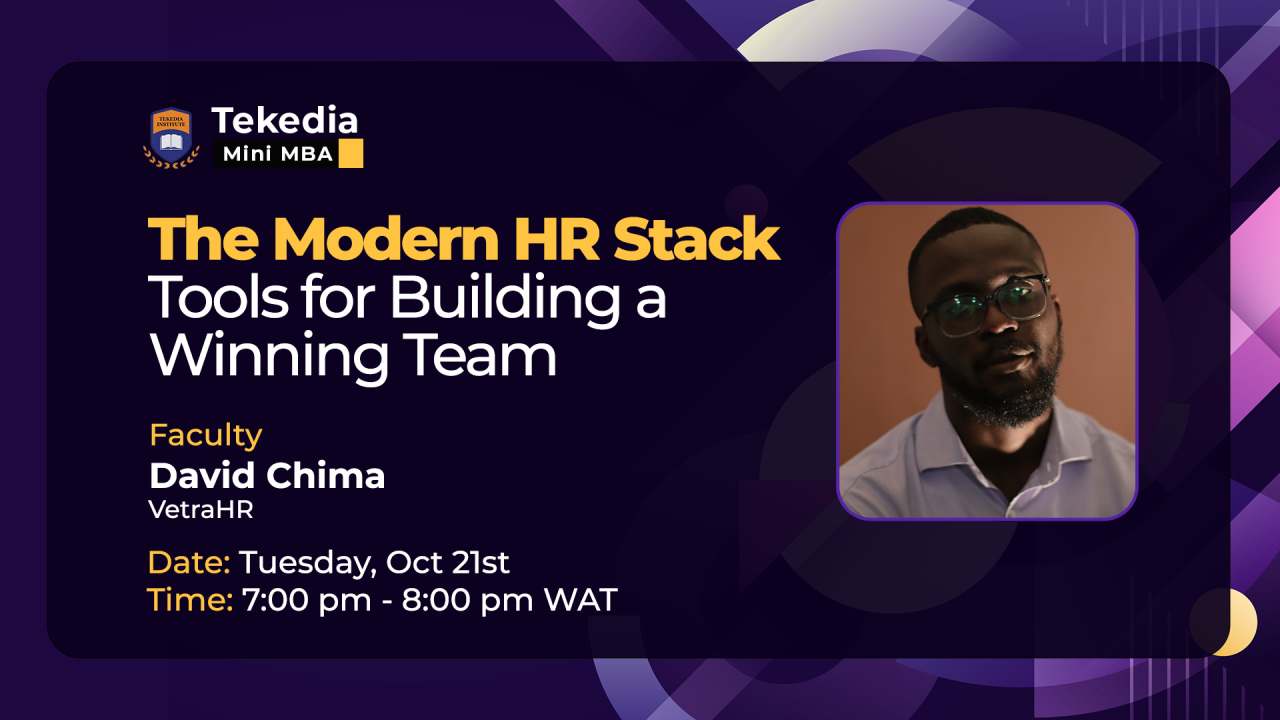
The Modern HR Stack: Tools for Building a Winning Team

0

In today’s accelerated business era, talent is not just a component of production, it is the production itself. The modern Human Resource (HR) stack has evolved beyond payroll and performance reviews into a full ecosystem of digital intelligence. From AI-driven recruitment engines to culture analytics dashboards, the HR stack is now the foundation upon which organizations build enduring competitiveness.

The best teams are not formed by chance; they are architected through systems that optimize how humans and algorithms collaborate. As industries digitize, HR leaders who understand technology’s leverage will become the true builders of institutional capability.

Across the enterprise, tools such as Applicant Tracking Systems (ATS), Learning Management Systems (LMS), performance analytics platforms, and engagement dashboards now create data loops that refine talent decisions. The result is a new order where intuition is augmented by data, and leadership is informed by insights.

Imagine a recruitment process powered by predictive AI that identifies cultural fit, or an LMS that personalizes learning paths based on employee performance signals; this is no longer science fiction, it is the daily playbook of winning organizations. The modern HR stack, therefore, is not about managing people; it is about engineering human potential.

Ultimately, a great HR stack enables what I call the Accumulation of Capability. Every hire, every training, every feedback session compounds to build an institutional muscle that outperforms competitors. Nations and companies grow when knowledge compounds within their people. As machines automate repetitive work, it is the well-equipped HR systems that will unleash creativity, collaboration, and capital in the workforce. To build a winning team in this age, leaders must see HR not as a department, but as the command center of organizational greatness.

Join us at Tekedia Mini-MBA as David Chima, CEO of VetraHR educates on how to build that modern HR Stack.

Tue, Oct 21 | 7pm-8pm WAT | The Modern HR Stack: Tools for Building a Winning Team– David Chima, VetraHR | Zoom link

BlockDAG Crosses $430M Raised with $0.0015 Entry & Upcoming Binance AMA as Bitcoin Cash & Binance Coin Enter Breakout Zones

0

The search for the top altcoins is intensifying as market momentum shifts into high gear. BNB is approaching a key breakout near $1,400, while Bitcoin Cash is recovering toward $580 after a strong rebound.

But BlockDAG (BDAG) is now leading the narrative with $430 million raised and a high-speed testnet already live. Its limited-time TGE code unlocks early access and a prime entry price of $0.0015, making it a standout among presale-stage projects.

As market cycles tighten and institutional attention increases, these altcoins stand out for their positioning, momentum, and roadmap clarity. In a landscape driven by delivery, this group is attracting attention as potential leaders heading into the final quarter of 2025.

BlockDAG’s TGE Code Drives Buying Before Genesis Day Launch

BlockDAG is rapidly gaining recognition among the top altcoins for 2025, especially as its Genesis Day approaches on November 26. With a total of $430 million raised, 27 billion+ coins sold, and over 312,000 holders, the project has established a credible presence even before hitting public markets. Its hybrid Proof-of-Work and DAG-based architecture is built to solve blockchain’s toughest issues, offering both scalability and speed. Currently, buyers can still access BDAG coins at $0.0015 through the TGE code.

Adding to the hype; BlockDAG is going LIVE on Binance for an exclusive AMA this Friday, October 24 at 3 PM UTC, marking one of its most significant global appearances to date. The session will deliver insider updates, roadmap previews, and major insights ahead of Keynote 4: The Launch Note and GENESIS DAY. This is the moment the crypto community will be watching closely as BlockDAG joins Binance to showcase the next phase of its $430M+ ecosystem. Buyers are encouraged to use code “TGE” to maximize earnings before the dashboard upgrade and price rise, with BDAG still priced at $0.0015 in Batch 31. Time is running out, secure your spot before this landmark event drives the next surge of momentum.

With 20,000+ miners sold, 3.5 million+ users on its X1 app, and a functioning testnet running smart contracts, token transfers, and NFT modules, BlockDAG has passed the stage of speculative hype. Its roadmap is clear, the audits from CertiK and Halborn are complete, and its developer base continues to grow. As a fully doxxed project with a global partnership with the BWT Alpine Formula 1® Team, BlockDAG checks all the boxes for what sets a top-tier presale apart in today’s market.

BNB Price Prediction Eyes Breakout Toward $1,400 Range

BNB continues to show strong momentum, currently trading around $1,184 after reaching a local high of $1,247. The BNB price prediction for Q4 2025 places the asset in a $1,000 to $1,400 range, with bullish projections reaching as high as $1,500 or more if whale accumulation and token burns stay consistent.

Confidence in Binance’s ecosystem remains high, driven by the auto-burn mechanism and its dominant position in the centralized exchange market. Analysts note that if BNB can maintain support above $1,000, it could make another push toward reclaiming its all-time high.

While macro factors and global regulation could impact sentiment, BNB remains one of the top altcoins backed by utility and long-term fundamentals. For buyers eyeing strength within established assets, BNB is still holding its ground as a proven performer.

Bitcoin Cash Price Forecast Targets $580 Breakout

Bitcoin Cash (BCH) is stabilizing near $535, recovering from recent lows of $510. Analysts are watching closely as the BCH price forecast aims for a breakout toward $580, with short-term models like CoinCodex suggesting a climb to $692 if momentum holds.

Predictions for late 2025 stretch from $500 to $750, depending on adoption, trading volume, and network activity. More ambitious models see potential highs reaching $1,000 or even $2,000 by 2030, though that would require major improvements in usage and broader DeFi integration.

With active addresses rising and volatility easing, BCH appears to be entering a phase of healthy consolidation. Traders and analysts now see it as one of the top altcoins in recovery mode, quietly rebuilding support ahead of what could be a stronger second leg in the 2025 bull cycle.

Final Thoughts: Three Altcoins, One Clear Early Winner

BNB and Bitcoin Cash are proving their staying power in a market that’s becoming increasingly selective. Both continue to perform well technically and are maintaining attention among traders searching for the top altcoins heading into 2026. BNB is holding near critical resistance, while BCH shows signs of regaining long-term support.

Still, BlockDAG’s token presale progress stands in a category of its own. With $430M raised, a $0.0015 entry price, live testnet activity, and the TGE code giving early buyers priority on Genesis Day, the project isn’t just promising results, it’s delivering them.

For those seeking more than speculative trades, BlockDAG may be the most grounded opportunity on the table right now.

Presale: https://purchase.blockdag.network

Website: https://blockdag.network

Telegram: https://t.me/blockDAGnetworkOfficial

Discord: https://discord.gg/Q7BxghMVyu

Africa’s Fundraising Momentum 2025: Fintech Faces New Rivals as Climate And Energy Contend For Share of Funds

0

As 2025 enters its final quarter, Africa’s start-up ecosystem continues to evolve, reflecting shifting investor priorities and sectoral momentum.

A review of year-to-date (YTD) fundraising data from January to September 2025 by Africa: The Big Deal reveals key trends shaping the continent’s innovation landscape. While Fintech continues to command significant attention, Energy and Climate-focused ventures are rapidly catching up.

Fintech Still Dominates

Fintech remains the dominant force in African start-up fundraising, but its share is narrowing. So far in 2025, the sector has attracted 33% of total funding, equivalent to $725 million out of $2.2 billion, excluding exits. Of this, fintechs accounted for 33% of equity funding and 29% of debt funding.

While this performance underscores fintech’s enduring appeal, the proportion is relatively lower than the historical average. Between 2019 and 2024, fintech captured around 45% of total funding, reaching a peak of 56% in 2021. The last time its share dipped to 33% was in 2020.

Among the 11 start-ups that raised more than $50 million in 2025, five are fintechs which are; Wave, secured $137 million in debt financing, Bokra, raised $59 million (also in debt). Stitch and LemFi completed Series B rounds of $55 million and $53 million, respectively, and Tasaheel (MNT-Halan) issued a $50 million corporate bond.

Energy Sector Surges, Matching Fintech in Funding Share

For the first time since 2019, the energy sector is nearly neck-and-neck with fintech in total funding raised, accounting for another 33% of the total so far in 2025. This is largely driven by a wave of debt financing, with energy start-ups raising $585 million this year, almost as much as all sectors combined in the entirety of 2024.

Four of the top 11 largest fundraisers this year are in the energy space which are, d.light ($300 million debt), Sun King ($156 million debt), Burn ($90 million debt), and PowerGen ($55 million equity).

Energy ventures have been particularly active in the debt market, capturing 63% of all debt raised in 2025, compared to 29% for fintech. However, their share of equity funding remains more modest at 11%, well below fintech’s 33%.

Climate Tech Gains Momentum

The strong performance of the energy sector has also boosted the profile of climate-focused start-ups, which now account for 39% of total funding in 2025, the highest share on record. This reinforces a trend first identified in 2023, as investors increasingly prioritize sustainability and green innovation.

Since 2019, over $5 billion has been invested in African climate tech start-ups, including $2.7 billion in just the past three years. This underscores the sector’s growing maturity and its critical role in Africa’s economic and environmental future.

Debt Financing on the Rise

Another defining feature of 2025 is the continued growth of debt financing in African start-up funding. So far this year, start-ups have raised $935 million in debt, surpassing the totals for both 2022 and 2024, and putting the ecosystem on track to exceed the $1.1 billion record set in 2023.

Debt now represents 42% of all funding raised in 2025, the highest share since 2019. This shift reflects a maturing ecosystem where:

  • Start-ups with stable revenues are increasingly turning to debt.
  • Debt instruments are becoming more available.
  • Energy and infrastructure ventures require larger debt packages.
  • Start-ups are more transparent about their debt financing, and
  • Media reporting on debt rounds has improved.

Since 2019, Africa’s start-ups have raised an estimated $3.9 billion in debt, with energy ventures accounting for nearly half ($1.9 billion). Fintech follows with 32%, and logistics and transportation with 11%. In 2025, the dominance of energy in debt financing has reached new heights, at 63% of all debt raised.

Outlook

The report suggests that while fintech continues to lead Africa’s start-up scene, the funding landscape is becoming more diversified. Energy and climate tech ventures are emerging as major contenders, backed by rising investor confidence in sustainable infrastructure.

Overall, Africa’s start-up funding in 2025 paints the picture of a maturing and diversifying innovation economy, one that balances profitability, sustainability, and long-term impact.

What Is Your Platform Risk?

0

More than 25 startups collapsed or pivoted in Nigeria when WhatsApp banking faded in Nigeria. Yes, that your big bank’s WhatsApp banking solution suddenly disappeared in the channel. That is one of the perils of building on some of these platforms. Simply, one change in the Terms & Conditions can break business models.

Meta which owns WhatsApp has one this week and it has to do with using WhatsApp to distribute AI agents: “Starting next year, Meta will ban some chatbots from WhatsApp… Meta said businesses using AI to serve customers on the platform won’t be affected. So, for example, a travel company won’t be barred from running a bot for customer service on the app. Rather, the move aims to prevent companies, besides Meta, from using WhatsApp to distribute AI agents. ” -LinkedIn News.

In other words, Meta wants to keep WhatsApp for the distribution of only Meta’s AI agents! So, OpenAI, Perplexity, etc must find new ecosystems to distribute their agents. And that brings to my question: “What Is Your Platform Risk?”

PayPal Mafia Rift Deepens as Reid Hoffman, David Sacks Clash Over AI and Politics

0

Two of Silicon Valley’s most influential figures — LinkedIn co-founder Reid Hoffman and venture capitalist David Sacks — have reignited their long-running feud, this time over artificial intelligence and its regulation.

The exchange between Hoffman and Sacks, both early members of the original “PayPal Mafia,” spilled into public view on Monday after Hoffman publicly defended Anthropic, a leading AI startup that Sacks had accused of “fear-mongering” and pushing a “regulatory capture strategy.”

“Anthropic, along with some others (incl Microsoft, Google, and OpenAI) are trying to deploy AI the right way, thoughtfully, safely, and enormously beneficial for society,” Hoffman wrote on X. “That’s why I am intensely rooting for their success.”

Hoffman, who has served on Microsoft’s board since 2017 following the company’s acquisition of LinkedIn, revealed that his venture capital firm, Greylock, has invested in Anthropic. He said he typically avoids commenting on individual AI companies but felt compelled to speak because “in all industries, especially in AI, it’s important to back the good guys.”

The comment appeared to be a direct response to Sacks, who last week criticized Anthropic after Jack Clark, the company’s co-founder and head of policy, published an essay titled “Technological Optimism and Appropriate Fear.” Sacks accused the company of orchestrating a “sophisticated regulatory capture strategy based on fear-mongering,” saying Anthropic was “principally responsible for the state regulatory frenzy that is damaging the startup ecosystem.”

Anthropic, founded in 2021 by former OpenAI executives and researchers who left over safety concerns, has been at the center of U.S. debates about AI oversight. The company has resisted federal efforts to block state-level AI regulation — including a Trump-backed provision that would have barred states from passing their own AI rules for ten years.

Sacks, who serves as President Donald Trump’s AI and crypto czar, has argued that such state regulations would stifle innovation and entrench large firms. Anthropic has taken the opposite view, warning that the rapid deployment of generative AI tools without guardrails could pose safety risks and public harm.

The policy divide between the two former PayPal colleagues quickly escalated into a personal and political clash.

“The leading funder of lawfare and dirty tricks against President Trump wants you to know that ‘Anthropic is one of the good guys,’” Sacks wrote on X in response to Hoffman’s post. “Thanks for clarifying that. All we needed to know.”

“Indeed,” Elon Musk replied, amplifying Sacks’ comment. Musk, another PayPal alumnus and founder of xAI, has also become a prominent figure in the Trump administration’s second term.

Hoffman fired back: “Shows you didn’t read the post (not shocked). When you are ready to have a professional conversation about AI’s impact on America, I’m here to chat.”

The exchange marked another chapter in the ideological split between Hoffman and Sacks — one that mirrors Silicon Valley’s broader political realignment. Hoffman, a major Democratic donor, poured millions into Kamala Harris’ unsuccessful presidential bid. Sacks, by contrast, emerged as a key Trump supporter ahead of the 2024 election and hosted a fundraiser for him at his San Francisco mansion.

Hoffman and Sacks were both early employees at PayPal, joining in 1999 and helping shape the online payments firm that later produced some of Silicon Valley’s most powerful entrepreneurs. Alongside Peter Thiel, Elon Musk, and Max Levchin, they became part of the so-called “PayPal Mafia,” a group whose members went on to found or fund major technology companies including Tesla, SpaceX, YouTube, Palantir, and LinkedIn.

The AI argument between the two, however, underscores a deeper policy divide emerging in the post-PayPal generation. AI development has become one of the most politically charged issues in Washington, dividing companies and policymakers over questions of safety, innovation, and control.

Hoffman, who was also an early investor in OpenAI and remains a shareholder, has positioned himself as an advocate for what he calls “responsible progress” in AI. His view aligns with that of major technology firms such as Microsoft and Google, both of which have publicly supported safety frameworks and risk assessments in deploying advanced AI systems.

Sacks, on the other hand, has used his government role to promote a lighter regulatory approach that prioritizes innovation and market freedom. His criticism of Anthropic reflects a broader skepticism among Trump administration officials who argue that AI companies are exaggerating safety risks to secure favorable regulations that would limit competition from smaller firms.

The public exchange between Hoffman and Sacks drew reactions from other Silicon Valley figures, including Jason Calacanis, co-host of the All-In podcast with Sacks. Calacanis invited Hoffman to join the show for another discussion, writing, “Come on the pod.”

Hoffman, who appeared on the podcast at the end of August — roughly two months before the presidential election — replied that he was “open to coming back on” but added, “this week is packed.”

The renewed tension between two of PayPal’s most influential alumni comes against the backdrop of intensifying scrutiny in the AI industry, over how new technologies interact with laws, labor, and democracy itself. For Hoffman, AI’s benefits depend on what he calls “deploying it the right way.” For Sacks, the threat lies in overregulation — and in his view, companies like Anthropic represent precisely that danger.

Their disagreement captures a broader collision between Silicon Valley’s libertarian past and its new era of political entanglement — where the question of who gets to define “the good guys” in AI may ultimately shape the technology’s future.