DD
MM
YYYY

PAGES

DD
MM
YYYY

spot_img

PAGES

Home Blog Page 2963

An unbelievable Wall Street big appetite on Nvidia

0

An unbelievable Wall Street big appetite: you generated a revenue of $30 billion over a three-month period, and yet many people are not happy, causing your share price to go down by 7% in after-hour trading:

“Nvidia, a leading technology company specializing in graphics processing units (GPUs) and Artificial Intelligence (AI), has reported its earnings for the second quarter (Q2), which ended July 28, 2024, showcasing remarkable growth fueled by demand for its AI technologies. The tech giant’s Q2 report, surpassed Wall Street expectations after it posted quarterly revenue of $30 billion, up 15% from the first quarter (Q1) and up 122% from a year ago.“

The fact that a revenue of $10 billion per month is no more enough, you will understand the real deal on where things stand. Indeed, it took the Dow, the US premium market index, decades to get to 14,000 (which happened in 2007) after it was established in 1897. But between 2007 and now, it has added 27,000 points (it did fall to 6,500 momentarily in 2009 during the great recession).

Simply, Wall Street can create an unseen value, out of the ambient light of production and market systems.  You cannot tell me that everything is fine if it took the Dow more than a century to hit 14,000,  only to use less than two decades to hit the current 41,000. What again has experienced that level of acceleration? Indeed, everything has been financialized and we are living it.

And as that happens, companies must generate enormous results to remain in the game. Sure – that is what is expected in a world built on efficiency. But, from a village boy mindset, $30 billion in three months, up 122% from a year ago, should not be seen as underperforming to lose 7% of value.

At the start of this year, when chipmaker Nvidia was a slip of a thing that hovered around $48 a share, conversations about AI felt tinged with existential angst. Many leaders said they were all in, eager to learn more and vowing to disrupt themselves, lest they be disrupted. We all assumed the impact was going to be big—so big that a majority of AI experts polled predicted there was at least a 5% chance it would cause human extinction.

Interest remains strong in AI and Nvidia, which is still up 150% this year after reporting a minor production snag amid strong earnings yesterday, and up almost 3,000% in the past five years. But the mood around the speed of disruption and the immediate impact on business has shifted. More familiarity with generative AI has brought more comfort in understanding how to use it. There’s also more awareness of AI’s limitations, from the softball questions at a Google staff meetings and bots spreading disinformation to employee distrust and regulation.

Nvidia Reports $30 Billion Q2 2024 Earnings, up 122% From A Year Ago

0

Nvidia, a leading technology company specializing in graphics processing units (GPUs) and Artificial Intelligence (AI), has reported its earnings for the second quarter (Q2), which ended July 28, 2024, showcasing remarkable growth fueled by demand for its AI technologies.

The tech giant’s Q2 report, surpassed Wall Street expectations after it posted quarterly revenue of $30 billion, up 15% from the first quarter (Q1) and up 122% from a year ago. For the quarter, GAAP earnings per diluted share was $0.67, up 12% from the previous quarter and up 168% from a year ago.

Non-GAAP earnings per diluted share we $0.68, up 11% from the previous quarter and up 152% from a year ago. Operating Income was $18.6 billion, representing significant growth from the $6.8 billion recorded a year earlier.

NVIDIA’s CEO, Jensen Huang, attributed the company’s success to the strong demand for its Hopper and the anticipation for the upcoming Blackwell architecture. The company has begun shipping Blackwell samples to partners and customers, further solidifying its leadership in Al and accelerated computing.

The CEO said,

“Hopper demand remains strong, and the anticipation for Blackwell is incredible. NVIDIA achieved record revenues as global data centers are in full throttle to modernize the entire computing stack with accelerated computing and generative Al. Blackwell samples are shipping to our partners and customers.

“Spectrum-X Ethernet for Al and NVIDIA Al Enterprise software are two new product categories achieving significant scale, demonstrating that NVIDIA is a full-stack and data center-scale platform. Across the entire stack and ecosystem, we are helping frontier model makers to consumer internet services, and now enterprises. Generative Al will revolutionize every industry.”

During the first half of fiscal 2025, NVIDIA returned $15.4 billion to shareholders in the form of shares repurchased and cash dividends. As of the end of the second quarter, the company had $7.5 billion remaining under its share repurchase authorization. On August 26, 2024, the Board of Directors approved an additional $50.0 billion in share repurchase authorization, without expiration.

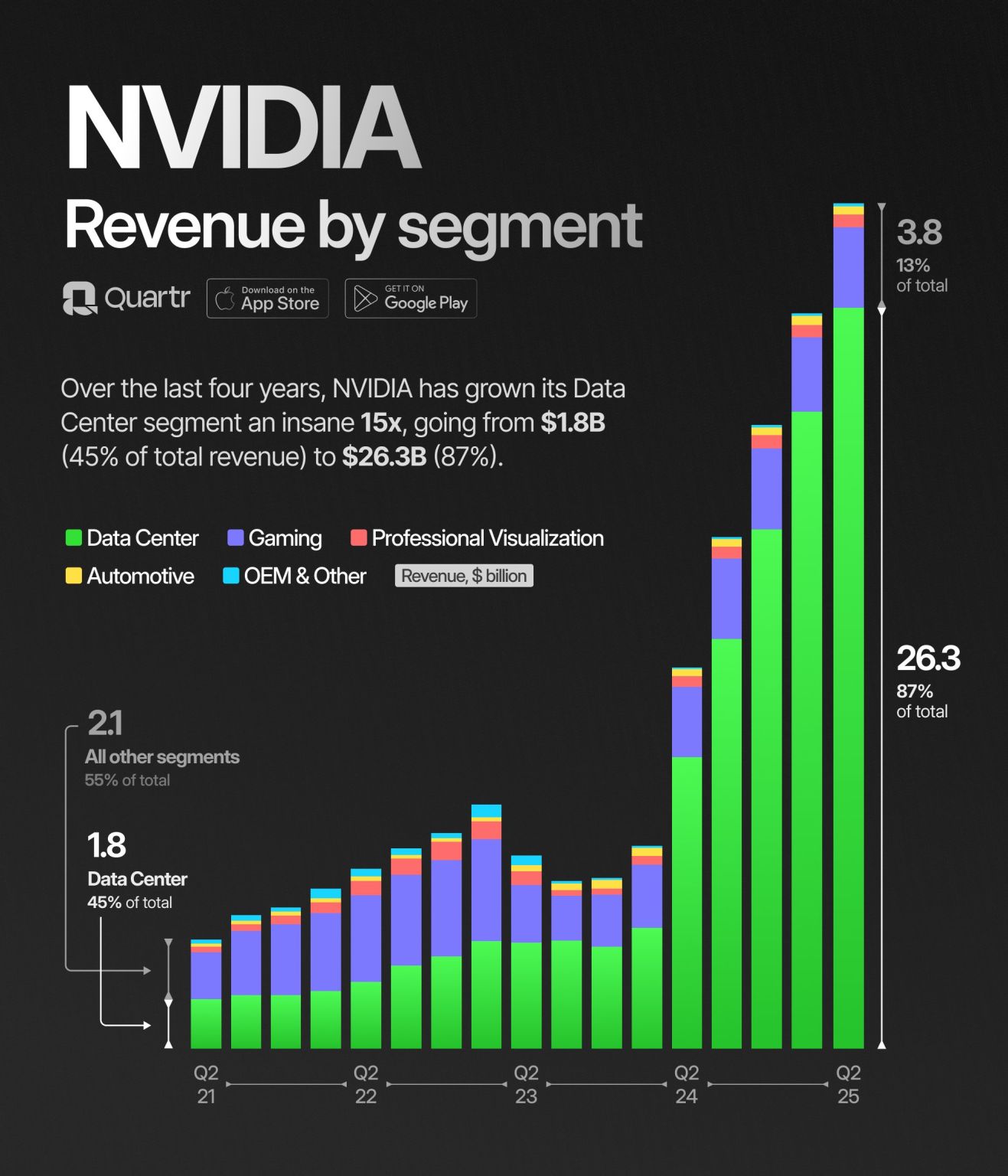
Notably, NVIDIA’s Data Center division reached new heights, reporting a record revenue of $26.3 billion for the second quarter of 2024. This marks a 16% increase from the previous quarter and a remarkable 154% growth compared to the same period last year.

The Data Center division’s success is driven by several key innovations and industry-leading developments in Al and computing, which include the following;

NVIDIA Spectrum-X Adoption: The Spectrum-X Ethernet networking platform has seen widespread adoption among cloud service providers, GPU cloud providers, and enterprises. This technology is being integrated into various offerings by NVIDIA’s partners, further expanding its influence across the industry.

NIM Microservices Expansion: NVIDIA released its NIM™ microservices platform to developers globally, with over 150 companies already integrating these services into their platforms to accelerate generative Al application development.

New Al Services: The company launched an inference service in collaboration with Hugging Face, powered by NIM microservices on NVIDIA DGX™ Cloud. This service enables developers to deploy popular large language models more efficiently.

Al Foundry and Llama 3.1: NVIDIA introduced the Al Foundry service and NIM inference microservices to accelerate generative Al for enterprises globally, featuring the Llama 3.1 collection of models.

NVIDIA’s Data Center business continues to lead the industry with cutting-edge technology and strategic partnerships, driving significant growth and setting new benchmarks in Al and data center performance.

Nvidia’s Balance Sheet and Cash Flow:

•Total Assets: $85.2 billion, up from $65.7 billion at the beginning of the year.

•Shareholders’ Equity: $58.2 billion, reflecting strong financial health and investor confidence.

•Net Income: $16.6 billion for the quarter, a substantial increase from $6.2 billion a year ago.

NVIDIA’s results reflect the accelerating adoption of generative Al, which CEO Jensen Huang predicts will revolutionize every industry. With strong financial performance and a growing portfolio of innovative products, NVIDIA continues to set the pace in the Al and computing landscape.

Chipmaking powerhouse Nvidia reported second-quarter earnings that more than doubled from a year ago, beating Wall Street estimates and signaling resilient demand from Big Tech customers. Revenue surged 122% to $30 billion, largely driven by the company’s data center business, which includes AI processors. Nvidia’s sales forecast — viewed by some on Wall Street as a gauge of AI spending — also surpassed analysts’ estimates. However, as Bloomberg notes, the outlook missed some of the more ambitious forecasts, raising concern that Nvidia’s “explosive growth is waning.”

Bitcoin And Ethereum Prices Plummet, Triggering A Wave of Liquidations

0

The price of Bitcoin extended declines from Tuesday, plunging by 5.9%, below the $59,000 price, triggering a wave of liquidations.

The more than 5% fall was echoed by the decline in the price of Ethereum, which fell more than 4.5%, below the $2,500 price.

Also, the price of Solana (SOL) was down more than 6% for the day at $147. Tokens, including XRP and Dogecoin (DOGE), also saw Tuesday dips of more than 5% over 24 hours.

According to CoinGlass, the sudden price drop triggered over $170 million in long-position liquidations in a single hour, stinging investors betting for the asset prices to rise. Those liquidations were reported to be dominated by BTC and ETH investors, with $65 million and $52 million in longs rekt, respectively.

“Crypto markets moved down sharply, triggering a leverage-driven liquidation. The move appears to have been kicked off by a material drop by Ethereum, which has been struggling all year versus Bitcoin”, said Steven Lubka, head of private clients and family offices at Swan Bitcoin.

Meanwhile, some investors and crypto enthusiasts, revealed that the bearish retracement in the prices of Bitcoin and Ethereum was triggered when news broke out that a federal grand jury returned a revised indictment against former President Donald Trump in his criminal election interference case in Washington, D.C.

It is understood that Trump has positioned himself as the pro-crypto candidate in the upcoming U.S. presidential election. Recall that the former U.S. president who once described Bitcoin as “a scam,” is now pitching himself as the pro-crypto presidential candidate.

“You’re going to be very happy with me. If crypto is going to define the future, I want it to be mined, minted, and made in the USA. If Bitcoin is going to the moon. I want America to be the nation that leads the way”. Trump said at the Bitcoin 2024 conference in Nashville, Tennessee,

Notably, amidst the recent bearish price action, the futures market is reported to have seen $93.52 million in long ether liquidation, which forces traders to sell their assets at market price to settle their debts, across centralized exchanges. Some $85.93 million in Bitcoin liquidations have occurred.

Also, on Tuesday, the U.S. spot Bitcoin funds saw net outflows amounting to $127.05 million. Notably, ARK 21Shares’ ARKB led the outflows with $101.97 million in negative flows, its largest outflow to date.

Bitcoin had seen a solid rise above $63,000 on Friday on the heels of remarks by U.S. Federal Reserve Chairman Jerome Powell signaling an interest rate cut next month. But the price of BTC stumbled yesterday, prior to the latest drop. However, the crypto asset price is still safely in the range it’s been sitting in since April between $55,000 and $70,000.

Some analysts have pointed to the recent state of Bitcoin price movements as achieving “equilibrium,” with a recent report from crypto analytics platform CoinGlass noting that it might precede a period of “heightened volatility.”

Despite Bitcoin failing to break past the $65,000 mark, experts have suggested that investors should anticipate a possible record high once August ends. In a TradingView post on August 26, Trading Shot highlighted that, based on historical price movements, the end of August could be pivotal in pushing Bitcoin to reach the coveted $100,000 mark.

The Warren Buffet’s Big Club Initiation And America’s Symphonic Economic Acceleration

0

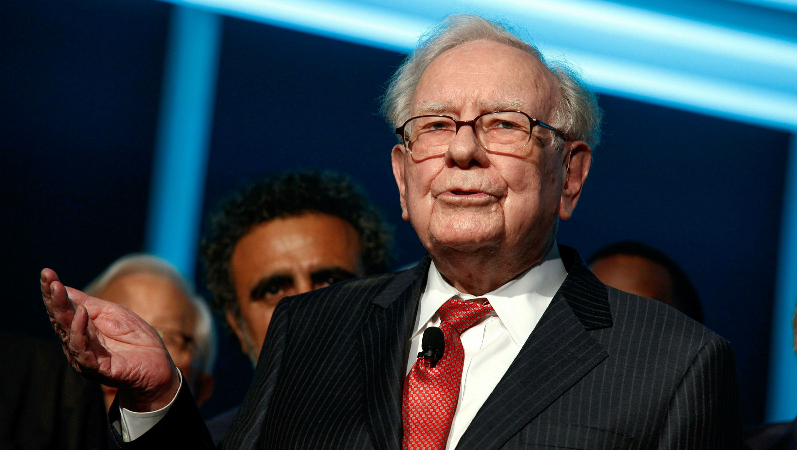
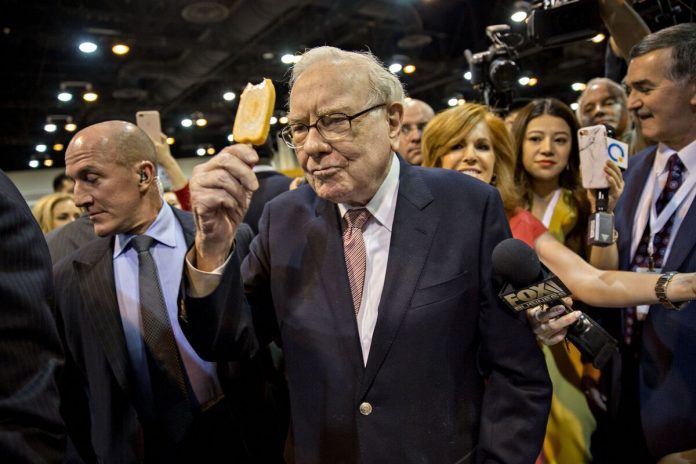
In the old boring industries, Warren Buffet’s Berkshire Hathaway has left the solid bounds of the traditional market, to touch the face of the ecclesiastical market alpha. Yes, Berkshire Hathaway has hit a market cap of $1 trillion, and got initiated into a special club:

“In the fast-paced world of high-tech valuations and digital-first businesses, it’s not every day that a company rooted in the old economy crosses the trillion-dollar threshold. Yet, on Wednesday, Warren Buffett’s Berkshire Hathaway did just that, joining the exclusive ranks of U.S. companies valued at $1 trillion. This achievement is particularly notable given the conglomerate’s focus on businesses that many might consider “traditional”—from railroads to insurance to retail.”

This is what we call symphonic economic acceleration. Yes, when the tech companies ascend, their improvements and the productivity accelerants they provide, are also enabling the boring 20th century industries to experience the alpha moments. It is magical because Nvidia, Apple and Bigtechs have not left insurance, railroads and others behind. America indeed is lucky on how they mix these ingredients, to cook the economic dishes, the world has come to consume!

For Warren Buffet, the Oracle, this is certainly a great moment for him. Indeed, when nations have great entrepreneurs, they rise. Buffett has served his nation, and markets have rewarded him beyond measures. The club of $1 trillion is a deserved cap. #legends.

Symphonic Innovation, as described by Tekedia, is an approach to innovation that is not limited to a specific domain. Instead, it involves a unified and harmonious deployment of various technology components to boost productivity and enhance competitiveness1. This concept emphasizes integrating multiple emerging technologies like blockchain, AI, and big data to transform industries, address market frictions, and create new competitive advantages2.

Berkshire Hathaway Hits $1 Trillion Market Cap, Forging A Legacy in Tradition in The Age of Modern Market

0

In the fast-paced world of high-tech valuations and digital-first businesses, it’s not every day that a company rooted in the old economy crosses the trillion-dollar threshold. Yet, on Wednesday, Warren Buffett’s Berkshire Hathaway did just that, joining the exclusive ranks of U.S. companies valued at $1 trillion.

This achievement is particularly notable given the conglomerate’s focus on businesses that many might consider “traditional”—from railroads to insurance to retail.

Berkshire’s journey to this milestone is a story of steady growth, strategic foresight, and, above all, a deep-seated belief in the fundamentals of value investing. As of Wednesday, shares of Berkshire Hathaway rose by 0.8% to $696,502.02, according to FactSet, officially pushing the company’s market capitalization past the $1 trillion mark. This feat comes on the heels of a remarkable 28% surge in Berkshire’s stock price in 2024, significantly outpacing the broader market’s gains.

At 94 years old, Warren Buffett, the “Oracle of Omaha,” stands as the architect of this empire—a company that, despite being steeped in traditional industries, has shown an uncanny ability to thrive in today’s complex and often volatile market landscape.

Old Economy, New Heights

Berkshire Hathaway’s rise to a trillion-dollar valuation is particularly striking given its portfolio’s composition. Unlike its peers in the trillion-dollar club—Apple, Nvidia, Microsoft, Alphabet, Amazon, and Meta—Berkshire is not driven by cutting-edge technology. Instead, it is powered by businesses that have been around for decades, such as BNSF Railway, Geico Insurance, and Dairy Queen. It’s a conglomerate built on a foundation of brick-and-mortar enterprises that many analysts might dismiss as relics in an era dominated by tech giants.

Yet, this very composition is what makes Berkshire’s achievement so significant. Cathy Seifert, a Berkshire analyst at CFRA Research, summed it up: “This milestone is a testament to the firm’s financial strength and franchise value.”

The company’s ability to command such a high valuation while sticking to its roots speaks volumes about the resilience of traditional business models, even in the face of modern market trends.

The Buffett Legacy

Warren Buffett’s journey with Berkshire began in the 1960s when he took control of what was then a struggling textile business. Over the decades, he transformed it into a sprawling conglomerate that now includes insurance, railroads, retail, manufacturing, and energy. His investment philosophy—rooted in patience, discipline, and a keen eye for value—has not only built Berkshire into a powerhouse but has also inspired generations of investors.

However, even as Berkshire basks in its trillion-dollar glory, Buffett has been making moves that suggest a more cautious outlook on the market. Recently, Berkshire has been in a selling mode, offloading a significant amount of stock, including half of its Apple stake, while amassing a record $277 billion in cash reserves by the end of June. For some, this signals that Buffett may be bracing for potential economic turbulence ahead.

This cautious stance extends to Berkshire’s recent sale of more than $5 billion worth of Bank of America shares in mid-July. This move is particularly noteworthy given that Buffett had been a major supporter of the bank in the aftermath of the 2008 financial crisis, purchasing preferred stock and warrants to help stabilize the embattled lender.

While Buffett is famous for advising investors against trying to time the market, his recent actions have led to speculation that he may have seen storm clouds on the horizon. Berkshire’s substantial investment in short-term Treasury bills, valued at $234.6 billion by the end of the second quarter, has now surpassed even the holdings of the U.S. Federal Reserve. This strategic conservatism suggests that Buffett is positioning Berkshire to weather any potential economic downturns, ensuring that the company remains a fortress of financial stability.

For investors, this approach has made Berkshire an increasingly attractive option in uncertain times. UBS analyst Brian Meredith recently raised his 12-month price target for Berkshire’s Class A shares to $759,000, citing strong second-quarter earnings and higher investment income. He believes that Berkshire’s diverse portfolio and substantial cash reserves make it a safe haven in a volatile market, with the potential for continued growth beyond the $1 trillion mark.

The Future of Berkshire As Buffet Passes the Torch

As Berkshire moves forward, the focus is also on the future leadership of the company. Greg Abel, currently vice chairman of Berkshire’s non-insurance operations, has been named Buffett’s successor. At this year’s annual meeting, Buffett assured shareholders that Abel, 62, will take the reins when he steps down. Abel will have the final say on investment decisions, a responsibility that has been crucial to Berkshire’s success.

But the road ahead is not without challenges. The high valuation of Berkshire’s stock, particularly its Class A shares, which now trade at a price 68% higher than the median home price in the U.S., has made it less accessible to smaller investors. Buffett has always resisted splitting the stock, believing that the high share price attracts long-term, quality-focused investors. However, in 1996, Berkshire did issue Class B shares, priced at one-thirtieth of a Class A share, to cater to those who wanted a stake in the company without the hefty price tag.

However, as Berkshire Hathaway celebrates its entry into the trillion-dollar club, the company also faces a pivotal moment in its history. The transition from Buffett to Abel will mark the end of an era, but the principles that have guided Berkshire’s success—prudent management, strategic foresight, and a commitment to long-term value—are expected to endure.

In an age where technology companies dominate the market, Berkshire Hathaway’s rise is seen as a powerful reminder that there is still immense value in traditional business models. The journey to $1 trillion has been a long one, but for Berkshire Hathaway, it’s just another milestone in a legacy defined by enduring success and unwavering commitment to its core principles.

As Buffett prepares to pass the torch, the company he built remains a testament to the power of long-term vision in a world that often favors short-term gain.