DD
MM
YYYY

PAGES

DD
MM
YYYY

spot_img

PAGES

Home Blog Page 297

VanEck Files S-1 for First U.S. Lido Staked ETH ETF

0

VanEck, a leading asset manager with over $133 billion in assets under management, submitted an S-1 registration statement to the U.S. Securities and Exchange Commission (SEC) for the VanEck Lido Staked ETH ETF.

This filing marks the first-ever U.S. ETF proposal directly tied to stETH, Lido’s liquid staking token representing staked Ethereum (ETH). The move builds on earlier groundwork, including a statutory trust registration filed in Delaware on October 2, 2025, and a preliminary prospectus submitted around October 16-17, 2025.

The fund would primarily hold stETH, a derivative token issued by Lido Finance when users stake ETH. stETH allows holders to earn staking rewards typically 3-5% APY while maintaining liquidity for use in DeFi applications.

It tracks the MarketVector Lido Staked Ethereum Benchmark Rate index, capturing both ETH price performance and staking yields. Investors gain indirect access to Ethereum’s proof-of-stake rewards without running validators or managing self-custody wallets.

Daily creations/redemptions in cash or in-kind stETH, with custody via regulated partners like Coinbase. Rewards accrue via stETH’s daily rebasing, net of Lido’s 10% fee.

Structured for traditional investors, potentially qualifying for 1099 reporting and appealing to institutions like pensions. Redemption baskets: 10,000 shares per 1,000 stETH.

Quarterly proof-of-reserves audits and insurance for validator slashing risks. Authorized participants: Firms like Jane Street and Virtu for price stability. Lido currently dominates Ethereum staking, with ~$40 billion in value locked about 23-33% of all staked ETH and over $2 billion in rewards distributed.

This ETF could amplify that by channeling institutional capital into the protocol. The filing arrives amid a more favorable SEC environment: Generic Listing Standards: Effective earlier in October 2025, these streamline approvals for crypto ETFs, cutting review times from 240 to 75 days under the Securities Act of 1933.

In July 2025, the SEC clarified that staking activities and tokens like stETH are generally not securities, removing a major hurdle for yield-bearing products. Analysts estimate ~70% approval odds, potentially by Q2 2026, following the success of spot ETH ETFs which drew $15 billion in inflows in their first six months.

If approved, this could unlock $5-30 billion in AUM within years, per projections, positioning stETH as Ethereum’s “benchmark” staking asset. stETH Price: Dipped ~5% immediately after the October 17 prospectus news amid broader market volatility, but has since stabilized near a 0.99-1.01 ETH peg.

LDO (Lido’s Token): Surged 3-17% in the week following the initial Delaware filing. Could boost ETH liquidity and price potentially to $5,000-6,000 by tightening supply through increased staking. It also signals a shift from spot ETFs to “yield ETFs,” with rivals like BlackRock and Fidelity eyeing similar products.

Lido controls ~30% of Ethereum validators; massive ETF inflows could push it over 33%, risking network security. Ethereum devs have discussed caps on liquid staking dominance. stETH rebasing may cause minor NAV fluctuations; SEC scrutiny on “dividends” or slashing exposure remains.

While first-to-file, other issuers could follow, and diversification mandates (e.g., including Rocket Pool) might be required. X recent posts highlight excitement around institutional DeFi integration:Users note it as a “gateway to staking” for big investors, bypassing technical barriers.

One analyst called it Ethereum’s “BlackRock moment”—efficient but potentially at the cost of decentralization. Lido’s foundation praised it as validation of liquid staking’s infrastructure role.

This filing underscores Ethereum’s maturation, blending DeFi yields with TradFi wrappers. Watch for SEC feedback in the coming months—approval could catalyze a new wave of staking products globally.

Coinbase Acquisition of Echo By Cobie Is A Great Leap For Liquifi

0
Fund, money cash dollar

Coinbase pulled off a blockbuster double play in the crypto space, snapping up Echo Cobie’s onchain fundraising powerhouse for ~$375 million while also dropping $25 million on his iconic UpOnly NFT to kickstart a podcast comeback.

This isn’t just a cash splash—it’s a calculated strike to dominate early-stage token launches, blend culture with commerce, and lock in community goodwill. Coinbase inked a cash-and-stock deal valued at approximately $375 million for Echo, the onchain capital formation platform founded by Jordan “Cobie” Fish in 2023.

Echo has already powered over $200 million in raises across ~300 deals, connecting founders with community investors via private sales and its self-hosted Sonar tool for public token launches on chains like Base, Solana, and Hyperliquid.

This slots perfectly into Coinbase’s “full-stack” vision for crypto projects—from ideation via tools like Liquifi to listings, custody, and now fundraising. Echo stays standalone for now, but Sonar integrates directly into Coinbase, opening doors for tokenized securities and real-world assets (RWAs) down the line.

As Cobie put it in his announcement post: “Echo will remain a standalone platform under its current brand for now, but we will integrate sonar’s public sale product into coinbase.” In a market where new tokens drive user growth think Binance’s edge via aggressive listings, this positions Coinbase as the go-to for fair, transparent launches.

It’s Coinbase 8th acquisition in 2025, signaling aggressive ecosystem-building amid post-election crypto optimism.

The UpOnly NFT: From Meme to Media Powerhouse ($25M Flex)

Coinbase wired 25 million USDC to Cobie’s wallet for the UpOnly NFT—a satirical token minted in May 2024 as a “bluff” with an absurd floor price. Burning it which Coinbase did contractually obligates Cobie and co-host Ledger Status to produce 8 new episodes of UpOnlyTV, the raw, no-BS crypto podcast that ran 2021–2023 and peaked as a cultural staple during the bull run.

CEO Brian Armstrong confirmed it with a cheeky X post: “The rumours are true, we bought the NFT. UpOnlyTV is coming back.” Cobie, ever the troll, joked about renaming it “Unc Only” due to their “severe old age” and spending the proceeds on cosmetic surgery.

But insiders see this as Coinbase’s media entry: sponsored episodes could blend education, hype, and listings to pull in retail crowds. NFT Angle: This ranks as the 5th priciest NFT ever sold, sparking a mini-rally in related memecoins (e.g., UPONLY on Base up 7,900%). It’s peak crypto irony— a parody of NFT hype now funds real content.

$25M as “Free” Marketing Genius?

Community sleuths are calling the NFT buy a bundled sweetener in the Echo deal totaling ~$400M, timed a day early for viral buzz. It amplified both announcements, turning a “noble failure” into a feel-good win. As one X user nailed it: “Coinbase gets the goodwill + brand of Cobie for ‘no additional cost’ and amplifies both news to capture all of CT.”

Congrats to Cobie— from Tesco shelf-stacker to crypto whale in a decade. Easier onchain raises mean more accessible deals, democratizing what was once VC-gated. BTC/ETH steady (~$112K/$4K), but this adds froth to Base and perps ecosystems. Watch for UpOnly guests like Hyperliquid’s Jeff—could spotlight integrations.

Post-Trump win, they’re lobbying for AML updates and rolling out perks like the Coinbase One Card. This feels like the start of a media-finance hybrid. One day you’re yapping on X, the next you’re cashed out to the moon. What’s next—Coinbase bids on Bankless? Onwards, as Cobie says.

4 Best Crypto Presales of 2025: BlockDAG, Snorter, Maxi Doge, & Bitcoin Hyper

0

The race for the best crypto presales of 2025 is heating up, and investors are watching closely as new projects redefine how early-stage crypto opportunities are valued. In a year dominated by utility, innovation, and hype, four names have emerged as standouts: BlockDAG, Snorter Token, Maxi Doge, and Bitcoin Hyper. These projects aren’t just riding trends, they’re building movements.

From cutting-edge blockchain scalability to meme-powered community appeal, they represent a full spectrum of what’s driving the next wave of Web3 adoption. With presale rounds raising millions and communities swelling globally, these tokens are becoming the center of crypto’s attention.

Here’s a deep dive into why each of these contenders stands among the best crypto presales and how early participants could see massive upside if the momentum continues post-listing.

BlockDAG (BDAG): The $430M Powerhouse of Scalability and Hype

With more than $430 million raised in its presale, BlockDAG is no ordinary crypto project; it’s staking its claim as a future Layer-1 leader. Early participants entered at just $0.0015 per BDAG, with a planned listing price of $0.05, translating to potential gains of over 3,000%. That margin alone makes BlockDAG one of the best crypto presales in recent memory.

Beyond numbers, BlockDAG is built on a hybrid DAG + Proof-of-Work architecture that eliminates network congestion and boosts throughput. Its Awakening Testnet hit 1,400 TPS, supported by a massive 3 million X1 mobile miners and 312,000 holders. The project’s upcoming Binance AMA (October 24) is expected to be the tipping point where its $430 million vision goes global.

Audited by CertiK and Halborn, BlockDAG combines transparency, tech maturity, and branding power backed by its Formula 1 partnership. For those still on the sidelines, the presale’s final stages could be the last opportunity to buy before a mainstream breakout.

Snorter Token (SNORT): The AI-Driven Meme Utility

Snorter Token has rapidly become one of the best crypto presales to watch, crossing $5.3 million raised with less than a week left. Built on Solana, SNORT powers the Snorter Bot, a trading tool that blends meme coin energy with algorithmic precision.

It’s positioned as a “bot-coin,” an AI-driven, Telegram-integrated platform targeting the fast-paced meme trading niche. The presale price hovers around $0.1081, with post-listing targets nearing $0.90 if the momentum continues.

Analysts cite its hybrid nature, part utility, part meme, as key to its appeal. While volatility is expected, early buyers see the potential for strong ROI once the bot ecosystem gains traction.

Maxi Doge (MAXI): Meme Power With Momentum

Maxi Doge is carving out its place among the best crypto presales with over $3.6 million raised and a community-first focus. Styled as the “rebirth of Dogecoin,” MAXI combines meme culture, staking rewards, and high-energy branding that resonates with retail traders.

Priced under a fraction of a cent during presale, the project’s bold forecasts like a 1,500× potential return by 2026, underscore its viral tone. Its appeal lies in accessibility: low entry price, community hype, and active social buzz. However, analysts caution that it remains speculative, thriving on emotion more than fundamentals.

For believers in the next meme-coin cycle, though, Maxi Doge could become a standout performer in 2025’s retail-driven rally.

Bitcoin Hyper (HYPER): Bringing Layer-2 Speed to Bitcoin

Bitcoin Hyper has raised over $24.4 million, placing it firmly among 2025’s best crypto presales. The project reimagines Bitcoin’s limitations through a Solana Virtual Machine (SVM)-compatible Layer-2 network that enables sub-second transactions, DeFi apps, and cross-chain operability, all while leveraging Bitcoin’s security.

Analysts praise it for bridging BTC’s trust with next-gen performance, calling it a potential rival to Cardano and Solana in scalability. With its focus on ultra-fast settlement and developer flexibility, Bitcoin Hyper is positioned not as a meme play, but as a high-utility infrastructure token. As with all ambitious presales, delivery risk remains, but its blend of strong branding and clear vision makes it a presale worth monitoring.

Conclusion

The landscape of the best crypto presales in 2025 reflects a mix of innovation, speculation, and accessibility. BlockDAG leads the charge with unmatched funding and cutting-edge technology, merging power and credibility. Snorter Token blends AI automation with meme energy, while Maxi Doge fuels retail enthusiasm with pure community hype. Bitcoin Hyper, meanwhile, captures the tech purists seeking Bitcoin’s scalability evolution.

For investors, these projects offer more than tokens; they’re early-stage stories with real momentum and global appeal. Presales are where fortunes are made and risks are highest, but timing and conviction often separate observers from participants. With major AMAs, exchange listings, and ecosystem launches on the horizon, now may be the time to pay attention. The best crypto presales aren’t just shaping narratives; they’re defining what the next bull run could look like.

Gold Price Drops Below $4100 Shredding $1.7T Worth of MarketCap

0

Gold has plummeted, erasing a massive chunk of its total market capitalization calculated as above-ground gold stocks multiplied by the spot price. Gold is trading at approximately $4,050 per troy ounce, down about 1.8–2.2% from yesterday’s close.

This puts it firmly below $4,100 marking a sharp pullback from recent all-time highs around $4,381 earlier this week. The drop equates to roughly $75–$85 per ounce from yesterday, the largest single-day fall since August 2020.

Over the past few days, gold has shed over 5% from its peak. Estimated at $27.8–$28.1 trillion today, based on ~216,265 metric tons 6.95 billion troy ounces of above-ground gold stocks. This is down from ~$29 trillion at the peak last week.

The plunge has erased $1.7–$1.75 trillion in market cap over the last 24–48 hours, confirming your figure. For context, earlier in the month, a single-day drop wiped out over $1 trillion alone.

Calculations based on 6.95B oz supply; minor variances from source estimates.Why the Drop?Profit-Taking: After a blistering rally up 48% year-over-year, investors are locking in gains ahead of Diwali and key U.S. inflation data this week.

A rebounding dollar and de-escalating U.S.-China trade frictions are pressuring non-yielding assets like gold. Capital is shifting to stocks, Bitcoin, or Treasuries as Q4 optimism builds.

Gold broke key support near $4,100, accelerating the sell-off; forecasts suggest potential tests of $4,045 if momentum persists. Short-term bearish, with downside risks to $4,000 if U.S. data surprises positively (e.g., cooler inflation).

But long-term bulls remain intact—analysts like Goldman Sachs eye $4,000+ by mid-2026, driven by central bank buying and scarcity. Gold’s “infinite market cap” slow supply growth keeps it a wealth benchmark, now rivaling entire stock indices in scale.

As of October 21, 2025, spot gold prices are hovering around $4,371–$4,393 per troy ounce, with intraday peaks touching $4,393.60 earlier. This marks a staggering ~60% surge year-to-date from ~$2,722 at the start of 2025, and it’s up over 19% in the past month alone.

Prices fluctuate rapidly; these are mid-morning ET figures. Gold briefly dipped after Monday’s record close above $4,380, but the uptrend remains intact. This isn’t just hype—gold’s ATH run is fueled by a perfect storm of global jitters.

Escalating U.S.-China trade tensions think tariffs and rare earth mineral disputes are pushing investors toward gold as a hedge against uncertainty. Expectations of further interest rate reductions make non-yielding assets like gold more appealing, especially with inflation lingering.

Ongoing U.S. sanctions, the Russia-Ukraine fallout, and diversification by central banks (e.g., China loading up) are supercharging buys. A softer USD and record inflows into gold ETFs are amplifying the rally.

Analysts like those at Goldman Sachs have bumped their 2026 forecast to $4,900/oz, citing sustained central bank hoarding. On the flip side, some warn of overbought conditions—Bank of America advises caution as prices stretch valuations thin.

From $850 to $4,400?Gold’s inflation-adjusted ATH was ~$850/oz in January 1980 nominal ~$2,000 in today’s dollars, but the nominal record was ~$2,000 in 2011. Fast-forward to 2025: It first cracked $4,000 on October 7 amid Fed bets and a U.S. government shutdown scare, then powered past $4,300 last week.

At ~$4,400, it’s obliterating those marks—up 50%+ YTD—and some bulls eye $5,000 or even $10,000 if chaos persists. One chart-watcher eyes a “sick move” to $4,400 after dipping below $4,196: “GC1! taking out PWL < 4196 then back up to 4400 for a new ATH would be a sick move .”

Peter Schiff’s “gold eating Bitcoin’s lunch” jab is still echoing—BTC’s down 32% in gold terms since August. If you’re eyeing exposure ETFs, futures, or physical, consider diversification over FOMO—experts stress a long horizon over chasing peaks. What’s your take: Buy the dip or wait for $4,400?

Gemini Launches Solana-Themed Credit Card with Auto-Staking Rewards

0
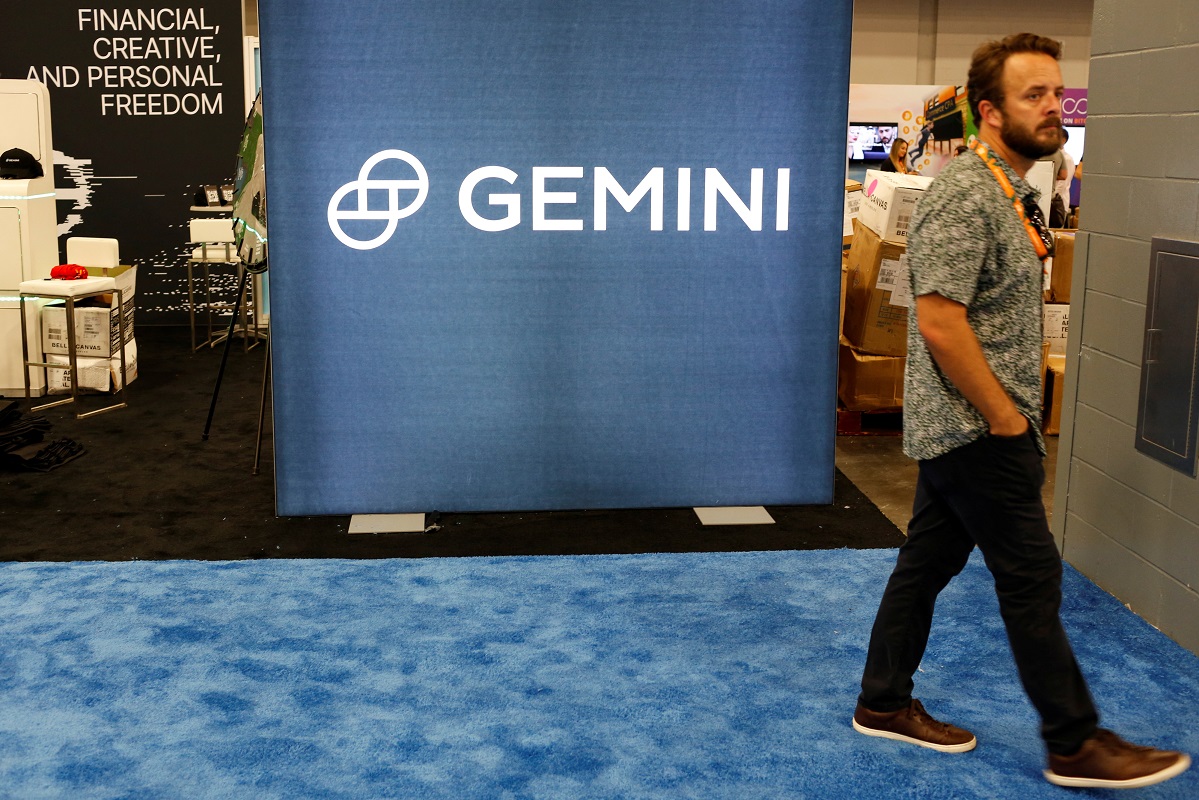
A man walks past the logo of Gemini Trust, a digital currency exchange and custodian, during the Bitcoin Conference 2022 in Miami Beach, Florida, U.S. April 6, 2022. REUTERS/Marco Bello/Files

Cryptocurrency exchange Gemini officially unveiled the “Solana Edition” of its Gemini Credit Card, marking its first blockchain-specific card design and introducing an innovative auto-staking feature for rewards.

This move deepens Gemini’s integration with the Solana ecosystem, allowing users to earn Solana (SOL) tokens on everyday spending while optionally staking those rewards directly for additional yield.

Earn up to 4% back in SOL on eligible purchases, with boosted rates of up to 10% at select partner merchants (e.g., for gas, EV charging, and rideshare spending). Rewards are flexible and can be redeemed in various cryptocurrencies.

For the first time, cardholders can enable automatic staking of SOL rewards on Gemini’s platform, earning up to 6.77% APY while supporting Solana’s network security through transaction validation. Users can unstake at any time, though processing may take hours to days.

The limited-edition physical card features a 16-gram matte metal build with Solana’s signature gradient design. It includes no annual or foreign transaction fees, plus Mastercard World Elite benefits like travel insurance and concierge services. Issued by WebBank.

Gemini highlighted that SOL rewards held for at least one year have appreciated by nearly 300%, making it one of the top-performing assets in their rewards program. This launch follows Gemini’s recent expansions in Solana support, including USDC and USDT transfers on the network and institutional staking services earlier in 2025.

The exchange cited Solana’s high throughput, low fees, and vibrant developer community as key reasons for the partnership.Market ReactionThe announcement contributed to a modest uptick in SOL’s price, with gains of around 2-3% in the following trading session.

Gemini’s stock (GEMI) also rose about 5% to $20.67. On X (formerly Twitter), the news generated buzz, including an official promo from Solana’s account emphasizing the card’s seamless fiat-to-SOL earning potential.How to Get StartedU.S. residents can apply via the Gemini app or website.

New users opt in during signup; existing cardholders can select SOL rewards and enable auto-staking in their settings. Availability is limited for the physical Solana-themed card.

This product positions Gemini as a leader in blending traditional finance with crypto, potentially accelerating Solana’s mainstream adoption by turning routine purchases into yield-generating opportunities.

Solana staking is the process of locking up SOL tokens to support the network’s operations, specifically its Proof-of-Stake (PoS) consensus mechanism, in exchange for rewards.

Proof of Stake (PoS)Solana uses a Proof-of-Stake model combined with Proof-of-History (PoH) to achieve high transaction throughput and low latency. Validators (nodes) process transactions and secure the network. Staking involves delegating SOL to validators, who use these tokens to participate in consensus and earn rewards.

PoH ensures efficient ordering of transactions, reducing the computational burden and enabling Solana’s high-speed blockchain. Users lock SOL in a stake account and delegate it to a validator of their choice. You don’t run a validator yourself; you entrust your SOL to one.

These are distinct from your main wallet. You create a stake account to hold the SOL you want to stake, which is then assigned to a validator. Once delegated, your stake enters an “activating” phase typically one epoch, ~2-3 days. After activation, it contributes to the validator’s voting power and starts earning rewards.

Rewards are distributed at the end of each epoch, based on the validator’s performance and the total staked SOL on the network. Annualized returns typically range from 5-8% APY (e.g., ~6.77% as noted in recent data), though this varies with network conditions.

To stop staking, you deactivate your stake, which enters a “deactivating” phase another epoch before the SOL becomes liquid again. This cooldown prevents immediate withdrawal. These are nodes that validate transactions and produce blocks.

The more SOL staked to a validator, the higher its chance of being selected to propose blocks. Choose validators with good uptime and reasonable fees typically 0-10% of your rewards.

Solana operates in epochs ~2-3 days, ~432,000 slots. Rewards are calculated and distributed per epoch based on the validator’s performance and the network’s inflation rate. Solana’s inflation currently ~4-6% annually funds staking rewards. The total reward depends on the global stake rate higher staked percentage reduces individual APYs and validator commission.

Unlike some blockchains, Solana currently has no slashing penalties for validator misbehavior, so your staked SOL is safe from loss due to validator errors, though you should still pick reliable validators to maximize rewards.

Staking with top validators can concentrate power. Supporting smaller, reliable validators helps network decentralization. With Gemini’s Solana Credit Card, rewards earned in SOL can be automatically staked via their platform.

This simplifies the process: Gemini handles delegation to a validator, and rewards compound at the network’s APY (e.g., ~6.77%). Users can opt out and unstake, subject to Solana’s standard epoch-based cooldown.

Solana’s scalability 65,000+ TPS makes it attractive for validators and stakers. Transaction costs are minimal, preserving rewards. Staking offers a way to earn yield on SOL holdings while supporting network security.