The Imo State election presents a case as to why Nigeria has no chance on its development quest: voodoo elections destroy nations. People rig their futures for politicians, and INEC, the electoral umpire FAILS to follow its basic guidelines. I did not study law but during my MBA program in the University of Calabar in the Business Law course, I picked some legal wisdoms!
First, the guidelines of INEC, as published and adopted, are an extension of the laws of the nation. And that means anything INEC has put there in the guidelines, provided they are within the ordinance of law, and adheres to the Constitution of Nigeria, are indeed extensions of the Constitution, even if those guidelines are not expressly stated in the Constitution.
So, if INEC says that the number of votes cannot be more than the number of accredited voters on election day, that must not be in the Constitution of Nigeria, before INEC can throw such non-complied results out, positing that irregularities have happened.
Understand that any company policy, via company handbooks, guidelines, etc which employees agree to adhere to, are mini-laws, and upon them, somebody could be convicted in court, depending on the severity of going against the policies. We do not say that because the Constitution of Nigeria does not have that “it is criminal to transfer your company’s money to yourself for personal gains”, that it is not a crime. The Constitution is the Strategic Law while those policies, guidelines, etc are manuals of the law.
As my professor noted in UNICAL, business regulations, policies, constracts, etc when done within the tenets of the Constitution, are indeed enforceable. Whatever NAFDAC puts out to ensure food is safe in Nigeria is the law of the land, and must be compiled with. If I extrapolate, INEC has no right to declare results in elections when the number of votes is more than the number of accredited voters because that is against its own guidelines. In other words, by INEC’s own guidelines, it could have stopped the madness by canceling the results before any litigation!
And that takes me to the other part, the protocol in Nigeria where parties have to sue in courts on INEC’s enforceability of its own guidelines. Yes, INEC organizes a nonsensical rigging jamboree, discounting all its guidelines, and then anoints one person as the “winner”, and then asks the “loser” to go to court. From my professor’s class, that was not the way the law should work: at least INEC in-house system should FIRST check if the election itself has complied with its own “mini laws” before the external courts can be involved.
That is why I maintain that when INEC wrote that elections should be transmitted electronically, and later aborted the process during a presidential election, that it violated its own law, and should have canceled (and redone) those areas it could not do electronic data transmission, as noted in the rule book. I noted that if INEC should be allowed to make guidelines and not comply with them, there is no more basis to prosecute any crime in Nigeria since one can argue that whatever NAFDAC, EFCC, Police, etc has in the books are not enforceable and should not be complied with. Indeed, INEC is expected by law to adhere to its guidelines just like universities expect teachers to adhere to guidelines they have put for grading exams, after the exams have been written!
By asking parties to go to court to fix its mess, INEC is saying that its guidelines have no material value. But that is not the way I think it should be. Get me right: I am not a lawyer and do not claim to know anything about law. But unless INEC does its job, Nigeria’s democracy will not evolve. If INEC can spend billions and organize chaos, discarding its guidelines, why do you think a policeman, teacher, banker, etc cannot discard his/her operating guidelines at work?
The Imo State election presents a case as to why Nigeria has no chance on its development quest: voodoo elections destroy nations. People rig their futures for politicians, and INEC, the electoral umpire FAILS to follow its basic guidelines. I did not study law but during my MBA… pic.twitter.com/79oxRs0wnz
Every company is built around 5 factors – knowledge, labour, capital, entrepreneurial/ organizational vision and (land). These five factors are managed or organized upon three elements – people, processes and tools. So, for “raw materials” in the production systems to be transformed, using these factors, into products and services, to fix the frictions in markets, companies must harmonize the interdependent relationships within people, processes and tools.
The core construct of project management rests on that interface. And when you bring the economics (hello, Engineer Turns Manager in my Engineering Management course by Prof PBU Achi in FUT Owerri), you can ascertain how effective the translation of inputs into finished products or services have become, across many vistas, including cost efficiency, product quality and execution time.
Join us at Tekedia Mini-MBA for a lecture on “Effective Project Management and Economics” by Olanrewaju Daodu. Our Faculty is a zen-master in project management: “.With a First-Class Honours degree in Construction Management from the University of Newcastle, I excel in driving project deliverables through a strong foundation in quality assurance, regulatory compliance, and stakeholder management. My expertise includes project management, automation, business intelligence, process improvement, and safety protocols”. He will teach today in the #best school.
Tekedia Mini-MBA – our product is knowledge. Pick a seat in the next edition here
The cryptocurrency world is filled with several digital finance terms and community jargon, which can be overwhelming for newcomers. Among these terms, “mainnet” and “testnet” are commonly encountered, each representing different stages in the blockchain lifecycle.
In this article, we’ll take a closer look at what mainnets and testnets are, how they function, and their fundamental differences in the blockchain ecosystem. Let’s dive in.
Introduction to Mainnet and Testnet in Blockchain
A mainnet is a fully operational blockchain version that manages real-world transactions and applications. However, a testnet is used for testing and development, allowing developers to experiment with new features without tampering with the mainnet.
What is Mainnet in Crypto?
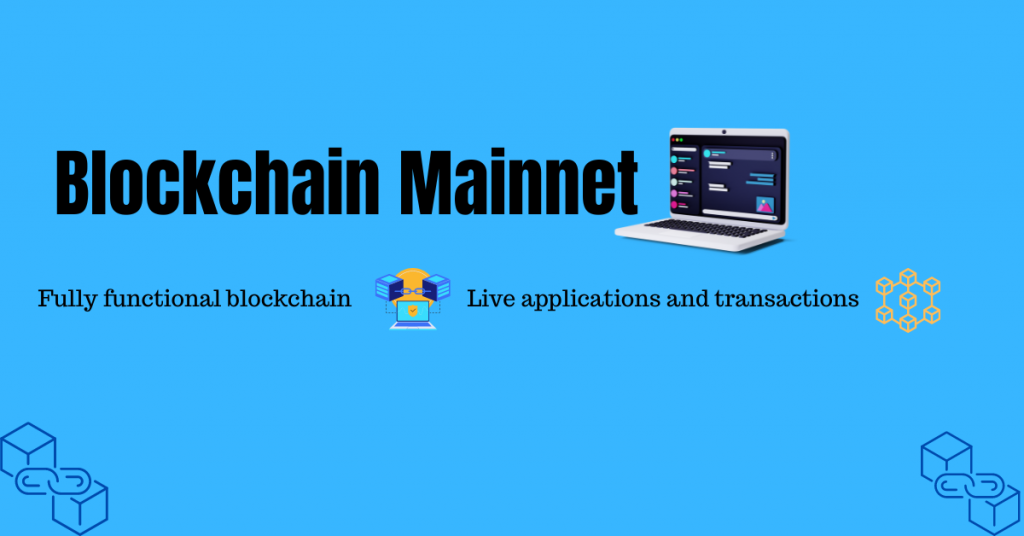
A mainnet is a fully functional blockchain network in which digital assets are exchanged, and smart contracts are executed as planned. It is the live environment in which cryptocurrencies have real value and all transactions are recorded on an immutable ledger. This means that a transaction cannot be altered or erased once it has been recorded, ensuring transparency and trust.
How Does Mainnet Work?
Blockchain Mainnet
The network nodes use consensus techniques such as Proof of Work (PoW) or Proof of Stake (PoS) to validate and process transactions. After that, blocks consisting of transactions are added to the blockchain. Additionally, network upgrades are carried out through soft or hard forks, while security is preserved through decentralization and cryptographic techniques.
What is the Purpose of Mainnet?
Mainnet manages real-life applications and performs real-time transactions on the blockchain. It also serves specific purposes that contribute to the growth of blockchain. Below are some of the benefits of Mainnet:
Operational Transaction
The mainnet is a live network where real-time transactions take place. While the testnet is used for network testing, actual exchanges of digital assets and currency take place on the mainnet. Users can transfer money and exchange assets in a real-world environment, proving the theoretical worth of the blockchain through practical application.
Deployment of Functional Smart Contracts
On the mainnet, smart contracts’ self-executing agreements are fully operational. These contracts execute automatically according to the agreed terms, supporting various applications from financial services to logistics and supply chain management. This automation improves efficiency and reduces reliance on intermediaries.
Security and Integrity
Mainnet uses consensus methods and sophisticated security measures to verify transactions and protect the network. Consensus mechanisms such as Proof of Work (PoW) and Proof of Stake (PoS) guarantee transaction verification and network agreement on the blockchain’s state. This improves the blockchain’s security and trustworthiness.
Increased Value and Trust
The transition from a testnet to a mainnet signifies a project’s readiness and reliability. Mainnet launches often result in token increases, reflecting the blockchain’s operational stability and full deployment. This shift increases investor and user confidence in the project’s long-term viability.
Fosters Development and Innovation
The mainnet offers a reliable and feature-rich platform for creating decentralized apps (dApps) and incorporating blockchain technology into several industries. It promotes continuous creativity by providing a conducive environment for both emerging and existing blockchain-based solutions to function properly.
What is a Testnet in Crypto?
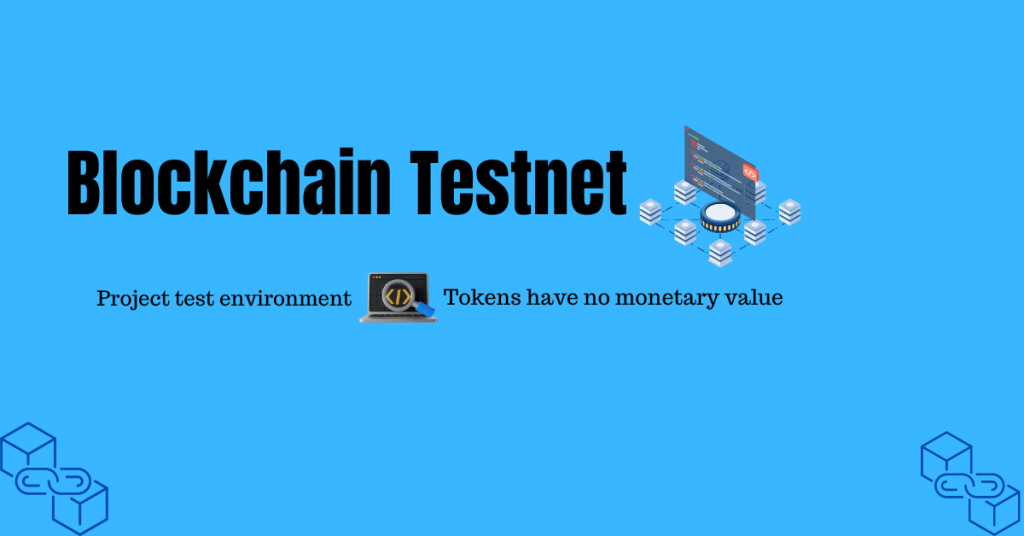
A testnet is a blockchain network created for testing and development before the solution goes live on the mainnet. Since it mimics the mainnet, developers can test apps and smart contracts without the risk of losing money.
How Does Testnet Work?
Blockchain Testnet
Testnet uses tokens with no monetary value to identify and correct errors in a risk-free environment. Before changes are released onto the mainnet, they can be tested in this controlled environment to ensure that they are secure and stable. It is a simulation environment where developers may improve and verify their project’s operation.
What is the Purpose of Testnet in Crypto?
Testnet is an essential testing phase in crypto that contributes to the growth and scalability of blockchain. Below are some of the benefits of a testnet:
Risk-Free Testing and Experimentation
Testnet offers a controlled environment where developers can experiment with smart contracts, decentralized apps (dApps), and new features without risking real assets. Since testnet tokens are unusable in the real world, developers may experiment with code, identify bugs, and improve functionality without worrying about losing money. This low-risk environment promotes creativity and enables extensive testing before releasing updates to the mainnet.
Safe for Mainnet Integrity
Developers can test and create new features and protocols on a testnet without affecting the mainnet.
Since experimentation on the mainnet may interfere with its stability and result in network downtime, the testnet helps to replicate the mainnet environment, without impacting the live blockchain. This maintains the network’s dependability and efficiency.
Cost-Efficient Development
Testing a network on the mainnet might be costly due to the usage of real cryptocurrency for transactions. However, the testnet provides a platform where developers and users can conduct transactions using free tokens. This reduces expenses for developers who need to experiment and iterate on their projects extensively without exceeding their budget.
Facilitates Continuous Improvement
As blockchain technology advances, with ongoing research addressing scalability, security, and functionality, a testnet plays a vital role in the process. It provides developers with a sandbox environment to test new protocol updates, modify smart contracts, and explore other innovations. Blockchain capabilities can be improved through this iterative process, enabling small, controlled upgrades before mainnet deployment.
Educational Tool for Users and Developers
Testnet serves as an educational resource for both new developers and users. It offers a risk-free environment for learning about blockchain technology, testing with smart contracts, and understanding how dApps operate. Developers can practice their skills and test their apps in a safe environment, while users can perform transactions and interact with various blockchain features without financial risk.
What is the Difference Between Mainnet and Testnet?
Mainnet vs Testnet
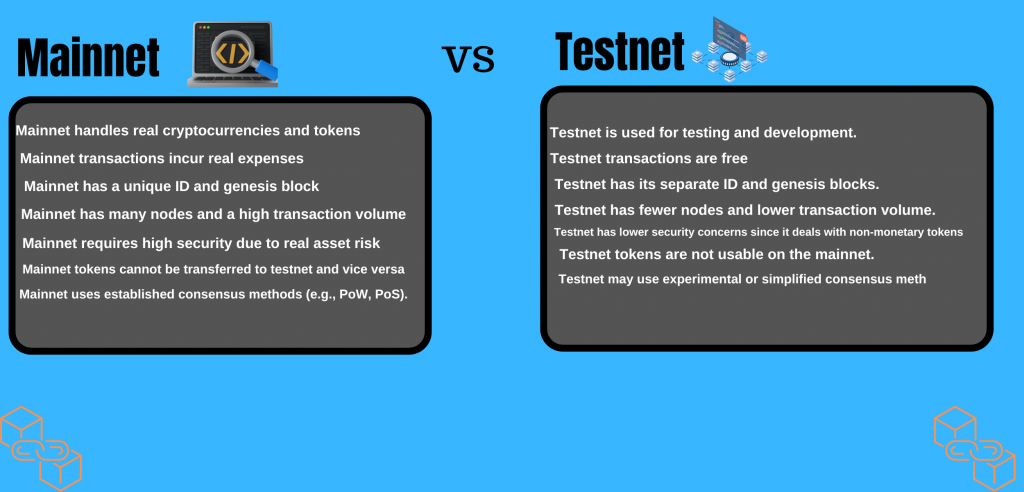
Although mainnet and testnet play essential roles in product efficiency and blockchain scalability, they differ across several aspects. Below are some of the differences between mainnet and testnet.
Purpose and Utilization
The mainnet is a fully functional blockchain network where smart contracts are executed. It deals with real cryptocurrencies or tokens with a finite amount of supply. In contrast, the testnet is a distinct blockchain environment designed for testing and development. Developers may test out new features and make enhancements without having to risk real currency.
Operational Costs
Since tokens on the mainnet have actual value, every operation and transaction incurs expenses. For instance, Ethereum gas fees are paid in ETH. However, the digital currencies used on the testnet are solely for testing and have no monetary value. Due to zero financial repercussions, this makes the testnet an ideal environment for extended testing and iterative development.
Genesis Blocks and Network ID
Every blockchain network is identified by a mainnet ID that distinguishes it from other networks, and each possesses a genesis block referring to the nascent stage of the network. Ethereum, for instance, has a mainnet ID of 1 and a unique genesis block that marks the start of its blockchain.
Additionally, a testnet has unique genesis blocks and network IDs. For example, the network IDs of Rinkeby and Ropsten testnets are 4 and 3, respectively. These identities and genesis blocks aid in identifying different blockchain environments to ensure accurate network identification and initialization.
Nodes and Transaction Frequency
The mainnet features numerous nodes distributed across the globe, working together to process and validate transactions. This widespread network supports a high frequency of transactions, reflecting its role in handling real-world financial activities. In comparison, the testnet has fewer nodes and handles a lower volume of transactions. This reduced scale indicates their purpose as testing grounds rather than active financial networks.
Security and Impact
Security is important on the mainnet since it uses real assets for transactions. Mainnet employs stringent security measures, including encryption, multi-signature transactions, and detailed smart contract audits to safeguard user funds and maintain network integrity. Any vulnerabilities or issues on the mainnet can lead to significant consequences, such as financial losses. Although testnet also focuses on security, it operates with a different set of priorities since the stakes are lower. The security protocols on testnet are designed to ensure safe experimentation without the risk of impacting real assets.
Token Transferability
Tokens from the mainnet cannot be moved to the testnet, and vice versa. For instance, since real Bitcoin or ETH are not accepted in the testnet ecosystem, transferring them from the mainnet to a testnet address will result in token loss. Additionally, tokens obtained via the testnet are not usable on the mainnet. However, once they have been verified and are prepared for deployment, apps and smart contracts that have been developed and tested on a testnet can be transferred to the mainnet.
Consensus Mechanism
Mainnet relies on existing consensus methods to guarantee network security and transaction validation. For instance, Proof of Work (PoW) is utilized on the Bitcoin mainnet, while Proof of Stake (PoS) is employed on Ethereum. Although consensus approaches are utilized on the testnet, it is frequently in an abridged or experimental form.
FAQs
Here are a few frequently asked questions with suitable responses:
Is the Money on Testnet Real?
Testnet is solely for testing network and dApp operations. It has no real-world value and is only usable within the test environment.
How do I Fund Testnets?
Testnet funds are accessible on the faucet. Several blockchains have a faucet where users and developers can obtain free tokens for testing purposes. Some popular testnet faucets are the Goerli faucet, Sepolia faucet, Polygon Mumbai faucet, Chainlink faucet, and Avalanche Fuji faucet.
What is the Best Wallet for Testnet?
While there are several efficient wallets for blockchain testnet, some popular wallets, such as Metamask, Phantom, and Keplr wallet allow users to navigate between the testnet and mainnet environment within the same wallet.
What Happens After Testnet?
After the testing phase of a network or a blockchain product, the mainnet launch occurs at the end of the development cycle. This allows the deployment of smart contracts and facilitates real-time transactions.
What Is a Tesnet Airdrop?
A testnet airdrop is a token reward given to users who help projects test their blockchain or product before it goes live.
What is a Mainnet Airdrop?
A mainnet airdrop is a reward or token incentive distributed to users for engaging with a live blockchain or product, often as part of promotional campaigns or to encourage network participation.
Final Thoughts
In conclusion, mainnet and testnet play key roles in blockchain technology. Mainnet is a live network where real transactions happen, and cryptocurrencies have actual value. It handles everyday operations and ensures everything works securely. Testnet, on the other hand, is used for testing new networks and dApps without financial risk. It uses free test tokens and allows developers to try out new features in a safe, controlled environment. This way, bugs and other issues are easily resolved before anything goes live on the mainnet.
Disclaimer: Kindly note that this article is solely for educational purposes and should not be considered as a piece of financial advice.
‘MTN has liquidated Visafone, recognising a loss of N30.3 billion ($18 million) on the 2016 acquisition of Nigeria’s last-standing CDMA network. “Following the absorption by MTN Nigeria, Visafone is now fully liquidated,” a note in its H1 2024 financial statement said”’ – TechCabal.
Like Bourdex and Starcomms, Visafone was in the class of CDMA companies. But they quickly faded when GSM companies like MTN, Econet* and Glo took off. These CDMA companies had knocked down Nitel and its cobwebs of voice telephony, but they could not withstand the GSM firms. Of course, today, GSM firms in Africa are at the crosshairs of Elon Musk’s Starlink which provides satellite broadband services.
Meanwhile, do you see that 15 kobo/sec in the photo? Yes, that 15 kobo was very “expensive” and that should be late 1990s.
The lesson of Visafone and CDMA cousins is an important one: the technology platform you adopt may even become the enabler of your failure. And that is why it is recommended that we seek professional opinions because some of those actions are not easily reversible.
This is a pure creative destruction in action. Creative destruction is a theory developed by Austrian-American economist Joseph Schumpeter in 1976 that describes how new innovations replace existing ones that have become obsolete. The term is often used to emphasize the dynamic nature of the modern economy and is generally viewed as a positive evolutionary process.
Schumpeter believed that capitalism is always changing and that new products and markets are constantly entering the sphere. He also believed that new ways of doing things are the main source of the capitalist economy’s development, and that old assumptions need to be broken so that new innovations can benefit from existing resources.
Creative destruction can lead to the destruction of existing economic structures, such as industries, firms, and jobs, but this destruction can also create long-term economic growth and progress.
For example, LASIK surgery has reduced visits to optometrists and opticians, but has increased the need for ophthalmologists. Similarly, the development of the internet led to the decline of the newspaper industry, and the rise of online shopping led to the decline of brick-and-mortar stores.
Amid the general decline plaguing the cryptocurrency market, investors and traders actively seek opportunities to turn their luck around. Many have turned to ETFSwap (ETFS) for huge profits. The token’s presale success has positioned it as the best opportunity for 1000x gains in the currency crypto economy. Here’s how you can join the presale.
Where And How To Buy ETFSwap (ETFS)
Institutional investors and crypto traders looking to get in on the ETFSwap (ETFS) presale can buy the token at its discounted price of $0.01831, the lowest it will ever be. On top of that, the platform has a 50% bonus promo offer on all token purchases right now. There will never be a better time to buy ETFSwap (ETFS).
Investors and traders who purchased ETFSwap (ETFS) tokens have highlighted the straightforward process of buying the tokens on the ETFSwap (ETFS) website. This is all thanks to the website’s intuitive navigation and user-friendly design. Furthermore, ETFSwap (ETFS) does not require new users to perform KYC verification. They simply sign up using their email addresses.
To get started, interested investors can go to the ETFSwap (ETFS) website on their browsers and follow these steps:
Step 1: Register Or Link Wallet
Click the Join Presale button. A pop-up with the option to link an existing wallet or create an ETFSwap (ETFS) account to manage their holdings will come up for the user to select their choice.
Step 2: Enter The Order And Make The Payment
Once registered, users should navigate to the Purchase Tokens section, enter their desired amount in USD, select their preferred payment cryptocurrency, and confirm their order by clicking Pay With Cryptocurrency. A payment wallet address will be displayed to the user so they can pay within 24 hours.
Step 3: Complete Purchase
After the payment has been confirmed, the purchased tokens will be reflected in the user’s account. At the end of the presale, each ETFSwap (ETFS) holder will receive airdropped tokens and any bonuses they have earned.
ETFSwap (ETFS) Set To Catapult Traders And Investors To Financial Freedom
ETFSwap’s (ETFS) ICO has raised eyebrows in the crypto community for its record-breaking performance. The token has sold over 86 million units and generated over $2.81 million in revenue in just a few weeks of its token presale. Renowned analysts have interpreted this phenomenal performance as excellent profit potential, predicting a 10,000% surge in a few weeks.
The ETFSwap’s (ETFS) increased traction can be ascribed to its platform’s attractive offering of hybrid institutional assets. The platform allows traders and investors to access tokenized ETFs backed by real-world assets, including the over $10 trillion strong crypto ETF market.
ETFSwap (ETFS) offers these highly sought-after investment vehicles on a decentralized platform, leveraging the scalability and security of the Ethereum blockchain. Therefore, users can enjoy perks like 24/7 access to the market, staking, and decentralized borderless and permissionless trading.
Furthermore, ETFSwap (ETFS) helps the “small guy”, so to speak, to supercharge their trades and multiply their earnings using leveraged orders. With 10x leverage for all trades and up to 50x for futures and options trading, users can turn their investment around with up to 100x profits.
ETFSwap (ETFS) is also considered one of the most secure platforms to trade on, thanks to the extensive security measures that have been taken. Cyberscope, a security auditing firm, found no security vulnerabilities when it audited the platform. Additionally, the project is doxxed and the brilliant team behind it has completed the KYC verification provided by SolidProof.
Conclusion
Investors and traders are swarming to buy into the ETFSwap (ETFS) presale before its price jumps 3x to $0.03846 at the next presale stage. They are convinced that the token will surge massively soon, turning their several $10,000 investments into millions. Smart investors use the ongoing 50% bonus promo to accumulate more tokens in preparation. You should too.