DD
MM
YYYY

PAGES

DD
MM
YYYY

spot_img

PAGES

Home Blog Page 3

Jensen Huang Rejects OpenAI Rift Claims as Nvidia Reaffirms Central Role in a $100bn AI Funding Push

0

Nvidia Chief Executive Jensen Huang has moved decisively to quash suggestions of strain between the world’s most powerful AI chipmaker and OpenAI, pushing back against reports that Nvidia is reconsidering the scale of its financial and strategic commitment to the ChatGPT creator at a critical moment for the artificial-intelligence industry.

Huang’s remarks came after The Wall Street Journal reported that Nvidia was stepping back from a previously announced plan to invest as much as $100 billion in OpenAI and to help build 10 gigawatts of AI computing infrastructure. The report suggested Huang had privately emphasized that the agreement was nonbinding, raised concerns about OpenAI’s business model, and pointed to growing competition from rivals such as Anthropic and Google. It also said discussions had shifted toward a smaller equity investment, potentially still in the tens of billions of dollars, rather than the full headline figure.

Speaking to reporters in Taipei on Saturday, Huang dismissed the notion outright. He described the idea of friction with OpenAI as “nonsense” and stressed that Nvidia would “definitely participate” in OpenAI’s next funding round, according to Bloomberg. He framed the investment not as a defensive move, but as a conviction bet on what he called one of the most important companies of the modern era.

“We will invest a great deal of money,” Huang said. “I believe in OpenAI. The work that they do is incredible. They’re one of the most consequential companies of our time.”

Huang declined to specify how much Nvidia would ultimately commit, deferring instead to OpenAI CEO Sam Altman on the size and structure of the fundraising. That reticence underscores a central tension now facing the AI sector: capital needs are exploding, but even the largest technology firms are wary of locking themselves into rigid, long-term commitments as the competitive landscape shifts rapidly.

OpenAI, meanwhile, has sought to project stability. A spokesperson told the Journal that Nvidia and OpenAI are “actively working through the details of our partnership,” adding that Nvidia “has underpinned our breakthroughs from the start, powers our systems today, and will remain central as we scale what comes next.” The statement reinforces the reality that, whatever the precise equity arrangements, OpenAI remains deeply dependent on Nvidia’s hardware to train and run its most advanced models.

The backdrop to the dispute is OpenAI’s extraordinary funding ambitions. In December, the Wall Street Journal reported that the company was seeking to raise up to $100 billion, a sum that would eclipse any previous private funding round in Silicon Valley. The New York Times reported this week that Nvidia, Microsoft, Amazon, and SoftBank are all in discussions about participating, highlighting how OpenAI has become a focal point for capital across the tech and finance worlds.

Each of those relationships carries its own strategic complexity. Microsoft remains OpenAI’s largest shareholder, holding roughly 27 percent following a restructuring last year, and continues to supply much of its cloud infrastructure. Amazon has signed a $38 billion, seven-year deal to provide AWS capacity and is reportedly weighing a further multibillion-dollar equity investment. SoftBank founder Masayoshi Son is said to be close to committing as much as $30 billion, extending his long-standing bet on transformative technologies.

However, the calculus is different for Nvidia. Unlike cloud providers that are both investors and customers, Nvidia’s dominance rests on selling chips and systems to everyone building large-scale AI. That position gives it immense leverage but also exposes it to accusations of favoritism if it appears too closely aligned with a single model developer. The Journal report’s suggestion that Huang has been vocal about competition from Anthropic and Google fits with Nvidia’s public stance that the AI ecosystem will remain plural, not winner-take-all.

Analysts say this helps explain why Nvidia has emphasized flexibility. Even if the original $100 billion figure was aspirational rather than contractual, the scale of OpenAI’s infrastructure plans is real. Training frontier models now requires tens of billions of dollars in compute, power, and data-center build-out, costs that are rising as models grow more complex and inference demand surges globally.

Huang’s comments in Taipei also come as Nvidia faces intensifying scrutiny from governments and regulators over its central role in AI supply chains. U.S. export controls, particularly on advanced chips destined for China, have already reshaped Nvidia’s product strategy. Any perception that Nvidia is wavering on its biggest AI customer could ripple through markets that view OpenAI as a bellwether for the sector’s growth trajectory.

Instead, Huang chose to send a message of confidence and continuity. He signaled both belief in the company’s mission and caution about the form that support will take by publicly backing OpenAI while declining to lock in a number. That balancing act reflects the broader state of the AI boom: enormous opportunity, unprecedented capital requirements, and strategic relationships that remain fluid rather than fixed.


Best AI Crypto Coins: DeepSnitch AI Eyes For 1000x Gains as Perplexity Signs $750M Microsoft Deal While KAITO and VANA Chase

0

Perplexity locked in a massive $750 million AI cloud deal with Microsoft, which basically confirms tech giants are dumping billions into AI infrastructure and expect artificial intelligence to absolutely crush the next decade of technology innovation.

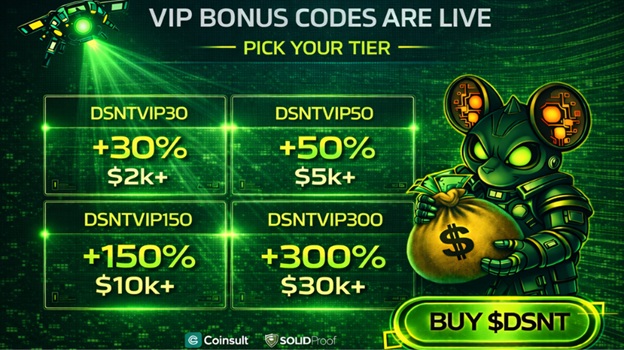
DeepSnitch AI, currently at a discount price, is screaming the best AI crypto coins opportunity with four live AI security agents already protecting traders, while 300% bonus codes turn your $30K into $120K tokens that explode to $32M when Microsoft’s endorsement sends AI crypto parabolic.

Microsoft drops $750M on AI: Blockchain AI tokens about to print

Perplexity securing a $750 million AI cloud infrastructure deal with Microsoft shows tech giants view artificial intelligence as the most critical technology investment for the next decade of digital transformation.

The deal provides Perplexity with massive computing resources from Microsoft Azure to scale AI operations, which signals that AI infrastructure demand is exploding faster than existing capacity can handle and creates opportunities for blockchain AI projects offering decentralized alternatives.

Top high-growth AI tokens for February 2026

1.     DeepSnitch AI destroys competition as best AI crypto coin with AI trading tools and 300% multipliers

DeepSnitch AI leads the best AI crypto coins list because it gives traders four operational AI weapons that create asymmetric advantages while your competition trades blind and loses money to scams.

AuditSnitch saves you from losing everything to rug pulls. Scan any contract in seconds before you ape in and watch it catch the honeypot functions, hidden mint capabilities, and malicious code that would have drained your wallet. This tool alone has saved early users millions by flagging scam projects during presale FOMO when emotions override logic

SnitchScan turns you into the whale. Track institutional wallet movements 24/7 across Ethereum, BSC, Solana, Polygon, and every major chain. Get instant alerts when smart money starts accumulating low-cap gems before CT catches on. Copy their entries, ride the momentum pump, exit into their buying pressure.

SnitchFeed makes you the first to know. Breaking news hits your feed in real time before it trends on Twitter. Partnership announcements, exchange listings, regulatory developments. Front-run the narrative, enter before the pump, take profits while retail is still reading the announcement.

SnitchGPT is your personal trading analyst working 24/7. Ask any security question and get instant answers using live blockchain data. “Is this contract safe?” “What’s the holder distribution?” “Are there any suspicious transactions?” Stop wasting hours researching and start making faster, more informed decisions that compound your edge.

The team extended presale after demand crushed projections, giving you exclusive access other traders won’t get. These live AI tools run exclusively for presale participants while everyone else waits. You’re building pattern recognition on whale accumulation zones and contract red flags that becomes your unfair advantage once public launch happens and you’re trading against people without these tools.

DeepSnitch bonus codes turn good entries into generational wealth. When DSNT runs to $10 during the AI security explosion Microsoft just validated with $750M, your $10K position hits $6.65 million.

2.     KAITO targets 10x returns through AI search infrastructure

KAITO trades at $0.39 on January 31 as AI-powered search infrastructure gains attention from Microsoft’s $750M deal validating that AI analytics tools represent critical infrastructure for information discovery.

The protocol gives traders AI search and analytics for crypto markets. KAITO could 10x if the AI analytics vs blockchain ecosystem narrative explodes throughout 2026 when institutional capital flows in.

3.     VANA builds toward 5x gains through data ownership infrastructure

VANA trades at $2 on January 31, riding the data ownership wave as users realize they’re getting farmed by Microsoft and every AI company for zero compensation on their personal data.

The protocol gives you ownership and monetization of your AI training data contributions. Positioned for 5x when privacy narrative explodes in 2026 and everyone demands control over their data.

VANA’s a safe AI analytics vs blockchain ecosystem bet with working products, but for best AI crypto coins that actually print millionaires, DeepSnitch AI at $0.03755 delivers four live AI security agents today plus 300% presale multipliers instantly quadrupling your stack.

Extended presale lets you master whale tracking and contract analysis before launch, edge that evaporates when public buying starts.

Conclusion: DeepSnitch AI leads AI crypto sector

Microsoft’s $750 million AI infrastructure deal validates unprecedented capital flows toward AI technology, benefiting blockchain projects offering working products at presale pricing.

KAITO and VANA deliver decent 5x to 10x returns as AI infrastructure plays, but the best AI crypto coins printing millionaires is DeepSnitch AI at $0.03755 with working AI security agents today plus 300% presale bonuses that 4x your bag instantly before launch sends prices parabolic and early advantages vanish.

Load $DSNT tokens at the official website before presale closes. Join Telegram and follow X for updates.

Frequently asked questions

What are the best AI crypto coins after Microsoft Perplexity deal?

Best AI crypto coins combine Microsoft validation with working products. KAITO and VANA offer 5x to 10x through AI infrastructure. DeepSnitch AI at $0.03755 delivers 1000x potential with 300% bonuses and live security tools.

Why does AI analytics vs blockchain ecosystem matter?

AI analytics vs blockchain ecosystem represents the intersection where decentralized AI tools solve problems that centralized tech giants cannot address effectively. DeepSnitch AI offers security tools that Microsoft’s centralized approach lacks.

Are KAITO and VANA the best AI crypto coins?

KAITO and VANA represent strong best AI crypto coins for slow gains. However, DeepSnitch AI offers explosive multiplication through working security agents, presale pricing, and 300% bonuses before public launch.

Best Crypto Presale for 2026: DeepSnitch AI Snags the Spotlight From Blazpay and Maxi Doge With 300x Growth Potential as Circle Builds Stablecoin Infrastructure for Institutions

0

Leading stablecoin issuer Circle aims to build a scalable payment network suitable for institutional-grade applications as companies explore stablecoin use in 2026. The firm is making this a priority.

Amid this development, DeepSnitch AI takes over the headlines, emerging as one of the best crypto presale projects ever to grace the crypto scene.

What sets DeepSnitch AI apart is its utility-focused approach in helping investors spot opportunities early before they go mainstream. This capability has attracted over $1.41 million in investment from traders looking to capitalize on what could become a 300x profit opportunity.

Circle pursues sturdy infrastructure to accelerate institutional stablecoin adoption

Circle, a renowned stablecoin issuer, is prioritizing the development of more efficient infrastructure in 2026 to bolster stablecoin adoption among institutional players.

In an X post on January 29, Nikhil Chandhok, Circle’s chief product and technology officer, revealed that the firm intends to push Arc, a layer-1 blockchain for institutional and large-scale use, from testnet to production.

Simultaneously, Circle aims to deepen the utility and expand the reach of its tokens: USDC, EURC, USYC, and the stablecoins its partners have launched together by integrating into other chains.

3 early-stage token launches with massive growth potential for 2026

1. DeepSnitch AI triggers FOMO among investors with a 300x growth prospect

The way retailers research new opportunities in the crypto market is about to change with the introduction of DeepSnitch AI. This protocol uses AI agents to spot market opportunities before they go mainstream.

Upon launch, DeepSnitch AI will deploy five AI agents (SnitchScan, SnitchFeed, SnitchCast, SnitchGPT, and AuditSnitch), built with the ability to track wallets, spot patterns, identify sentiment shifts, optimize strategies, and alert users to fraud or FUD.

With these tools in your reach, winning will become a walk in the park. The best part is that if you participate in the ongoing DeepSnitch AI presale and are holding DSNT, you will have access to beta-test these tools.

DSNT is currently in stage four of its ongoing presale and is already making waves among the best crypto presale projects. This sentiment comes from the belief that it will attract more investments on top of the current $1.41 million and could rise 300x from its current price of $0.03755.

2. Blazpay: AI-focused infrastructure among upcoming crypto presales

Blazpay is branded as a utility-focused platform that builds a functional architecture to simplify DeFi participation rather than to feed speculative narratives.

This platform supports trading, asset management, and cross-chain interaction via a unified interface, making decentralized finance offerings easier to access.

As of now, Blazpay is in phase 7 of its presale, selling for $0.0178. It has sold out 260.79 million tokens out of 282.04 million, and is closing in on wrapping up this epoch, having raised $2.3 million.

3. Maxi Doge ranks among the best new ICOs

Maxi Doge takes a community-centric approach by creating a unique, viral meme to attract risk traders. For traders who max out their positions, Maxi Doge offers zero stop losses and unlimited trading sessions.

Some of the key features of Maxi Doge include staking rewards and special access to trading competitions. As it focuses on advancing its reach, Maxi Doge will partner with trading platforms to host gamified competitions where the winners will receive prizes.

Maxi Doge’s presale has crossed the $4.5 million mark and is gearing up for its exchange debut. But a new rival, DeepSnitch AI, is stealing the spotlight from Maxi Doge, Blazpay, and other early-stage token launches.

The bottom line

DeepSnitch AI is turning investor focus to its AI-powered ecosystem, where traders and investors can use AI agents to spot market opportunities early and get ahead of the competition.

Many consider DeepSnitch AI the best crypto presale project because, in addition to its invaluable utility, it is also offering investors a 300% bonus on presale purchases above $30,000 with the code DSNTVIP300.

At its current price of $0.03755, a $30k investment would get you 798,935 tokens. When the code is used, you get a total of 3,195,740 tokens, which will be valued at $120,000. Imagine if DSNT hits $1, that is an easy $3 million+ return. But this opportunity won’t stick around forever.

Visit the official website for more information, and join X and Telegram for community updates.

FAQs

1. What is the best crypto presale token to buy today?

Among the upcoming crypto presale projects making waves today, DeepSnitch AI is considered the best as it could deliver 300x returns upon launch in addition to an array of AI agents that position users for incredible wins.

2. Which of the early-stage token launches can really rise 100x?

Most emerging presale projects claim to be the next 100x crypto, but DeepSnitch AI backs this claim up with expanding utility, a clear roadmap, growing adoption, and prospective leadership status.

3. Why is DeepSnitch considered one of the best new ICOs?

In just four presale stages, DeepSnitch AI has raised $1.41 million, users have staked more than 20 million tokens on the platform, its AI agents are available to investors serious about making a profit, and its presale is still in its earliest stage, leaving more room to grow.

Best Crypto to Buy Now: DeepSnitch AI Surpasses HYPE and STABLE With 150% Price Surge as the DOJ Concludes $400M Seizure

0

The Department of Justice (DOJ) has finalized a court order declaring the United States government the titleholder of seized cryptocurrencies and digital assets associated with Helix’s operations from 2014 to 2017.

This development comes as DeepSnitch AI overshadows major cryptocurrencies, with its price surging 150% amid its ongoing presale. The rally propelled the price to $0.03755 as the project raised $1.41 million.

Many now say DeepSnitch AI may be on the verge of soaring one hundred-fold as they anticipate its exchange debut. As a result, DeepSnitch AI could be the next crypto to buy now.

DOJ concludes $400M seizure in Helix case

According to a report on January 29, the US Department of Justice closed the case against the Bitcoin-era darknet mixing service provider Helix, sanctioning the forfeiture of over $400 million in cryptocurrencies and digital assets.

The assets were seized from Helix operator Larry Harmon between 2014 and 2017. Helix was developed to hide Bitcoin transactions on darknet markets.

On January 21, the US District Court for the District of Columbia issued an order that formally transferred ownership of the seized assets to the government. Henceforth, all assets previously owned by Helix have become properties of the United States.

Which of the trending coins this week can rise 100x in 2026?

1. DeepSnitch AI poised as the next crypto to 100x as demand jumps

DeepSnitch AI is taking a systematic approach to reduce guesswork in trading and investing and replace it with actionable, data-driven execution.

By leveraging five AI agents that gather real-time intelligence across several chains, DeepSnitch AI can help retail investors make well-informed investment decisions based on market sentiment and institutional demand.

SnitchScan, SnitchGPT, SnitchCast, SnitchFeed, and AuditSnitch are the five AI agents DeepSnitch AI creators built, and each has been integrated into a live dashboard that allows them to function simultaneously.

To access them, you have to be a DSNT holder. DSNT is currently in stage four of its presale, selling for $0.03755, with over $1.41 million raised.

Recently, DeepSnitch AI launched a bonus program for presale investors, allowing them to increase their holdings up to 3x right after purchase. This bonus is one of the reasons DeepSnitch AI is among the trending coins this week.

2. Hyperliquid price prediction: Commodity market explosion drives 24% rally

Following an explosion in commodity trading on Hyperliquid, HYPE surged 37.3% to $31.20. Silver became the most traded asset on the exchange during the Asian session.

Around the same time, Bitcoin and Ethereum recorded the highest trading volume among cryptocurrencies on Hyperliquid. This surge in activity prompted a response from the exchange’s CEO, Jeff Yan.

Also, the co-founder of Hyperliquid, Jeff, noted that Hyperliquid had become the most liquid market for crypto price discovery. Due to this momentum across the board, HYPE is expected to keep increasing in market value.

3. Stable price prediction: Why is the asset pumping?

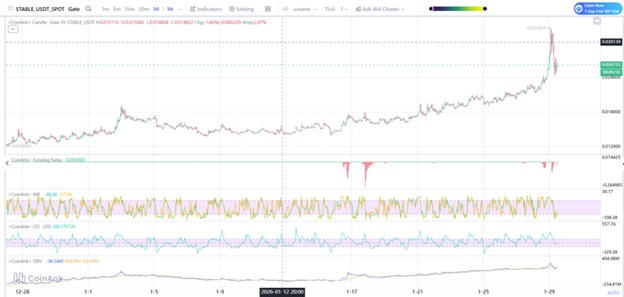
Stable is one of the trending coins this week and possibly one of the top cryptocurrencies to buy today. Over the past seven days, Stable has gained 30% in value, hitting $0.025.

This upswing has been attributed to a confirmed imminent network upgrade and short liquidation in the Stable perpetual market.

The Stable team announced that the v1.2.0 mainnet upgrade is scheduled for February 4, switching gas fees to USDT0 and eliminating extra wrap and unwrap steps on the network.

With these improvements, Stable could surge even higher, probably touching $0.030 in the coming days.

The bottom line

Despite the positive performance of HYPE and STABLE, DeepSnitch AI outperformed both altcoins, posting a 150% gain while still in its presale stage. This performance has stoked forecasts that it could be the next crypto to 100x.

DeepSnitch AI’s native token currently costs $0.03755, but not for long, as demand continues to accelerate. Also, the recent bonus structure, which allows investors to use the codes DSNTVIP150 or DSNTVIP300 to claim 150% and 300% bonuses on purchases above $10k and $30k, respectively, further adds to the allure.

Visit the official website for more information, and join X and Telegram for community updates.

FAQs

1. What is the best crypto to buy now?

The best crypto to buy now, based on market preference, is DeepSnitch AI, a presale token with potential to be the next crypto to 100x.

2. What are the top cryptocurrencies to buy today?

Based on the last seven days’ performance metrics, DeepSnitch AI, Stable, and HYPE would be the top cryptocurrencies to buy today due to their resilience amid the marketwide drawdown.

3. Which of the trending coins this week can soar 100x?

Given its low-cap status, growing retail attention and adoption, and clear utility, many predict DeepSnitch AI could rise 100x before this year ends.

India Considers Teen Social Media Ban as Global Momentum Builds After Australia’s Move

0

A proposal by an ally of Indian Prime Minister Narendra Modi to ban social media use for children is gaining attention not just for its domestic implications, but for what it could mean globally if the world’s most populous country follows a growing international trend sparked by Australia.

The draft legislation, introduced by lawmaker L.S.K. Devarayalu of the Telugu Desam Party, would prohibit anyone under the age of 16 from holding a social media account, placing full responsibility for age verification and enforcement on the platforms themselves. While the bill is a private member’s proposal and not formal government policy, its emergence reflects a broader political and regulatory shift underway in multiple countries after Australia’s decision to impose the world’s first nationwide ban on social media access for teenagers.

Australia’s move, enacted last month, has become a reference point in global policy circles. The government framed the ban as a response to mounting evidence linking excessive social media use among teens to anxiety, depression, cyberbullying, and sleep disorders. Early indications from Australia — including strong public support from parents and educators and the absence of major social disruption — have emboldened other governments to consider similar restrictions, even in the face of fierce opposition from technology companies.

France has moved quickly. Its National Assembly has backed legislation to bar children under 15 from accessing social media platforms, arguing that existing self-regulation by tech firms has failed to protect minors. In Britain, the government is examining age-based access limits as part of a broader review of online safety laws, while Denmark and Greece have launched policy studies focused on youth mental health and digital addiction. Canada, Germany, and Ireland have also reopened debates around minimum age requirements, parental consent frameworks, and stricter enforcement obligations for platforms.

Against this backdrop, India’s entry into the debate carries outsized significance. With roughly one billion internet users and about 750 million smartphones in circulation, India is the largest growth market for global platforms such as Meta’s Facebook and Instagram and Alphabet’s YouTube. Any meaningful restriction on youth access would immediately affect tens, if not hundreds, of millions of users — far more than in Australia or any European country.

Devarayalu has framed the issue as both a child-safety concern and a question of national interest. He has argued that Indian children are becoming addicted to social media at the same time the country is supplying enormous volumes of behavioral data to foreign companies. That data, he said, is then used to build advanced artificial intelligence systems, with the economic and strategic benefits accruing outside India.

His bill explicitly shifts the burden of compliance onto social media companies, requiring them to disable underage accounts and prove they have effective age-verification systems in place.

The proposal also aligns with a growing narrative within the Modi administration around data sovereignty and digital self-reliance. India has repeatedly signaled discomfort with a model in which global technology firms extract value from Indian users without commensurate local benefits. The government’s chief economic adviser reinforced this view last week by saying India should consider age-based access policies to tackle what he called “digital addiction,” a remark that suggested the issue is now being discussed at the highest levels of economic policymaking.

Technology companies have responded cautiously. Meta has said it supports parental oversight and age-appropriate experiences but has warned that outright bans could drive teenagers toward unregulated or less safe online spaces. Alphabet’s YouTube and X have declined to comment on the Indian proposal, while India’s IT ministry has so far remained silent, indicating that the government may be weighing its options rather than rushing to endorse the bill.

Enforcement remains a central challenge, particularly in a country as large and diverse as India. Critics of similar laws elsewhere argue that age verification at scale raises privacy concerns and may be difficult to implement without excluding legitimate users or creating new risks. Supporters counter that Australia’s experience shows governments can move beyond voluntary safeguards and force platforms to take responsibility for the harms linked to youth engagement.

What distinguishes India from other countries considering similar bans is sheer scale. If New Delhi were to adopt age-based restrictions on social media, it would not only reshape the daily digital habits of millions of children but also alter the growth trajectory of global platforms that increasingly depend on emerging markets. For Big Tech, an Indian ban would represent a far more serious commercial and strategic shock than Australia’s, simply because of the size of the user base involved.

Even if Devarayalu’s bill does not pass in its current form, it is likely to trigger sustained parliamentary debate and push the government closer to formal action. However, India’s deliberations suggest that age limits on social media are moving from the fringes of policy discussion into the global mainstream – following Australia’s lead.