DD
MM
YYYY

PAGES

DD
MM
YYYY

spot_img

PAGES

Home Blog Page 3

Crypto Casino CoinPoker Revamps Real Money Poker App On iPhone And Android With Freeroll Giveaways

0

Decentralized crypto casino and poker site CoinPoker has launched a long awaited upgrade to its mobile platform. Previously only available as an Android app, the revamped poker app is now also compatible with iPhone devices in-browser with no download required.

To access the site on iOS, players simply need to visit play.coinpoker.com on any mobile browser such as Chrome or Safari.

Alongside improving the mobile poker app for speed and stability worldwide, CoinPoker has also added a new tournament to its monthly schedule: a $5,000 freeroll tournament.

That giveaway promotion is scheduled for the last Friday of every month at 5pm UTC with no buy-in required. Entry is exclusively available to any new players who sign up and use the code MOBILE during registration.

How to Join the $5,000 Monthly Poker Freeroll

Joining the Mobile Monthly Freeroll is very straightforward. Restrictions are deliberately low so that new CoinPoker players can benefit, with minimum obstacles.

It’s open to all new players sign up and play, like this:

  1. Visit play.coinpoker.com and register using bonus code MOBILE

  2. Play any of the real money poker games – cash games or tournaments, Texas Hold’em or Omaha, the choice is yours

Next, new players automatically receive a seat in the next Mobile Monthly Freeroll that takes place at the end of that month at 5pm UTC.
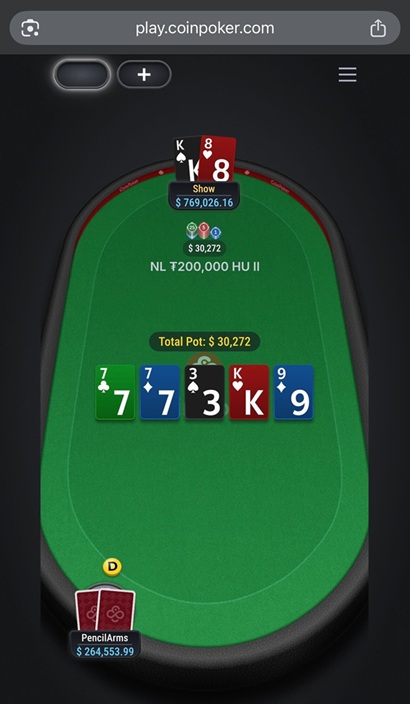
CoinPoker’s New Real Money Poker App: Fast, Smooth, and Download-Free

The launch of the Mobile Monthly Freeroll pairs perfectly with CoinPoker’s upgraded mobile poker platform. The platform is built to deliver a seamless poker experience directly through mobile browsers.

No App Store download or installation is required – players can get started playing iOS poker from anywhere, through Chrome, Safari, Firefox, or whichever iPhone browser they prefer, and then wait for the freeroll or jump into cash games immediately – stakes run from $0.01/$0.02 all the way up to $1000/$2000.

For beginners and recreational players, the $5,000 freeroll is a safe way to boost their bankrolls and try out the real money poker app for free in one large prizepool tournament.

The Mobile Monthly Freeroll also acts as an open door to explore the platform’s broader offerings, like the upcoming $10M GTD Winter Series, or 24/7 cash games. Now available directly through a mobile browser for smooth iOS poker experience on-the-go.

Latest Updates For Crypto Casino Fans

Checking the verified CoinPoker Twitter or Instagram is the perfect way to stay ahead of the pack, by seeing new promotions, crypto giveaways, upcoming tournament series, and exclusive events like the Android and iPhone poker freeroll before other players.

CoinPoker’s Twitter and Instagram also have never-before-seen footage and interviews with professionals like Owen “PR0DIGY” Messere or Triton ambassador Mario Mosböck, who recently launched a YouTube channel to promote the site.

The site regularly hosts major online poker festivals such as the Coin Series of Poker (CSOP) and the Cash Game World Championship (CGWC) with added value and crypto giveaways for players. The platform continues to push modern poker forward with transparent technology and an innovative design, now supporting iPhone poker play as well as Android poker, alongside its desktop client for Windows and Mac.

Games on the site are played in USDT, equivalent to USD, and the real money poker app also accepts fiat deposits in over 25 countries worldwide, automatically converted before you join the tables. For fans of other games, a full crypto casino and sportsbook are also available within the software. Both poker and casino play comes with a welcome bonus of 150% up to $2,000.

Visit the New Mobile Poker Platform Here

About CoinPoker

CoinPoker is one of the leading crypto casinos focused on fairness, innovation, and accessibility. Powered by a provably fair RNG and supported by some of the game’s most renowned players, such as WSOP Online Main Event champion Benjamin ‘Bencb’ Rolle, Hustler Casino Live regular Nik Airball, and many more.

CoinPoker has been ranked among the best crypto casinos and best poker apps across leading publications such as 99Bitcoins, Card Player Magazine, PokerScout and PokerStrategy.

Website: coinpoker.com

Media contact: media@coinpoker.com
TikTok’s U.S. Sale Set for January 2026 as Oracle-Led Consortium Takes Control

0

The long-running uncertainty hanging over TikTok’s future in the United States has finally lifted, with the sale of its U.S. operations now formally sealed and a takeover date set for Jan. 22, 2026.

A consortium of American and allied investors will assume control of the video-sharing platform’s U.S. business, bringing an end to years of political pressure, regulatory threats, and negotiations that once put the app on the brink of an outright ban.

Under the agreement, TikTok’s U.S. operations will be housed in a new entity, TikTok USDS Joint Venture LLC. Ownership of the venture is carefully structured to address U.S. national security concerns while keeping ByteDance, TikTok’s Chinese parent, financially involved. Three managing investors—Oracle Corporation, private equity firm Silver Lake, and Abu Dhabi state investment firm MGX—will collectively hold 45% of the new company. Another 5% will be owned by additional new investors whose identities have not been fully disclosed. Affiliates of existing ByteDance investors will hold 30.1%, while ByteDance itself will retain a 19.9% stake.

The ownership split underscores the political balancing act behind the deal. U.S. authorities had insisted on meaningful American control of TikTok’s operations, particularly its data and content systems, while ByteDance pushed to remain an economic participant in one of its most valuable markets.

TikTok chief executive Shou Chew confirmed that the transaction has been officially signed in a memo to staff on Thursday, a copy of which was viewed by The Hollywood Reporter. Chew struck a reassuring tone, emphasizing continuity for employees and users despite the change in ownership.

“I want to take this opportunity to thank you for your continued dedication and tireless work,” Chew wrote. “Your efforts keep us operating at the highest level and will ensure that TikTok continues to grow and thrive in the U.S. and around the world. With these agreements in place, our focus must stay where it’s always been—firmly on delivering for our users, creators, businesses and the global TikTok community.”

President Donald Trump signed an executive order in September formally sealing the TikTok deal, though few concrete details were made public at the time. Trump had earlier floated the possibility that the Murdoch family, through Fox Corp., could join the ownership group. It remains unclear whether Fox or Murdoch-linked entities are among the unnamed investors taking up the remaining 5% stake.

The deal caps a turbulent chapter for TikTok in Washington. The app had faced legislation that would have effectively banned it from operating in the United States unless ByteDance divested. Trump intervened with executive orders that delayed enforcement of the ban, creating space for negotiations that ultimately led to the current agreement.

Beyond ownership, the structure of control and oversight appears designed to directly confront the concerns that drove the political backlash against TikTok in the first place. Chew said the agreement includes retraining TikTok’s content recommendation algorithm using U.S. user data, with the explicit aim of ensuring the feed is insulated from external influence.

Oracle will oversee data protection, reinforcing its role as the trusted custodian of U.S. user information, while the deal also grants ultimate decision-making authority over content moderation and related policies within the United States to the U.S.-based entity.

Those provisions are likely to be closely scrutinized by lawmakers and regulators who have long argued that TikTok’s algorithm and data practices posed national security risks.

The investor lineup also highlights the deepening ties between technology, media, and global capital. Oracle and Silver Lake bring significant experience in both enterprise technology and entertainment. Oracle founder Larry Ellison has become an increasingly influential figure in Hollywood, backing his son David Ellison’s bid to acquire Paramount and playing a role in efforts to secure Warner Bros. Discovery, with Oracle’s financial firepower underpinning those ambitions.

Silver Lake, meanwhile, is already a major force across media and sports. It owns talent agency WME, controls TKO Group Holdings, and in September partnered with Saudi Arabia’s Public Investment Fund in the acquisition of video game publisher Electronic Arts, further cementing its influence in digital entertainment.

The deal secures continued access to TikTok’s most lucrative advertising market at a time when competition with Meta’s Instagram Reels and Google’s YouTube Shorts remains fierce. It also delivers a politically defensible outcome that avoids banning a platform used by tens of millions of Americans while asserting U.S. oversight.

The Background of The Sale

TikTok’s troubles in the United States date back to its explosive growth. The short-form video app rapidly became one of the most influential social platforms in the country, reshaping online culture, advertising, music promotion, and political messaging. That success also drew scrutiny from U.S. lawmakers and security agencies, who argued that TikTok’s ownership by China-based ByteDance could expose sensitive user data or allow foreign influence over content consumed by millions of Americans.

Concerns intensified as geopolitical tensions between Washington and Beijing worsened. Lawmakers repeatedly questioned TikTok executives on Capitol Hill, pressing them on data storage, algorithmic control, and the potential for Chinese government access. TikTok responded by insisting that U.S. user data was not shared with Chinese authorities and by rolling out mitigation measures, including storing U.S. data on servers overseen by Oracle.

Those steps, however, failed to fully calm political anxiety.

The pressure peaked with a 2024 legislation that would have effectively banned TikTok in the United States unless ByteDance divested control of its U.S. business. The prospect of a ban threatened to wipe out a platform used by tens of millions of Americans, disrupt a massive creator economy, and hand an advantage to rivals such as Meta Platforms’ Instagram and Google’s YouTube.

President Donald Trump emerged as a central figure in the final phase of the standoff. While he had sought to ban the app through executive order during his first term, Trump ultimately opted for a negotiated outcome rather than an abrupt shutdown this time. He signed executive orders postponing the enforcement of the ban, giving TikTok time to reach an agreement that would satisfy U.S. security demands while preserving the app’s operations.

Those negotiations culminated in the deal announced this week.

AI Frenzy, Uneven Economic Figures, Some Deals and Regulatory Pushbacks: 2025 Rounding Off Loud

0

As the global economy nears the end of 2025, a series of seismic shifts across regulatory, energy, and financial landscapes is forcing a fundamental re-evaluation of growth and risk.

From the courtrooms of California to the trading floors of Tokyo, the “easy money” era is being replaced by a high-stakes reckoning over debt, safety, and the true cost of the AI-driven future.

The U.S. Economic “Blackout”: Inflation, Tariffs, and the 43-Day Shutdown

A historic data crisis currently clouds the American economic landscape following the longest government shutdown in U.S. history. The 43-day impasse, which ended in mid-November, not only furloughed 1.4 million federal employees but also triggered an unprecedented “statistical blackout.” For the first time ever, the Bureau of Labor Statistics (BLS) failed to publish an unemployment rate for October, and the October Consumer Price Index (CPI) was canceled entirely as data could not be collected retroactively.

When the delayed November CPI was finally released, it underscored a worsening affordability crisis. While economists had predicted a 3.1% year-on-year surge—the largest in 18 months—the actual data arrived at 2.7%, a figure experts are treating with extreme caution. This “abnormal weakness” is largely attributed to the delay in data collection, which inadvertently skewed toward late-month holiday discounts rather than capturing the average price levels of the full month.

Underneath this statistical noise, the impact of sweeping import tariffs is becoming undeniable. Samuel Tombs of Pantheon Macroeconomics notes that retailers have already passed on roughly 40% of tariff costs to consumers as of September, a figure expected to climb to 70% by March 2026.

This “tariff pass-through” has stalled progress on inflation and is falling disproportionately on lower-income households with no savings buffer. Consequently, the Federal Reserve has signaled a halt to further rate cuts, holding the benchmark at the 3.50% to 3.75% range until the true trajectory of the labor market and trade-driven inflation becomes clear.

The AI Frenzy

The artificial intelligence sector has experienced an unprecedented surge this year, with global investments reaching new heights and driving economic growth, but not without raising alarms over sustainability, job losses, and ethical risks.

Leading the charge are a handful of powerhouse players. OpenAI, now valued at $500 billion, solidified its dominance with annualized revenue hitting $13 billion by mid-year, fueled by massive deals including partnerships for the ambitious Stargate AI infrastructure project. Rival Anthropic saw its revenue soar to $7 billion, while Elon Musk’s xAI grew rapidly to $500 million in annualized revenue, bolstered by its Grok models and supercomputer developments.

Tech giants like Google (Alphabet), Meta, Microsoft, and Amazon remain central, integrating AI deeply into cloud services and consumer tools, with hyperscalers committing over $300 billion in capital expenditures. The frenzy is most evident in infrastructure spending. Companies poured an estimated $375 billion globally into AI this year, including data centers, GPUs, and power systems. Major announcements included Microsoft’s $23 billion in new AI investments, much targeted at markets like India, and multi-billion-dollar cloud commitments, such as Anthropic’s $30 billion deal with Microsoft.

Yet, beneath the optimism lie significant concerns. Energy consumption has emerged as a flashpoint, with AI data centers straining grids and prompting warnings of rising electricity costs and environmental impacts. Job displacement tops public worries, with surveys showing over 40% of Americans fearing unemployment from automation. Experts and advocates also point to potential “bubble” risks, with some studies noting high failure rates in AI initiatives despite the torrent of capital.

Tokyo’s Fiscal Tightrope: Takaichinomics vs. the Interest Trap

In Japan, a historic collision between aggressive fiscal spending and the Bank of Japan’s (BOJ) exit strategy is reaching a boiling point. Prime Minister Sanae Takaichi, who initially rose to power on a platform of dovish expansion, has been forced to soften her stance as the weak yen drives up energy and food costs. The administration’s latest ¥21.3 trillion ($136 billion) stimulus package—the largest since the pandemic—is designed to reflate the economy, but it has sent 10-year bond yields to 18-year highs near 1.97%.

The Ministry of Finance now faces a staggering “interest trap.” If benchmark yields rise to 2.5%, annual interest payments on Japan’s massive debt will double, jumping from ¥7.9 trillion to ¥16.1 trillion by fiscal 2028. This fiscal burden leaves Finance Minister Satsuki Katayama on high alert for currency intervention, with analysts predicting the yen will remain locked in a volatile range between 150 and 160 through 2026.

The Nuclear Renaissance: A $1.3 Billion Bet on the AI Grid

As governments struggle with debt, the private sector is pouring unprecedented capital into the energy infrastructure required to sustain the artificial intelligence boom. Radiant Nuclear’s recent $300 million Series D funding round, valuing the startup at $1.8 billion, highlights an extraordinary surge in investor confidence. Radiant is racing toward a July 2026 deadline to achieve criticality with its “Kaleidos” microreactor, a portable 1MW powerhouse designed to replace diesel generators and power hyperscale data centers.

This investment frenzy is fueled by desperate data center developers like Equinix, which has already pre-ordered 20 units. However, the sector faces a looming “winnowing” year. While startups like X-energy and Aalo Atomics have successfully built prototypes, the true test in 2026 will be mass manufacturing. If these companies cannot move from “first-of-a-kind” designs to factory-scale production, the current “nuclear bubble” may burst as power-hungry AI models outpace the grid’s ability to modernize.

Regulatory Reckonings: Tesla’s Deception Ruling

The drive for autonomous technology is hitting a regulatory wall in California. A state administrative law judge recently ruled that Tesla engaged in deceptive marketing, finding that the “Autopilot” and “Full Self-Driving” (FSD) branding creates a “false impression” of autonomy for systems that still require active human supervision.

The ruling gives Tesla a 60-to-90-day grace period to update its branding or face a 30-day suspension of its dealer license in its largest U.S. market. While Tesla maintains that sales remain uninterrupted and that no customers have formally complained, the decision provides a legal foundation for federal agencies like the DOJ and SEC to pursue fraud investigations.

This pressure creates a stark divide in Tesla’s operations: while it tests unsupervised Robotaxis in Texas, it must now navigate a “consumer protection” order in California that could redefine how autonomous systems are marketed globally.

The “Everything App” War: Coinbase and the Media Mega-Mergers

In the corporate world, consolidation is the dominant theme of 2026. Coinbase has launched its biggest push yet to become a “one-stop financial app,” rolling out stock trading, 24/5 perpetuals, and a regulated prediction market through Kalshi. CEO Brian Armstrong is betting that bringing equities on-chain will democratize global access and keep users engaged during crypto lulls. Simultaneously, the launch of the x402 payments standard is preparing the platform for an “agentic economy,” where AI agents handle automated financial transactions.

Meanwhile, the media industry is embroiled in a hostile takeover battle. The board of Warner Bros. Discovery (WBD) has formally rejected a $108 billion hostile bid from Paramount Skydance, labeling it “illusory.” WBD’s leadership remains committed to a merger with Netflix, arguing that their $27.75-per-share agreement is far more secure than David Ellison’s offer, which they claim lacks a firm financial “backstop.”

The Netflix deal would see WBD spin off its linear networks into a new entity called Discovery Global, allowing the core Hollywood studios to merge with the streaming giant—a move the board insists provides “superior, more certain value” to shareholders.

A Soft CPI, a Sharp Rally — and a Big Question Mark Hanging Over U.S. November’s Inflation Data

0

Wall Street got exactly what it wanted on Thursday: a consumer price report that looked decisively cooler than expected. Stocks surged out of the gate, Treasury yields slid, and traders ramped up bets that the Federal Reserve could soon cut interest rates.

But as the dust settled, unease crept in. For many economists quoted by CNBC, the November inflation report raised as many questions as it answered.

According to the Bureau of Labor Statistics, headline consumer price inflation slowed to 2.7% year-on-year in November, while core inflation — which strips out food and energy — came in even lower at 2.6%. Both readings undershot forecasts by a wide margin. Economists surveyed by Dow Jones had expected headline inflation of 3.1% and core CPI of 3%.

The surprise marked a sharp break from recent data showing inflation proving stubborn, especially in services. It also arrived under unusual circumstances. The November report was released eight days late due to the U.S. government shutdown, and October’s CPI data was never published at all. That forced the BLS to rely on methodological assumptions to bridge the gap — assumptions that were neither fully explained nor clearly disclosed.

That opacity immediately set off alarm bells among economists.

“The downside surprise reflects weakness in both goods and services, but may be partly due to methodological issues,” said Michael Gapen, chief U.S. economist at Morgan Stanley.

He described the reading as “noisy” and cautioned that the data may not offer a reliable signal about the underlying inflation trend.

Gapen suggested the BLS may have carried forward prices in some categories, effectively assuming zero inflation during the missing period. If that is the case, he warned, inflation could easily reaccelerate in December once the data normalizes.

At the center of the controversy is a crucial housing component: owners’ equivalent rent, or OER. OER plays an outsized role in CPI, accounting for a significant share of the services basket and heavily influencing the Fed’s inflation outlook.

Alan Detmeister, an economist at UBS, said the October price changes for OER appear to have been “set to zero,” a highly unusual assumption. Evercore ISI’s Krishna Guha went further, saying it looked like the BLS inserted zero inflation across multiple categories when calculating housing inflation for roughly one-third of the cities used in the CPI sample.

“To the extent that it introduces a downward bias, the Fed would be mindful of the risk of taking the data on housing services inflation at face value,” Guha wrote.

The concern is not just academic. If housing inflation was artificially suppressed in November’s data, the distortion could linger for months. Detmeister warned that the weakness would likely reverse sharply next spring, potentially producing unusually large increases in OER and tenants’ rents in the April CPI report released in May.

Until then, he said, price levels for housing components may remain biased downward, complicating the Fed’s effort to gauge whether inflation is genuinely under control.

Housing wasn’t the only source of skepticism. Stephanie Roth of Wolfe Research pointed to the timing of the BLS’s data collection, which occurred later in November than usual. That period coincides with heavy holiday discounting, potentially exerting downward pressure on goods prices.

“The market seems to be taking the data as a dovish signal,” Roth said, “but given the technical quirks we expect the Fed will put less weight on this reading.”

She added that while inflation does not appear to be accelerating due to tariffs or other shocks, a rebound is likely once the data stabilizes following shutdown-related disruptions.

Even before the report was released, some analysts had warned that the shutdown could inject bias into the numbers. Those concerns intensified after the data crossed the wires — and the market reaction began to cool.

By the end of the trading session, stocks had pulled back from their highs. Technology shares carried most of the gains, while more economically sensitive sectors such as banks slipped into negative territory. Treasury yields, which initially fell sharply, also climbed off their lows.

The episode leaves the Federal Reserve in a familiar bind. On the surface, inflation appears to be easing faster than expected, strengthening the case for rate cuts. Beneath that surface, however, the data is clouded by technical distortions that policymakers are unlikely to ignore.

Against this backdrop, the conclusion of some economists is that for now, November’s CPI has delivered relief to markets — but not clarity.

A Ceasefire Between Russia and Ukraine will Help De-escalate Tension and Improve Oil Prices

0

Peace negotiations between Russia and Ukraine have gained momentum, with U.S., Ukrainian, and European officials reporting alignment on roughly 90% of a proposed framework during recent Berlin talks.

These include potential U.S.-backed security guarantees for Ukraine and a multinational stabilization force, though territorial disputes remain unresolved. Fighting continues, but progress has already influenced markets, such as oil prices dropping to multi-year lows by removing geopolitical risk premiums.

A ceasefire would likely act as a catalyst for positive sentiment in cryptocurrency markets, which are highly sensitive to geopolitical developments. De-escalation reduces global uncertainty, encouraging investors to rotate from safe-haven assets e.g., U.S. Treasuries, dollar into risk-on assets like Bitcoin and major altcoins.

This could trigger a short-term “relief rally,” lowering implied volatility and supporting price recovery. Stabilized or lower energy prices—Russia being a major supplier could ease inflationary pressures, particularly in Europe, potentially allowing central banks more room for accommodative policies and increased liquidity—factors that historically benefit cryptocurrencies.

When the conflict escalated in 2022, Bitcoin and crypto markets declined sharply alongside equities. A reversal could mirror relief seen in past de-escalations, driving gains in high-beta assets. Analysts generally view this as net positive in the short term, with potential for meaningful upside in Bitcoin and altcoins via sentiment-driven reallocation.

Crypto especially Bitcoin has at times benefited from the conflict as a perceived “digital gold” or tool for sanctions evasion in Russia. Resolution could reduce this narrative and demand, exerting short-term downward pressure.

Broader factors like central bank policies, interest rates, inflation, and leveraged positions in derivatives markets could limit or reverse gains. Any rally might be transient without sustained liquidity easing.

More dependent on regulatory shifts, institutional adoption, and global economic conditions than the ceasefire alone. Reduced volatility from peace could support maturation but shift focus away from crisis-driven adoption.

A credible ceasefire would likely deliver a short-term boost to crypto prices through improved risk sentiment and indirect macro relief, though sustained gains hinge on wider economic trends.

Markets have shown sensitivity to these talks already like oil declines, defense stock selloffs, suggesting crypto could follow suit with a risk-on move if progress solidifies.

Officials described progress on security guarantees, with alignment on key elements like a U.S.-led ceasefire monitoring mechanism and potential multinational forces. Zelenskyy called the draft proposals “very workable” but emphasized unresolved territorial issues.

Russia has not yet formally responded to the latest framework. Kremlin spokesperson Dmitry Peskov reiterated that Moscow seeks a comprehensive deal, not a temporary truce, and has not received updated documents. Fighting continues, including strikes on energy infrastructure. Upcoming steps may include U.S. consultations with Russia and potential high-level meetings.

Experts remain cautious, noting persistent red lines e.g., Russian control over occupied territories like Donbas, opposition to foreign troops in Ukraine. Polymarket still assign low odds ~3-10% to a ceasefire by early 2026, reflecting skepticism despite optimistic headlines.

Implications for Crypto Markets

Cryptocurrencies continue to track broader risk sentiment, with recent talks contributing to cautious optimism but no dramatic price shifts yet. Bitcoin and major altcoins have shown mild stability amid the headlines, mirroring reduced geopolitical premiums in other markets.

De-escalation would likely reduce global tail risks, encouraging capital rotation from safe havens (USD, Treasuries) to risk assets. This could spark a relief rally in Bitcoin, Ethereum, and altcoins, lowering volatility and supporting higher valuations.

Stabilized energy markets could ease inflation especially in Europe, giving central banks flexibility for looser policy—historically positive for liquidity-driven assets like crypto. Crypto dipped sharply during the 2022 escalation; a reversal could drive short-term gains, similar to past de-escalations.