DD
MM
YYYY

PAGES

DD
MM
YYYY

spot_img

PAGES

Home Blog Page 3

How Evidence Shapes Truck Accident Litigation in Austin, TX

0

Truck accident litigation is rarely decided by sympathy or surface facts. In reality, these cases rise or fall on evidence—what is preserved, what is documented, and what can withstand scrutiny. In Austin, Texas, where commercial trucking traffic moves through crowded highways, construction zones, and fast-growing urban corridors, the aftermath of a serious truck crash becomes a race against time. Digital records, corporate documents, and physical proof begin to disappear almost immediately. This is why injured victims often turn to Austin truck accident attorneys who understand that in complex trucking cases, accountability is not assumed—it is built through evidence.

Why Truck Accident Evidence Is Different From Car Accidents

Unlike standard vehicle collisions, truck accidents involve commercial operations governed by strict regulations and layered responsibilities. A single crash may implicate a driver, a trucking company, a maintenance contractor, a freight broker, or even a vehicle manufacturer. Each entity generates records, data, and reports that can either clarify liability or obscure it.

This complexity makes evidence collection both more challenging and more critical. Without early, strategic preservation of proof, key information can be lost or controlled by parties with strong incentives to limit exposure.

The Critical Role of Time-Sensitive Evidence

In truck accident litigation, time works against injured victims. Commercial vehicles often carry electronic logging devices, onboard computers, and GPS systems that record speed, braking, hours of service, and route data. These records are not preserved indefinitely.

If evidence is not requested and secured quickly, data may be overwritten or destroyed under routine retention policies. Surveillance footage from nearby businesses or traffic cameras can disappear just as fast. In Austin, where traffic density and construction are constant, scenes change quickly, making early documentation essential.

How Corporate Records Shape Liability

Beyond physical evidence, truck accident cases hinge on corporate documentation. Driver qualification files, training records, maintenance logs, and dispatch instructions often reveal whether safety protocols were followed—or ignored.

These records help establish patterns, not just isolated mistakes. A fatigued driver may point to unrealistic delivery schedules. A mechanical failure may trace back to skipped inspections. Litigation strength grows when evidence shows systemic issues rather than one-time errors.

Insurance Strategy and Evidence Control

Trucking companies and their insurers understand the power of evidence. Defense strategies often focus on narrowing the narrative early, framing the accident as unavoidable or shifting blame onto other drivers.

This is where evidence becomes leverage. When data contradicts initial statements or exposes regulatory violations, settlement dynamics change. For truck accident attorneys in Austin, building a case around objective proof—not assumptions—creates pressure that insurers cannot easily dismiss.

Expert Analysis Turns Data Into Proof

Raw data alone does not win cases. Evidence must be interpreted, contextualized, and explained. Accident reconstruction experts analyze vehicle dynamics and impact forces. Industry experts interpret federal and Texas trucking regulations. Medical experts connect crash mechanics to injury severity.

In Austin truck accident litigation, expert testimony often bridges the gap between technical records and legal accountability. Courts and insurers respond to clear, credible explanations grounded in evidence rather than speculation.

How Texas Law Elevates Evidence Standards

Texas law places a premium on proof, particularly in high-value commercial cases. Comparative fault arguments, damage thresholds, and corporate defenses all increase the importance of strong documentation.

In Austin, where trucking routes include both interstate highways and congested urban roads, evidence must address multiple driving environments. Speed data, lane positioning, and reaction times take on different meanings depending on where and how the collision occurred.

The Second Life of Evidence: Trial Preparation

Even when cases resolve before trial, they are shaped by trial readiness. Evidence collected early must be organized, preserved, and presented as if a jury will evaluate it.

This approach affects negotiations. When trucking companies see that evidence supports a clear narrative of fault and damages, they reassess risk. This is why truck accident attorneys in Austin who prepare cases for court—not just settlement—often achieve stronger outcomes.

What Happens When Evidence Is Weak

When evidence is incomplete or delayed, the balance shifts. Insurers gain room to question causation, minimize damages, or stretch litigation timelines. In truck accident cases, weak evidence often leads to prolonged disputes or undervalued claims.

This is not because injuries are less serious, but because proof is less persuasive. The absence of data creates uncertainty, and uncertainty favors the defense.

Conclusion: Evidence Is the Foundation of Accountability

Truck accident litigation in Austin, Texas, is not driven by emotion or assumption. It is driven by evidence—what was recorded, preserved, and proven. From electronic data to corporate records and expert analysis, each piece contributes to a larger picture of responsibility.

When evidence is treated as the foundation rather than an afterthought, accountability becomes harder to avoid. In a city where commercial trucking plays a constant role in daily life, the outcome of serious truck accident cases ultimately depends on one question: not just what happened on the road, but what can be proven afterward.

India’s Factory Growth Ticks Up in January, but Weak Confidence and Hiring Signal a Cautious Manufacturing Outlook

0

India’s manufacturing sector showed modest signs of recovery in January, with factory activity inching higher as domestic demand improved, but the rebound was too mild to restore business confidence or trigger a meaningful pickup in hiring, according to a private survey released on Monday.

The HSBC India Manufacturing Purchasing Managers’ Index (PMI), compiled by S&P Global, rose to 55.4 in January from December’s two-year low of 55.0. While the reading remained firmly above the 50-mark that separates expansion from contraction, it fell short of the preliminary estimate of 56.8, pointing to a slower-than-expected improvement in operating conditions.

India’s PMI has stayed in expansionary territory since July 2021, underscoring the resilience of the manufacturing sector through successive global shocks. Still, the January data suggest that momentum remains uneven and fragile.

Factory output strengthened from December, when growth had eased to a 38-month low, reflecting a modest revival in production schedules. New orders also regained some of the ground lost in the previous month, indicating that demand conditions have stabilized after a soft patch at the end of last year.

However, the composition of demand highlights an important imbalance. Export orders improved only marginally from December and remained weak overall, signaling that the recovery was largely driven by domestic consumption rather than overseas markets. Manufacturers reported receiving orders from clients across Asia, Australia, Canada, Europe, and the Middle East, but the pace of export growth remained subdued, mirroring a challenging global trade environment marked by slowing growth, tighter financial conditions, and lingering geopolitical uncertainty.

The weak export performance contrasts with India’s broader ambitions to expand its manufacturing footprint globally and deepen its integration into supply chains, shifting away from China. It also comes as exporters face rising uncertainty from U.S. trade policies under President Donald Trump, which have weighed on sentiment and planning across several sectors.

Despite the improvement in output and new orders, the survey showed little evidence that manufacturers are confident enough to expand their workforce aggressively. Employment growth rose to a three-month high, but the pace of hiring remained modest. Firms reported adjusting staffing levels only cautiously to meet higher workloads, suggesting they remain wary about the durability of the demand recovery.

That caution was reflected more starkly in business sentiment. Overall confidence about future output slipped to its lowest level in three-and-a-half years. Only 15% of surveyed manufacturers said they expected production to increase over the next 12 months, while the majority anticipated no change. Such subdued optimism points to lingering concerns over global demand, input costs, and policy uncertainty, both at home and abroad.

Inflation dynamics within the sector were mixed. Input cost inflation accelerated to a four-month high, with companies citing higher prices for chemicals, copper, iron, steel, and transportation. These increases reflect both commodity market pressures and elevated logistics costs, which continue to squeeze margins.

Yet manufacturers appear reluctant or unable to pass those higher costs on to customers. Output price inflation fell to its lowest level in nearly two years, indicating weak pricing power despite firmer demand. This suggests intense competition and price sensitivity in the market, particularly as consumers remain cautious and export markets stay soft.

However, the January PMI paints a picture of a manufacturing sector that is still expanding but struggling to build convincing momentum. Domestic demand is providing a cushion, but weak exports, muted hiring, and falling confidence underline the challenges facing manufacturers as they navigate an uncertain global environment and rising cost pressures.

Analysts expect the data to reinforce the importance of sustaining domestic demand while addressing structural bottlenecks that continue to limit India’s manufacturing competitiveness and export growth.

Beta Glass Delivers Breakout Year as PBT Jumps 155% on Pricing Power and Operational Stability

0

Beta Glass Plc posted one of its strongest financial performances in recent years, recording a 154.5% year-on-year surge in profit before tax to N50.66 billion for the year ended December 31, 2025, up sharply from N19.90 billion in 2024.

The results, contained in the company’s unaudited financial statements released to the Nigerian Exchange on Friday, January 30, 2026, underline a year in which revenue growth, margin expansion, and operational resilience converged to reshape the company’s earnings profile.

The glass packaging manufacturer benefited from higher demand across its beverage, pharmaceutical, and food segments, while improved production stability and firmer pricing allowed it to absorb cost pressures and significantly widen margins. The outcome was not just stronger profits, but also improved cash generation and a sturdier balance sheet.

Financial performance shows margins doing the heavy lifting

Revenue for the year rose 26.8% to N149.12 billion from N117.58 billion in 2024, pointing to sustained demand from fast-moving consumer goods producers and pharmaceutical companies that rely heavily on glass packaging. While revenue growth was solid, the more striking development was how much faster profits grew than sales.

Gross profit climbed 71.2% year-on-year to N52.66 billion, compared with N30.76 billion in the prior year, signaling a significant improvement in cost control, pricing discipline, and production efficiency. Operating profit nearly doubled, rising 99.7% to N47.02 billion from N23.56 billion in 2024, showing that gains were driven primarily by core operations rather than one-off items.

Profit after tax rose 145.5% to N33.46 billion, reflecting the combined effect of stronger operating earnings and effective financial management. The widening gap between revenue growth and profit growth indicates that Beta Glass entered a more favorable operating phase in 2025, where scale and efficiency began to work more decisively in its favor.

A strong finish to the year helped reinforce the trend. Fourth-quarter revenue stood at N34.74 billion, while gross profit for the quarter rose 71.2% year-on-year to N10.77 billion. Profit before tax in Q4 increased by 38% compared with the same period in 2024, helping offset earlier volatility and cementing full-year gains.

Cost structure and operating discipline

The results suggest that Beta Glass managed inflationary pressures better than many manufacturers operating in Nigeria’s challenging macroeconomic environment. While energy costs, logistics, and imported inputs remained elevated, the company’s pricing strategies and production stability helped protect margins.

Operating cash flow rose sharply to N43.77 billion, up about 150% year-on-year, reflecting improved working capital management and stronger earnings quality. This level of cash generation is notable given the scale of capital expenditure undertaken during the year.

Total liabilities increased to N87.82 billion from N69.56 billion, partly reflecting higher trade payables and financing linked to expansion and capital projects. However, the rise in liabilities was outpaced by asset growth, leaving the balance sheet in a stronger net position.

Balance sheet expansion and capital investment

Total assets expanded by 37.2% to N184.30 billion from N134.35 billion in 2024, driven largely by increased investment in property, plant, and equipment. Management has consistently positioned capital expenditure as central to sustaining long-term competitiveness in a capital-intensive industry.

A major highlight was the successful furnace rebuild at the Delta Plant (DF1), completed in October 2025 in a record 48 days. According to Chief Executive Officer Alexander Gendis, the project is expected to improve production efficiency, reduce downtime risk, and enhance the plant’s long-term sustainability. In a sector where furnace reliability directly affects output and costs, this upgrade carries strategic importance beyond the immediate financial year.

Chief Financial Officer Hélène Paradisi described 2025 as a year that validated management’s strategic focus on execution and liquidity management. She said the 26.8% revenue growth and 71.2% increase in gross profit underscored the company’s commitment to sustainable value creation, rather than short-term gains.

The emphasis on disciplined execution suggests that the performance was not driven by a single favorable factor, but by a combination of pricing decisions, operational stability, and targeted investments that reinforced each other over the course of the year.

Shareholder returns and dividend trajectory

Beta Glass’ improved earnings have translated into stronger shareholder returns. Dividends paid in 2025 rose to N1.64 billion, compared with N0.84 billion in 2024. For the 2024 financial year, shareholders approved a doubled dividend payout of N1.76 billion at the company’s 51st Annual General Meeting.

Dividend per share increased from N1.40 in 2023 to N2.95 in 2024, a 111% year-on-year rise, reflecting confidence in earnings sustainability. Dividend history shows a steady upward trend, supported by rising profitability and cash flow, reinforcing Beta Glass’ appeal as an income-generating stock within the manufacturing space.

Looking ahead to 2026, Beta Glass says it remains focused on operational efficiency and capacity optimization as it navigates broader economic pressures. While demand from beverages and pharmaceuticals is expected to remain supportive, the company still operates in an environment shaped by exchange rate volatility, energy costs, and infrastructure constraints.

Even so, the 2025 results suggest that Beta Glass has reached a scale and level of operational resilience that allows it to convert moderate revenue growth into outsized profit gains. If production stability is maintained and pricing discipline holds, the company appears well-positioned to defend margins and sustain strong cash generation, even as macroeconomic headwinds persist.

Treasury Yields Stable As Investors Adopt Wait And See Attitude Toward Fed Leadership Uncertainty

0

U.S. Treasury yields exhibited minimal movement on Monday, February 2, 2026, as investors parsed President Donald Trump’s nomination of Kevin Warsh as the next Federal Reserve chair.

The decision has injected a dose of hawkish uncertainty into monetary policy outlooks while simultaneously offering some reassurance on central bank independence.

The 10-year Treasury yield eased less than 1 basis point to 4.238%, the 2-year yield ticked up less than 1 basis point to 3.531%, and the 30-year yield dipped less than 1 basis point to 4.87%.

Bond prices and yields move inversely, and the subdued trading underscores a market cautiously recalibrating expectations amid Warsh’s hawkish leanings and the broader economic resilience signaled by recent data. Warsh, a former Federal Reserve governor from 2006 to 2011 and a key figure in the Bush administration’s response to the financial crisis, was nominated late last week to succeed Jerome Powell, whose term ends in May 2026.

Described by Trump as “central casting” for the role, Warsh is seen as an inflation hawk with deep market expertise, having served as the Fed’s liaison to financial markets during turbulent times.

Experts like New York University’s Mark Gertler view the pick with “cautious relief,” citing Warsh’s experience and potential to reassure markets of the Fed’s independence, even as his past criticisms of quantitative easing (QE) as a “reverse Robin Hood” policy raise questions about future rate paths.

Warsh has advocated for a “regime change” at the Fed, critiquing its data reliance and balance sheet management, but he supports easing in 2026 if productivity gains allow for non-inflationary growth.

Market reactions to the nomination have been pronounced since Friday, with U.S. stock futures lower on Monday, the dollar strengthening, and Treasury yields edging higher initially before stabilizing.

Precious metals faced steep declines, with gold and silver deepening their historic sell-off, as investors interpreted Warsh as a signal for sustained or higher rates to combat inflation.

The pan-European Stoxx 600 and Asia-Pacific indexes extended losses, reflecting global unease over potential Fed policy shifts.

Analysts at Wells Fargo and Edward Jones suggest Warsh could represent a dovish tilt relative to Powell but tempered by the Federal Open Market Committee’s (FOMC) collective structure, potentially supporting two quarter-point rate cuts in the second half of 2026 if neutral rates around 3% are targeted.

Manufacturing data took center stage Monday, providing upbeat signals on economic health. The S&P Global U.S. Manufacturing PMI rose to 52.4 in January 2026 from 51.8 in December, above the preliminary estimate of 51.9, marking the strongest expansion since May 2022 with sharp output growth despite subdued new orders and export weakness linked to tariffs.

The ISM Manufacturing PMI surged even more dramatically to 52.6 from 47.9, beating forecasts of 48.5 and signaling the first expansion in 12 months, with new orders jumping to 57.1—its highest since February 2022—and production accelerating to 55.9.

These readings indicate a solid sector rebound, though input costs rose at the fastest pace since August amid trade uncertainties. Labor market indicators loom large this week, offering further clues on Fed policy space. The Job Openings and Labor Turnover Survey (JOLTS) for December 2025 is slated for release on February 3, with expectations around 7.21 million openings, down slightly from November’s 7.146 million.

The ADP private payrolls report for January 2026 follows on February 4, after December’s addition of 41,000 jobs and 4.4% annual pay growth.

Recent weekly NER Pulse data showed 7,750 jobs added for the four weeks ending January 3, 2026, slightly below the prior period’s 8,000. These metrics will inform whether employment risks have abated, following the Fed’s January removal of “downside risks to employment” language from its statement.

Analysts debated whether the pick alters the bullish equity setup, citing Warsh’s potential for “regime change” but dovish stance on rates.

Crypto markets felt the ripple, with Bitcoin briefly dipping to $75,000 amid the “Warsh Shock,” viewed as bearish short-term due to hawkish signals. Gold and silver’s plunge was attributed to a chain reaction from the nomination, hotter PPI data, and thin liquidity.

As Senate confirmation hearings approach—likely in spring 2026—Warsh’s testimony could clarify his stance on rates, balance sheet policy, and independence, potentially easing market jitters. Currently, the nomination’s hawkish undertones have pushed back rate-cut bets, contributing to a risk-off tone, though robust manufacturing data offers a counterbalancing narrative of economic strength.

DeepSnitch AI Bonus: Hong Kong Announces Stablecoin Licenses Amid Crypto Downturn As SOL Hovers Around $100 While DeepSnitch AI Attracts ADA Whales With Impressive 300x Bonus Offers

0

Hong Kong is taking a decisive step toward regulated digital assets as the Hong Kong Monetary Authority (HKMA) prepares to issue its first stablecoin issuer licenses in March, according to a Reuters report.

The announcement arrives during a turbulent period for the crypto market, where declining prices and uncertainty have pushed major assets like Solana below the $100 mark, intensifying investor caution.

Despite this, attention is shifting toward high upside opportunities positioned ahead of the next cycle. One project gaining traction is DeepSnitch AI, whose DeepSnitch AI bonus structure and early-stage incentives are attracting Cardano whales.

With the Deepsnitch AI presale bonus explained clearly, the platform is emerging as a standout narrative amid today’s shifting crypto landscape.

Hong Kong moves closer to approving its first regulated stablecoin issuers

Hong Kong’s financial regulator is nearing a major milestone in its digital asset framework, as the Hong Kong Monetary Authority (HKMA) prepares to issue its first stablecoin-related licenses as early as March.

Speaking during a Legislative Council session, HKMA Chief Executive Eddie Yue indicated that the authority’s evaluation process for stablecoin applicants is close to completion. He noted that the initial rollout will be highly selective, with only a limited number of licenses expected to be granted in the first phase.

DeepSnitch AI bonus: Traders rush to DeepSnitch AI for attractive bonus offers amid crypto bear market

As crypto markets grind through uncertainty, traders are moving toward tools that actually work in real time. That shift explains why DeepSnitch AI is seeing a surge in attention right now. While most projects are stalled by volatility, DeepSnitch AI is already live and offering an impressive bonus structure that has attracted traders and investors alike.

This growing urgency around its bonus is one of the factors driving interest in the DeepSnitch AI bonus narrative as the presale enters its final stretch.

DeepSnitch AI is a live intelligence platform built specifically for traders who need clarity during chaos. Instead of speculation or future promises, it offers immediate utility through a single dashboard that connects four active AI agents: SnitchFeed, SnitchScan, SnitchGPT, and AuditSnitch.

One of these agents, SnitchFeed, continuously scans on-chain activity and social momentum to reveal real-time alerts when attention, dominance, or behavior shifts across tokens. Rather than chasing noise or reacting late, traders see signals forming as they happen, turning market confusion into actionable insight.

DeepSnitch AI is currently in the 4th stage of its presale, priced at $0.03830, already up by 150%  from its initial $0.01510 entry point, showing the growing demand around the project.

While the project has briefly delayed its launch, it has only strengthened the position of users. Instead of rushing a public release, holders retain exclusive access while the system continues to mature,  creating access, learning, and enjoying DSNT allocation perks that cannot be replicated later.

Solana investors grow concerned as SOL hovers around $100

Solana’s native token has recently felt more pressure than momentum. In the week from January 27 to February 2, 2026, SOL slid from about $122.34 to approximately $103.05, marking a decline of roughly 15% as it trades near the critical psychological $100 level.

Adding to the unease, blockchain chartist Alicharts identified that if SOL fails to hold around current levels, the next meaningful support zone could be near $63, suggesting thinner bids under the market and more downside risk if selling accelerates.

ADA whales unimpressed as Cardano sees 15% weekly drop

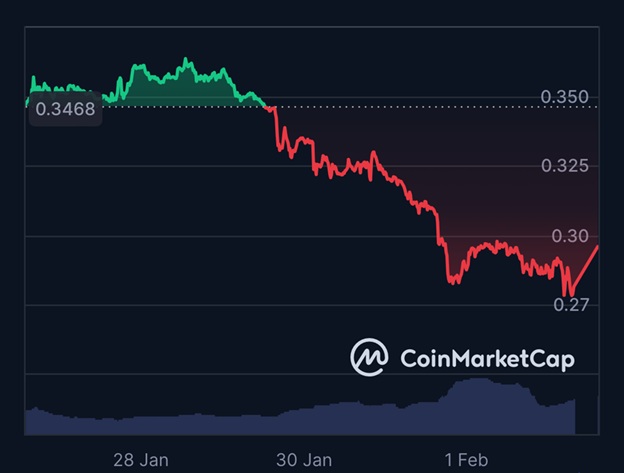
ADA has struggled to find a footing this week, sliding roughly 15% between January 27 and February 2, 2026. ADA opened the period near $0.346 and is now trading around $0.293. Despite occasional surges in recent sessions, the overall tone of the asset has been bearish.

Interestingly, while price action looks weak, on-chain data shows significant whale accumulation even amid the pullback, large holders have been adding tens of millions of ADA to their positions as the price dips, a behavior that some analysts interpret as strategic accumulation rather than panic selling.

Conclusion

While the broader crypto market wrestles with volatility, traders are increasingly gravitating toward projects that already deliver value. This is where the DeepSnitch AI bonus continues to stand out. With live tools, a working dashboard, and a presale still in progress, DeepSnitch AI offers early buyer benefits that go beyond speculation.

While timing remains everything in crypto, the DeepSnitch AI bonus structure amplifies that advantage. At the current price of $0.03755, a $5,000 purchase delivers roughly 133,000 DSNT tokens but applying a 50% bonus increases that allocation to about 200,000 DSNT.

This is why the DeepSnitch AI bonus conversation keeps coming up among traders looking for huge growth

Visit the official website for priority access and check out X and Telegram for their latest community updates.

FAQs

What token is being coined as the next big crypto in 2026?

Several analysts are watching AI driven utility tokens closely, and DeepSnitch AI is increasingly mentioned due to its live products and early stage pricing.

Is the DeepSnitch AI bonus window still open?

Yes, the DeepSnitch AI bonus window remains available during the current presale stage, allowing early participants to secure additional DSNT tokens before launch.

Can investors benefit from the DeepSnitch AI bonus offers?

Investors can benefit significantly from the DeepSnitch AI bonus by increasing their token allocation at the current presale prices. The project enables buyers to gain more DSNT upfront, which can dramatically improve long term returns if the project performs as expected after launch.