DD
MM
YYYY

PAGES

DD
MM
YYYY

spot_img

PAGES

Home Blog Page 3

Rekt x FaZe Energy Drink Cans Arrive on Amazon, Expanding the Brand’s Reach

0

The gaming and creator economy continues to reshape consumer markets, and the latest milestone comes as Rekt’s collaboration with FaZe Clan officially lands on Amazon.

The launch of Rekt x FaZe energy drink cans on the world’s largest online marketplace marks a significant step in the evolution of gaming-inspired consumer products.

By moving beyond direct-to-consumer sales and specialty retailers, the partnership is positioning itself to reach a much broader audience of gamers, esports fans, and everyday consumers looking for functional beverages.

FaZe Clan has long been recognized as one of the most influential organizations in esports and gaming entertainment. Over the years, it has expanded far beyond competitive gaming into content creation, fashion, music, and lifestyle branding.

Teaming up with Rekt, a beverage company focused on serving gamers and digital-native audiences, represents a natural extension of FaZe’s strategy to monetize its highly engaged community through consumer products that align with its identity.

The availability of Rekt x FaZe cans on Amazon significantly increases accessibility for customers. Rather than relying on limited online drops or niche gaming stores, consumers can now purchase the drinks through Amazon’s extensive logistics network.

This allows for faster shipping, easier product discovery, and the convenience of recurring subscriptions for regular buyers. For many brands, Amazon serves as both a sales platform and a marketing engine, exposing products to millions of shoppers who may not already be part of the gaming ecosystem.

Energy drinks have become deeply embedded within gaming culture. Long gaming sessions, esports tournaments, and content creation often require sustained focus and energy, making the category highly competitive.

Established brands have invested heavily in esports sponsorships, influencer marketing, and event partnerships over the past decade. Rekt’s collaboration with FaZe demonstrates how newer brands are using authentic community connections rather than traditional advertising to compete in the crowded marketplace.

The partnership provides another opportunity to diversify revenue streams beyond sponsorships and media content. Esports organizations have increasingly sought stable sources of income through merchandise, food products, collectibles, and branded consumer goods.

Successfully scaling a beverage partnership through Amazon could provide recurring sales while reinforcing FaZe’s presence as a lifestyle brand rather than simply an esports organization.

The move highlights a broader trend in creator-led commerce. Influencers and digital communities are becoming powerful drivers of product demand, often outperforming traditional celebrity endorsements because of their close relationships with audiences.

Gaming fans are generally more willing to support products associated with creators they trust, especially when those products align with their daily habits and interests.

Amazon’s marketplace offers valuable advantages beyond distribution. Product reviews, recommendation algorithms, and promotional tools can significantly increase visibility if customer reception is positive.

Strong sales performance could encourage further retail expansion into supermarkets, convenience stores, or specialty retailers, creating additional growth opportunities for both Rekt and FaZe.

The launch may inspire similar collaborations across the gaming industry. As esports organizations continue searching for sustainable business models, branded consumer products are becoming an increasingly attractive avenue for growth. Partnerships that successfully blend community engagement with practical, everyday products have the potential to generate long-term customer loyalty.

The arrival of Rekt x FaZe energy drink cans on Amazon represents more than just another product launch. It reflects the growing influence of gaming culture on mainstream commerce and demonstrates how digital-first brands are leveraging trusted platforms to scale their businesses.

If consumer demand remains strong, the collaboration could become a model for future creator-driven product launches across the gaming, entertainment, and lifestyle industries.


Nigeria Tightens Crypto Oversight With New Tax Rules for Digital Assets and Exchanges

0

Nigeria has taken one of its most significant steps toward regulating the digital asset economy, with the Nigeria Revenue Service (NRS) unveiling comprehensive guidelines that bring cryptocurrencies and other virtual assets firmly within the country’s tax framework.

The new Guidelines on the Taxation of Virtual Assets, issued under the recently enacted Nigeria Tax Act and Nigeria Tax Administration Act, establish a detailed compliance regime for virtual asset service providers (VASPs), centralized cryptocurrency exchanges and peer-to-peer (P2P) trading platforms.

The framework follows the transformation of the Federal Inland Revenue Service (FIRS) into the Nigeria Revenue Service (NRS) under Nigeria’s sweeping tax administration reforms and signals the government’s determination to expand the tax base by capturing a rapidly growing segment of the digital economy.

The rules introduce mandatory tax identification requirements, automated tax deductions, stricter reporting obligations and substantial penalties for non-compliance, marking a shift from largely voluntary tax compliance to systematic digital tax enforcement.

Exchanges Become Tax Collection Agents

Under the new guidelines, supervised virtual asset service providers, centralized cryptocurrency exchanges and operators of P2P escrow marketplaces must now function as tax collection agents on behalf of the government. Rather than relying solely on taxpayers to declare digital asset transactions, regulated platforms will automatically collect and remit various taxes during transaction settlement.

The taxes include:

  • Electronic transactional levies (stamp duties/EMTL-type charges)
  • Value Added Tax (VAT), where applicable
  • Withholding taxes on qualifying transactions
  • Contract-related transaction duties

The policy effectively embeds tax collection into the settlement process, similar to the automatic deductions already implemented across Nigeria’s banking sector.

One of the most significant changes is the introduction of compulsory Tax Identification Number (TIN) integration across regulated digital asset platforms.

Every customer opening an account with a regulated cryptocurrency exchange or P2P escrow platform must provide a valid TIN during registration. Platforms are also expected to integrate their systems with government tax infrastructure, enabling automatic deduction of applicable taxes and electronic remittance within statutory deadlines through the NRS TaxPro platform.

The measure significantly strengthens the government’s visibility into cryptocurrency transactions and substantially reduces anonymous participation on regulated exchanges.

For users, it effectively ends pseudonymous trading on licensed centralized platforms in Nigeria.

What Is Taxable?

The guidelines clarify that digital assets themselves are not taxed merely because they appreciate in value.

Instead, taxation generally occurs when gains are realized through disposal or exchange.

The framework distinguishes between different forms of digital asset activity.

Self-transfers remain exempt, meaning moving cryptocurrency between wallets owned by the same individual does not trigger tax because there is no change in beneficial ownership.

For businesses, profits generated from virtual asset activities will be taxed under Nigeria’s standard 30% Corporate Income Tax (CIT) regime.

Individual investors will be taxed on profits realized from selling, swapping, or trading digital assets under the applicable Personal Income Tax framework.

The NRS also clarified that income earned from:

  • Staking rewards
  • Cryptocurrency mining
  • Airdrops
  • Validation and verification services will be treated as taxable income.

The new framework significantly raises compliance obligations for cryptocurrency investors. Users will be expected to maintain detailed transaction records, including purchase prices, exchange fees, blockchain network fees, and disposal values.

Without adequate documentation establishing acquisition costs and deductible transaction expenses, taxpayers risk having assessments based on gross transaction values rather than actual realized gains.

The guidelines therefore place greater importance on accurate cost-basis calculations, particularly for active traders executing multiple transactions across different platforms.

The NRS has introduced substantial penalties designed to encourage compliance among both service providers and taxpayers.

For virtual asset service providers and P2P operators:

Violation Initial Penalty Monthly Penalty
Failure to register, collect or remit taxes N10 million N1 million for every subsequent month
Violation Initial Penalty Monthly Penalty
Failure to register for tax purposes N50,000 N25,000 for every subsequent month

In addition to financial penalties, regulated exchanges risk regulatory sanctions, including possible suspension or revocation of licenses issued by the Securities and Exchange Commission for persistent violations.

Industry Faces Major Technology Upgrades

The regulations also require significant technological changes across Nigeria’s regulated cryptocurrency industry.

Exchanges will need systems capable of:

  • Verifying customer TINs
  • Calculating multiple tax obligations automatically
  • Deducting applicable taxes during settlement
  • Maintaining detailed transaction records
  • Reporting directly to the NRS TaxPro platform

For many domestic operators, implementing these capabilities is likely to require significant investment in compliance infrastructure and automated tax reporting systems.

Implications for Nigeria’s Crypto Market

The new framework is expected to reshape trading behavior across Nigeria’s digital asset ecosystem. Retail traders and high-frequency investors may experience higher transaction costs as multiple micro-charges are automatically deducted during trading activities.

Some market participants may increasingly migrate toward decentralized exchanges (DEXs) and non-custodial protocols that operate outside the scope of centralized intermediaries, although such platforms present their own regulatory and compliance challenges.

Institutional investors and regulated financial firms, however, may view the framework positively because it provides greater legal clarity regarding the taxation of digital assets. For the government, automated tax collection could improve compliance while generating a new and potentially significant source of non-oil revenue as cryptocurrency adoption continues to expand.

The guidelines represent another shift in Nigeria’s evolving approach toward digital assets.

Relations between Nigerian regulators and the cryptocurrency industry have undergone a marked transformation over the past several years. Earlier restrictions imposed by the Central Bank of Nigeria on banking relationships with cryptocurrency businesses gave way to a more structured regulatory framework after the SEC introduced licensing regimes for digital asset service providers.

The NRS guidelines complement those reforms by establishing a formal tax regime that integrates virtual assets into Nigeria’s broader fiscal system. Rather than treating cryptocurrencies as operating outside the conventional financial architecture, the government is positioning digital assets alongside traditional financial instruments for tax administration purposes.

While the rules are likely to increase compliance costs for exchanges and traders, they also provide long-awaited clarity on the tax treatment of digital assets and signal the government’s intention to incorporate the crypto economy into the country’s formal financial and regulatory framework.

Festival Season Meets Football: How to Bet on the Game Without Leaving the Party

0

Festival season presents fabulous opportunities for engagement and fanfare. It’s a celebratory milieu coupled with artistic narratives and a wellspring of creative energy. This is hardly the appropriate time to be staring at a screen and ensconced in the digital realm. Indeed, festivities are the perfect counterbalance to solemnities; a convivial celebration and triumph of the human spirit.

This is especially true at concerts, shindigs, and gatherings of the townsfolk. The public square is where the magic unfolds. From arts & crafts to song & dance; it’s an old-fashioned celebration that resonates within. It’s about discovering new artists, meeting interesting people, and broadening cultural horizons.

It Takes Mass to Move Mass

Step over the threshold into the end zone. This is gridiron territory. The hullabaloo and how are you come together in perfect discord. They butt heads and tear things up. Ultimately, this is a nimble dance of hulking giants. It’s not symmetry, it’s brutish bulldozing as they tear downfield chasing glory. The buildup is arguably the best part. And the electric atmosphere dovetails with the razzle-dazzle unfolding before tens of thousands of raucous fans.

But even the most seasoned festival goers take pause when football season arrives. There is a magnificent artistic tapestry to the NFL. It transcends mere sporting prowess and showcases as artistry in motion. Such is the practiced precision of premier athletes.

It’s at this implausible juncture that festival-goers are torn. Look closely. They can be seen sneaking a peek at the score. Perhaps even scrolling through a list of injury updates. Meanwhile, others are eagerly anticipating game alerts. Football season has an uncanny knack of eliciting interest from fans. In fact, it never fails.

Stay and Enjoy the Festivities

There is no need to abscond from the pomp and ceremony of song and dance. Football presents many opportunities for fans. The decadent appeal of a moneyline wager is tough to shake. It’s a definite anchor to the action while the focus is elsewhere. Those who enjoy dabbling in football bets here and there understand that it’s not where you are that matters – it’s where your head’s at.

Betting aficionados are multi-layered, sort of like onions. You peel back a layer, and another to understand how they assess every situation on its merits. Football betting is complex yet simple. It’s as much about strategic analysis, as it is about tactical gameplay, and gut feel. It’s an art, and a science, and it’s none of those things all at the same time. Simply put, any responsible adult who enjoys gridiron action can place a wager.

There’s so much to do at festivals, it almost feels as if adding anything else to the list might detract from the experience. Food stalls, gifts and curios, arts and crafts, interesting people, a lively atmosphere – you name it, it’s there in abundance. Believe it or not, football fans always have a minute available in between mouthfuls of gnocchi, hot dogs, or tiramisu. It literally only takes a couple of seconds to sneak a peek. Halftime scores, TDs, full-time scores, and proposition bets are plenty exciting.

It’s almost as if a little bit of fortune-telling prowess is needed to cut through the numbers. But alas, no such prognostication is necessary. It’s just a fun bet at a reputable platform. When you register for football betting on VoltageBet, you’re on the virtual field of play. It’s an ambiance of merriment, number-crunching, and supporting your favorite team. The good news is that it doesn’t much matter what festival-centric activities are taking place. Many fans find themselves grabbing a drink, waiting for the next act, or finding a place to sit for five minutes.

The Profile of a Typical Football Bettor

Football bettors are cut from many different cloths, each with the same underlying thread. Some punters love checking the scores every couple of minutes to get a handle on the action. Others enjoy following the injury reports for details on who’s likely to play and how that impacts outcomes. Between friends or colleagues, there’s lots of back and forth with discussions on moneyline wagers. It’s the social nature of football betting that fosters that community vibe. Either way, football is a fun-filled complementary activity at festivals.

Just remember, there’s always room for both pursuits. One fees the soul through artistic expression. And the other satisfies our innate desire for competition, strategy and grand spectacle. Onward to the end zone!

Remittix Markets Is Live, Giving Crypto Traders A New Perps Platform To Watch

0

Crypto traders have another perpetual futures platform to assess following the official launch of Remittix Markets.

The new platform brings live perps trading into the RTX ecosystem, expanding Remittix beyond its original crypto-to-fiat payments focus. It also gives active traders a new way to interact with the project ahead of the official RTX token launch.

For Remittix, going live is an important first step. The next test will be whether Markets can attract sustained trading activity and deliver the experience users expect from a competitive perps platform.

Remittix Markets Opens A New Route Into Perps Trading

Perpetual futures allow traders to take long or short positions without contracts expiring on a fixed date.

This gives users the flexibility to respond to both rising and falling markets, hedge existing holdings and maintain exposure across changing conditions. Unlike spot trading, perps also allow leverage, although this can increase losses and liquidation risk as well as potential returns.

The launch of Remittix Markets opens the RTX ecosystem to traders who may not have previously followed the project through its PayFi proposition.

Instead of being connected only to payments, Remittix now has a dedicated product built around active crypto markets.

What Traders Will Be Watching

Launching a platform is only the beginning. Traders will now assess how Remittix Markets performs in real conditions.

Important factors will include liquidity, order execution, platform stability, fees, funding rates, supported markets and risk controls. Users will also expect a clear interface and reliable performance during periods of sharp volatility.

These areas will determine whether traders return regularly and whether Remittix Markets can build lasting activity.

As a new entrant, the platform has not yet established the user numbers or trading volume associated with larger perps venues. However, going live gives users something tangible to test rather than another product that remains on a roadmap.

A New Platform In A High-Activity Sector

Perpetual futures are among the most actively used products in crypto.

Traders frequently move between platforms in search of better execution, deeper liquidity and a stronger overall experience. This creates opportunities for new platforms when they can give users a clear reason to try them.

Remittix Markets enters with an existing community and a wider product ecosystem already taking shape. That gives it a different starting point from a trading platform launched as an isolated product.

Remittix Offers More Than Perps Trading

The wider Remittix ecosystem also includes a fully developed PayFi platform that has been tested by members of the community.

PayFi is designed to let users initiate transfers using crypto while recipients receive fiat directly into their bank accounts. The product aims to simplify the exchange, conversion and withdrawal stages often required when moving money from digital assets into traditional banking.

This gives Remittix two distinct audiences. Markets targets active traders, while PayFi targets individuals and businesses seeking simpler crypto-to-fiat payments.

RTX Moves Closer To Its Next Milestone

The Remittix presale has passed $31 million and is approaching the $32 million milestone, when the team is expected to reveal the official RTX launch date.

With Markets now live and PayFi already developed and tested, RTX is moving toward launch within a broader ecosystem covering both trading and payments.

Remittix Markets still has to prove itself through real user activity. Even so, its launch gives crypto traders a new perps platform to evaluate and adds another working product to the expanding RTX ecosystem.

Discover the future of PayFi with Remittix by checking out their project here:

Website: https://remittixpresale.io

Perps Trading: https://remittixmarkets.io

FAQ

What is Remittix Markets?
Remittix Markets is the live perpetual futures trading platform within the RTX ecosystem.

What should traders assess before using a new perps platform?
Traders should review liquidity, fees, execution, supported markets, funding rates, reliability and risk controls.

What makes Remittix different from a standalone trading platform?
Remittix combines perps trading with a developed PayFi platform designed for crypto-to-fiat bank transfers.

The Biggest Shift in Artificial Intelligence Is Not Technology

0

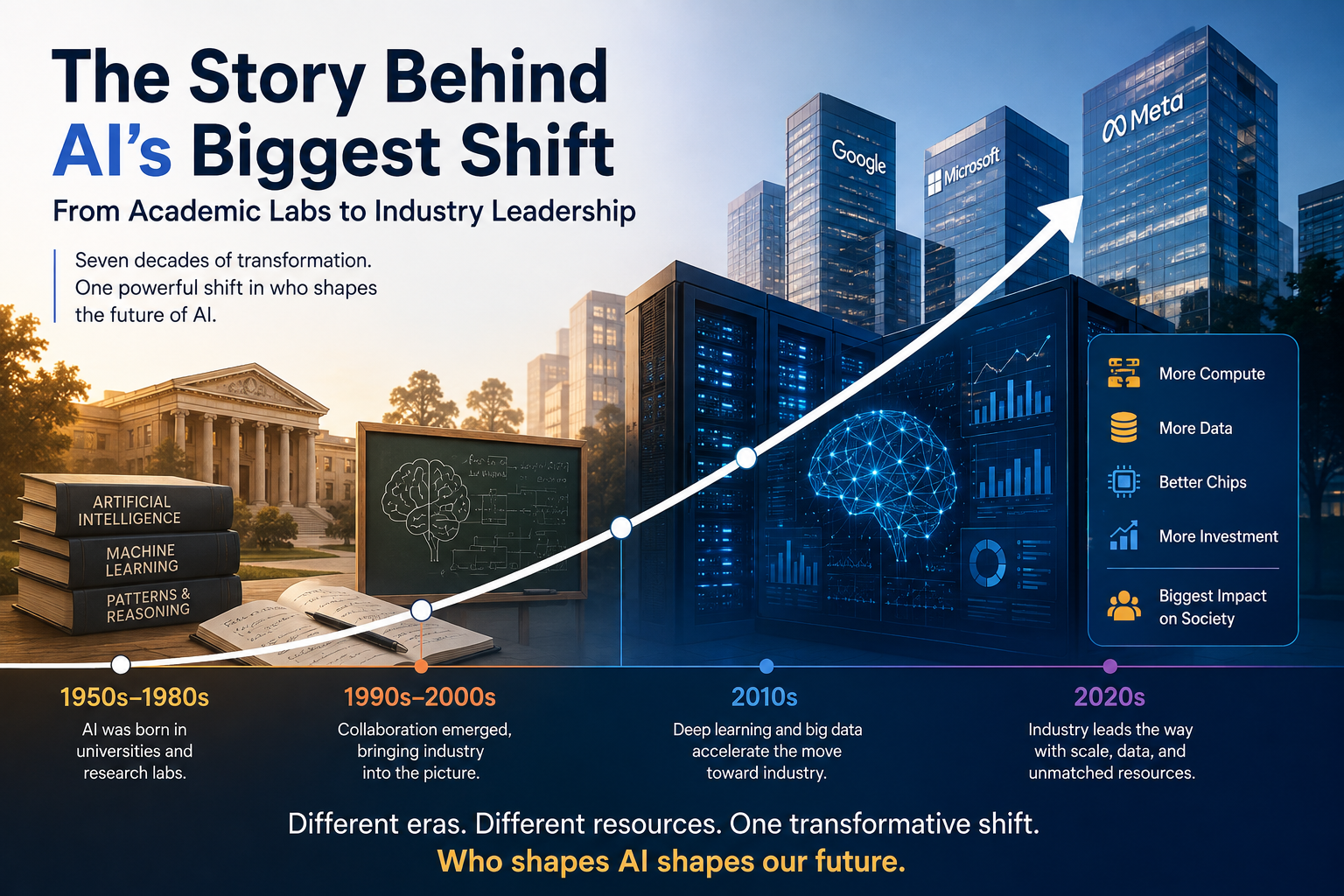
Artificial intelligence is often described as a race for smarter algorithms, faster computers, and more powerful models. Yet one of the most significant changes in the field has received far less attention. The real transformation is not only what AI can do, but who now has the power to shape its future.

Evidence from a historical dataset tracking the affiliations of research teams behind notable AI systems from 1950 to 2022 reveals a remarkable story. Over the decades, the centre of AI innovation has gradually shifted from universities to private companies. This transformation did not happen overnight. It reflects long-term changes in investment, computing power, access to data, and the growing influence of the technology industry.

In the early decades of AI, universities were the unquestioned home of innovation. Researchers worked in academic laboratories, supported largely by public funding and driven by scientific curiosity. Their mission was to expand knowledge, test new ideas, and explore how machines could imitate aspects of human intelligence. Commercial success was rarely the primary objective. Universities set the pace for discovery and defined the direction of AI research.

As interest in AI expanded, businesses began to recognise its commercial potential. Companies started working more closely with universities, combining academic expertise with practical resources. These partnerships created opportunities for ideas to move more quickly from research laboratories into products and services. For many years, this relationship strengthened both scientific discovery and technological innovation.

Everything changed with the rise of modern AI. Building advanced systems became increasingly expensive and required enormous computing power, vast amounts of data, specialised computer chips, and sustained financial investment. These resources became just as important as scientific talent. Large technology companies were better positioned to acquire and manage them than most universities.

As a result, private companies gradually became the leading force behind many of the world’s most influential AI systems. Universities continued to make important discoveries, but transforming those discoveries into large-scale applications increasingly depended on resources that only well-funded organisations could provide.

This shift should not be interpreted as a decline in academic excellence. Universities remain essential to AI progress. They educate the next generation of researchers, develop new theories, and publish discoveries that continue to shape the field. Many of today’s leading AI scientists began their careers in academia before moving into industry, carrying with them the knowledge and skills developed through years of academic research.

What has changed is the balance of influence. Success in AI is no longer determined solely by brilliant ideas. It now depends equally on access to advanced computing infrastructure, high-quality data, specialised hardware, and the financial capacity to sustain years of experimentation. Innovation has become as much about resources as it is about research.

This evolution also changes how knowledge is created and shared. Academic research has traditionally encouraged openness through publications and collaboration. Commercial organisations, by contrast, often operate within competitive markets where protecting intellectual property is essential. As private companies take on a larger role in AI development, some of the most important advances are increasingly shaped by business priorities alongside scientific ambition.

Even so, the relationship between universities and industry remains deeply interconnected. Academic institutions continue to produce foundational knowledge, while companies provide the resources needed to transform those ideas into technologies used by millions of people. Neither sector can thrive in isolation. The future of AI depends on their ability to complement one another.

For governments, the message is equally important. Building national leadership in AI requires far more than producing talented graduates or funding university research. Countries must also invest in digital infrastructure, advanced computing capabilities, semiconductor technologies, and innovation ecosystems that encourage responsible collaboration between research institutions and industry.

Business leaders should also take note. Competitive advantage in AI will not belong only to organisations with exceptional technical talent. It will belong to those that combine expertise with long-term investment, reliable infrastructure, responsible governance, and the ability to translate research into solutions that address real-world challenges.

Ultimately, the story of AI is about more than technological progress. It is about how the centres of innovation have evolved over time. Universities laid the intellectual foundations of artificial intelligence, but private companies now play a defining role in determining how those ideas are developed, scaled, and applied. Understanding this shift provides valuable insight into the future of AI and reminds us that the next era of innovation will be shaped not only by groundbreaking ideas, but also by those with the capacity to bring them to life.