

Artificial intelligence is often described as a race for smarter algorithms, faster computers, and more powerful models. Yet one of the most significant changes in the field has received far less attention. The real transformation is not only what AI can do, but who now has the power to shape its future.
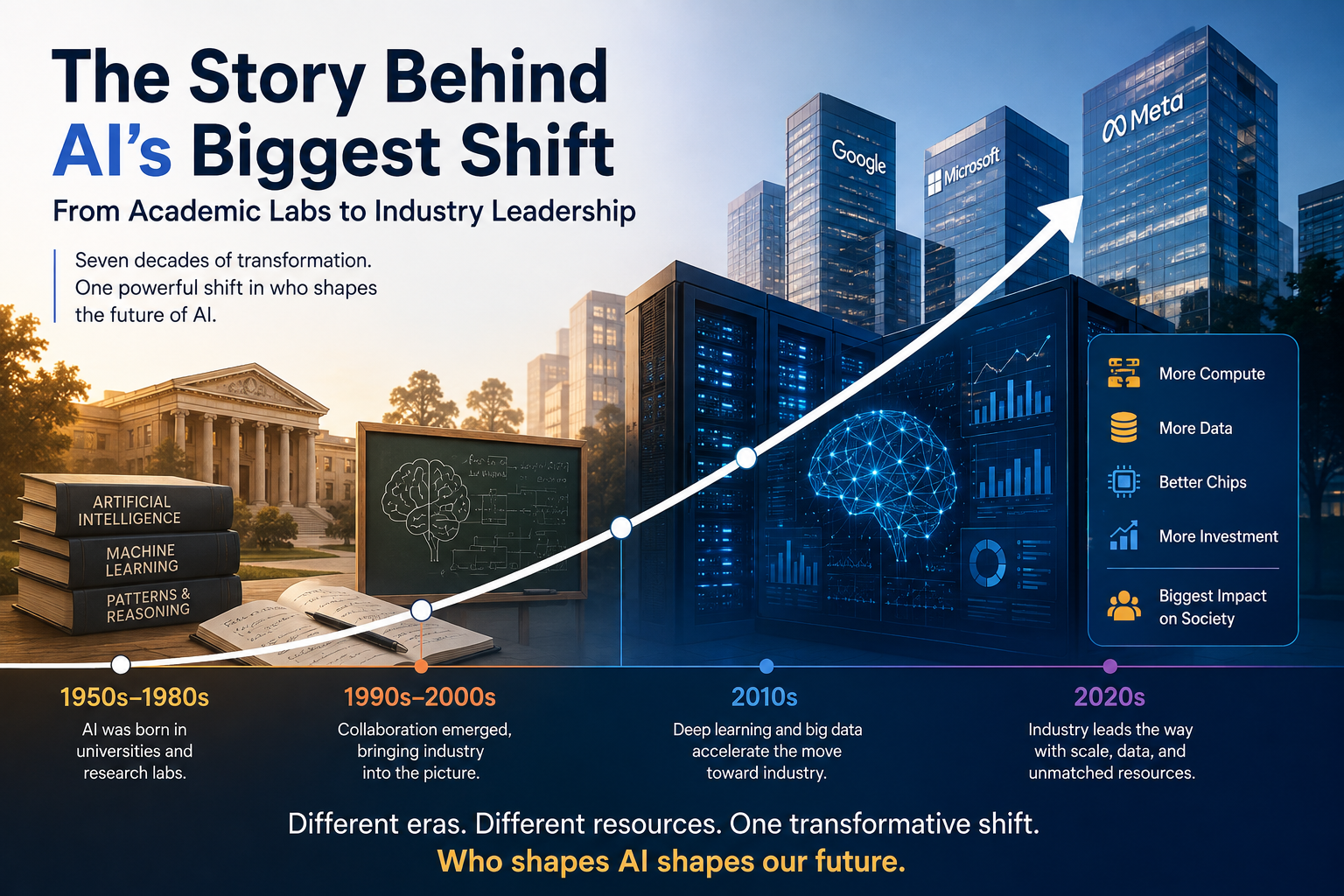
Evidence from a historical dataset tracking the affiliations of research teams behind notable AI systems from 1950 to 2022 reveals a remarkable story. Over the decades, the centre of AI innovation has gradually shifted from universities to private companies. This transformation did not happen overnight. It reflects long-term changes in investment, computing power, access to data, and the growing influence of the technology industry.
In the early decades of AI, universities were the unquestioned home of innovation. Researchers worked in academic laboratories, supported largely by public funding and driven by scientific curiosity. Their mission was to expand knowledge, test new ideas, and explore how machines could imitate aspects of human intelligence. Commercial success was rarely the primary objective. Universities set the pace for discovery and defined the direction of AI research.
Register for the next Tekedia Mini-MBA.
Register for Tekedia AI in Business Masterclass.
Join Tekedia Capital Syndicate and co-invest in great global startups.
As interest in AI expanded, businesses began to recognise its commercial potential. Companies started working more closely with universities, combining academic expertise with practical resources. These partnerships created opportunities for ideas to move more quickly from research laboratories into products and services. For many years, this relationship strengthened both scientific discovery and technological innovation.
Everything changed with the rise of modern AI. Building advanced systems became increasingly expensive and required enormous computing power, vast amounts of data, specialised computer chips, and sustained financial investment. These resources became just as important as scientific talent. Large technology companies were better positioned to acquire and manage them than most universities.
As a result, private companies gradually became the leading force behind many of the world’s most influential AI systems. Universities continued to make important discoveries, but transforming those discoveries into large-scale applications increasingly depended on resources that only well-funded organisations could provide.

This shift should not be interpreted as a decline in academic excellence. Universities remain essential to AI progress. They educate the next generation of researchers, develop new theories, and publish discoveries that continue to shape the field. Many of today’s leading AI scientists began their careers in academia before moving into industry, carrying with them the knowledge and skills developed through years of academic research.
What has changed is the balance of influence. Success in AI is no longer determined solely by brilliant ideas. It now depends equally on access to advanced computing infrastructure, high-quality data, specialised hardware, and the financial capacity to sustain years of experimentation. Innovation has become as much about resources as it is about research.
This evolution also changes how knowledge is created and shared. Academic research has traditionally encouraged openness through publications and collaboration. Commercial organisations, by contrast, often operate within competitive markets where protecting intellectual property is essential. As private companies take on a larger role in AI development, some of the most important advances are increasingly shaped by business priorities alongside scientific ambition.

Even so, the relationship between universities and industry remains deeply interconnected. Academic institutions continue to produce foundational knowledge, while companies provide the resources needed to transform those ideas into technologies used by millions of people. Neither sector can thrive in isolation. The future of AI depends on their ability to complement one another.
For governments, the message is equally important. Building national leadership in AI requires far more than producing talented graduates or funding university research. Countries must also invest in digital infrastructure, advanced computing capabilities, semiconductor technologies, and innovation ecosystems that encourage responsible collaboration between research institutions and industry.
Business leaders should also take note. Competitive advantage in AI will not belong only to organisations with exceptional technical talent. It will belong to those that combine expertise with long-term investment, reliable infrastructure, responsible governance, and the ability to translate research into solutions that address real-world challenges.
Ultimately, the story of AI is about more than technological progress. It is about how the centres of innovation have evolved over time. Universities laid the intellectual foundations of artificial intelligence, but private companies now play a defining role in determining how those ideas are developed, scaled, and applied. Understanding this shift provides valuable insight into the future of AI and reminds us that the next era of innovation will be shaped not only by groundbreaking ideas, but also by those with the capacity to bring them to life.