DD
MM
YYYY

PAGES

DD
MM
YYYY

spot_img

PAGES

Home Blog Page 3023

Top 3 Altcoins to Watch: Unexpected AI Altcoin Set to Lead the 2024 Bull Run With 10,000x Potential?!

0

With the crypto market constantly evolving, a trio of altcoins is catching the spotlight. Among them, an unexpected AI-driven coin is emerging as a potential leader for 2024, promising massive gains. This article delves into which altcoins show promise and could be primed for significant growth, capturing the attention of savvy investors.

CYBRO Presale Advances as Demand for AI-based Tokens Surges

The CYBRO presale has rapidly advanced to its fifth stage, amassing over $1.6 million. This AI-based yield aggregator offers users the potential to enhance their earnings within the Blast ecosystem, delivering unparalleled rewards for staking ETH and stablecoins. Smart investors see great potential in $CYBRO tokens as the Artificial Intelligence (AI) is the hottest trend in crypto nowadays,

Benefits for CYBRO Token Holders:

  • Competitive staking rewards
  • Access to airdrops
  • Reduced trading and lending fees
  • A robust insurance program within the platform

Industry experts forecast a potential return on investment of 1200%, with CYBRO tokens currently available at a presale price of just $0.03 each. This technologically advanced initiative has already garnered attention from prominent crypto whales and influencers, reflecting strong market confidence and interest..

With only 21% of the total token supply allocated for the presale and approximately 80 million tokens already sold, now is an opportune moment to secure a position in this innovative project, which holds significant potential to become a major player in the cryptocurrency space.

>>Join CYBRO and aim for future returns up to 1200%<<

Solana’s Potential Bull Run: 2025 and Beyond

Solana is a fast blockchain platform that competes with Ethereum and Cardano, offering a great base for apps. Its coin, SOL, is crucial for transactions and rewarding participants. The value of SOL is clear as it supports its ecosystem without complicated features. Investors might consider SOL because of its strong network and developer interest. The benefits include quicker transactions and wide project access on Solana’s network. By 2025, SOL could reach $377.70, a substantial increase from current levels. Looking at 2030, prices might rise to $443.70. This suggests potential growth beyond current investments with a chance for several times return in the future.

Dogecoin: What Makes This Coin a Potential Future Star?

Dogecoin started as a joke in 2013, featuring a Shiba Inu meme as its symbol. Unlike Bitcoin, Dogecoin has no limit on supply, adding 10,000 new coins every minute. It gained fame in 2021, reaching a $50 billion market cap, thanks to social media and Elon Musk. You might consider investing in Dogecoin because its active community and viral appeal create interest. The coin’s price could rise significantly. Predictions suggest a high of $0.45 by 2025 and potentially $1.10 by 2029. The power of media and community backing could play a big role in these gains. However, it’s always important to make investment choices that align with your own financial goals.

Conclusion

SOL and DOGE have shown promise, but they hold less short-term potential. CYBRO, a cutting-edge DeFi platform, is the standout in the current bull run. It offers unique AI-powered yield aggregation on the Blast blockchain. Investors can benefit from lucrative staking rewards, exclusive airdrops, and cashback on purchases. CYBRO ensures seamless deposits and withdrawals, providing a superior user experience. Its emphasis on transparency, compliance, and quality has attracted significant interest from crypto whales and influencers. CYBRO represents a significant opportunity for maximizing earnings and stands out among the competition.

Site: https://cybro.io
Twitter: https://twitter.com/Cybro_io
Discord: https://discord.gg/xFMGDQPhrB
Telegram: https://t.me/cybro_io
Tekedia Capital Congratulates Periculum on UNDP Recognition

0

Join me to congratulate Periculum, a Tekedia Capital portfolio company, for a recognition by the United Nations Development Programme, for creating technology “solutions addressing critical development challenges aligned with the Sustainable Development Goals (SDGs).” Periculum builds AI and data-driven solutions for underserved markets.

At Tekedia Capital, our mission is to invent the Next Africa through entrepreneurial capitalism where companies create forces of products and services, to overcome frictions in the market.  Invent the Next Africa with Tekedia Capital here.

Nigeria’s Fiscal Deficit Dropped by 29% in Q1 2024

0

Nigeria’s fiscal deficit has seen a notable reduction as of the first quarter of 2024, decreasing by 29% from N3.96 trillion in the same period of 2023 to N2.83 trillion.

According to data from the Central Bank of Nigeria (CBN), the country’s revenue in the first quarter of 2024 increased to N1.76 trillion, up from N1.32 trillion in the same period of 2023. Expenditure for the same period stood at N1.53 trillion, reflecting an ongoing struggle to balance the budget.

The reduction of the deficit comes as a reprieve against Nigeria’s growing ordeal of budget deficits, a reality that profoundly impacts the government’s ability to implement policies effectively. However, while a positive development, the deficit reduction still reflects a broader issue of revenue shortfalls relative to the country’s ambitious spending plans.

A fiscal deficit occurs when a government’s expenditures surpass its revenues, forcing it to borrow to cover the shortfall. This situation has become a recurring theme in Nigeria’s financial management, where the government often finds itself running multiple budgets concurrently.

Currently, Nigeria is juggling four budgets simultaneously due to the accumulation of deficits over the years. This multi-budget scenario creates a complex environment where financial resources are stretched thin, leading to delays and inefficiencies in policy implementation.

In a bid to bridge the fiscal gap, the Nigerian government introduced a 50% windfall tax on banks’ foreign-currency revaluation profits in 2023. This tax, which was later increased to 70% by the Senate, is intended to generate additional revenue for infrastructure and other critical spending.

While this measure provides a temporary boost to the government’s coffers, analysts warn that it is not a sustainable long-term solution to the deficit problem.

“The purpose of the windfall tax on banks is to support the budget. Given this, there will be an extra source of income to the government for the given period and in effect reduce the budget deficit,” said Emeson Kelvin, a Lagos-based finance analyst. He further noted, however, that “bank FX gains in the 2023 full year should not be seen as an extra source of income for the federal government of Nigeria.”

Tobi Ehinmosan, a macroeconomic and fixed-income analyst at FBNQuest Merchant Bank, also weighed in on the issue, stating that it is not certain how much the Federal Government will gain from the banks’ realized foreign exchange gains.

“The potential revenue from banks will not meet the country’s rising expenditure plans,” Ehinmosan said.

The FBN Quest analysts, in a daily morning note entitled, ‘A lower fiscal deficit in Q1 ’24,’ which was released on August 1, said: “Improved crude oil production, efficiency in tax revenue mobilization, and the 70% windfall tax on banks’ forex revaluation gains could potentially boost the Federal Government of Nigeria’s revenue purse. We anticipate an expansion of FGN’s expenditure profile due to the recent increase in workers’ wages and elevated debt servicing costs resulting from the government’s reliance on borrowings to finance its budget deficit because of revenue underperformance. As such, we expect the FGN’s fiscal operations to remain in deficit in subsequent quarters.”

The fiscal deficit issue is compounded by broader economic challenges. Since President Bola Tinubu’s removal of petrol subsidies in May 2023, the country has faced soaring fuel prices and a depreciating currency. The Central Bank’s decision to merge all segments of the FX market into the Investors and Exporters window and reintroduce the willing buyer, willing seller model has added to the economic volatility.

An Accelerated Stabilization and Advancement Plan draft report presented by Finance Minister Wale Edun indicates that Nigeria may spend up to N5.4 trillion on petrol subsidies in 2024, up from N3.6 trillion in 2023.

“At current rates, expenditure on fuel subsidy is projected to reach N5.4 trillion by the end of 2024. This compares unfavorably with N3.6 trillion in 2023 and N2.0 trillion in 2022,” the report said.

Although Bayo Onanuga, the president’s special adviser on information and strategy, dismissed the viral document, describing it as unofficial and merely a policy proposal still under review at the highest levels, the projection underscores the immense fiscal pressures facing the government, as it attempts to balance the need for subsidies with the imperative of reducing the deficit.

Analysts note that while the recent reduction in the deficit is a good sign, the broader challenges of managing multiple budgets, rising debt, and economic instability continue to hinder effective policy implementation. These continue to strain the government’s capacity to execute its programs and policies as intended.

Nigeria Freezes $37 Million in Cryptocurrency Linked to #EndBadGovernance Protest Organizers 

0

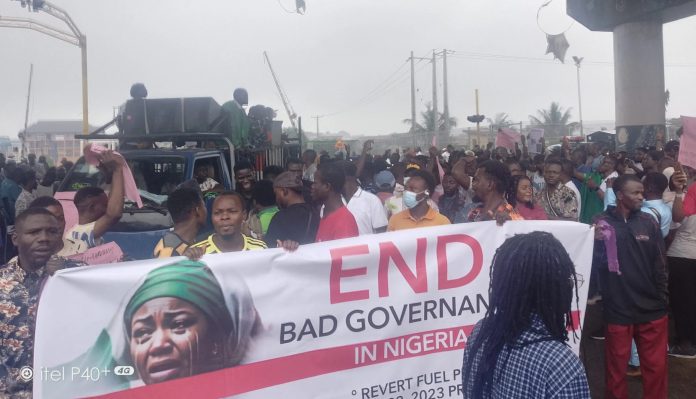
The Nigerian government has escalated its response to the recent #EndBadGovernance protests by freezing more than $37 million worth of cryptocurrency believed to be held in wallets associated with some of the protest organizers.

This action was taken following an order by the Federal High Court in Abuja, issued by Justice Emeka Nwite on July 9, 2024.

The Economic and Financial Crimes Commission (EFCC), which initiated the freezing order, claimed that the assets were proceeds of money laundering and terrorism financing. The court granted the order ex parte, a legal procedure where the decision is made without notifying or hearing from the affected parties.

“That an order of this honourable court is hereby made freezing the wallet addresses/accounts stated in the schedule below, which wallets are owned by individuals currently being investigated for offences of money laundering and terrorism financing, pending the conclusion of the investigation,” ruled Justice Nwite after hearing the EFCC’s application.

The largest wallet frozen holds USDT 37 million (approximately $37 million), with three other wallets containing significantly smaller amounts. While the identities of the wallet owners were not disclosed in court filings, sources close to the investigation indicated that the accounts were traced to individuals suspected of organizing the #EndBadGovernance protests, which swept across multiple Nigerian cities from August 1 to 10, 2024.

These protests were sparked by widespread discontent over the rising cost of living, severe economic hardships, and a general sense of dissatisfaction with the government’s performance. As the protests gained momentum, the Nigerian government responded with a heavy hand.

Security forces reportedly killed more than 20 protesters, and in the capital city of Abuja, peaceful demonstrators and journalists—clearly identified by their press vests—were targeted with live ammunition. In the aftermath, arrests and prosecutions were swift, with police in Kano State and other regions detaining individuals suspected of looting during the demonstrations.

Additionally, seven Polish citizens were arrested in Kano for allegedly brandishing Russian flags, which the authorities linked to attempts to incite further unrest.

This crackdown on protest organizers is not without precedent. During the 2020 #EndSARS movement, which protested against police brutality and specifically targeted the notorious Special Anti-Robbery Squad (SARS), the government also employed financial measures to suppress dissent. The Central Bank of Nigeria (CBN), under the leadership of then-Governor Godwin Emefiele, froze 20 bank accounts linked to key figures in the #EndSARS movement.

Emefiele publicly labeled the protest organizers as sponsors of terrorism, a claim that significantly intensified the government’s efforts to discredit the movement. The CBN argued in court that the frozen funds were connected to terrorism financing, an assertion that played a critical role in securing a 90-day extension of the freezing order from the Federal High Court in Abuja.

However, the court later vacated the freezing order after legal negotiations between the CBN and the account holders’ legal representatives.

In both the #EndSARS and #EndBadGovernance cases, the courts have been criticized for failing to uphold the constitutional rights of Nigerian citizens to peaceful protest.

The Nigerian Constitution guarantees freedom of expression, assembly, and association, all of which are fundamental to a functioning democracy. Yet, these rights have been increasingly undermined by judicial actions that align more closely with the government’s agenda than with the protection of civil liberties.

Legal experts and human rights advocates have voiced concerns over the judiciary’s role in these instances, arguing that the courts have become complicit in the suppression of dissent. The use of ex parte orders to freeze assets without giving affected parties the opportunity to defend themselves has been particularly contentious. Critics argue that such orders circumvent due process and serve as a tool for the government to stifle opposition and dissent under the guise of national security.

The recent freezing of cryptocurrency assets linked to the #EndBadGovernance protests has only intensified these concerns. The EFCC’s application to freeze the assets was based on allegations of money laundering and terrorism financing, but the lack of transparency and the swift judicial approval of the freezing order has raised questions about the fairness of the process.

The use of financial measures to target protest organizers is seen by many as part of a broader strategy to dissuade Nigerians from exercising their constitutional rights to protest and to hold their government accountable.

The case has reignited the debate over the balance between national security and civil liberties, with many fearing that the government’s approach could set a dangerous precedent for the future of democratic expression in Nigeria. Rights advocates believes the growing pattern of financial repression, coupled with aggressive law enforcement tactics, paints a troubling picture of the state of civil rights in the country.

Nigerian Banks Need To Breathe As They Recapitalize

0

The banks are now the small guys: “The Bank Directors Association of Nigeria (BDAN) has raised an alarm over the recent decision by the National Assembly to impose a 70% windfall tax on foreign exchange (FX) revaluation gains by Nigerian banks, calling on the lawmakers to revisit the legislation. BDAN, representing the collective voice of bank directors across Nigeria, expressed its concerns following a meeting where the implications of the newly amended finance act were thoroughly discussed. The association described the 70% windfall tax as “excessively burdensome and ill-timed,” particularly in light of the ongoing recapitalization efforts within the banking sector.”

Indeed, you want them to raise more funds from FOREIGNERS and you are retroactively taxing them, thereby making sure those foreigners do not come. In the Igbo Nation, the elders will say that no one uses two legs to stretch at the same time. What they mean there is that most times, things must be sequenced, for the best outcome.

For a bank? Which books are the correct ones? The ones which they have published before the windfall tax or the ones we are expecting as a result of the new tax? You can do that to a farming business or a cement business or an energy business, but when it comes to banking, doing that will trigger many dependencies which may even push some correspondent banks in New York, London, etc to pause certain things UNTIL the correct books are ratified.

Good People, this is banking. The banks need to breathe also even though most do not like them! And how ironic? If the government takes out this tax, would Nigerians expect some of those bank fees to go? We the people also need to breathe from bank fees.

In its statement, BDAN urged the National Assembly to revisit the amendments, calling for constructive dialogue between lawmakers and industry stakeholders. The association emphasized the need for clarity on what exactly constitutes the FX gains to be taxed and raised concerns about how the government plans to address scenarios where banks might incur losses rather than profits from their foreign exchange transactions.

“We respectfully urge the National Assembly to revisit these amendments and engage in constructive discussion,” the statement read.

BDAN’s concerns are not isolated, as many within the financial sector share similar sentiments. The association warned that such a high levy could have long-term negative effects on the industry, potentially deterring investment and innovation, which are crucial for the sector’s development and for maintaining Nigeria’s economic stability.

Nigerian Bank Directors Urge National Assembly to Reconsider 70% Windfall Tax on Banks Amid Recapitalization Struggles