DD
MM
YYYY

PAGES

DD
MM
YYYY

spot_img

PAGES

Home Blog Page 304

The Swadeshi Campaign and African Textile Heritage [GIN Therapy Part 1]

0

This article ‘weaves’ – literally – a narrative to present Ghana first, then India, then Nigeria in what I dub the “GIN (Ghana, India, Nigeria) Therapy.”

Highlights

  • Heritage Textiles in Ghana: Kente as a Model of Cultural and Economic Revival.
  • The Swadeshi Campaign in India:  Weaving Cultural Identity, Economic Growth, and Sustainability.
  • Nigeria Aso-oke Remains Unprotected: Indigenous Textiles, Craft, and Cultural Identity.

Heritage Textiles in Ghana: Kente as a Model of Cultural and Economic Revival

Across Africa, traditional textiles serve as powerful tools of cultural diplomacy and economic transformation. Ghana’s Kente cloth, recently inscribed by UNESCO on the Representative List of the Intangible Cultural Heritage of Humanity, exemplifies this transformation. Kente functions as a means of communication and identity construction, reflecting the social histories of Ghanaian communities and operating both as a cultural archive and an economic commodity. It supports livelihoods through craftsmanship, entrepreneurship, and cultural exports. Designers like Aristide Loua of Kente Gentleman have modernized these traditions, merging local weaving with contemporary fashion sensibilities. UNESCO’s broader recognition of African cultural practices – from Ghana’s Kente to Botswana’s Wosana rainmaking ritual – highlights how heritage crafts, when properly supported, can drive economic resilience, tourism, and cultural continuity.

India: The Swadeshi Campaign and Revitalization of Textile Heritage

The Indian textile and clothing industry, valued at USD 179 billion in 2024, remains a cornerstone of the nation’s economy, expanding at an annual rate of over 7 percent. Household consumption accounts for 58 percent of the domestic market and is growing at 8.19 percent, while non-household consumption makes up 21 percent, with a 6.79 percent annual growth rate — as reported in the Times of India. With supportive policies and the newly introduced Swadeshi Campaign, the sector is projected to grow at a compound annual growth rate (CAGR) of 9–10 percent, potentially reaching USD 250 billion by 2030. Reforms in the Goods and Services Tax (GST) framework are expected to enhance consumption, bolstering both domestic and institutional markets. The Ministry of Textiles launched the Swadeshi Campaign, a national initiative spanning six to nine months, promoting domestic consumption of handloom, handicrafts, and indigenous textile products while repositioning Indian textiles as symbols of national pride and cultural continuity, especially among younger generations — according to the Times of India. The campaign’s goals include:

  • Stimulating domestic demand for Indian-made textiles.
  • Empowering weavers, artisans, and MSMEs within the textile ecosystem.
  • Aligning with initiatives such as the Production Linked Incentive (PLI) Scheme for TextilesPM MITRA Parks, and One District One Product (ODOP) (Times of India, 2025).
  • Encouraging institutional procurement of Indian fabrics for uniforms, décor, and furnishings across ministries, PSUs, and educational institutions.

These efforts are supported by exhibitions, cultural festivals, and digital storytelling under the slogan:

“Swadeshi kapda desh ki shaan — yahi hai Bharat ki pehchaan.” (Swadeshi fabric is the pride of the nation — this is India’s identity.) (Times of India, 2025)

Cotton, central to India’s textile value chain, lags in productivity compared to global peers. The government’s Mission for Cotton Productivity, introduced in the FY26 Budget, promotes higher yields, sustainability, and extra-long staple cotton varieties. This aligns with India’s 5F visionFarm to Fibre to Factory to Fashion to Foreign – connecting farmers, manufacturers, and exporters.

Nigeria Aso-oke Remains Unprotected: Indigenous Textiles and Cultural Identity Nigeria boasts a rich textile heritage, with fabrics such as Akwete, Ukara, Aso-Oke, and Adire representing centuries of artistry, symbolism, and community life. These textiles are continuously enriched through creativity and innovation, passed down via families, apprenticeships, and formal education. Learning also occurs at museums, exhibitions, festivals, and workshops. Both men and women participate actively — women typically weave and produce yarn, while men build looms and tools. Chief weavers oversee quality standards, mediate disputes, and establish trade networks. These textiles serve as vehicles of identity and social communication, conveying status, history, and belonging. This mirrors Ghana’s Kente, where craftsmanship embodies cultural, social, and communicative meaning.

Closing Thoughts

In this first part of my “GIN (Ghana, India, Nigeria) Therapy” Chronicles — textiles have been explored — showcasing opportunities and challenges — From Ghana’s Kente to India’s Swadeshi Campaign and Nigeria’s indigenous textiles, heritage fabrics operate as symbols of identity, innovation, and economic resilience. The revival of traditional textiles demonstrates a global trend — aligning cultural preservation with modern economic development. However, while Kente has now secured Geographical Indication (GI) status, neighbouring Nigeria still leaves its textiles (Aso-oke, Adire, Akwete etc.) unprotected and largely exposed. As for India, the Swadeshi Campaign offers a blueprint for inclusive, sustainable growth, while African textile heritage exemplifies how culture-driven industries can generate employment, entrepreneurship, and global influence. Together, these examples highlight the potential of heritage textiles to weave a future where culture, commerce, and sustainability coexist.

Ghana has officially obtained Geographical Indication (GI) status for Kente Cloth, securing its recognition and protection as an authentic Ghanaian heritage. This designation ensures that only Kente woven in Ghana can be labelled and sold as ‘Kente.’ In contrast, while Aso-oke – a handwoven textile deeply rooted in Yoruba culture – remains a symbol of artistry and tradition, it lacks formal protection under intellectual property (IP) laws such as copyright or patents. This absence of legal safeguarding has sparked growing concerns over cultural appropriation and commercial misuse of Aso-oke by foreign entities.
Top Crypto Gainers: BlockDAG’s $430M+ Presale Shocks Market While Monero, BNB & Sui Aim for Growth

0

The crypto market has shown signs of life again, with a few standout projects pulling ahead while others stay flat. These top crypto gainers are getting attention for solid reasons: technological strength, credible teams, and powerful community support.

What’s interesting is how each of them comes from a completely different angle: one from privacy, another from exchange utility, one from next-gen scaling, and one from new-age ecosystem growth. Together, they reflect what’s exciting about crypto right now, innovation that actually performs.

In this roundup, we look at four projects that have become the talk of the season: BlockDAG, Monero, Binance Coin, and Sui. Each one represents a different story of growth, resilience, and vision. And while the market has its share of uncertainty, these names continue to pull in buyer curiosity and build real use cases. Let’s dive into why they’re being listed among the top crypto gainers of the week.

1. BlockDAG: The $430M+ Presale Powerhouse Redefining Performance

BlockDAG has been the headline project this month for all the right reasons. With over $430 million raised in its presale and more than 27 billion BDAG coins sold, it’s showing market confidence that few early-stage projects can match. The presale is now in its 31st batch, offering a final chance to access the coin at $0.0015 special price, ahead of its planned launch price of $0.05 once the presale ends. That price gap alone has drawn attention from those watching for high-potential early-entry projects.

The strength of BlockDAG lies in its hybrid technology. It combines Proof-of-Work security, the same system used by Bitcoin, with a Directed Acyclic Graph (DAG) structure that allows for multiple transactions to be processed simultaneously. This design lets the network handle between 2,000 and 15,000 transactions per second, solving the usual trade-off between speed and decentralization. Its Awakening Testnet is already live and EVM-compatible, meaning developers can build right away.

Led by CEO Antony Turner and advised by distributed computing pioneer Dr. Maurice Herlihy, BlockDAG has built a reputation for transparency and credibility. Security audits from CertiK and Halborn further reinforce its reliability.

Add to that a new partnership with BWT Alpine Formula 1® Team, and you have a project that’s merging innovation with strong global visibility. For many, it’s the standout among the top crypto gainers, combining real technology with measurable growth.

2. Monero: Privacy’s Strong Comeback

Monero (XMR) has long been known for its privacy-first design, and it’s making headlines again thanks to recent upgrades. Trading around $308.62, Monero has moved between a low of $284.43 and a high of $314.24 this week, showing strong recovery and renewed buying pressure. The release of its “Fluorine Fermi” update has been a key driver, improving peer-to-peer security and helping protect against network surveillance.

This update directly strengthens what Monero stands for: true transactional privacy. With roughly 14.7% of nodes previously showing suspicious behavior, these fixes have been welcomed by its global user base. Analysts expect resistance near $320 and possible upward movement toward $350 if the market holds steady. While privacy coins face ongoing regulatory questions, Monero’s commitment to security and decentralization keeps it in conversations about the top crypto gainers of October.

3. Binance Coin: Market Resilience Amid Volatility

Binance Coin (BNB) continues to show resilience despite volatile market moves. Currently priced near $1,099.53, it has traded as high as $1,129.59 and as low as $1,049.42 in recent sessions. Earlier this month, BNB briefly hit a record high of $1,370 before a quick correction. That kind of movement highlights both its strength and the market’s sensitivity to regulatory and macroeconomic shifts.

BNB’s performance is tightly linked to the Binance ecosystem, which includes the BNB Chain and the world’s largest crypto exchange. Despite global scrutiny of exchange compliance, BNB’s core use cases, transaction fee reductions, staking, and network utility keep it relevant.

The token’s price stability at four-figure levels suggests solid community backing. As one of the top crypto gainers, BNB continues to demonstrate that large-cap tokens can still deliver movement backed by real-world utility rather than speculation alone.

4. Sui: Growth and Testing Moments

Sui (SUI) is another project drawing attention for both its growth metrics and its challenges. Currently trading around $2.49, it has moved within a daily range of $2.36 to $2.50. The Sui network recently faced a $3 million exploit affecting Typus Finance, but the ecosystem has continued to expand despite that setback. Over the last year, Sui’s total value locked (TVL) grew by more than 1,200%, a sign of strong developer and user activity.

Analysts note that Sui is competing head-to-head with larger ecosystems on developer engagement. It’s even surpassed some established networks like BNB in growth metrics. Resistance levels sit near $3.33, with key support around $2.55.

The team’s consistent updates and new integrations show that the project is actively building through market challenges. Its community believes the fundamentals are intact, making Sui one of the smaller yet determined contenders among the top crypto gainers right now.

Summing Up

Each of these projects, BlockDAG, Monero, Binance Coin, and Sui, reflects a different growth path. From privacy and performance to utility and developer momentum, they show that innovation still drives crypto’s momentum even during uncertain markets. BlockDAG stands out for its hybrid design and massive presale success, Monero for its continued privacy leadership, Binance Coin for stability in scale, and Sui for proving that new ecosystems can grow fast despite setbacks.

These top crypto gainers highlight a key point for the broader market: investor interest follows tangible progress. Whether it’s through speed, security, or usability, each of these projects brings something real to the table. Their next few months will show whether they can sustain that growth, but for now, they’re the names keeping crypto conversations alive.

BlockDAG’s $430M Presale Ignites Frenzy as Cardano’s Hydra Upgrade & NEAR’s AI Tech Struggle to Keep Up

0

As 2025 unfolds, the search for the next big crypto intensifies. Cardano (ADA), NEAR Protocol (NEAR), and newcomer BlockDAG are capturing the spotlight, each offering a unique blend of scalability, technology, and growth potential. Cardano is seeing signs of a rebound with major upgrades underway, NEAR is advancing through AI and cross-chain integrations, and BlockDAG (BDAG) is turning presale success into measurable progress.

Among these three, BlockDAG’s focused execution and $430 million presale achievements are making it one of the most talked-about projects of 2025. As the market shifts from hype-driven speculation toward practical delivery, investors are beginning to prioritize utility, community, and performance. Here’s a closer look at how each project stands in the race to define the next big crypto.

Cardano: Building Momentum with Hydra & Mithril

Cardano (ADA) is trading near $0.245 and has recently found strong double-bottom support, hinting at a potential rally toward $1.30. Its Hydra and Mithril upgrades are central to this optimism, designed to enhance scalability and enable faster off-chain processing. These updates aim to boost efficiency and position Cardano as a sustainable blockchain solution capable of handling real-world demand.

However, Cardano’s cautious and research-first approach has sparked mixed reactions. While its governance model and academic foundation inspire trust, critics argue the platform’s slow rollout could limit its short-term competitiveness. Despite these challenges, ADA’s community-driven structure and clear upgrade path continue to make it a long-term contender.

For Cardano, the next phase will be defined by how well its upgrades translate into active adoption. If Hydra delivers as promised, ADA could reassert itself as a top player and a leading candidate for the next big crypto.

NEAR: Technical Progress Meets Market Hesitation

NEAR Protocol (NEAR) is steadily advancing around the $1.20 mark, supported by the rollout of AI tooling and enhanced cross-chain connectivity. These developments have reinforced NEAR’s reputation for technical innovation, but market enthusiasm has yet to fully match its engineering achievements.

While the project’s roadmap shows promise, NEAR faces an uphill battle in building the kind of grassroots momentum seen in larger ecosystems. Unlike Cardano’s established following or BlockDAG’s record-breaking presale engagement, NEAR’s growth has been more restrained.

Still, its focus on AI integration and cross-chain scalability sets a strong foundation for long-term expansion. To compete effectively in 2025, NEAR will need to balance its technical leadership with stronger community engagement and consistent ecosystem expansion. With the right execution, NEAR could evolve from a quiet performer to one of the year’s breakout successes.

BlockDAG: Delivering on Vision Through Action

BlockDAG has become one of the year’s most promising stories, showing how precise execution can transform early promise into measurable success. The project’s presale has reached $430 million, selling over 27 billion coins. Its current Batch 31 price stands at $0.0304, while a limited entry remains available at $0.0015 via the “TGE” code, a remarkable value considering the 2,940% ROI from its first batch.

The project’s roadmap outlines clear and achievable milestones: finalizing its mainnet, completing miner shipments across the X1 to X100 series, reaching the $600 million funding target, and securing multiple Tier-1 exchange listings. The Awakening Testnet is already operational, equipped with EVM compatibility, real-time explorer functionality, and Stratum mining integration, all signs of a network ready for deployment.

Under CEO Antony Turner’s leadership, BlockDAG continues to strengthen investor confidence through verified audits, multi-sig treasury control, and MiCA-compliant documentation. Its approach prioritizes transparency and technical readiness over speculation, making it one of the most credible contenders for the next big crypto title in 2025.

Final Thoughts

The competition between Cardano, NEAR, and BlockDAG illustrates the growing divide between speculative tokens and execution-driven blockchains. Cardano’s upgrades are slowly unlocking its potential, NEAR’s AI-driven development highlights innovation, and BlockDAG’s hands-on delivery proves results matter more than hype.

Cardano and NEAR each bring value through persistence and technical advancement, yet BlockDAG’s momentum, from its $430 million presale to its live testnet, demonstrates measurable progress toward full-scale adoption. With tangible steps, active delivery, and verified compliance, BlockDAG is setting a benchmark for how modern blockchain projects should grow.

For investors seeking the next big crypto, these three projects each offer opportunity, but BlockDAG’s transparent roadmap, technological execution, and proven community backing position it at the forefront of 2025’s blockchain evolution.

Presale: https://purchase.blockdag.network

Website: https://blockdag.network

Telegram: https://t.me/blockDAGnetworkOfficial

Discord: https://discord.gg/Q7BxghMVyu

Whitelist Coming Soon – Zero Knowledge Proof’s Unified Model Could Win Over Enterprises

0

For years, a fundamental debate has split the blockchain world: zk-SNARKs versus zk-STARKs. One side championed SNARKs for their speed and small proof sizes, ideal for private transactions. The other advocated for STARKs, valuing their transparency and resistance to quantum computing. Teams have dedicated entire roadmaps to proving one is superior. But what if the answer wasn’t to choose a side, but to combine their strengths? This is precisely what Zero Knowledge Proof (ZKP) has done, creating a hybrid architecture that leverages the best of both worlds. By doing so, it has engineered a solution that is flexible, powerful, and built to adapt to any challenge the future might hold.

A Masterstroke of Engineering: The Hybrid Advantage

The decision to integrate both zk-SNARKs and zk-STARKs into a single Layer 1 protocol is a defining feature. This isn’t a compromise; it’s a strategic advantage that allows the network to apply the right tool for every specific job. Imagine a network that can process simple, high-frequency private payments with the lightning-fast efficiency of zk-SNARKs, keeping fees low and confirmation times short.

Now, picture that same network handling complex, large-scale smart contract computations for decentralized finance or enterprise applications using the scalable and transparent power of zk-STARKs. This dual capability means Zero Knowledge Proof doesn’t have to sacrifice performance for security or decentralization for privacy. It’s a unified system designed for maximum utility, providing developers and users with a level of flexibility previously thought impossible. This creates a resilient and adaptable foundation for building next-generation applications.

Designed to Outmaneuver and Adapt

This hybrid approach gives Zero Knowledge Proof (ZKP) an unmatched ability to evolve. While other protocols are locked into a single cryptographic method, this network can pivot based on technological advancements and changing market needs. This “future-proof” design is a core element of its architecture, ensuring long-term relevance and performance in a rapidly changing industry. The benefits are clear and substantial:

  • Optimal Performance: It uses zk-SNARKs for tasks where proof size and verification speed are critical, like confidential transactions.
  • Ultimate Scalability: It deploys zk-STARKs for complex computations where transparency and quantum resistance are paramount, without needing a trusted setup.
  • Unmatched Versatility: Developers can build DApps that draw on the strengths of both systems, creating more sophisticated and secure applications.
  • Long-Term Resilience: By incorporating STARKs, the network is already prepared for the potential threat of quantum computing, a challenge other networks have yet to address.

A Complete Ecosystem Built on a Flexible Foundation

The hybrid technology of Zero Knowledge Proof is not just a theoretical concept; it is the engine powering a comprehensive and practical ecosystem. The project’s vision extends far beyond simple private transactions. This flexible foundation supports a wide array of real-world applications, each benefiting from the network’s unique combination of privacy and scale. The platform is being built to host private DeFi protocols, allowing for confidential swaps and lending. It enables zero-knowledge identity solutions, where users can prove compliance without revealing sensitive personal data. Even NFTs and gaming economies can operate securely, with private ownership verification. By providing the tools for these multi-sector utilities, Zero Knowledge Proof is establishing itself as a foundational layer for the future of a private, decentralized internet. This is what makes the network’s bandwidth so valuable.

Pre-Purchase the Bandwidth of the Future

The whitelist to join the Zero Knowledge Proof ecosystem will be opening soon. This presents a rare window of opportunity for early participants to get involved at the entry level. This isn’t just about early access; it’s an opportunity to pre-purchase the future-proof bandwidth of this next-generation network. As more developers and users begin to build on and use the platform, the demand for its unique capabilities will grow.

The architecture of Zero Knowledge Proof (ZKP) has solved core industry challenges, positioning it for significant adoption. Securing a spot through the whitelist means becoming an early part of a network built for longevity and adaptability. The chance to participate before the project gains mainstream recognition is limited.

Conclusion: The Unmatched Solution

By refusing to choose a side in the cryptographic proof debate, Zero Knowledge Proof (ZKP) has created something far more powerful: a unified solution. This hybrid network represents a technological singularity that competitors, locked into a single methodology, simply cannot match. It’s a complete ecosystem that balances privacy, scalability, and security without compromise. Its design is inherently adaptable, ready for the challenges of today and the innovations of tomorrow. The upcoming whitelist offers a brief chance to get in early on a project that has already addressed some of blockchain’s most fundamental limitations. It’s an invitation to become part of a network built not just for the current market, but for the future.


Find Out More about Zero Knowledge Proof:

Website: https://zkp.com/

The Modern HR Stack: Tools for Building a Winning Team

0

In today’s accelerated business era, talent is not just a component of production, it is the production itself. The modern Human Resource (HR) stack has evolved beyond payroll and performance reviews into a full ecosystem of digital intelligence. From AI-driven recruitment engines to culture analytics dashboards, the HR stack is now the foundation upon which organizations build enduring competitiveness.

The best teams are not formed by chance; they are architected through systems that optimize how humans and algorithms collaborate. As industries digitize, HR leaders who understand technology’s leverage will become the true builders of institutional capability.

Across the enterprise, tools such as Applicant Tracking Systems (ATS), Learning Management Systems (LMS), performance analytics platforms, and engagement dashboards now create data loops that refine talent decisions. The result is a new order where intuition is augmented by data, and leadership is informed by insights.

Imagine a recruitment process powered by predictive AI that identifies cultural fit, or an LMS that personalizes learning paths based on employee performance signals; this is no longer science fiction, it is the daily playbook of winning organizations. The modern HR stack, therefore, is not about managing people; it is about engineering human potential.

Ultimately, a great HR stack enables what I call the Accumulation of Capability. Every hire, every training, every feedback session compounds to build an institutional muscle that outperforms competitors. Nations and companies grow when knowledge compounds within their people. As machines automate repetitive work, it is the well-equipped HR systems that will unleash creativity, collaboration, and capital in the workforce. To build a winning team in this age, leaders must see HR not as a department, but as the command center of organizational greatness.

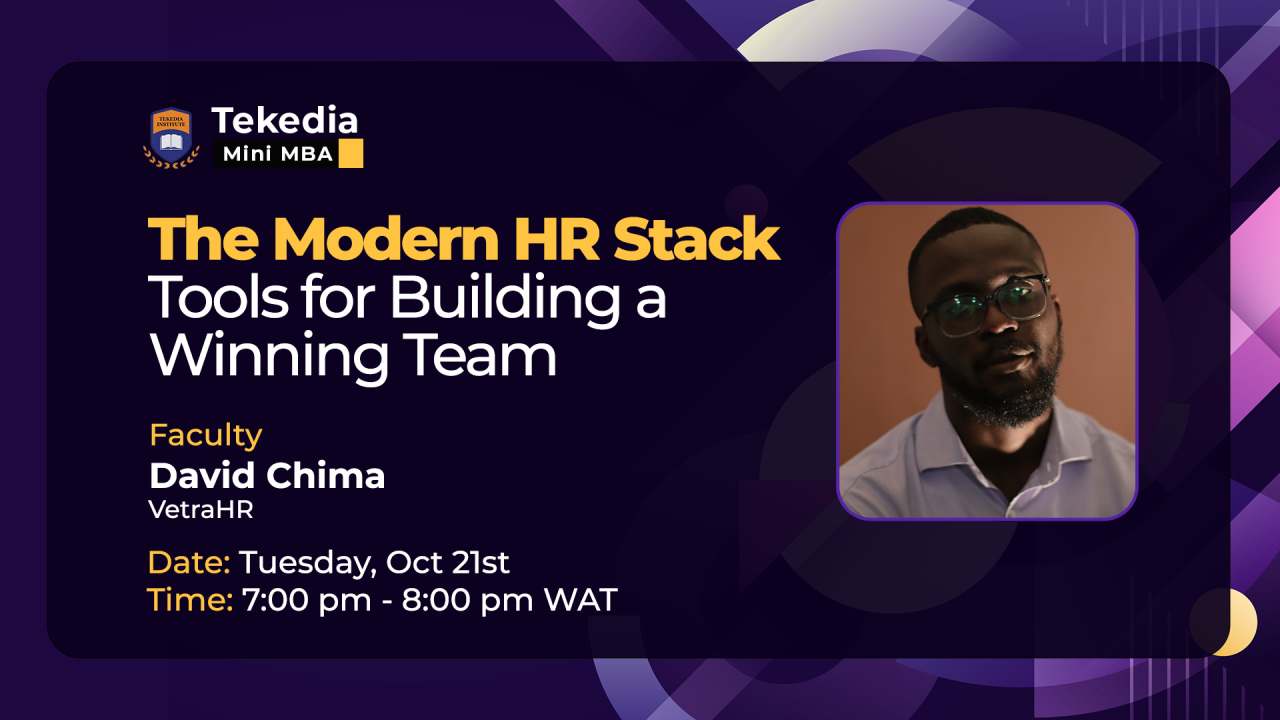
Join us at Tekedia Mini-MBA as David Chima, CEO of VetraHR educates on how to build that modern HR Stack.

Tue, Oct 21 | 7pm-8pm WAT | The Modern HR Stack: Tools for Building a Winning Team– David Chima, VetraHR | Zoom link