DD
MM
YYYY

PAGES

DD
MM
YYYY

spot_img

PAGES

Home Blog Page 3043

Safaricom Reconsiders Partnership With Elon Musk Starlink, as Telecom Competition Hits in Kenya

0

Safaricom, Kenya’s leading telecom operator, has confirmed ongoing discussions with Elon Musk’s Starlink and other satellite providers, signaling a shift in strategy as competition heats up in its home market, where the telco has long maintained a dominant position.

Peter Ndegwa, CEO of Safaricom disclosed that the company is considering partnerships with Starlink or other satellite providers to ensure cutting-edge technology integration.

A report by the Kenyan Wall Street earlier this month disclosed that Starlink had initially approached Safaricom for a partnership before its entrance into the Kenyan market. However, Safaricom rejected the proposal citing concerns over regulatory oversight due to Starlink’s cross-border service model.

Recall that Safaricom in August this year, called for stricter regulations on Satellite Internet providers, amid Starlink’s entry into Kenya. In a formal letter addressed to the Communications Authority of Kenya (CAK), Safaricom urged the regulator to consider requiring satellite providers to partner with local mobile network operators.

Part of the letter reads,

“Satellite coverage inherently spans multiple territorial borders and in doing so has the potential to illegally provide services and cause harmful interference within the territorial borders of the Republic of Kenya”.

The telecom giant is advocated for a regulatory framework that ensures satellite providers like Starlink operate under similar conditions as local telecom companies, particularly regarding licensing, service standards, and contributions to the Universal Service Fund, which supports the expansion of telecommunications services to rural and underserved areas.

Meanwhile, in response to Starlink’s entry, Safaricom has upgraded its home fire speeds to maintain its competitive edge in the market. The telco, which dominates various aspects of Kenya’s telecom sector, has recognized the need for collaboration with satellite providers to stay ahead.

Despite initial reluctance, Safaricom CEO Ndegwa has recently acknowledged that talks with Starlink have continued, indicating a pragmatic approach from both sides.

“We have had some discussions, and we will continue to have those discussions to the extent that they complement what we are offering”, he said.

Safaricom’s decision to partner with Musk Starlink sparked mixed reactions from Kenyan Netizens on X,

@Gonza_254 wrote,

“Safaricom is so obsessed with being a monopoly, they don’t want competition, so that they can do what they want”.

@EliakimS16 wrote,

“Which partnership is this? Let’s just have the two operate as it is. We will have better services.”

@nash_nzioka wrote,

“Safaricom has dominated and exploited the market for long. Anti-trust Law should be implemented to deter such kind of collusion and to allow Starlink which is a worthy competitor, to square it with Safaricom.”

@KLukoko wrote,

“Safaricom hates competition, and thrives as an exploitative monopoly. By dangling a partnership deal, means one thing, Safaricom has been rattled.”

The change in Safaricom’s stance change in Safaricom’s stance aligns with comments from Kenya’s President William Ruto, who recently stated that the decision to allow Starlink into the country was driven by the government’s desire to promote healthy competition, which would lead to better quality and more affordable Internet services. President Ruto emphasized that competition encourages innovation, noting that Safaricom had already stepped up its game in response to the new market dynamics.

Starlink on the other hand, has been aggressively expanding its global footprint, aiming to disrupt the telecommunications and ISP sector through its satellite internet service. Musk also confirmed that Starlink will soon have 300 satellites providing continuous coverage over mid-latitudes, enabling direct-to-mobile phone service, a potential game-changer in the telecommunications industry.


Where really is your ‘Community’ in Web 3?

0

Where really is your ‘Community’ in Web 3?

Some days ago I was responding to a post by Osueke Henry .  He was questioning the power of incentives to ‘Community’ and suggested it was a Mirage. Following up on the same theme, he commented : It’s time to build communities … where people come to contribute, not just consume… where ideas are the currency, and growth is the reward.’

I’m not sure the open market end of Web 3 has even consumers in the normal sense. I’m also not sure the environment can be classed as Web 3. The customer at the retail end off ‘cryptographic architectures’ seems to be somewhere between a reseller and a gambler.

When we look at human behaviour, the concept of ‘collecting things’ is ingrained deep in our psyche.

People have over time, built huge collections of all sorts of things. From when I was a tiny little boy up to now, I have seen people collect things that were predictable, to some things that were very strange.

Birds eggs, birds feathers, beer caps, beer mats, coins, postage stamps, cards of footballers, baseball cards, different sports people. Autographed sports gear, music works of entertainers, pokemon cards..

While there was the vague notion that some rare specimen may become valuable because of the gulf between demand and scarcity, people generally created these pastimes as human bridges and in this, formed a community.

Where indulgences are concerned, people sometimes express themselves through property whose value is subjective.

The more ‘things’ they own, the more the concept of individual expression through ‘things’ gets diluted. You may have hundreds of pairs of shoes, but that VIP party you get to go to? You only have two feet with you there!

It doesn’t matter how many iconic cars you own. If you roll down Akin Adesola in VI on a Sunday, you can only drive one.

Not everyone has that type of personality where visible extensions of themselves are important to their sense of portrayal.

Even if they have, thousands of lifetimes are necessary to illustrate all the angles of ‘me’ collectibles in Web3 make possible.

The concepts of ‘Repeat Business’ and ‘Customer Continuity’ are unattainable. Nobody is building with that core to their model.

So what model are they building to? Well, this is where the whole concept of ‘community’ as web 3 marketing have it, are totally out of sync.

But to understand the development of this ‘fake’ web 3 community environment, we have to go back to the origin of cryptocurrency.

With the explosion of ‘ERC 20’ tokens drowning out REAL cryptocurrency coins coming from REAL blockchains that were mined, exchanges started to become under regulatory attack, and gamblers (cough) ‘investors’ began to dump almost instantaneously as they bought.

The day of the $hitcoin had dawned.

So, the ‘Casino’ and ‘Bookie’ end of the spectrum, who couldn’t just randomly pump silly ERC 20 tokens anymore had to come up with a new plan.

So here it was, invent all this low quality, 10,000 run computerized excuses for art, and use cheap tokenizing off cryptographic architectures that aren’t ‘proper blockchains’

These weren’t ‘cryptocurrencies’ and so could evade the interests of established ‘financial services’ state machinery.

The new number for all ERC protocols is now homogenized in ERC 419.                        A little later, someone resurrected the ‘Yahoo Boy’ off Solana

Airdrops abounded to create fever pitch.

Purchasers’ behaviour had positive curiosity in the early days of Cryptopunks, but post ‘Bored Ape’, the pace of dumping frenzy began to match that of the ERC 20 phenomenon. By the time of ‘Pudgy Penguin’ things are beyond a joke.

There is no ‘community’ here, or no ‘collecting’ going on in the normal sense of the word.

Where in the world can you profit from ‘consumption’ behaviour?

Product community DOES NOT EXIST. Not even in mainstream social media activity. Just transients jumping from one brief echo chamber to another.

Go to any event about ‘Web 3’ and find someone who has sole enthusiasm with tunnel focus about just one specific Web3 product as Michael Saylor is about Bitcoin.

An individual not involved in building the product or owning the project, but an ambassador everywhere they go.

Someone who has branded their Persona with this one specific Web 3 product as a die hard football fan does with their team.

This person does not exist.

And if a collection of such people can’t exist, then no ‘Web 3 product Community’ exists.

So called (post product launch) community is invisible in open spaces. Only fake echo chambers exist.

Where then, do you build your community? If ‘Repeat Business’ and ‘Customer Continuity’ are unattainable, why on earth would you build it among flippers (cough) users?

Nobody needs a bot driven ramp that can’t last the life of a candle.

Corrales Cachola describes it a bit differently – ‘web3 communities have it backward — they build a finished product first (i.e., an NFT) and then use the community to hype the product to force it on the market’

We believe you build community pre-product, not post product, and make community integral to ‘growth and innovation’.

At 9ja Cosmos we have a small community active on Handshake and GitHub is where innovation has roots.

REAL (pre-product) community managers don’t seem to exist though

At 9ja Cosmos , we are not interested in creating airdrop incentives for flippers.  We are more interested in building quality, improving the decentralization component, and creating ‘uncommonness’, while adding innovation.

Some think we have no interest in ‘Community’. This is not true. But we want to see a new type of ‘Community’ emerging. A pre-product/pre-market community.

Only those who feel they were part of the evolution will feel personally invested in the outcome.

Information Security And Digital Forensics at Tekedia Mini-MBA

0

More fintech companies are collapsing in Africa due to cyber attacks, KYC and privacy issues than any other problem. This means that understanding cybersecurity is very important for business leaders and managers.

Join us as we discuss information security and digital forensics at Tekedia Institute. This is a very important course in Tekedia Mini-MBA as we understand the importance of digital security in the age of digitization.

Our Faculty, Dr. Francis Nwebonyi, before he moved to the academia world was securing the integrity of autonomous vehicles for BMW Group’s future diving machines. He is an IAM Engineer (Identity and Access Management Engineer) and holds a PhD in Computer Science with focus on Network and Information Security from Universidade do Porto. An exponential geek and a brilliant educator, he is a zen-master in this game.

Sat, Sept 28 | 7pm-8pm WAT | Information Security And Digital Forensics – Dr. Francis Nwebonyi, Bath Spa University |

Join us at the best school here.

The SAB121 Act and the U.S. Legislative Response

0

In recent developments, the U.S. legislative bodies have taken a significant stance on the Staff Accounting Bulletin No. 121 (SAB 121), issued by the Securities and Exchange Commission (SEC). This bulletin, which had implications for the treatment of digital assets by financial institutions, has been the subject of much debate and legislative action.

The House of Representatives passed H.J.Res. 109 with bipartisan support, aiming to overturn the SEC’s SAB 121 under the Congressional Review Act (CRA). This resolution was introduced by Representative Mike Flood and garnered support from both sides of the aisle. The primary concern addressed by the resolution was the requirement for financial institutions and firms safeguarding their customers’ digital assets to hold those assets on their balance sheet. Critics argued that this was cost-prohibitive and hindered the ability of highly regulated financial institutions to act as custodians of digital assets.

The bipartisan resolution ensures consumer protection by removing these roadblocks, allowing consumers to hold their digital assets through highly regulated banks and other financial institutions. This move was seen as a step towards bringing commonsense into digital asset policy and was applauded by various stakeholders in the financial sector.

Here are the main points:

Recognition of Digital Assets and Liabilities: SAB 121 requires entities that control digital assets owned by another entity or individual to recognize these digital assets and a corresponding liability on their balance sheets.

Evaluation of Liabilities: The liability recognized under SAB 121 is evaluated under ASC 815 to determine if it includes a derivative.

Measurement of Liabilities and Assets: The liability for the obligation to safeguard the digital assets is measured initially and subsequently at the fair value of the safeguarded digital assets. The safeguarding asset is measured similarly but adjusted for any potential loss events.

Disclosure Requirements: Entities must disclose the nature and amount of crypto assets they are responsible for safeguarding for their customers.

These provisions aim to address the unique risks and uncertainties present in custodial arrangements for digital assets, ensuring that entities reflect the fair value of these assets and the associated obligations on their balance sheets. This guidance is applicable to financial statements prepared under both US GAAP and IFRS Accounting Standards.

Furthermore, the Senate took action by voting to pass H.J. Res 109, reflecting bipartisan support against the SEC’s crypto policy. This legislative action underscores the ongoing debate around the regulation of digital assets and the role of traditional financial institutions in this emerging field.

The legislative response to SAB 121 is a clear indication of the U.S. government’s commitment to creating a regulatory environment that fosters innovation while ensuring consumer protection. It also highlights the importance of dialogue and collaboration between regulators, legislators, and industry stakeholders to address the complexities of digital asset custody and management. It also underscores the role of Congress in serving as a check on regulatory overreach, ensuring that any rules or bulletins that have significant implications undergo thorough review and public commentary.

The collaborative effort between members of both the House and Senate demonstrates a proactive approach to digital asset policy, aiming to protect consumers while enabling highly regulated financial institutions to provide secure custody services. This move is a positive step towards establishing the United States as a leader in the digital economy, encouraging innovation, and providing a stable environment for the burgeoning industry of digital assets.

BICCON and SIBAN – Calls for Safeguard of Nigeria’s Blockchain Industry

0

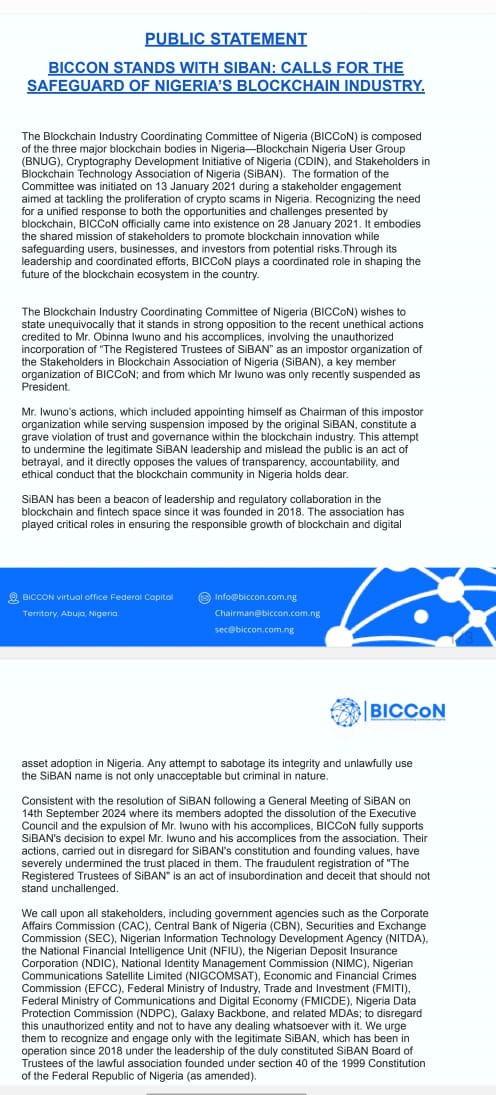
The landscape of cryptocurrency in Nigeria is a dynamic and evolving space, marked by the interplay of creativities, innovations, regulation, and community governance. At the forefront of this landscape are two pivotal organizations: the Blockchain Industry Coordinating Committee of Nigeria (BICCON) and the Stakeholders in Blockchain Technology Association of Nigeria (SiBAN).

The recent developments within SiBAN have highlighted the challenges of self-governance in a rapidly growing industry. The expulsion of its president, Obinna Iwuno, following allegations of misconduct, underscores the importance of adherence to governance standards and ethical practices. BICCON’s support for SiBAN’s decision reflects a commitment to maintaining trust and accountability within the community.

BICCON, established in January 2021, serves as an umbrella body for major blockchain groups in Nigeria, including the Blockchain Nigeria User Group (BNUG), Cryptography Development Initiative of Nigeria (CDIN), and SiBAN itself. This inter-community working group aims to foster collaboration and coordination among the various stakeholders within the Nigerian blockchain ecosystem.

SiBAN, founded in 2018, positions itself as a self-regulatory body for the blockchain and digital assets industry in Nigeria. It seeks to create a conducive environment for all players in the blockchain space, advocating for a regulatory framework that supports innovation while ensuring consumer protection and industry integrity.

According to Media Chat with Kue Barinor Paul, Esq Public Relations Officer of the Blockchain Industry Coordinating Committee of Nigeria, BICCoN strongly opposes the unauthorized incorporation of “The Registered Trustees of SiBAN” by Mr. Obinna Iwuno and accomplices. We’re calling on all blockchain/cryptocurrency community members, government agencies, and partners to stand with the authentic SiBAN platform during this challenging time. BICCoN remains dedicated to fostering trust, innovation, and responsible growth in Nigeria’s blockchain sector.

In bridge to foster Blockchain multidisciplinary approach to technological innovations and learning, the Blockchain Nigeria User Group (BNUG) Chaired by Chimezie Chuta is organizing a Decentralized Intelligence Conference V2 in Lagos, Nigeria in October 2024 where participants will learn how Blockchain, Web3, Crypto and the Intersection of Artificial intelligence is revolutionizing the Fintech sector.

Moreover, the recognition of cryptocurrency by the Securities and Exchange Commission (SEC) of Nigeria marks a significant milestone. The approvals-in-principle granted to six operators in the digital assets and digital investments sector signal a progressive shift towards regulatory clarity. This move by the SEC is applauded by both BICCON and SiBAN, as it promises to foster a more regulated and secure environment for cryptocurrency operations in Nigeria.

The collaborative efforts of BICCON and SiBAN, along with the SEC’s regulatory advancements, are indicative of Nigeria’s potential to become a leading hub for blockchain technology and digital assets. As the industry continues to mature, the focus on ethical governance, regulatory compliance, and community engagement will be crucial for sustaining growth and innovation in the Nigerian crypto space.

The unfolding narrative of crypto administration in Nigeria is one to watch, as it will undoubtedly influence the broader African continent’s approach to embracing digital currencies and blockchain technology. With organizations like BICCON and SiBAN at the helm, the future of cryptocurrency in Nigeria looks promising, balancing the scales of innovation and regulation for the betterment of the industry and its stakeholders.