DD
MM
YYYY

PAGES

DD
MM
YYYY

spot_img

PAGES

Home Blog Page 3064

Nigerian Communications Commission (NCC) Sets September 14 Final Deadline for SIM-NIN Linkage

0

The Nigerian Communications Commission (NCC) has set September 14, 2024, as the final deadline for Nigerians to complete the ongoing SIM-NIN linkage exercise. This directive, aimed at ensuring all active mobile lines are properly linked to a National Identification Number (NIN), comes after a series of deadline extensions.

With over 153 million SIMs already linked to NINs, reflecting a 96% compliance rate, the NCC is pushing to close the gap and achieve 100% compliance. The telecom regulator warned that any lines not linked by the September 14 deadline will be deactivated by the network operators.

In its directive, the NCC made it clear that by September 15, 2024, all SIM cards operating in Nigeria must be linked to a verified NIN. The Commission, in a statement signed by its Director of Public Affairs, Reuben Muoka, emphasized the urgency of this final deadline, urging all subscribers to resolve any issues related to their NIN-SIM linkage before the cutoff date.

“We urge all members of the public who have not yet completed their NIN-SIM linkage, or who have faced issues due to verification mismatches, to visit their service providers promptly to update their details before the deadline. Alternatively, the approved self-service portals are available for this purpose,” the NCC stated.

The Challenge of Information Mismatch

Despite the high compliance rate, millions of lines remain unlinked. As of March 2024, there were 219 million active lines across the networks of MTN, Globacom, Airtel, and 9mobile, indicating that a substantial number of subscribers have yet to complete the NIN-SIM linkage.

A significant hurdle in achieving full compliance has been the issue of information mismatches during the verification process. According to telecom operators, many subscribers have been unable to link their SIMs to their NINs due to discrepancies between the information they provided during their NIN registration and what is currently on record.

These mismatches can stem from various sources, including typographical errors, discrepancies in personal details such as name spellings or dates of birth, or inaccuracies in the initial data entry during the NIN registration process with the National Identity Management Commission (NIMC).

The challenge is further compounded by the fact that subscribers are often unaware of the specific mismatched information. This lack of transparency leaves them unable to correct the errors, trapping them in a cycle of unsuccessful attempts to complete the linkage. For many Nigerians, this has resulted in repeated visits to telecom service centers, where they encounter long queues and, at times, conflicting instructions on how to resolve their issues.

The NCC acknowledged this challenge, noting that it has been a significant hurdle in achieving full compliance.

The journey to achieving full compliance has not been smooth. The compulsory NIN-SIM linkage began in December 2020, when the government mandated that all SIM cards be linked to an NIN to enhance security and curb criminal activities. However, the process has been fraught with delays and extensions, partly due to the sheer scale of the task and the issues encountered by subscribers during the linkage process.

In April 2024, the NCC set a deadline for full network barring for subscribers with unverified NINs, but this was extended to July 31, 2024, to give consumers more time. The current September 14 deadline is the final extension, according to the NCC, and it leaves little room for further delays.

In late July 2024, millions of subscribers found themselves unable to make or receive calls after their lines were barred for not being linked to verified NINs. This led to widespread frustration and chaos, as affected customers besieged telecom service centers in a bid to resolve their issues. The situation escalated to the point of violence in some locations.

The timing of the barring coincided with a planned nationwide protest, adding to the tension. In response, the NCC ordered telecom companies to temporarily reactivate the barred lines, providing subscribers with a limited window to complete the linkage process. This move was seen as a necessary step to avoid further unrest, but it also underscored the difficulties in enforcing the policy.

The Final Countdown

With the September 14 deadline fast approaching, the NCC is making it clear that there will be no further extensions. The goal is to ensure that all active lines in Nigeria are linked to a verified NIN, a move that the Commission believes is critical for national security and efficient telecom regulation.

While the NCC’s final push for compliance highlights the critical importance of the SIM-NIN linkage exercise in securing Nigeria’s digital space, the ongoing challenges underscore the need for improved data management and transparency in the NIN registration process. For many Nigerians, the success of this initiative will depend not only on their ability to link their SIMs but also on the government’s ability to address the underlying issues that have plagued the exercise from the start.

As the deadline approaches, it remains to be seen whether the NCC and telecom operators can overcome these challenges and achieve full compliance, or whether millions of Nigerians will find themselves cut off from their mobile networks due to unresolved data discrepancies.

Nigeria’s Non-oil Export Records $2.7bn Revenue in H1 2024 – NEPC

0

Nigeria’s non-oil export sector recorded a remarkable achievement in the first half of 2024, generating an impressive $2.7 billion in revenue.

This figure, which marks a 6.26% increase compared to the $2.539 billion earned during the same period in 2023, underlines the country’s ongoing efforts to diversify its economy away from oil dependency. The progress was detailed by Nonye Ayeni, the Executive Director of the Nigerian Export Promotion Council (NEPC), during a progress report presentation on Nigeria’s non-oil export performance in Abuja.

Key Drivers of Growth

Ayeni attributed this robust growth to several key factors, notably the smooth transition of government in May 2023 and the subsequent policy advancements under President Bola Tinubu’s Renewed Hope agenda. The President’s focus on revitalizing the non-oil sector has provided a stable environment for export activities to flourish.

Additionally, the NEPC’s “Operation Double Your Exports” initiative has played a crucial role in boosting export performance. This initiative has emphasized partnerships, advocacy, capacity building, and export intervention programs, all of which have contributed to the sector’s success.

“In just six months, we have seen tangible results from our concerted efforts to expand Nigeria’s non-oil export base,” Ayeni stated. “The increase in both the volume and value of exported products is a testament to the effectiveness of these policies and initiatives.”

Diversification and Market Expansion

A significant highlight of the report was the diversification of Nigeria’s export products and the broadening of its market reach. During the first half of 2024, a total of 211 different products were exported from Nigeria, reflecting a shift from traditional agricultural commodities to more semi-processed and manufactured goods. Cocoa beans remained the leading export product, accounting for 23.18% of the total non-oil exports. This was followed by urea/fertilizer and sesame seeds, which contributed 13.78% and 11.04%, respectively.

Notably, there has been a growing prominence of newer export products such as fresh vegetables, citrus peel, and sorghum. Although these emerging products still occupy a smaller market share, they represent the ongoing diversification and broadening of Nigeria’s export portfolio.

“These emerging products, though still developing in market share, reflect the diversification and broadening of Nigeria’s export portfolio,” Ayeni noted, emphasizing the importance of innovation and adaptation in the export sector.

Indorama-Eleme Fertilizer and Chemical Limited led the pack of the top 20 exporting companies, with $198.8 million. Starlink Global and Ideal Limited followed closely with $184.7 million, while Outspan Nigeria Limited exported $177.75 million worth of cocoa. Other significant contributors included Dangote Fertilizer Limited and Metal Recycling Industries Limited, showcasing the strong performance of both established and emerging players in the non-oil export sector.

On the financial front, Zenith Bank Plc emerged as the dominant player, handling 43.09% of the total Non-Oil Export Proceeds (NXPs). First Bank Nigeria Plc and Fidelity Bank followed with 6.56% and 6.38%, respectively.

Ayeni urged more financial institutions to capitalize on the opportunities within the non-oil export sector, especially in the context of the African Continental Free Trade Area (AfCFTA), which presents a significant opportunity to enhance exporters’ capacity and access to international markets.

Expanding Global Reach

Nigeria’s non-oil products are being exported to 122 countries across Africa, the Americas, Asia, Europe, and Oceania, highlighting the global demand for Nigerian goods. The top three importing countries were the Netherlands, Malaysia, and Brazil. Interestingly, Ghana was the only African country to feature in the top 15 global importers of Nigerian products, occupying the 14th position.

Within the African continent, 14 ECOWAS member countries imported Nigerian products worth $156.117 million, accounting for 5.79% of the total export value. The majority of these exports, 95.08%, were routed through Nigeria’s seaports, with the remainder distributed via international airports and land borders.

The non-oil export sector is expected to play an increasingly vital role in driving economic growth, amid Nigeria’s efforts to diversify its economy. Ayeni emphasized the NEPC’s commitment to working with critical stakeholders to address export challenges and stimulate further growth.

The NEPC is focusing on product diversification, capacity building, and market expansion, in addition to strong financial support from leading banks, to set the stage for sustained growth in the coming years.

Nasdaq Files for SEC Approval to start Trading Bitcoin Options

0

The Nasdaq Stock Market, a global electronic marketplace for buying and selling securities, has recently made headlines with its move to embrace the burgeoning world of cryptocurrency. In a significant development, Nasdaq has filed with the Securities and Exchange Commission (SEC) for approval to start trading Bitcoin options. This move, if approved, could mark a pivotal moment in the integration of digital assets into the traditional financial markets.

Bitcoin options are financial derivatives that allow investors to hedge or speculate on the price movements of Bitcoin without the need to directly own the underlying asset. The introduction of such options on a platform like Nasdaq is indicative of the growing interest and acceptance of cryptocurrencies among mainstream investors.

Nasdaq’s proposal involves the creation of the Nasdaq Bitcoin Index Options (XBTX), which would track the CME CF Bitcoin Real-Time Index operated on the Chicago Mercantile Exchange. This partnership with index provider CF Benchmarks aims to offer a regulated, secure, and familiar method of trading Bitcoin options, which has seen a surge in popularity in recent years.

The significance of this development cannot be overstated. By proposing to list Bitcoin options, Nasdaq is not only acknowledging the legitimacy of digital currencies but also providing a platform that could potentially offer greater security, regulatory clarity, and professionalism in cryptocurrency trading. This is a strategic move that aligns with Nasdaq’s existing infrastructure, which includes listing other types of index options, and the recent launch of a Bitcoin spot ETF run by BlackRock.

The potential benefits for investors are manifold. Nasdaq Bitcoin Index Options would enable the application of traditional options investment strategies, such as hedging and risk management, while also allowing exposure to the digital assets landscape. Moreover, the proposed options would streamline the trading process, enabling customers with retail accounts at well-known brokerages to access these options through their current accounts.

The decision to pursue XBTX seems to be a natural progression for Nasdaq, given its footprint in equity options, ETF options, and index options. The move is expected to open the door to further product development and could be a game-changer for investors looking to trade Bitcoin in a listed derivative form.

As the crypto market continues to evolve, the approval of Bitcoin index options by the SEC would complete the Bitcoin ETF market, providing a crucial piece of the liquidity picture that ETF options would bring. Nasdaq’s initiative is a bold step forward in the adoption of digital assets, signaling a new era where traditional finance and cryptocurrency converge.

With the US SEC’s decision pending, the financial world eagerly awaits the outcome, which could potentially transform the landscape of cryptocurrency trading and solidify Bitcoin’s position within the realm of established financial instruments. The approval of Nasdaq’s Bitcoin options would not only benefit seasoned investors but also open up new avenues for those looking to diversify their portfolios with digital assets. As we stand on the cusp of this new frontier, the implications for the future of finance are profound and far-reaching.

An unbelievable Wall Street big appetite on Nvidia

0

An unbelievable Wall Street big appetite: you generated a revenue of $30 billion over a three-month period, and yet many people are not happy, causing your share price to go down by 7% in after-hour trading:

“Nvidia, a leading technology company specializing in graphics processing units (GPUs) and Artificial Intelligence (AI), has reported its earnings for the second quarter (Q2), which ended July 28, 2024, showcasing remarkable growth fueled by demand for its AI technologies. The tech giant’s Q2 report, surpassed Wall Street expectations after it posted quarterly revenue of $30 billion, up 15% from the first quarter (Q1) and up 122% from a year ago.“

The fact that a revenue of $10 billion per month is no more enough, you will understand the real deal on where things stand. Indeed, it took the Dow, the US premium market index, decades to get to 14,000 (which happened in 2007) after it was established in 1897. But between 2007 and now, it has added 27,000 points (it did fall to 6,500 momentarily in 2009 during the great recession).

Simply, Wall Street can create an unseen value, out of the ambient light of production and market systems.  You cannot tell me that everything is fine if it took the Dow more than a century to hit 14,000,  only to use less than two decades to hit the current 41,000. What again has experienced that level of acceleration? Indeed, everything has been financialized and we are living it.

And as that happens, companies must generate enormous results to remain in the game. Sure – that is what is expected in a world built on efficiency. But, from a village boy mindset, $30 billion in three months, up 122% from a year ago, should not be seen as underperforming to lose 7% of value.

At the start of this year, when chipmaker Nvidia was a slip of a thing that hovered around $48 a share, conversations about AI felt tinged with existential angst. Many leaders said they were all in, eager to learn more and vowing to disrupt themselves, lest they be disrupted. We all assumed the impact was going to be big—so big that a majority of AI experts polled predicted there was at least a 5% chance it would cause human extinction.

Interest remains strong in AI and Nvidia, which is still up 150% this year after reporting a minor production snag amid strong earnings yesterday, and up almost 3,000% in the past five years. But the mood around the speed of disruption and the immediate impact on business has shifted. More familiarity with generative AI has brought more comfort in understanding how to use it. There’s also more awareness of AI’s limitations, from the softball questions at a Google staff meetings and bots spreading disinformation to employee distrust and regulation.

Nvidia Reports $30 Billion Q2 2024 Earnings, up 122% From A Year Ago

0

Nvidia, a leading technology company specializing in graphics processing units (GPUs) and Artificial Intelligence (AI), has reported its earnings for the second quarter (Q2), which ended July 28, 2024, showcasing remarkable growth fueled by demand for its AI technologies.

The tech giant’s Q2 report, surpassed Wall Street expectations after it posted quarterly revenue of $30 billion, up 15% from the first quarter (Q1) and up 122% from a year ago. For the quarter, GAAP earnings per diluted share was $0.67, up 12% from the previous quarter and up 168% from a year ago.

Non-GAAP earnings per diluted share we $0.68, up 11% from the previous quarter and up 152% from a year ago. Operating Income was $18.6 billion, representing significant growth from the $6.8 billion recorded a year earlier.

NVIDIA’s CEO, Jensen Huang, attributed the company’s success to the strong demand for its Hopper and the anticipation for the upcoming Blackwell architecture. The company has begun shipping Blackwell samples to partners and customers, further solidifying its leadership in Al and accelerated computing.

The CEO said,

“Hopper demand remains strong, and the anticipation for Blackwell is incredible. NVIDIA achieved record revenues as global data centers are in full throttle to modernize the entire computing stack with accelerated computing and generative Al. Blackwell samples are shipping to our partners and customers.

“Spectrum-X Ethernet for Al and NVIDIA Al Enterprise software are two new product categories achieving significant scale, demonstrating that NVIDIA is a full-stack and data center-scale platform. Across the entire stack and ecosystem, we are helping frontier model makers to consumer internet services, and now enterprises. Generative Al will revolutionize every industry.”

During the first half of fiscal 2025, NVIDIA returned $15.4 billion to shareholders in the form of shares repurchased and cash dividends. As of the end of the second quarter, the company had $7.5 billion remaining under its share repurchase authorization. On August 26, 2024, the Board of Directors approved an additional $50.0 billion in share repurchase authorization, without expiration.

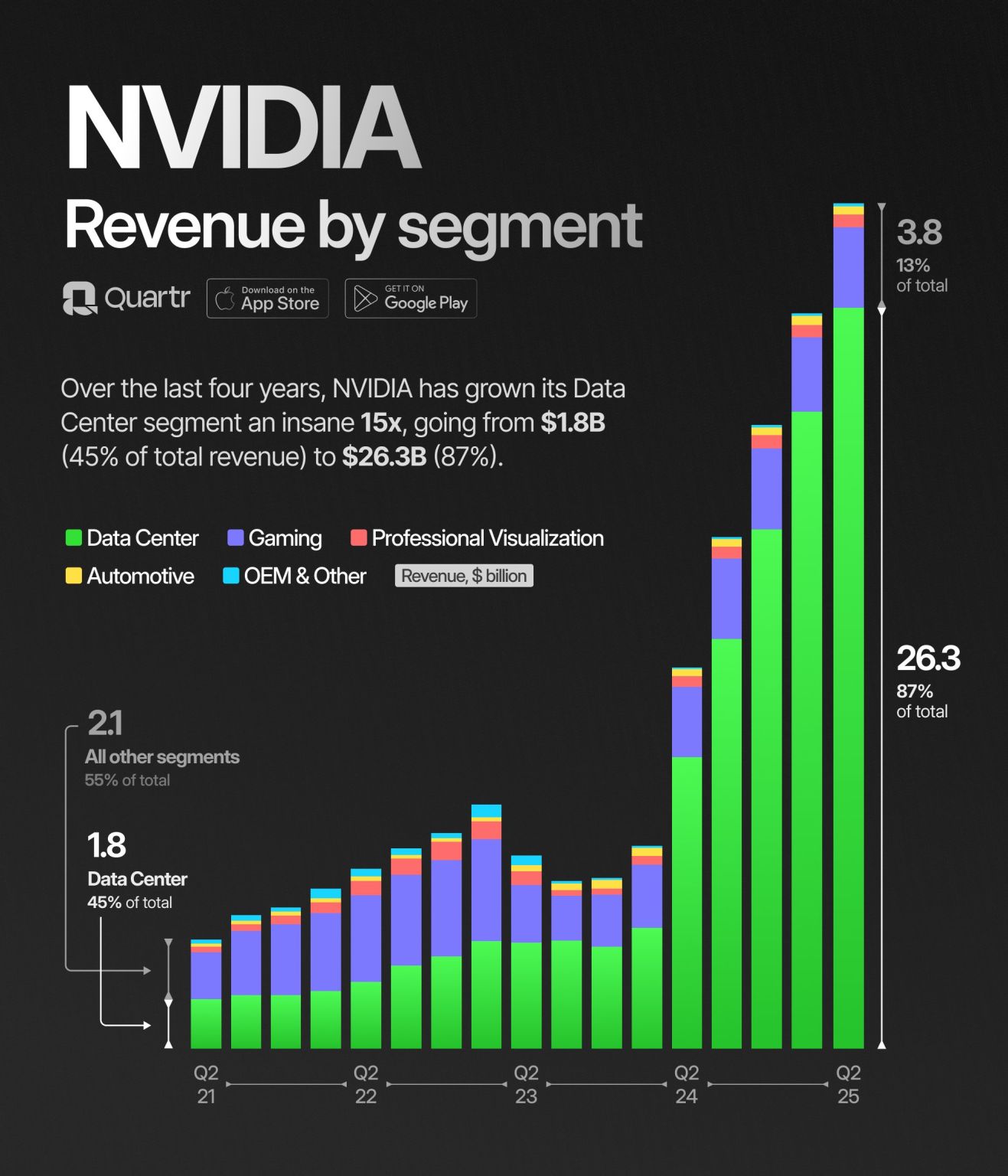
Notably, NVIDIA’s Data Center division reached new heights, reporting a record revenue of $26.3 billion for the second quarter of 2024. This marks a 16% increase from the previous quarter and a remarkable 154% growth compared to the same period last year.

The Data Center division’s success is driven by several key innovations and industry-leading developments in Al and computing, which include the following;

NVIDIA Spectrum-X Adoption: The Spectrum-X Ethernet networking platform has seen widespread adoption among cloud service providers, GPU cloud providers, and enterprises. This technology is being integrated into various offerings by NVIDIA’s partners, further expanding its influence across the industry.

NIM Microservices Expansion: NVIDIA released its NIM™ microservices platform to developers globally, with over 150 companies already integrating these services into their platforms to accelerate generative Al application development.

New Al Services: The company launched an inference service in collaboration with Hugging Face, powered by NIM microservices on NVIDIA DGX™ Cloud. This service enables developers to deploy popular large language models more efficiently.

Al Foundry and Llama 3.1: NVIDIA introduced the Al Foundry service and NIM inference microservices to accelerate generative Al for enterprises globally, featuring the Llama 3.1 collection of models.

NVIDIA’s Data Center business continues to lead the industry with cutting-edge technology and strategic partnerships, driving significant growth and setting new benchmarks in Al and data center performance.

Nvidia’s Balance Sheet and Cash Flow:

•Total Assets: $85.2 billion, up from $65.7 billion at the beginning of the year.

•Shareholders’ Equity: $58.2 billion, reflecting strong financial health and investor confidence.

•Net Income: $16.6 billion for the quarter, a substantial increase from $6.2 billion a year ago.

NVIDIA’s results reflect the accelerating adoption of generative Al, which CEO Jensen Huang predicts will revolutionize every industry. With strong financial performance and a growing portfolio of innovative products, NVIDIA continues to set the pace in the Al and computing landscape.

Chipmaking powerhouse Nvidia reported second-quarter earnings that more than doubled from a year ago, beating Wall Street estimates and signaling resilient demand from Big Tech customers. Revenue surged 122% to $30 billion, largely driven by the company’s data center business, which includes AI processors. Nvidia’s sales forecast — viewed by some on Wall Street as a gauge of AI spending — also surpassed analysts’ estimates. However, as Bloomberg notes, the outlook missed some of the more ambitious forecasts, raising concern that Nvidia’s “explosive growth is waning.”