DD
MM
YYYY

PAGES

DD
MM
YYYY

spot_img

PAGES

Home Blog Page 307

Crypto Bulls Roar: 10 Best Crypto Coins with 1000x Potential You’ll Regret Missing This Quarter

0
Blazpay - best crypto ai coins

As 2025 draws to a close, the crypto market is once again lighting up – and this time, it’s fueled by AI-integrated innovation, multichain expansion, and DeFi disruption. Traders are asking one question louder than ever: which crypto will explode in 2025? The latest trend suggests that AI-enhanced ecosystems could dominate the next cycle, turning smart investments into generational wealth.

The top contenders this quarter include a mix of blue-chip giants like Bitcoin, Ethereum, and Solana, alongside rising challengers like Blazpay – an AI-powered DeFi platform that’s rapidly redefining what the best crypto ai coins can deliver. While the market corrects, smart investors are positioning early in presales and utility-driven projects that offer low entry and high scalability.

Below is a closer look at 10 coins every investor should watch closely this quarter – from long-term leaders to emerging innovators primed for exponential returns.

Current Market Overview (as of October 18, 2025)

Coin Current Price Market Cap 24h Change Key Highlight
Blazpay (BLAZ) $0.0075

(Presale)

$735K

raised

+67% sold Multichain AI & DeFi
BNB (Binance Coin) $1086.49 $158.3B -5.74% Testing $1,000 support
Solana (SOL) $183.46 $85.5B +0.78% Active trading volume
Bitcoin (BTC) $106,730 $2.13

trillion

+0.24% Near key resistance
Cardano (ADA) $0.626 $22.3B +0.25% RSI oversold
TRON (TRX) $0.311 $27B +0.76% Stable range
Ethereum (ETH) $3,846.86 $462.8B +0.37% Holding resilience
Polkadot (DOT) $2.91 $4.09B -4.38% Short-term bearish
Sui (SUI) $2.43 $6.3B -0.43% Cooling after rally
XRP (XRP) $2.32 $130.5B -1.57% Consolidating below $2.85


1. Blazpay – The AI-Powered Underdog With Explosive Potential

If there’s one project redefining the best crypto ai coins narrative in 2025, it’s Blazpay. Currently in Phase 2 of its presale, priced at just $0.0075, Blazpay has already raised over $735,000, with 67% of tokens sold. The platform merges AI, Multichain DeFi, and seamless trading infrastructure, offering one of the lowest-risk entry points among new crypto projects this year.

AI SDK and Perpetual Trading: A Unified Future

Blazpay’s integrated AI SDK enables developers to create smart DeFi products that operate across Ethereum, Solana, BSC, and Polygon, eliminating silos that plague traditional crypto ecosystems. Its Perpetual Trading Suite gives users real-time access to leveraged trading and automated market insights – a rare combination at the presale stage.

This convergence positions Blazpay as a frontrunner among the best crypto ai coins to buy in Q4 2025 – a project bridging accessibility, innovation, and yield potential at once.

$2,000 Investment Scenario – The Quiet 1000x Setup

Imagine entering the Blazpay presale at $0.0075 with a $2,000 allocation, securing roughly 266,666 BLAZ tokens. If Blazpay even reaches $0.75 post-listing – a realistic target given AI+DeFi demand – that same investment could surge to $200,000.
That’s a 100x return before listings, making it a potential Best 1000x crypto contender for those entering early.

Blazpay - best crypto AI coins

Price Forecast for 2025–2026: Analysts Turn Bullish

Analysts forecast Blazpay could reach between $0.25 and $0.80 after exchange listings, with further upside toward $1.50+ by mid-2026 if institutional partnerships continue. As one of the best coins to invest in before mass listings, Blazpay’s trajectory mirrors early Solana or Avalanche stages – low entry, massive reward.

How to Buy Blazpay Tokens

  1. Visit the official Blazpay presale website.
  2. Connect your MetaMask or Trust Wallet.
  3. Select ETH, BNB, or USDT as payment.
  4. Enter the desired investment amount (minimum $50).
  5. Confirm and claim tokens after presale closes.

Blazpay’s presale currently ends in 13 days, after which the price rises to $0.009375 – reinforcing urgency for early investors.

2. BNB – Holding the Exchange Powerhouse Line
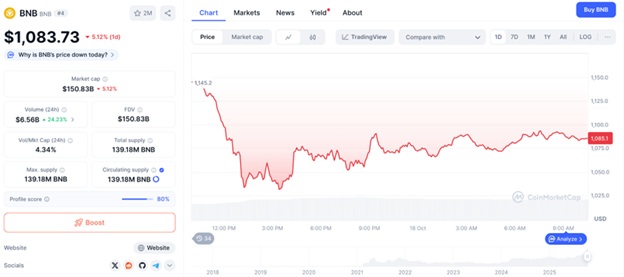
BNB remains one of the best crypto coins to buy for traders who believe in exchange-based ecosystems. Priced near $1086, it’s battling to stay above its 50-day EMA support at $1046. Analysts note that if BNB can sustain above $1,000, it may retest $1,150–$1,250 levels. Despite pressure, BNB remains a long-term infrastructure asset – a reliable pick even in volatile times.

3. Solana – The Comeback Smart Chain

After retracing from $200, Solana is consolidating near $183.46. It remains a leader in high-throughput blockchain solutions, with rising developer adoption. Solana’s market cap of $85.5B keeps it firmly within the best crypto coins discussions, as its scalable infrastructure supports AI-integrated dApps.

4. Bitcoin – Stability Amid Volatility

At $106,730, Bitcoin remains the benchmark for institutional accumulation. While its growth curve is steadier than smaller projects, BTC’s dominance secures its place among the best coins to invest in during uncertain market conditions. Analysts see resistance near $110,000, with strong buying sentiment near $100,000.

5. Cardano – The Silent Innovator
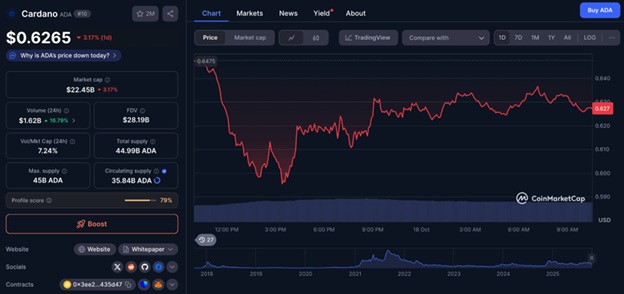
Cardano (ADA) trades at $0.626 with a market cap of $22.3B. Oversold RSI levels suggest potential reversal toward $0.80 in Q4. With new DeFi partnerships forming, Cardano retains its appeal as one of the best crypto coins, integrating smart contract interoperability and long-term scalability.

6. TRON – The Steady Performer

TRON (TRX) continues to maintain stable returns, trading around $0.31. Its $27B market cap highlights strong network usage and developer retention. TRON’s strategic partnerships and DeFi lending expansions make it a moderate yet steady asset among the best crypto coins to buy for yield-focused investors.

Blazpay - Best 1000x crypto

7. Ethereum – The Institutional Favorite

Ethereum (ETH) is trading near $3,846, holding strong despite volatility. With over $462B in market cap, Ethereum continues to dominate as a base layer for most AI-driven DeFi protocols. As a cornerstone of the best crypto coins, its transition toward scalability upgrades in 2025 ensures ongoing dominance.

8. Polkadot – Undervalued and Oversold

At $2.91, Polkadot faces short-term pressure but remains undervalued given its interoperability features. Long-term projections aim toward $3.74–$4.99 in 2026. For risk-tolerant investors, DOT’s low valuation and ecosystem expansion make it the best coin to invest in at current levels.

9. Sui – The Newcomer Making Waves

Trading at $2.43, Sui continues to attract attention as a next-generation smart contract platform. Despite short-term cooling, its high trading volume ($1.9B) shows active market participation. Its AI-driven developer tools position it firmly among the emerging best crypto coins in 2025.

10. XRP – The Comeback Asset

At $2.32, XRP remains a market heavyweight. With over $130B market cap, it’s rebounding from SEC-era volatility toward renewed institutional confidence. XRP’s global remittance integrations and liquidity utility could reignite its rally toward $3+ if market momentum strengthens in Q4.

Conclusion: Market Cycles Reset, Opportunities Multiply

The final quarter of 2025 is shaping into one of recalibration – where AI-backed ecosystems, multichain innovation, and presales like Blazpay take center stage. Whether you’re chasing stability through Ethereum and Bitcoin or hunting for asymmetric upside with Blazpay and Sui, the current dip could be the defining moment for the next bull cycle.

In a market that rewards timing and innovation, Blazpay’s model may indeed mark it as the Best 1000x crypto this quarter – the best coin to invest in before 2026 turns up the heat.
Blazpay - best crypto coin to buy

Join the Blazpay Community

Website: www.blazpay.com
Twitter: @blazpaylabs
Telegram: t.me/blazpay

Germany Deploys Eurofighter Jets to Poland for Enhanced NATO Air Patrols

0

Germany has announced plans to station Eurofighter Typhoon fighter jets at a Polish airbase to bolster NATO’s air defense on the alliance’s eastern flank.

This move, revealed by German Defence Minister Boris Pistorius on October 15, 2025, during a NATO ministers’ meeting in Brussels, aims to increase Germany’s visibility and responsiveness amid rising tensions with Russia. The jets will operate from Malbork Air Base in northern Poland, supporting armed patrol flights under NATO’s Operation Eastern Sentry.

Operation Eastern Sentry was launched in September 2025 following a major incursion where 19 Russian drones entered Polish airspace on September 10, prompting Poland to invoke NATO’s Article 4 consultations for the first time since Russia’s full-scale invasion of Ukraine in 2022.

Some drones were intercepted by NATO assets, including Dutch F-35s, while others crashed into Polish territory, causing minor damage and heightening fears of escalation. This incident marked the most serious Russian airspace violation over a NATO member since the Ukraine war began, prompting a rapid multinational response.

Pistorius emphasized that the deployment would make Germany “even more active, present, and visible” along NATO’s eastern border, focusing on traditional air surveillance, defense against incursions, and countering drone threats.

Prior to this permanent basing, Germany had contributed four Eurofighters from its Rostock-Laage base for temporary patrols over Poland. The Eastern Sentry mission involves a coalition of allies deploying assets to cover airspace from the Arctic to the Black Sea.

Mixed deployments for Baltic and Polish coverage; expanded patrols through December 2025. The mission is set to expand, with additional refueling zones established across the North Sea, Germany, Poland, and the Baltic states to support sustained operations.

NATO has also intercepted Russian MiG-31s over Estonia recently, underscoring the heightened alert level. This deployment occurs against a backdrop of escalating Russian provocations, including fighter jet incursions into Estonian airspace and surveillance flights over German supply routes.

Polish Prime Minister Donald Tusk described the September drone event as “the closest we have been to open conflict since World War Two.” While NATO stresses deterrence over confrontation, figures like U.S. President Donald Trump have advocated for more aggressive responses, such as shooting down intruding jets.

The alliance maintains that these measures strengthen collective defense without provoking direct escalation. Broader discussions tie it to NATO’s Baltic Air Policing enhancements amid multiple incursions.

NATO’s Baltic Air Policing (BAP) mission is a collective defense initiative to secure the airspace of Estonia, Latvia, and Lithuania, which lack sufficient air forces to patrol their skies independently.

Launched in 2004 after the Baltic states joined NATO, the mission ensures the integrity of NATO airspace, particularly along the alliance’s eastern flank near Russia.

It operates under NATO’s Integrated Air and Missile Defence System, with allied nations rotating fighter jet detachments to maintain a constant presence. Protect Baltic airspace, deter incursions, and respond to potential threats, particularly from Russian aircraft operating near or violating NATO borders.

Allies deploy for 4–6 month periods, with 3–4 nations contributing simultaneously. Recent contributors include Germany, France, Italy, Netherlands, Denmark, and Norway.

Operation Eastern Sentry: Initiated in September 2025 following a major Russian drone incursion into Polish airspace 19 drones on September 10, 2025, prompting Poland to invoke NATO’s Article 4. This has expanded BAP’s scope, with enhanced patrols over Poland and the Baltic states through December 2025.

Russian MiG-31s intercepted over Estonia, highlighting ongoing Russian provocations. Unidentified drones and Russian surveillance flights near German supply routes and Baltic borders.

Germany’s decision to station Eurofighters at Malbork, Poland, strengthens BAP’s southern flank, replacing temporary rotations from Rostock-Laage. Netherlands F-35s led drone interceptions in September 2025. France Rafale fighters scrambled for drone intercepts.

Denmark F-16s and a frigate for maritime-air integration. UK Potential for up to 6 Typhoons; already active in Polish patrols. Italy, Poland, Norway: F-35s and F-16s for regional coverage.

QRA jets scramble to intercept unidentified or hostile aircraft, often Russian military planes flying without transponders or flight plans near NATO airspace. Refueling zones across the North Sea, Germany, Poland, and the Baltics ensure sustained operations.

The mission has intensified due to Russia’s war in Ukraine and recent airspace violations, with NATO emphasizing deterrence over escalation. Demonstrates NATO’s unity and rapid response capability. Counters Russian attempts to test alliance resolve, especially after high-profile incidents like the Polish drone incursion.

Reinforces deterrence amid debates over stronger responses, such as calls from figures like Donald Trump to shoot down intruding aircraft. X posts reflect heightened awareness, with outlets like DPA International noting Germany’s deployment as part of BAP’s expansion.

Switzerland’s Gambling Supervisory Authority GESPA Files Criminal Complaint Against FIFA Collect

0

Switzerland’s Gambling Supervisory Authority GESPA, or Geldspielaufsicht, filed a criminal complaint against FIFA over its NFT platform, FIFA Collect. The regulator alleges that certain features of the platform constitute unlicensed gambling services under Swiss law, specifically lotteries and sports betting.

FIFA, headquartered in Zurich, faces potential penalties if prosecutors pursue charges, though the platform remains operational for now. FIFA Collect is a blockchain-based platform launched to offer digital collectibles (NFTs) tied to World Cup moments, allowing users to buy, collect, and trade them.

A key element is the “Right-to-Buy” (RTB) NFTs, which provide holders with priority access to purchase tickets for the 2026 FIFA World Cup hosted across North America. These NFTs are sold for prices starting around $999, with some resold for up to $30,000 based on team performance or rarity.

GESPA initiated a preliminary investigation in early October 2025 after becoming aware of the platform. The probe focused on mechanics involving random draws for prizes or monetary benefits or ticket access in exchange for a “monetary stake”.

Under Switzerland’s Federal Act on Gambling, activities meeting the criteria of chance, stake, and prize require a license—regardless of whether the operator is based abroad, as long as they’re accessible to Swiss users.

Competitions on the platform that reward participants via chance-based selection, such as NFT drops or prize mechanics. The RTB NFTs are seen as akin to betting on tournament outcomes, where value fluctuates based on team advancement.

GESPA confirmed the services are “not licensed in Switzerland and are therefore illegal,” obligating the regulator to report to prosecutors. GESPA Director Manuel Richard emphasized that further details on the complaint are confidential, leaving it to law enforcement to investigate.

The case could disrupt its $11 billion revenue forecast for 2023–2026, where ticketing and digital sales play a major role. It may force enhanced compliance, such as KYC/AML checks, geo-blocks for Swiss users, or redesigned NFT mechanics to avoid “gambling-like” elements. FIFA has not publicly responded yet.

This highlights regulatory scrutiny on NFTs blending collectibles with real-world rewards. Legal experts predict it could set precedents across Europe for classifying chance-based digital assets, affecting blockchain projects in gaming, fan engagement, and tokenization.

Switzerland’s gambling laws are governed primarily by the Federal Act on Gambling (Gambling Act, BGS), enacted in 2019, which regulates both land-based and online gambling activities. Gambling under the BGS includes activities involving a monetary stake, an element of chance, and the possibility of a prize.

This covers lotteries, sports betting, casino games, and certain skill-based games where chance plays a significant role. In the FIFA Collect case, the Swiss Gambling Supervisory Authority (GESPA) views the platform’s “Right-to-Buy” (RTB) NFTs and random-draw mechanics as gambling, as they involve a stake.

All gambling activities accessible to Swiss residents require a license from GESPA, whether the operator is based in Switzerland or abroad. Unlicensed gambling is illegal under Article 130 of the BGS, leading to the criminal complaint against FIFA for operating FIFA Collect without a license.

Only Swiss-based casinos for casino games or lotteries like Swisslos and Loterie Romande for lotteries and sports betting can obtain licenses. Foreign operators are generally excluded unless partnered with a licensed Swiss entity.

The law applies to any gambling service accessible in Switzerland, even if hosted internationally. FIFA, headquartered in Zurich, and its NFT platform accessible at collect.fifa.com fall under this jurisdiction.

Licensed operators must implement measures like Know Your Customer (KYC) checks, age verification 19+ for gambling in Switzerland, and tools to prevent gambling addiction. FIFA’s platform reportedly lacks robust KYC/AML anti-money laundering measures, raising compliance concerns.

Operating unlicensed gambling services accessible in Switzerland is a criminal offense, punishable by fines or imprisonment Article 130, BGS. GESPA’s complaint against FIFA stems from this provision. Advertising unlicensed gambling is also prohibited.

Online gambling is permitted only by licensed Swiss casinos or lottery operators. Foreign websites offering gambling to Swiss users can be blocked by the Swiss Federal Gaming Board (SFGB) or GESPA, and internet service providers may be ordered to restrict access.

Gambling winnings from licensed operators are tax-free for players up to CHF 1 million. Unlicensed platforms don’t benefit from this exemption, and operators face taxes on gross gaming revenue.

NFT drops or prize allocations resemble lotteries due to their chance-based nature. RTB NFTs: These are seen as sports betting, as their value (e.g., ticket access) depends on unpredictable team outcomes.

The platform’s availability to Swiss users without a gambling license violates the BGS. GESPA’s action reflects Switzerland’s strict stance on unregulated gambling-like activities, especially those leveraging new technologies like NFTs.

Switzerland’s laws aim to balance a regulated gambling market with player protection and prevention of illegal activity. The FIFA case highlights how emerging digital assets (NFTs) can fall under gambling regulations if they involve chance, stakes, and rewards.

This could influence how global platforms structure similar offerings to avoid legal risks in Switzerland and beyond. The complaint is now with Swiss prosecutors, who will decide whether to press charges. Updates may emerge as proceedings advance.


Wikipedia’s Human Traffic Declines Amid Rise of AI-Driven Search and Social Media Habits

0

Wikipedia, long hailed as one of the last bastions of reliable, community-curated knowledge on an increasingly commercial and AI-saturated internet, is seeing a noticeable dip in human engagement.

According to new data shared by Marshall Miller of the Wikimedia Foundation, human pageviews on Wikipedia have fallen by about 8% year-over-year.

Miller, who detailed the findings in a new blog post, said the decline became apparent after an update to Wikipedia’s bot detection systems revealed that a large portion of the site’s unusually high traffic between May and June actually came from bots designed to avoid detection. The adjusted data, he said, now paints a more accurate picture — one that shows a steady decline in organic, human-driven visits to the encyclopedia.

The explanation for this trend lies in the broader shifts shaping how people consume information online. Miller identified “the impact of generative AI and social media on how people seek information” as key factors behind the decline. Search engines, including Google, are increasingly providing direct, AI-generated answers to user queries rather than linking to source websites like Wikipedia. This means that while Wikipedia content continues to inform millions of users daily, many of those users never actually click through to the site.

At the same time, younger generations are gravitating toward short-form video platforms like TikTok, Instagram Reels, and YouTube Shorts for quick, visually engaging answers to their questions — a habit that bypasses the traditional open-web model that Wikipedia helped define.

“Younger generations are seeking information on social video platforms rather than the open web,” Miller wrote.

Google, for its part, has disputed claims that its AI summaries or “overviews” in search reduce traffic to knowledge sources. The company has argued that links to external websites are still provided and that users can click through to learn more. But data across the web suggests that the introduction of AI-generated search summaries has indeed shifted user behavior.

However, Miller maintained that Wikipedia remains a critical foundation of the global information ecosystem. Even if readers are not visiting the site directly, the encyclopedia’s content still forms the backbone of many AI and search tools.

“Knowledge sourced from Wikipedia is still reaching people even if they don’t visit the website,” Miller noted.

The challenge, however, is that fewer visits mean fewer opportunities for volunteers to edit and expand Wikipedia’s content — the lifeblood of the platform. It could also translate to fewer small donations, which are essential to funding the Wikimedia Foundation’s operations.

“With fewer visits to Wikipedia, fewer volunteers may grow and enrich the content, and fewer individual donors may support this work,” Miller cautioned.

The risk is not merely financial or operational. As generative AI systems rely on vast repositories of existing information to generate new text, a decline in Wikipedia’s volunteer base could have downstream effects on the quality of knowledge available across the internet. If fewer human editors are updating and correcting Wikipedia, the accuracy of the AI systems that depend on it could suffer as well.

Interestingly, Wikipedia itself experimented with integrating generative AI, testing automated summaries of entries earlier this year. However, the initiative was paused after editors voiced concerns that AI-generated text could compromise the platform’s integrity, transparency, and editorial standards.

In response to the decline in engagement, the Wikimedia Foundation is taking several steps to ensure Wikipedia remains relevant and visible in a changing information landscape. The organization is developing a new framework for attributing content used by AI models and search engines, aiming to reinforce the visibility of Wikipedia’s role in shaping digital knowledge. It also has two dedicated teams working to expand the platform’s reach among new readers globally, particularly in emerging markets where mobile and social platforms dominate.

Miller’s post also included a broader appeal to readers and internet users to support what he called “content integrity and content creation.” He urged users to look beyond AI summaries and social media snippets by clicking through to original sources, checking citations, and contributing where possible.

“Talk with the people you know about the importance of trusted, human-curated knowledge,” he wrote, “and help them understand that the content underlying generative AI was created by real people who deserve their support.”

Since its launch in 2001, Wikipedia has grown into one of the most visited websites in the world and one of the few remaining large-scale collaborative projects run by volunteers. Its open-access model has stood in contrast to the algorithm-driven, ad-funded structures that dominate most of today’s internet. Yet even Wikipedia is now facing the same pressures as other legacy web institutions — declining visibility, competition from AI, and changing consumption habits that favor speed over depth.

The recent revelation that human traffic is falling may not mean Wikipedia’s influence is waning, but it underscores a pivotal moment. If the encyclopedia’s role as a public good is to endure in the age of generative AI, it will need both institutional adaptation and renewed public engagement.

Emirates NBD Takes 60% Stake in India’s RBL Bank at $3bn, Signaling Deepening Gulf Investment in Asia’s Financial Sector

0

Dubai’s largest lender, Emirates NBD, is making a bold push into India’s fast-growing financial sector with a $3 billion investment for a 60% stake in RBL Bank.

The deal, which marks the largest cross-border acquisition in India’s financial industry, points to the rising influence of Middle Eastern capital in Asian markets and the strengthening financial corridor between India and the Gulf.

According to a joint statement by both lenders, Emirates NBD will invest 268.53 billion Indian rupees ($3.05 billion) in RBL Bank through a preferential issue of shares. The move comes amid a flurry of cross-border deals in India’s banking industry, following Japan’s Sumitomo Mitsui Banking Corporation’s acquisition of up to 25% in Yes Bank earlier this year.

The acquisition extends the footprint of Emirates NDB beyond the Middle East into one of the world’s most dynamic banking markets, reflecting what both banks described as “confidence in India’s fast-growing financial sector and its strategic importance within the India-Middle East-Europe Economic Corridor.”

India’s financial sector, valued for its stability and growth potential, has attracted significant foreign investment in recent years. With rising credit demand, a booming digital banking ecosystem, and a growing middle class, India has become a key destination for foreign banks seeking long-term exposure to emerging markets.

RBL Bank, though smaller compared to India’s leading private lenders, has been on a steady recovery path since its management overhaul in 2021 following the resignation of former CEO Vishwavir Ahuja. The bank, which operates 562 branches across 28 Indian states and serves over 15 million customers, has seen its stock price surge by 90% in 2025 — a stark contrast to the 8% gain recorded by the benchmark Nifty 50 index during the same period.

As of March 2025, RBL Bank reported total assets of 1.46 trillion rupees ($16.61 billion), ranking it as the 13th largest among India’s 21 private banks. The infusion of new capital from Emirates NBD is expected to fortify the lender’s balance sheet, enhance its Tier-1 capital ratio, and provide long-term liquidity to support growth across retail and SME segments.

“The infusion will significantly strengthen RBL Bank’s balance sheet, enhance its Tier-1 capital ratio, and provide long-term growth capital,” the banks said in their joint release.

Regulatory Endorsement and Expansion Prospects

Under Indian law, foreign investment in private sector banks is capped at 74%, with any single foreign institution restricted to a 15% holding unless the Reserve Bank of India (RBI) grants an exemption. Reuters reported that the RBI has informally communicated its support for Emirates NBD’s proposal, paving the way for regulatory clearance.

As part of the acquisition, Emirates NBD will also make an open offer to retail shareholders to purchase additional shares at 280 rupees per share, in line with Indian takeover regulations requiring an acquirer of more than 25% to offer another 26% to public investors.

Following completion, Emirates NBD will be designated as the “promoter” of RBL Bank — a regulatory classification in India that grants significant influence over management and decision-making. The Dubai-based lender will gain the right to nominate directors to RBL’s board, subject to regulatory approvals.

Analysts say the acquisition could spark a wave of similar foreign investments in India’s mid-tier banking space.

“This will open up floodgates for more such investments into small- and mid-sized banks in the country,” said Anand Dama, head of financial sector research at Mumbai-based brokerage Emkay Global Capital Financial Services.

Deepening Financial Ties Along the India-Gulf Corridor

The deal also signals a growing financial convergence between India and the Gulf Cooperation Council (GCC) economies, especially as trade and investment relations deepen under the India-Middle East-Europe Economic Corridor (IMEC) initiative.

For Emirates NBD, which had total assets of $297 billion as of June 2025, the acquisition of RBL Bank represents both a strategic diversification and a geopolitical alignment with one of its most significant trade partners. The lender, majority-owned by the Dubai government, has been expanding aggressively in recent years — entering markets such as Egypt, Saudi Arabia, and Turkey, where it bought DenizBank in 2019.

The UAE banking sector as a whole has benefited from strong domestic liquidity, a high-interest-rate environment, and government-led diversification away from oil dependency. Banks like Emirates NBD and Abu Dhabi’s First Abu Dhabi Bank (FAB) have used their strong capital positions to pursue international growth, particularly in high-potential emerging markets.

It is believed that India offers a compelling mix of growth, stability, and digital transformation that aligns with Emirates NBD’s expansion strategy. Analysts say the Indian banking sector’s balance of regulation, digital innovation, and customer growth makes it a natural fit for large Middle Eastern banks seeking international exposure.

The acquisition comes at a time when India’s private banking sector is consolidating and modernizing, with mid-tier lenders seeking partnerships or capital infusions to stay competitive. The entry of Emirates NBD not only strengthens RBL’s capital base but also introduces fresh governance practices and cross-border expertise that could enhance operational efficiency.

For Indian regulators, the deal underscores the country’s growing appeal to sovereign-backed foreign investors seeking stable long-term returns outside traditional oil markets. It also provides a signal of confidence in India’s economic reforms and financial resilience amid global uncertainty.

In the long term, analysts believe the Emirates NBD-RBL partnership could pave the way for further regional financial integration between India and the Middle East — potentially leading to joint ventures in fintech, trade finance, and infrastructure funding.