DD
MM
YYYY

PAGES

DD
MM
YYYY

spot_img

PAGES

Home Blog Page 3110

Telegram User Base Soars to an Impressive 950 Million Users, Set to Launch App Store

0

Telegram, a fast, secure, and powerful messaging app that lets users access chats from multiple devices, has seen its user base surge to an impressive 950 million users.

This significant milestone highlights the platform’s growing popularity and its ability to attract a global audience.

Recall that in 2022, according to Sensor Tower’s Q1 2022 Data Digest, Telegram was among the top 5 most downloaded apps in the world. Of the top 5 apps, Telegram was the only platform that didn’t spend billions on marketing to buy downloads.

Highlighting this achievement, Pavel Durov, Founder & CEO, Telegram said,

“In 2022, Telegram is again among the top 5 most downloaded apps in the world (just like in 2021). Of these top 5 most popular apps, Telegram is the only one that doesn’t spend billions on marketing to buy downloads. In a way, we are the only app that is on the list purely because it is genuinely loved by the people.”

In addition to nearing a 1 billion user base, Telegram is set to launch its app store and an in-app browser with support for web3 pages this month, the company’s founder said.

It is however worth noting that the rapid growth of users on Telegram, is majorly attributed to the popularity of Tap-to-earn crypto games like Hamster Kombat, TapSwap, and Notcoin, amongst others, on the platform.

The platform’s open and decentralized nature aligns well with the principles of cryptocurrency and blockchain technology, which has made it a natural fit for crypto games, which often emphasize decentralization and community participation.

Telegram has long supported cryptocurrency and blockchain initiatives, but its efforts to enter the space slowed down after its initial coin offering failed in 2018. Fast forward to December 2022, the platform began auctioning usernames on the TON blockchain.

It has since then focused on helping developers build mini-apps and games that use cryptócurrency for transactions. This year, it started sharing ad revenue with channel owners by handing out toncoin (a token on the TON blockchain). Earlier this month, Telegram started letting channel owners convert stars to toncoin to buy ads at discounted rates or trade cryptocurrencies.

The intersection of Telegram’s robust user base and the innovative potential of cryptocurrency and blockchain technology suggests a bright future for crypto games on the platform. As the app continues to grow and evolve, it is likely to become an even more integral part of the crypto gaming ecosystem.

Notably, Telegram’s surge in popularity has positioned it as a key platform for crypto games. With its supportive features and engaged user base, it offers a unique environment for the development of blockchain-based games.


From Bullish to Bearish: How Sentiment Indicators Predict Market Movements

0

Sentiment indicators offer a window into the collective mindset of market participants, guiding traders through a bumpy road to make smarter and “better” decisions. This article will explore the essence of market sentiments, the mechanisms behind sentiment indicators, their predictive accuracy, practical applications, and the future trajectory of this field.

Understanding Market Sentiments

Market sentiments significantly influence stock prices and overall market dynamics. These sentiments encapsulate the collective emotional responses of traders and investors towards specific assets, markets, or sectors. Sentiments are typically classified as bullish, reflecting optimism and expectations of rising prices, or bearish, indicating pessimism and expectations of falling prices.

Accurate sentiment assessment involves monitoring diverse factors, including news, economic data, social media trends, and political events. These factors provide insights into market participants’ expectations and emotions, shaping market movements.

The Role of Sentiment Indicators

Sentiment indicators serve as quantitative measures of market sentiments, helping traders gauge the market’s mood through data analysis. These indicators encompass a range of sentiment-related variables, such as investor sentiment surveys, put-call ratios, and social media sentiment analysis.

By leveraging sentiment indicators, traders can detect potential sentiment shifts before they manifest in stock prices, enabling them to position themselves advantageously and capitalize on market movements.

Bullish vs Bearish: What’s the Difference?

Understanding the distinction between bullish and bearish sentiments is fundamental for traders. Bullish sentiment signals optimism and the anticipation of price increases, while bearish sentiment denotes pessimism and the expectation of price declines.

Recognizing whether the market sentiment is primarily bullish or bearish allows traders to adjust their strategies accordingly. In bullish markets, traders might focus on buying opportunities to ride the upward trend. Conversely, in bearish markets, strategies may shift towards short-selling or adopting defensive measures to safeguard portfolios.

The Science Behind Sentiment Indicators

The Psychology of Trading

Human emotions, particularly fear and greed, significantly influence financial markets. Sentiment indicators aim to capture these emotions and translate them into measurable data. Understanding the psychology behind trading enables traders to interpret sentiment indicators more effectively.

For instance, extreme optimism might indicate an impending market correction, while excessive pessimism could signal an oversold market, presenting buying opportunities.

Quantifying Market Sentiments

Quantifying market sentiments involves analyzing data and converting it into numerical values that represent prevailing emotions. Data sources include surveys, social media platforms, news sentiment analysis, and options market data.

By quantifying sentiment, traders can track sentiment trends over time and identify potential market turning points. However, sentiment indicators should be integrated with other technical and fundamental analysis tools for a comprehensive view.

Predicting Market Movements with Sentiment Indicators

The Accuracy of Sentiment Indicators

Sentiment indicators, while valuable, are not infallible and should not be used in isolation. They provide significant insights into market sentiments but must be corroborated with other technical and fundamental analysis tools to enhance predictive accuracy. Confirming sentiment indicators with other analysis techniques, such as analyzing candlestick patterns, increases the likelihood of successful trading.

When sentiment indicators align with other signals, such as trend reversals or key support and resistance levels, they can be potent tools for anticipating market movements. Confirming sentiment indicators with other analysis techniques increases the likelihood of successful trading.

Limitations and Challenges in Prediction

Market sentiments can shift rapidly, necessitating regular monitoring of sentiment indicators to reflect the most current data. Additionally, sentiment indicators can be influenced by external factors unrelated to market movements, necessitating cautious interpretation.

Practical Application of Sentiment Indicators

Strategies for Using Sentiment Indicators

Traders can adopt various strategies when using sentiment indicators. Contrarian traders, for instance, may exploit sentiment extremes by taking positions contrary to prevailing sentiments.

Others may use sentiment indicators to validate their existing analysis, confirming their trading decisions. By integrating sentiment indicators with other technical and fundamental analysis, traders can enhance their overall strategies.

Risk Management with Sentiment Indicators

Risk management is crucial in trading, and sentiment indicators can play a vital role. By monitoring sentiment indicators, traders can assess the overall market sentiment and adjust their risk management strategies accordingly.

For example, excessively bullish sentiments might prompt traders to tighten stop-loss levels to protect against potential reversals. Conversely, extreme bearish sentiments might lead traders to loosen stop-loss levels to avoid premature exits.

AfDB President Adesina, Femi Otedola, Ask Nigeria to Allow Dangote Refinery to Flourish

0

The President of the African Development Bank (AfDB), Akinwunmi Adesina, has cautioned the Bola Tinubu administration against adopting a hostile stance towards Dangote Refinery, following the recent spat between oil regulating agencies and the chairman of the oil plant Aliko Dangote.

Adesina said that the government should focus on fostering an environment conducive to the refinery’s success, rather than engaging in actions that could undermine it.

In a statement on Tuesday, the Afreximbank president highlighted the significance of Dangote’s investment, noting that few entities could match the $19.5 billion commitment made by Aliko Dangote in a country with considerable policy uncertainties. He pointed out that investing in Nigeria’s current economic climate is challenging, making it essential for the government to support such substantial investments.

“Investing is tough, considering that very few entities, if any at all, could afford to invest $19.5 billion, as Dangote had done, in a country where the economic climate was fraught with policy uncertainties,” Adesina said.

He further noted that while “pettiness is easy,” the focus should be on creating an enabling environment for such investments to thrive.

The caution from Adesina comes on the heels of allegations from the head of Nigeria’s oil regulator, the Nigerian Midstream and Downstream Petroleum Regulatory Authority (NMDPRA), Farouk Ahmed. Ahmed accused Dangote Refinery of attempting to monopolize the supply of refined crude products to the nation’s oil marketers.

Adesina countered these allegations, arguing that few entities have the financial capability to invest $19.5 billion in building a refinery of Dangote’s scale.

“How many individuals or companies can do railways? How many can do refineries of the scale of Dangote Refinery?” Adesina asked.

He asserted that wanting to be the sole fuel supplier after such an investment does not equate to creating a monopoly. According to him, there is no evidence to suggest that Dangote Refinery has acted anti-competitively or has prevented other companies from establishing refineries.

“No smart investor would make a $19.5 billion investment and want it to be undermined by importers,” Adesina said. He added, “Let the importers set up local refineries and compete by refining in Nigeria. That is fair and justified competition.”

Dangote has alleged that people in the Nigerian National Petroleum Company Limited (NNPCL) and some traders in the oil industry set up a blending plant in Europe, hinting at vested interests behind the recent attacks on his refinery.

Although the CEO of the NNPCL, Mele Kyari, has denied the claim, saying he neither has nor knows anyone in the state-owned company, who owns a blending plant in Europe, the allegation has been fully bought by many.

Adesina warned that the government’s hostile body language towards Dangote Refinery sends the wrong signal to potential foreign investors. He said disparaging Dangote, who is one of Nigeria’s largest investors, could deter other investors from committing to the country.

“This whole disparaging of Dangote is uncalled for. It is self-defeating. And it is very bad for Nigeria. Who will want to invest in a country that disparages and undermines its own largest investor?” he noted.

Growing Support from Business Leaders

Several prominent Nigerians, including former Vice President Atiku Abubakar, former Anambra State governor, Peter Obi, and business mogul Femi Otedola, have voiced their support for Dangote. Otedola praised Dangote as a visionary who has made significant investments in Nigeria.

He highlighted Dangote’s achievements, including building the largest single-train refinery in the world, the second-largest sugar refinery, and the largest cement factory, among other substantial industrial projects.

“My brother, the Visionary, has built the largest single train refinery in the world, not in Kano, but in Lagos State. He is the owner of the second-largest sugar refinery in the world, also in Lagos State, and the largest cement factory in the world, not in Kano, but in Kogi State,” Otedola said.

“Additionally, he has established one of the second-largest fertilizer plants in the world, soon to surpass the biggest one in Qatar, also in Lagos State. Furthermore, he has built a fertilizer plant in Lagos that already exports globally. Aliko Dangote is a titan that God created specially for mankind,” he continued.

Among other things, Otedola noted Dangote’s role as the largest private sector employer in Nigeria and a significant taxpayer. He also noted that Dangote Group’s contributions extend beyond industrial facilities to critical infrastructure projects, such as major roads in Lagos and Kogi states.

“His contributions extend beyond industrial facilities to critical infrastructure, having built major roads such as the Apapa Oshodi-Owonrosoki Express Road, Wharf Road, and the Obajana-Kabba Road,” he recounted.

Otedola advised the federal government to emulate other countries by supporting local industries like the Dangote Group for the country to thrive.

“This whole disparaging of Dangote is uncalled for. It is self-defeating. And it is very bad for Nigeria. Who will want to invest in a country that disparages and undermines its own largest investor?” Adesina stated.

U.S. Secret Service Director Cheatle Resigns Over Assassination Attempt on Trump

0

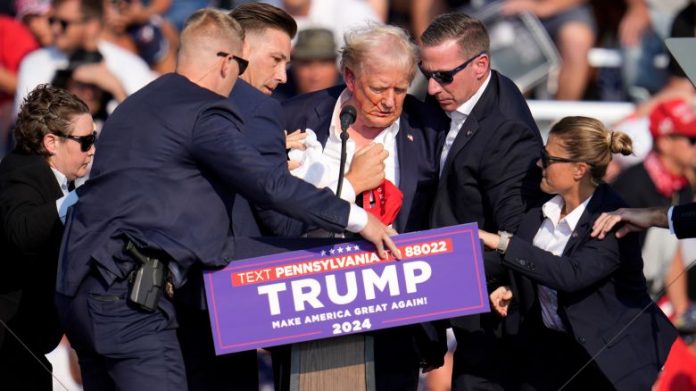
The U.S. Secret Service Director Kimberly Cheatle resigned on Tuesday, following an attempted assassination of former President Donald Trump at a Pennsylvania campaign rally.

The incident has raised serious questions about the efficacy and preparedness of the Secret Service under Cheatle’s leadership, thrusting the agency into the spotlight amidst intense scrutiny and controversy.

The harrowing events unfolded on July 13th at a rally in Butler Township, Pennsylvania. Thomas Crooks, a 20-year-old gunman, managed to position himself on a roof approximately 150 yards from the stage where Trump was speaking.

From that vantage point, Crooks fired multiple rounds, narrowly missing the former president but resulting in the death of one individual and critical injuries to two others. The gunman was eventually killed by a Secret Service sniper, but not before causing significant chaos and fear among the rally attendees.

This incident has been described as the most serious assassination attempt against a U.S. president in over four decades. The severity of the situation has prompted widespread criticism of the Secret Service’s preparedness and response.

The agency’s failure to secure the roof from which Crooks fired has been a focal point of the backlash, with many questioning why the Secret Service did not extend its security perimeter to include the complex that housed the building.

Cheatle’s Response to Congressional Inquiry

The House Oversight and Accountability Committee held a hearing to examine the Secret Service’s actions surrounding the rally. During this hearing, members of the committee expressed their outrage and demanded answers from Director Cheatle.

Despite the mounting pressure, Cheatle initially refused to resign, asserting her qualifications and experience as the best person to lead the agency. She argued that her nearly 30 years of service equipped her with the necessary skills to address the challenges faced by the Secret Service.

However, Cheatle’s refusal to answer many of the committee’s questions only fueled further frustration. Representatives from both sides of the aisle, including Chairman James Comer (R-Ky.) and ranking Democrat Jamie Raskin (D-Md.), demanded her resignation, citing a lack of confidence in her ability to lead the agency effectively.

The committee’s criticism centered on the Secret Service’s failure to secure the roof and the decision to allow Trump to take the stage despite receiving reports of a suspicious person at the event.

Faced with intense scrutiny and mounting pressure, Cheatle ultimately decided to step down from her position.

In a letter to Secret Service staff, she expressed her regret and acknowledged the agency’s shortcomings.

“In light of recent events, it is with a heavy heart that I have made the difficult decision to step down as your Director,” she wrote. “The Secret Service’s solemn mission is to protect our nation’s leaders and financial infrastructure. On July 13th, we fell short on that mission.”

Cheatle’s resignation marks a significant turning point for the Secret Service, an agency already reeling from a series of scandals and missteps in recent years. Homeland Security Secretary Alejandro Mayorkas quickly appointed Secret Service Deputy Director Ronald Rowe as acting director until President Joe Biden selects a permanent replacement.

In a statement, Biden thanked Cheatle for her decades of public service and praised her integrity.

“As a leader, it takes honor, courage, and incredible integrity to take full responsibility for an organization tasked with one of the most challenging jobs in public service,” Biden said.

He also assured the public that a new director would be appointed soon.

Trump and Congressional Leaders’ Reactions 

The response to Cheatle’s resignation has been mixed. Former President Trump, in a social media post, criticized the Biden administration for its handling of his security.

“The Biden/Harris Administration did not properly protect me, and I was forced to take a bullet for Democracy. IT WAS MY GREAT HONOR TO DO SO!” Trump wrote.

On the other hand, House Oversight Committee Chairman James Comer stated that Cheatle’s resignation would not halt the committee’s efforts to demand greater accountability from the Secret Service.

“The Secret Service has a no-fail mission yet it failed historically on Director Cheatle’s watch,” Comer stated. “While Director Cheatle’s resignation is a step toward accountability, we need a full review of how these security failures happened so that we can prevent them going forward.”

This One Failure Came with a Bold Efficacy Question

The Secret Service’s failure to secure the roof from which Crooks fired has raised questions about its operational protocols and decision-making processes. Cheatle’s rationale for not placing a sniper on the roof, citing safety concerns due to the roof’s slope, was met with skepticism and ridicule. Critics argued that such decisions compromised the safety of the former president and rally attendees.

Moreover, the Secret Service admitted that it had incorrectly stated that the agency had not rejected requests from Trump’s campaign for enhanced security. This admission, coupled with the broader criticism of the agency’s preparedness, has further eroded public trust in the Secret Service’s ability to fulfill its protective mission.

The incident has also highlighted the broader issue of intelligence and threat assessment. Prior to the rally, the Secret Service was informed of intelligence suggesting that Trump was the target of an Iranian assassination plot.

While Crooks has not been linked to Iran, the intelligence failure to prevent the attack has raised concerns about the agency’s ability to respond to credible threats effectively.