DD
MM
YYYY

PAGES

DD
MM
YYYY

spot_img

PAGES

Home Blog Page 3117

The Unalloyed Right and Opportunity to be Heard

0

“A hearing can only be fair when all parties to the dispute are given a hearing or an opportunity of hearing. If any party is refused a hearing or denied the opportunity to be heard, the hearing cannot qualify as fair hearing”- Supreme Court Justice Obaseki in the case of Otapo v Sunmonu

The right to a fair hearing is one of the most important fundamental human rights available to any person. It can be argued to be the most important fundamental human right recognizable in most jurisdictions of the world. 

It is basically the right of any/every party in a suit or litigation to be accorded the right and opportunity to be heard and to have the opportunity to respond to every allegation made against him. This right mandates the court to be unbiased and independent and to just act as an umpire in the litigation. This right to fair hearing also extends to the right of an individual to be given a lawyer (free of charge or at the cost of the state), if the individual cannot afford a lawyer, so that the individual will properly be heard in court, especially in a criminal matter. 

This right is provided for in S. 36 of the constitution of the federal republic of Nigeria, 1999 (as amended). 

It is recognized in the amendment rights of the United States of America and it is The Sixth Amendment right. It is also provided for and fully recognized in the United Nations Declaration on Human and People’s Rights, hence provided for in Article 10 and also provided for in Article 7 of the African Charter. 

These laws (both national, regional and worldwide) are all saying one thing; that every human should have an unalloyed right (to speak) & be heard at any point in time. 

Once your right to speak and to be heard is denied you as a person, you are good as nothing. 

This right is so important that if a person can prove that he was denied the right to speak and be heard in the lower court before judgment was given, such judgment will be annulled and voided in its entirety. But if you slept on this right and failed to exercise it when it was accorded to you and judgment was given, you will not be permitted to appeal for the reversal of the judgment just because you by your own will failed to exercise this right and the judgment given was not in your favor. 

Even in everyday life occurrences, you should always exercise your fundamental human right to speak and say your bit, especially when it comes to defending yourself even if what you said is regarded as nonsense or doesn’t make any sense.

The Domino Effect: How Rising Oil Prices Strain Nigeria’s Fuel Supply Chain

0

The recent uptick in global oil prices, fueled by geopolitical tensions in the Middle East, has sent ripples across Nigeria’s fuel supply chain, exacerbating an already precarious situation.

As Brent crude futures soared to $90.78 per barrel and U.S. West Texas Intermediate (WTI) crude climbed to $86.78, concerns about the stability of Nigeria’s fuel market intensified.

Ceasefire negotiations between Israel and Hamas, which briefly offered hope for a reduction in geopolitical tensions and a subsequent drop in oil prices, failed to materialize into a significant decline. Instead, prices remained elevated, ameliorating concerns in oil-importing nations like Nigeria.

The Effect of Rising Oil Prices on Subsidy Payments

The Nigerian National Petroleum Company Limited (NNPCL) finds itself grappling with mounting debts owed to oil traders, amounting to a staggering $3 billion for imported petrol, according to a report by Reuters. Despite efforts to gradually settle these payments, the pace remains sluggish, casting a shadow over the country’s ability to secure vital fuel imports.

“The slow pace of payments points to the slow comeback of fuel subsidies, discontinued in May 2023, depleting the NNPC’s budget for imports,” remarked industry insiders. Compounding the issue are escalating global gasoline prices and a weakening naira, further straining the NNPC’s import capabilities.

The Nigerian government is reportedly paying N17 billion daily on fuel subsidies but has stopped recently due to financial constraints, resulting in fuel queues resurfacing across the country. The situation is raising concern that the situation could escalate in the coming weeks if outstanding subsidy payments are not promptly paid.

With crude oil prices nearing the $90 mark, the cost of importing petrol into Nigeria has surged, putting immense pressure on the already burdened NNPCL. Despite this, the NNPCL has staunchly denied the existence of subsidies on imported petrol, attributing the rising costs to the recovery of full importation expenses.

“The oil firm is only recovering the full cost from the products that they import,” affirmed Mele Kyari, the Group Chief Executive Officer of NNPC Limited. However, market dynamics tell a different story, with petrol prices skyrocketing in West Africa, far surpassing the government’s price cap.

The Emergence of Dangote Refinery as a Game Changer

Amidst the turmoil in Nigeria’s fuel sector, the emergence of the Dangote Refinery offers a glimmer of hope. With the capacity to process 650,000 barrels per day, it is expected to revolutionize the country’s refining industry and reduce its dependence on imported petroleum products.

“Dangote Refinery has commenced supplying the domestic market with diesel and aviation jet fuel, marking a significant milestone in Nigeria’s quest for self-sufficiency,” remarked Abubakar Maigandi, head of the Independent Petroleum Marketers Association of Nigeria.

However, the transition towards reliance on domestically refined products is not without its challenges. As discussions between local oil marketers and Dangote Refinery continue, questions linger regarding pricing, margins, and logistical considerations.

Garima said IPMAN has reached out to Dangote Refinery with a proposal to fix the fuel price at N550 per liter, alleviating the impact of rising global oil prices.

“We have proposed that the lifting price should be N550 per litre in Lagos,” revealed Garima. “We expect that the price of locally refined petrol would be cheaper than imported petrol, due mainly to local availability of crude oil and removal of transportation costs.”

The Looming Threat of Fuel Scarcity

Despite the optimism surrounding Dangote Refinery’s potential to alleviate Nigeria’s fuel woes, the reality remains stark. With subsidy payments pending and global oil prices on an upward trajectory, the specter of widespread fuel scarcity looms large.

The completion of the rehabilitation of the Port Harcourt Refinery, situated in Rivers State, Nigeria, brings hope for more affordable oil products and is expected to contribute to meeting the country’s domestic demand for petroleum products. Nevertheless, recent obstacles, notably the shortage of crude oil supply, have severely hindered production at the refinery. This mirrors a comparable issue that has compelled the Dangote Refinery to seek crude oil supplies beyond Nigeria’s borders.

Stakeholders believe that if decisive action is not taken swiftly to address the underlying issues plaguing Nigeria’s fuel supply chain, the consequences could be dire. They said the government must prioritize effective policy measures and collaborative efforts with industry stakeholders to avert an impending crisis.

The Igbo Apprenticeship System on Display: A Review of “Áfàméfùnà” an Nwa-Boi Story

0

The movie “Áfàméfùnà” which was directed by Kayode Kasum, beautifully showcased the age-long Igbo Apprenticeship system, a successful business model believed to produce young millionaires yearly.

Áfàméfùnà depicted the intricacies of the apprenticeship system, unveiling the cultural heritage, Ambition, Loyalty, Betrayal, and Sacrifice inherent in the system.

Also, against the backdrop of the Nigerian Civil War in 1967, the movie underlines the crucial role played by the Igbo apprenticeship system in revitalizing the fortunes of the Igbo tribe, having lost everything during the war.

The movie opened with a short note by Harvard Business Review acknowledging the Igbo apprenticeship system as a form of stakeholder capitalism, which read,

“The Igbos in Africa have been practicing for centuries what is today known as stakeholder capitalism. The Igbo apprenticeship system (IAS) has been recognized as the largest business incubator in the world as thousands of ventures are developed and established yearly through it. For the Igbos and some Africans, it is a working system which has brought equality and peaceful coexistence in communities”.

Diving into the movie, the storyline begins with a young boy named Afam, brought to the city by his boss (Odogwu), to undergo training in business. As part of the apprenticeship practice, Afam first receives orientation about the business, as well as rules (do’s & don’t) from his boss, and is taught the ropes of the business by experienced salesboys.

Over time, Afam grew familiar with the business operations and in turn, passed on his knowledge to salesboys brought in afterward, guiding them through the intricacies of the trade. A common practice within the apprenticeship system that involves experienced salesboys passing on the business knowledge to new recruits, thereby ensuring the continuity and preservation of the model.

Despite the strength of the apprenticeship system, the film also acknowledged challenges that plagues the system such as dishonesty and greed among apprentices whose mischievous acts often frustrate the businesses of their masters, illustrated by Paulo’s selfish acts of inflating prices of goods for personal gain, described as “Apriko.”

As with the apprenticeship system, some salesboys earn their masters’ admiration due to their loyalty, diligence and exceptional business skills. The movie illustrates this scenario by depicting Afam being granted freedom ahead of Paul, despite the latter’s longer tenure in the business.

In summary, the movie transcends beyond entertainment, offering a profound exploration of the Igbo apprenticeship system. It showcased the Igbo spirit of resilience, resourcefulness, and economic empowerment, highlighting the values of brotherhood and hard work.

Notably, the Igbo apprenticeship system is often described as the “unofficial business school” and is regarded as the largest business incubator in the world as thousands of business ventures are established each year through this system.

As Nigeria and several nations across the globe grapple with extreme poverty and social inequality, there are calls to review and potentially adapt the Igbo apprenticeship model to address these challenges.

The Lesson from Zenith Bank’s N677 billion PAT for Builders

0

This is a big response. The Central Bank of Nigeria wants banks to have a paid-up capital of N500 billion. But here, one bank made a profit after tax of N677 billion in one year.

Good People, there is something fundamentally intriguing about Nigeria. Yes, it is so wide apart that you may not know you are in the same country. The country of Zenith Bank which closed on N677 billion and one of  Unity Bank which declared billions in losses.

I read one book – Acres of Diamonds – and I realized that the diamonds I am looking for may be right before me. Yes, we often dream of fortunes to be made elsewhere even though opportunities may be around the corner. I am not here to debate and against bank profits (I have written about them in the past), I am here to tell everyone that promises remain for the future.

May Zenith Bank’s alpha give you energy to keep pushing…

Zenith Bank Declares N676.91bn Profit After Tax (PAT) for FY 2023, GTBank’s GTCO N539.655bn

Zenith Bank Declares N676.91bn Profit After Tax (PAT) for FY 2023, GTBank’s GTCO N539.655bn

2

Zenith Bank Plc, one of Nigeria’s premier financial institutions, has made history with its exceptional financial performance for the fiscal year 2023. The bank recently unveiled its audited accounts, revealing gross earnings of a staggering N2.13 trillion.

This remarkable figure represents a remarkable growth of 125.4% year-on-year and stands as the highest gross earnings ever reported in the company’s storied history.

Key Highlights of FY 2023 vs FY 2022:

Gross Earnings: N2.13 trillion, +125.4% YoY
Net Interest Income: N736.18 billion, +100.8% YoY
Net Income on Fees and Commission: N109.31 billion, -17.7% YoY
Trading Gains: N566.97 billion, +166.6% YoY
Profit Before Tax: N795.96 billion, +179.6% YoY
Profit After Tax: N676.91 billion, +202.3% YoY
Earnings per share: N21.55, +201.8% YoY
Loans and Advances: N6.57 trillion, +63.4% YoY
Total Assets: N20.37 trillion, +65.8% YoY
Total Shareholders’ Equity: N2.32 trillion, +68.5% YoY
Retained Earnings: N1,179,390 vs N625,005
Proposed Dividends: N3.50 per share (Total for the year N4 per share).
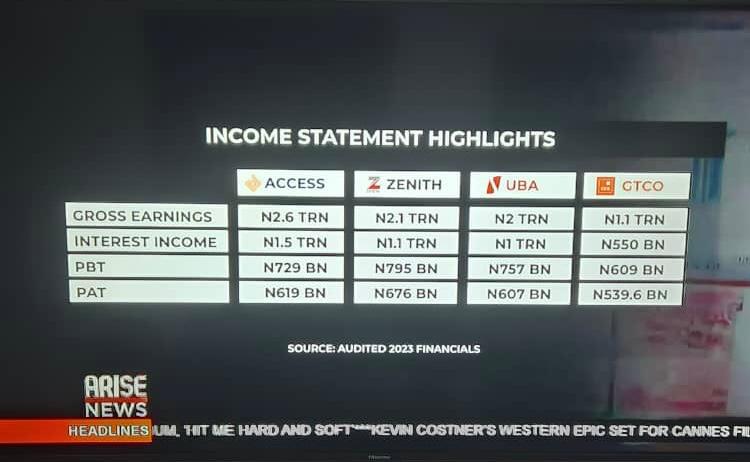
Zenith Bank’s extraordinary performance is underscored by its significant surge in interest income, which amounted to a staggering N1.1 trillion. However, the bank also made a substantial provision of about N409.6 billion, which reduced its Net Interest Income after provisioning to N326.5 billion. This provision may be linked to challenges in utilizing retained earnings for dividend payments, especially following the central bank’s decision to exclude retained earnings from its calculation of a bank’s share capital.

Additionally, Zenith Bank greatly benefited from foreign exchange rate dynamics, accruing an estimated N228.9 billion from forex revaluation gains. The bank also reported impressive trading gains of N566.9 billion. Interest income from treasury bills in 2023 skyrocketed to N179.0 billion, marking a remarkable 310.4% growth from the previous year.

Moreover, interest income from government and other bonds reached N187.4 billion in 2023. Notably, electronic product fees emerged as a major contributor to fees and commission income, amounting to N51.8 billion, representing a 13.3% increase from the previous year.

Zenith Bank’s capital adequacy ratio climbed to 22% in 2023, up from 20% in the preceding year, further solidifying its financial strength and stability in the market.

Guaranty Trust Holding Achieves Remarkable Growth in FY 2023

Also, Guaranty Trust Holding made significant strides in the fiscal year 2023, as evidenced by its impressive financial performance. The holding company reported a gross earnings figure of N1.187 trillion, representing a remarkable increase of 120.03% from the previous year’s earnings of N539.235 billion.

A cursory review of the financial statements reveals that interest income emerged as a substantial contributor, constituting 46.42% of the gross earnings. This underscores the importance of interest income in driving the company’s revenue generation efforts.

Furthermore, Guaranty Trust Holding reported a robust profit before tax of N609.308 billion for the year ended December 31, 2023. In line with its commitment to shareholder value, the company proposed a final dividend of N2.70 per share.

A notable shift in the composition of gross earnings occurred compared to the previous year, with foreign exchange (FX) revaluation gains playing a more significant role. In FY 2023, FX revaluation gains contributed 37.24% to the gross earnings, reflecting a notable increase from the previous year’s contribution of 10.74%.

Key highlights of FY 2023 compared to FY 2022 include:

Gross earnings: N1.187 trillion, +120.03% YoY
Interest Income: N550.755 billion, +69.25% YoY
Interest Expense: N114.059 billion, +72.56% YoY
Net interest income: N436.697 billion, +68.41% YoY
Loan impairment charges: N102.953 billion, +758.91% YoY
Net fees and commission income: N109.428 billion, +18.95% YoY
FX revaluation gain: N441.791 billion, +662.54% YoY
Other operating expenses: N122.429 billion, +31.56% YoY
Profit for the period: N539.655 billion, +218.99% YoY
Earnings per share: N19.05, +220.17% YoY
Loans and advances to customers: N2.480 trillion, +31.52% YoY
Cash and bank balances: N2.310 trillion, +42.47% YoY
Total Assets: N9.691 trillion, +50.33% YoY
Customers’ deposits: N7.411 trillion, +65.23% YoY
Share capital & share premium: N138.187 billion
Retained earnings: N580.024 billion, +169.96% YoY

The commentary accompanying the financial results indicates that interest income remains a major driver of gross earnings, primarily fueled by growth in loans and advances.

However, the company has strategically reduced its reliance on loans and advances by increasing exposure to investment in debt securities, thereby diversifying its risk profile and enhancing the stability of its balance sheet.

Furthermore, Guaranty Trust Holding’s conservative lending policy likely contributed to the moderation of its loan provision to N103 billion. This prudent approach underscores the company’s commitment to managing risk effectively while maximizing shareholder value.