DD
MM
YYYY

PAGES

DD
MM
YYYY

spot_img

PAGES

Home Blog Page 3120

RLBK’s Innovative Presale Outshines Established Meme Coins PEPE and BOME, Capturing Attention Amid Growing Utility Concerns

0

Rollblock (RLBK) has investors fascinated with its utility-focused approach. This is because of the growing utility concerns of top meme coins like Pepe Coin (PEPE) and Book of Meme (BOME). Rollblock is hosting an innovative presale and promises stability and substantial returns. Meanwhile, the aforementioned coins rely on a hype that is driven by the community.

The successful presale, raising over $1 million, highlights significant confidence in Rollblock’s potential. As a utility token, Rollblock offers a revenue-sharing model that ensures a steady income for token holders, setting it apart from the speculative nature and growing utility concerns of meme coins.

Pepe Coin (PEPE): A meme powerhouse

Pepe Coin ($PEPE) stormed into the crypto scene in April 2023, riding high on the fame of the Pepe the Frog meme. This meme coin didn’t waste any time making headlines, hitting a $1 billion market cap in just three weeks—something that took Dogecoin (DOGE) years to achieve. Such a rapid rise made PEPE one of the top meme coins on the market.

Despite the wild price swings, the number of $PEPE holders has been steadily increasing. The community’s support has been holding on longer than anyone could have expected. However way you look at it: PEPE has no inherent value or promise of financial returns.

Book of Meme (BOME): Massive potential about to be unlocked

Book of Meme (BOME) is aiming to shake up the meme coin space by merging memes with decentralized storage. Just after launch, BOME saw remarkable gains. But it’s worth mentioning it has also faced significant volatility since its launch in March 2024.

The project has ambitious plans for the future, including tools for meme creation and interactive games. These features are still in development, making BOME a speculative asset for now. It is definitely one of the top meme coins to watch though.

Rollblock (RBLK): Utility token with real potential

Top meme coins like PEPE and BOME dominate the headlines with their utility concerns. While utility token Rollblock (RLBK) is a breath of fresh air for those looking for something more solid. Unlike the top meme coins that rely on social media hype, Rollblock is all about real-world value. This new project is tailored for the online gambling market, combining centralized and decentralized gaming platforms to offer a smooth and engaging experience.

What makes Rollblock really stand out is its innovative revenue-sharing model. Token holders get a share of the casino’s daily profits, providing a steady income stream. This boosts the token’s value and ensures dependable returns.

Rollblock’s presale has been a hit, raising over $1.2 million in stage 4, with tokens priced at just $0.017 each. This shows investors are confident in Rollblock’s potential to deliver consistent returns and practical value, unlike the more speculative top meme coins.

A key concern with top meme coins like PEPE and BOME is their lack of utility. They thrive on community hype and social media buzz, but this can be fickle and unsustainable in the long run. Rollblock addresses these utility concerns by offering real-world applications.

Also it’s crazy easy to get started. With just an email or wallet connection, users can begin earning right away, avoiding the hassle of complicated KYC procedures that many other platforms require. This simplicity will boost user numbers and investor interest right off the bat.

People are looking for reliable investment opportunities, and Rollblock fits the bill perfectly. Utility token Rollblock is a smart choice for anyone looking to diversify their portfolio and secure reliable returns. While PEPE and BOME deal with the ups and downs of the meme coin market, Rollblock offers stability and strong growth potential.

Discover the Exciting Opportunities of the Rollblock (RBLK) Presale Today!

Website: https://presale.rollblock.io/
Socials: https://linktr.ee/rollblockcasino

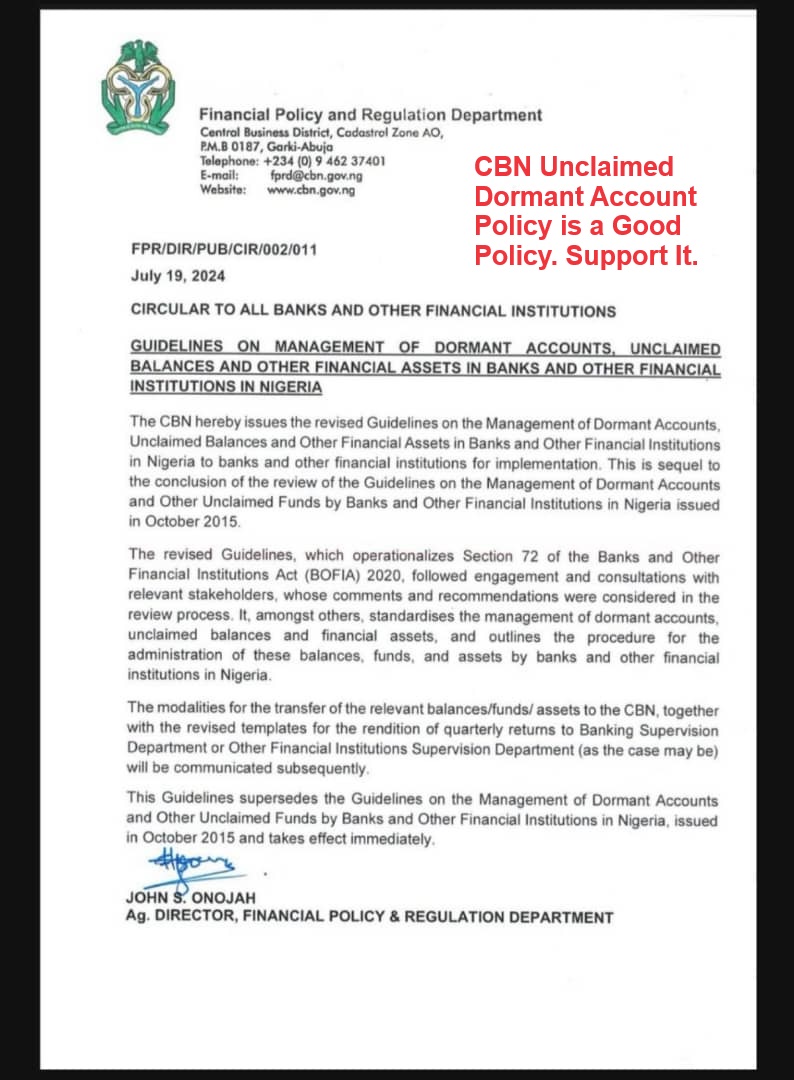
Central Bank of Nigeria (CBN) ‘s Unclaimed Dormant Account Policy is a Good Policy

1

The summary: “The Central Bank of Nigeria (CBN) has announced its plan to harvest funds from unclaimed balances, dividends and dormant accounts, potentially putting them in Nigerian Treasury Bills (NTBs) and other government securities. This announcement comes as part of the newly released “Guidelines on Management of Dormant Accounts, Unclaimed Balances, and Other Financial Assets in Banks and Other Financial Institutions in Nigeria,” which aims to standardize the handling of dormant accounts and unclaimed financial assets.”

Good People, this is a good policy. Nigerians should support the apex bank even though some people are distorting this policy, positing that the government wants to hijack people’s money. That is not true.

(The government noted that it would return the funds if later the owner comes up. Sure, I get the concern on the capacity of the Nigerian government to make the owner whole. Yet, that is not the real issue here as the risk there cannot be compared to the huge benefit of this policy. In other words, the benefits are clear and outweigh the risks.)

First, a dormant account of ten years is not being hijacked. Banks are smart, they will do everything possible to check on with the customer before the 10-year deadline, because no bank would like to lose deposits for the government. In other words, this policy will make banks check on with their customers at least from the 9th year! 

But where the bank is unable to get in contact with the customer in all forms, would you prefer the bank to keep that money or the government? Today, banks keep the funds, and most are stolen and illegally converted by bad actors in banks. In all developed economies, such funds are warehoused with the national treasury if the bank cannot establish contacts with the customer or next of kin or any beneficiary via the national ID.

In Nigeria, many people die and their spouses do not even know they have bank accounts. This will force banks to disclose owners of the accounts as they are being transferred to the federal government. The next level of advocacy is for the government to make that data public with original addresses/contacts used.

That man called “Eze-ego” (king of money) has died and within years, his family is begging for food,  because Eze-ego opened bank accounts no one knew about, and when he died, the banks did not reach the family on the pretense of “privacy” and wishes of our clients. Nonsense. With this policy, if the bank does not want the balance sent to the government, it must reach the family so that the account does not go dormant. 

I have been pushing for this policy and today, I commend Yemi Cardoso, the CBN Governor, for this policy. This is an A+ policy making. It must be put in the books in the National Assembly, not just a circular so that one crazy future Governor does not change it.

Remember #1 Rule for informally structured traders and business owners:  keep records of bank accounts, share certificates, etc and make sure spouses and kids know what you are doing since there is hardly any formal business structure!

My Response

On this being a hijacking: Imagine if you support your thesis with a reason. Someone is a thief here – either the bank or the government. The victim is that dead man who left N10m and the wife is begging for N100k to support the kids. Tell me why this is a theft when the government noted that it would return the funds in 10 days or so if the owner resurfaces. Dropping political correctness is nonsense because you are not bolder than Ndubuisi, but one thing is clear – I have no agenda, I make my calls irrespective of how anyone feels. Tell me why this is a “theft”

On lack of disclosure: At least under the whistleblower policy, someone is  open to jail time. Be the head responsible and hide it, some good persons can disclose and that is it. Making it a law means someone thinks before playing with the bank lords. That is the issue here – you do not beg them!

Nigeria Discloses plans to Harvest Unclaimed Balances, Dividends and Funds in Dormant Accounts

0

The Central Bank of Nigeria (CBN) has announced its plan to harvest funds from unclaimed balances, dividends and dormant accounts, potentially putting them in Nigerian Treasury Bills (NTBs) and other government securities.

This announcement comes as part of the newly released “Guidelines on Management of Dormant Accounts, Unclaimed Balances, and Other Financial Assets in Banks and Other Financial Institutions in Nigeria,” which aims to standardize the handling of dormant accounts and unclaimed financial assets.

The revised guidelines operationalize Section 72 of the Banks and Other Financial Institutions Act (BOFIA) 2020. These guidelines were formulated following extensive engagement and consultation with relevant stakeholders, whose feedback and recommendations were incorporated into the final document. The guidelines provide a structured approach for the administration of dormant accounts, unclaimed balances, and other financial assets, ensuring transparency and consistency in their management.

According to the guidelines, the CBN will establish a dedicated account called the “Unclaimed Balances Trust Fund (UBTF) Pool Account” to manage these funds. The guidelines mandate that both the principal and any accrued interest from these investments must be refunded to beneficiaries within ten working days of receiving a request.

The guideline document specifies:

  1. The CBN shall open and maintain the ‘UBTF Pool Account’.
    It shall maintain records of the beneficiaries of the unclaimed balances stored in the UBTF Pool Account.
  2. The funds will be invested in Nigerian Treasury Bills (NTBs) and other securities as approved by the ‘Unclaimed Balances Management Committee’.
  3. The principal and interest (if any) on the invested funds will be refunded to the beneficiaries within ten working days of receiving a request.
  4. If an extension of the timeline is necessary, a notice of extension, including reasons, shall be communicated to the requesting financial institution (FI).

Eligible Accounts and Exemptions

The guidelines define eligible accounts as those that have remained dormant for ten years or more, encompassing various account types such as current, savings, term deposits, domiciliary accounts, and prepaid card accounts. Other financial assets eligible under these guidelines include proceeds from unclaimed financial instruments, unclaimed salaries, wages, and bonuses.

However, certain accounts are exempt from these provisions. Accounts that are subject to litigation, under investigation by regulatory authorities or law enforcement agencies, or encumbered accounts (such as those with liens or used as collateral) are not included in the guidelines.

CBN’s Responsibilities

The CBN is charged with maintaining the UBTF Pool Account, overseeing the management committee, and ensuring adherence to the guidelines. The bank will publish the list of owners of unclaimed balances and the procedures for reclaiming these funds on its website.

Additionally, the CBN will issue an annual notice in three national daily newspapers, inviting the public to review details of outstanding unclaimed balances under its custody.

Financial institutions are mandated to monitor inactive accounts, notify customers of inactivity, and protect these accounts from unauthorized usage. They must also publish details of dormant accounts and transfer eligible unclaimed balances to the CBN’s UBTF Pool Account quarterly. Furthermore, financial institutions are required to maintain records and publish notices regarding the process of reclaiming unclaimed balances.

In instances where financial institutions are liquidated, the Nigeria Deposit Insurance Corporation (NDIC) will assume the role of the financial institution. The NDIC’s involvement ensures that unclaimed balances in liquidated institutions are managed and transferred in accordance with the guidelines, safeguarding the interests of the account owners and ensuring compliance with regulatory standards.

Account owners are also tasked with responsibilities. They must inform financial institutions of any changes in their personal information and submit applications for reclaiming their funds. Proper proof of ownership must be provided, and the procedures outlined in the guidelines must be followed.

These measures aim to enhance transparency and ensure that unclaimed balances are adequately managed and returned to their rightful owners.

In the new guidelines, the CBN stated that the modalities for the transfer of the relevant balances, funds, and assets to the CBN, along with the revised templates for the quarterly returns to the Banking Supervision Department or Other Financial Institutions Supervision Department (as applicable), will be communicated subsequently.

Why the CrowdStrike Outage is a Non Talking Point for Decentralization, Bitcoin, FIAT and Web3

0

I think there are a lot of protagonists and antagonists floating around in online platforms with some fairly rigid views.

On the one hand, the cryptosceptics and blockchain skeptics try to paint the decentralized landscape as an environment top heavy with criminal gangs involved in illicit trade, and everything that is an undercurrent to modern day societal ills, which is simply not true.

On the other hand, many advocates try to paint a picture of alternative structures that can endure beyond everything else, though, on its own, this is insufficient. It is continuity of service that is most important.

From the dawn of human civilization, nothing held value simply by being. Human creation brought value by changing something to bring use case – being able to start fires, fashioning tools, inventing the wheel.

It isn’t enough that it simply ‘is’ it’s about what can it do for you?

Blockchain architecture doesn’t provide a UI (user interface) and any coin feature it may have doesn’t directly provide a means to transfer it. Stored value is a perception based on it’s capacity to exchange.

Trades, transactions, value movement was suspended if it depended on CrowdStrike, a fairly ubiquitously used provider. It affected some exchanges and didn’t affect others. Some people globally lost access to finances, whether they were in a bank or a crypto exchange. It was an anomaly in upgrade software, not a hack, or system failure.

If a person or business had CrowdStrike  somewhere in the UX (user experience) route to their ‘stored value’, you would be unable to deal with them. If your own ‘stored value’ was present in the hidden mechanisms that allow you to trade, you would be completely cut off.

It’s important to understand ‘value’ wasn’t ‘lost’ In some cases it was put ‘beyond use’, until CrowdStrike problems were resolved. Whether FIAT currency, cryptocurrency or something else, ALL value instruments were affected, some a bit more than others, some ‘geo’ locations more than others, depending on where CrowdStrike had been successful at securing businesses. Data intense institutions unconnected to value instrument services, such as some hospitals and airports were also impacted.

My keys were always safe in my Ledger hardware wallet, but so was the 50 Euro in my jacket pocket.

I’ve seen a lot of ‘strange’ posts, coming from cryptocritics and crypto advocates alike. It somehow reminds me of some folk bemoaning Nigeria and hailing somewhere else as better. I don’t grudge anybody’s opinion, but for me to listen to that, I have to see not only is it information led, but experience led, and execution led.

I see people that were born, schooled, worked, and received health care in Nigeria. They can relate to these things directly. What can they relate about this other place? Nothing but hearsay. Should they try it? This is a different question. But to argue merits between two choices without an equally developed grasp of fundamentals is just rhetoric.

One of the biggest understanding deficits is sometimes among a subset of the Blockchain/Web 3 spectrum commonly known as ‘Bitcoin Maxis’. Many prioritize Bitcoin to the exclusion of other cryptocurrencies or Blockchain use cases. This is a big weakness when squaring off against the cryptocritic masses.

Often, the cryptocritics are actually more aware of the wider Blockchain and Web 3 spectrum than some skin deep Bitcoin Maxis are. Bitcoin Maxis may become defensive and unilaterally dismissive of everything else, rather than having a diverse grasp of the spectrum, giving cryptocritics robust informed responses. This makes them seem like lightweights to cryptocrytics, who, perhaps see the whole spectrum as a Bitcoin Maxis ‘turf’.

While an Ethereum fan may not have used Polygon, or be able to offer a technical critique of it, they will at a minimum, know what it is. Some Bitcoin Maxis can’t even provide nuance to explain the descriptive gaps in ‘PoW’ as a ‘consensus’ and the significance of ‘Sybil Defence Mechanism’, and they might not be able to tell you about BRC 69 or Ordinals. So we have these challenges.

So whether it is critics or advocates who posted, they have completely and absolutely missed the relevance of DECENTRALIZATION.

The whole point is autonomy over stored value to fuel capacity for freedom, personal sovereignty, rights of the individual, and mitigation against mass control.

An outage doesn’t prove any side is right. With services resumed, whether you are a Bitcoin Maxi, an 0x fan, a greenback lover, or part of the CBDC brigade, those same arguments will rage on.

The outage isn’t a Eureka moment to teach us, we don’t have full end-to-end DECENTRALIZATION. We know this already. It’s work in progress. While the advent of Bitcoin in 2008 was a leap, other things like the Printing Press, Democracy and The Internet brought decentralization catalysis with them.

Centralizing actors always come in to thwart societal evolutions in order to exercise some kind of central control and corner income.

Today it continues, with the same type of actors deflecting the concept of Web3, to product label, using a ruse of a Web 2 that never was.

This is also why 9ja Cosmos began carving out its tenets – the Rigveda 2.

Rigveda 2 – 1 : Web 3 is as an ‘End-to-End Decentralized UX’ [user experience]

also: 

Rigveda 2 – 2 : ‘There isn’t, wasn’t and won’t be a Web2’

Rigveda 2- 3 : ‘Whether a token in Web3 is an ‘NFT’, does not depend on the asset it has title to. It depends on the token protocol leveraged to create it.’

9ja Cosmos is here…

Get your .9jacom and .9javerse Web 3 domains  for $4 at:

.9jacom Domains

.9javerse Domains

.det0x Domains

Preview our Sino Amazon/Sinosignia releases (Ente)

Preview our Sino Amazon/Sinosignia releases (Pinterest)

Visit 9ja Cosmos LinkedIn Page

Visit 9ja Cosmos Website

Equity Investing: Cap Table, Valuation, MFN and SAFE – Ndubuisi Ekekwe

0

Join us at Tekedia Mini-MBA today as we discuss equity investing, focusing on cap table, company valuation, MFN (most favoured nation) and SAFE (Simple Agreement for Future Equity).

After this session and extending the lecture by our Faculty on Thursday, you can confidently create a model on the worth of your business, and  from that build a cap table, and allocate the company shares, considering monetary investments, efforts with co-founders, etc.

We’re the best school. Zoom link in the Board.