DD
MM
YYYY

PAGES

DD
MM
YYYY

spot_img

PAGES

Home Blog Page 3170

Altcoin Season At Risk: Why Spot Ethereum ETFs May Not Trigger A Crypto Market Rally

0

The anticipated altcoin season might be at risk as a crypto analyst gives reasons why Spot Ethereum ETFs may not trigger a crypto market rally in this cycle. While the prediction casts a bearish shadow over the market, innovative ETF-focused platforms like ETFSwap (ETFS) are set to gain significantly from the introduction of Spot Ethereum ETFs. This launch is anticipated to boost the widespread adoption of the innovative crypto project and its native token, ETFS, in the altcoin season. 

ETFSwap (ETFS) Poised For Price Surge Post Spot Ethereum ETFs

ETFSwap (ETFS) has been gaining momentum in the crypto space, driven by the surging demand for both Spot Ethereum ETFs and the anticipated altcoin season. This platform is a decentralized ETF exchange, which allows users to trade tokenized ETFs by swapping cryptocurrencies.

By collaborating with MiCa-compliant regulated investment banks, ETFSwap (ETFS) can incorporate blockchain technology to facilitate security and streamline ETF and crypto trading. This platform boasts numerous trading features and provides advanced investment strategies for users to boost their trading performance and potentially maximize their returns.

Despite predictions suggesting that Spot Ethereum ETFs may not trigger a crypto market rally, ETFSwap (ETFS, which is wholly focused on tokenized institutional ETFs is well-positioned for a massive rally. This platform grants users access to perpetual trading options, offering outstanding liquidity and freedom to close and open all trading positions at any time.

By building its platform on blockchain technology, ETFSwap (ETFS) can effectively safeguard users’ assets, privacy and anonymity, utilizing cutting-edge security protocols to prevent cyber attacks and other threats. This platform has integrated Artificial Intelligence (AI) powered ETF trackers and screeners to provide users with the highest level of ETF recommendations based on historical data and algorithmic analysis.

With Solana and Ripple’s ETFs set to launch in the crypto market, ETFSwap (STFS) is also poised to capitalize on the hype to propel the price of its native token, ETFS to new heights. Given the massive potential of the crypto project, numerous analysts have predicted that ETFS could surge as high as 108X this bull cycle.

With ETFSwap (ETFS) investors can enjoy borderless and automated trading, having the opportunity to seamlessly trade ETFs from various parts of the world. Its ERC-20 native token, ETFS, also offers a high yield percentage when traders stake their tokens.

These tokens are available in ETFSwap’s ongoing presale, and investors are quickly snapping up substantial amounts of ETFS tokens at a very low price. With over 250 million tokens already being sold and over $2 million raised, the presale is swiftly reaching its targets and expected to end soon.

Investors are urged to buy ETFS tokens at their present low price of $0.01831 to increase their chances of maximizing their profits when the value of each token rises to $0.03846 ahead of the altcoin season.

Why Ethereum Spot ETFs May Not Trigger A Market Rally

In a recent blog post, Amberdata’s director of derivatives, Greg Magadini has expressed skepticism that Ethereum’srelative volatility over Bitcoin will persist. He has raised questions about whether the launch of Spot Ethereum ETFs trading would lead to a sustained and substantial increase in Ethereum’s price and volatility.

Amberdata’s report indicates that Spot Ethereum ETFs may not trigger a significant market rally, potentially compromising the anticipated altcoin season. Magadini also disclosed that the answer to his question, “Does the ETH ETF truly react aggressively to the start of an ETF trading?” will be determined once Spot Ethereum ETFs begin to see inflows and substantial volume in the market.

Conclusion On Altcoin Season

Despite new reports disclosing possibilities of Spot Ethereum ETFs failing to trigger a crypto market rally, ETFSwap (ETFS) is still poised for significant growth following the launch of these digital assets. Investors can easily swap their cryptocurrencies for tokenized ETFs ahead of the projected altcoin season to maximize their profits and mitigate risks. With the market’s growing demand and hype for Spot Ethereum ETFs, ETFSwap’s native token is set to skyrocket to new all-time highs, and investors can take advantage of the excitement to accumulate more ETFS tokens during ETFSwap’songoing presale.


For more information about the ETFS Presale:

 Visit ETFSwap Presale

Join The ETFSwap Community

The Israel-Hamas Conflict might Spill into Lebanon

0

The complexities of the Israel-Hamas conflict are profound and have far-reaching implications that extend beyond the immediate regions involved. The potential for the conflict to spill over into neighboring countries, such as Lebanon, is a concern that international observers and regional stakeholders are closely monitoring.

The Israel-Hamas conflict, which has seen numerous escalations over the years, is deeply rooted in a long history of political, territorial, and ideological disputes. The most recent developments in the conflict have seen a series of military operations and exchanges of fire, which have had significant humanitarian impacts on the civilian populations involved.

The involvement of Lebanon in this conflict would not only exacerbate the already tense situation but could also lead to a broader regional conflict, drawing in various actors and complicating efforts for a peaceful resolution. Lebanon, which has its own complex political and social challenges, including a fragile economy and a diverse demographic composition, could face severe consequences if the conflict were to extend into its territory.

The main issues at the heart of the conflict include:

Territorial Disputes: The question of land rights and sovereignty in the region, particularly in Gaza and the West Bank, has been a central point of contention. The borders of Israel and a future Palestinian state remain unresolved, with both sides laying claim to territories.

Security Concerns: Israel’s security concerns include the threat of rocket attacks and other forms of violence from Hamas and other militant groups. Conversely, Palestinians in Gaza face severe living conditions, partly due to blockades imposed by Israel and Egypt, which they argue are for security reasons.

Political Recognition: Hamas, which governs the Gaza Strip, does not recognize the state of Israel and calls for its destruction. Israel, along with many other countries, considers Hamas a terrorist organization. This mutual non-recognition creates a significant barrier to peace negotiations.

Humanitarian Issues: The conflict has led to a humanitarian crisis in Gaza, with high casualty rates, destruction of infrastructure, and a dire economic situation exacerbated by the blockade.

Settlements and Occupation: The expansion of Israeli settlements in the West Bank and the ongoing occupation are seen by Palestinians and many international observers as a violation of international law and an obstacle to peace.

Political Instability: The internal political divisions within the Palestinian territories, particularly between Hamas in Gaza and the Palestinian Authority in the West Bank, complicate efforts to reach a unified stance in negotiations with Israel.

The role of regional and international players, including the United States, Iran, and others, influences the dynamics of the conflict, often adding layers of geopolitical complexity. The international community, including the United Nations and various diplomatic entities, has been actively involved in trying to mediate and de-escalate tensions in the region. The pursuit of a sustainable peace agreement that addresses the core issues at the heart of the conflict is seen as the only viable solution to prevent further loss of life and stability in the region.

As the situation continues to evolve, it is crucial for all parties involved to consider the ramifications of their actions and to engage in dialogue that prioritizes the safety and well-being of civilians. The path to peace is undoubtedly challenging, but it is the only path that can lead to a future where all can coexist without the shadow of war looming over them. The hope is that through persistent diplomatic efforts and a commitment to understanding, a resolution that ensures the security and dignity of all people affected by this conflict can be achieved.

CBN Authorizes IMTOs to Sell Forex on Official Market to Boost Remittance Flows

0

In a significant policy shift aimed at bolstering foreign exchange liquidity and enhancing the formal channels of remittance inflows, the Central Bank of Nigeria (CBN) has granted eligible International Money Transfer Operators (IMTOs) the authority to sell foreign exchange (FX) in Nigeria’s official market.

This initiative, effective immediately, is part of the CBN’s efforts to ensure the efficient operation of the foreign exchange markets and improve the remittance process.

The latest directive, as outlined in a circular signed by Dr. W. J. Kanya, CBN’s Acting Director of the Trade & Exchange Department, introduces several measures designed to facilitate access to naira liquidity for diaspora remittances.

“As part of CBN’s commitment to the smooth functioning of the foreign exchange markets and enabling greater remittance flows through formal channels, the Bank has implemented measures that will enable eligible International Money Transfer Operators (IMTOS) access Naira (NGN) liquidity through the CBN,” the circular stated.

Under this new framework, IMTOs can directly access the CBN window or work through their Authorized Dealer Banks (ADBs) to carry out forex transactions. This policy intervention arrives at a critical juncture, with the official FX market struggling with liquidity issues.

Over the past month, the value of FX turnover on the NAFEM window has fluctuated between $83 million and $390 million, highlighting the pressing need for increased liquidity.

Operational Guidelines for IMTOs and ADBs

The CBN has provided clear guidelines to ensure that IMTOs and ADBs adhere to the new measures:

  • Same-Day Settlement: Transactions executed and confirmed before noon on any trading day will qualify for same-day settlement, expediting liquidity for remittance beneficiaries.
  • Transparent Pricing: The pricing for transactions with the CBN will be based on prevailing NAFEM rates, ensuring transparency and alignment with market standards.
  • Daily Regulatory Returns: All participants are required to submit daily regulatory returns to the CBN, detailing the sources of funds to maintain accountability and transparency.
  • Partner Bank Confirmation: IMTOs must confirm their partner banks and provide standard settlement instructions to ensure the smooth implementation of these measures.

Background and Recent Policy Changes

This initiative is part of a broader strategy by the CBN to enhance the efficiency of remittance inflows. In January 2024, the CBN removed the cap on exchange rates quoted by IMTOs, which previously had to be within a -2.5% to +2.5% range around the previous day’s closing rate of the Nigerian Foreign Exchange Market.

Further, the CBN revised its guidelines for IMTO operations, significantly raising the application fee for an IMTO license from N500,000 in 2014 to N10 million—a 1,900% increase. The CBN also established a minimum operating capital requirement for IMTOs at $1 million for foreign entities and an equivalent amount for local IMTOs.

Additionally, IMTOs were previously barred from purchasing foreign exchange from the domestic market to fulfill their obligations. This new circular effectively lifts that ban, allowing IMTOs to trade on the official market.

Collaborative Task Force

The CBN’s agreement with IMTOs to establish a Collaborative Task Force aimed at doubling remittance inflows into Nigeria is another key component of its strategy. This task force, reporting directly to CBN Governor Yemi Cardoso, is expected to play a pivotal role in achieving the bank’s remittance objectives. Last month, the CBN granted 14 new Approval-in-Principle (AIP) licenses to IMTOs, signaling the expanding landscape of money transfer operations in Nigeria.

Allowing IMTOs to sell foreign exchange on the official window is anticipated to significantly impact the official FX market. By enabling IMTOs to access naira liquidity directly through the CBN or via ADBs, the supply of foreign exchange in the official market is expected to increase. This, in turn, will reduce pressure on the parallel market and help stabilize exchange rates.

Despite the CBN’s proactive measures to enhance foreign exchange liquidity and stabilize the market, recent efforts to contain forex volatility have largely fallen short. The naira has continued to depreciate, trading around N1500/$1.

This underscores the challenges the CBN faces in its quest to stabilize the currency and the broader economic environment. The introduction of IMTOs into the official forex market is believed to be a bold step, but whether it will significantly change Nigeria’s FX market trajectory remains to be seen.

Potential U.S. Ban on TikTok Threatens Oracle’s Business

0

Oracle Corporation, a major player in the software and cloud infrastructure market, has acknowledged in its annual report that a potential U.S. ban on TikTok could significantly impact its business.

This disclosure comes amidst increasing regulatory pressure on TikTok’s Chinese parent company, ByteDance, due to national security concerns over user data.

In April, President Joe Biden signed a bill demanding that ByteDance sell TikTok within nine months, with the possibility of a one-year extension, to avoid a U.S. ban. The ownership structure of TikTok has been a contentious issue in the United States, fueled by fears that user data could be accessed by the Chinese government.

Oracle has been providing cloud infrastructure services to TikTok, which boasts over 170 million users in the U.S. These users rely on the app for various purposes, including business, news, entertainment, and social connection.

In its annual report for the fiscal year ended May 31, Oracle stated, “If we are unable to provide those services to TikTok, and if we cannot redeploy that capacity in a timely manner, our revenues and profits would be adversely impacted.”

Concerns over TikTok’s ownership and data security are not new. In 2020, then-President Donald Trump pushed for the sale or divestiture of TikTok’s U.S. assets, which led to negotiations with Microsoft and ultimately resulted in Oracle being selected as a key cloud services provider.

ByteDance’s proposal to the U.S. Treasury Department included Oracle’s involvement to ensure TikTok’s continued operation in the U.S. under the initiative known as Project Texas. This initiative aimed to safeguard user data by housing TikTok’s U.S. operations on Oracle’s cloud infrastructure within the country. Additionally, Oracle was tasked with compiling the app and delivering it to third-party app stores.

Oracle CEO Safra Catz highlighted the positive relationship with TikTok in a 2022 conference call with analysts, saying, “The one thing I can tell you is we have an excellent relationship with the folks at TikTok.”

Oracle has not disclosed specific financial details regarding its relationship with TikTok. However, analysts from Evercore estimated in April that TikTok could be generating annual U.S. sales of $16 billion, potentially spending 3% to 5% of its revenue on cloud infrastructure. This translates to an estimated $480 million to $800 million in revenue for Oracle.

For the fiscal year, Oracle’s cloud infrastructure revenue totaled $6.9 billion, indicating that the potential loss of TikTok as a client would be a substantial blow.

Advocacy and Opposition to the Ban

The potential ban on TikTok has sparked significant opposition from both institutions and individual users. Over 170 million Americans use TikTok not just for entertainment but as a crucial tool for business and information dissemination. Small business owners, influencers, educators, and journalists rely on the platform to reach audiences and generate income. Some users have sued the government while others have mobilized to advocate against the ban, highlighting TikTok’s role in fostering economic opportunities and community engagement.

Advocacy efforts include petitions, social media campaigns, and lobbying efforts aimed at convincing lawmakers to allow TikTok to continue operating in the U.S. Critics of the ban argue that it infringes on free speech and disrupts the livelihoods of millions of Americans.

Elon Musk, the owner of microblogging social media platform X, formerly Twitter, said in April that the move is “contrary to freedom of speech and expression,” adding he is against the proposed TikTok controls “even though such a ban may benefit the X platform.”

TikTok’s Efforts to Remain Operational in the US

In response to the mounting pressure, TikTok has made several efforts to address security concerns and remain operational in the U.S. The company has invested in Project Texas, an initiative designed to keep TikTok services for U.S. users running on Oracle’s cloud infrastructure located inside the country. TikTok said Oracle would also be responsible for compiling the app and delivering it to third-party app stores, enhancing data security.

Furthermore, TikTok said it has been transparent about its data handling practices and has implemented measures to prevent unauthorized access to user data. Recently, the company said it moved to create an independent algorithm for its US users. Despite these efforts, the U.S. government remains firm on its stance, with bipartisan legislation targeting TikTok and President Biden’s signing of the bill mandating its sale.

The U.S. government has taken substantial steps toward potentially banning TikTok. The new legislation requires ByteDance to sell TikTok within a specified timeframe or face a ban. In addition to legislative actions, there have been ongoing investigations and hearings scrutinizing TikTok’s data practices and its ties to China.

TikTok has filed a lawsuit arguing that the law mandating its sale violates First Amendment free speech protections. The legal battle is expected to be prolonged, with significant implications for both TikTok and Oracle.

Africa’s AI At This Time Is Electricity

0

I shared an opinion on a national AI roadmap, and asked everyone in the committee: how do you plan to power this AI roadmap in [that country]?

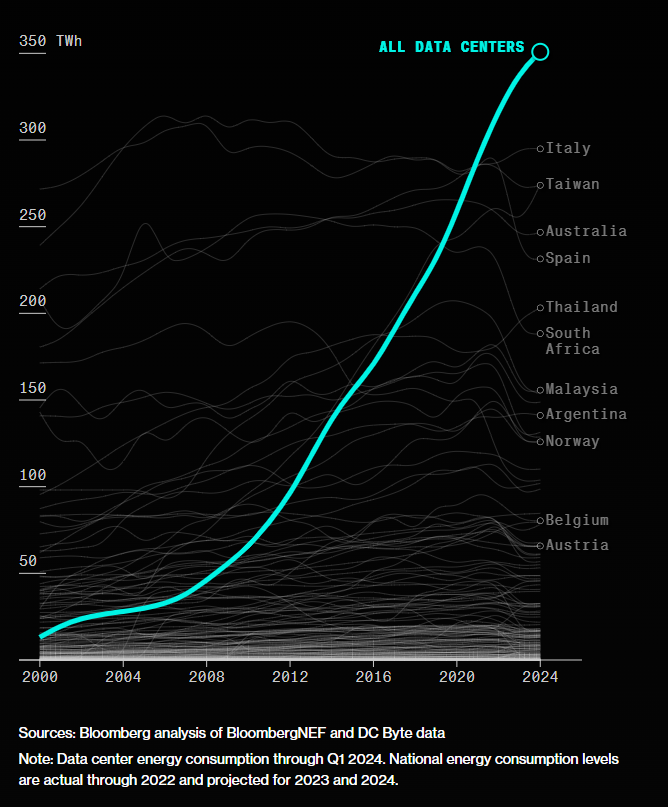
Good People, the challenge Africa has on AI is not really the technical component. The real issue is electricity. If you do not have electricity to power an electric bulb in Ovim, how do you think you will have energy to power that AI future?

There are things which cannot be leapfrogged and one of those is electricity.  Indeed, there is no way we can touch that AI future UNLESS we can do the basic things. Electricity is a component of those “basic things”.

So, as governments launch AI roadmaps in Africa, do not forget to challenge them, and remind them that our AI today is electricity. If we do not understand that, it does mean that we will be scaling AI consumerism, instead of AI production.

Image credit: Barchart – Global Data Centers now consume more electricity than most countries