DD
MM
YYYY

PAGES

DD
MM
YYYY

spot_img

PAGES

Home Blog Page 318

a16z’s $50M Investment in Jito Boosts Solana’s Staking Infrastructure

0

Andreessen Horowitz’s crypto arm a16z Crypto announced a $50 million strategic investment in Jito, a leading liquid staking and MEV Maximal Extractable Value protocol on the Solana blockchain.

This marks a16z’s largest single commitment to Jito to date and underscores growing institutional interest in Solana’s high-throughput ecosystem amid a recovering crypto market.

The investment was made via a private token sale, granting a16z an undisclosed allocation of Jito’s native JTO tokens at a discounted rate. It values Jito at approximately $800 million post-investment, based on circulating supply metrics.

Funds will support Jito’s expansion of open-source infrastructure, validator technology, developer tools, and liquid staking solutions. This includes enhancing the recently launched Block Assembly Marketplace (BAM), which optimizes transaction ordering and execution on Solana for better network efficiency.

Ali Yahya, General Partner at a16z Crypto: “Jito is catalyzing growth for the entire Solana ecosystem through its pace of delivery and BAM’s measurable impact on network efficiency. We’re excited to back Jito and its stellar team’s efforts to accelerate the adoption of decentralized finance.”

Brian Smith, Executive Director at the Jito Foundation: The deal has an “exceptionally long time horizon” and will help position Solana as “the home for internet capital markets well into the next decade.”

Jito is a core infrastructure provider on Solana, founded to improve validator performance and transaction processing. Its flagship products include: JitoSOL: A liquid staking token allowing users to stake SOL for rewards while maintaining liquidity over $3.2 billion in market cap as of the announcement.

MEV Tools: Including a specialized validator client and BAM, which reduces spam, enhances fairness, and boosts overall network speed. Jito powers about $2.8 billion in liquid staking activity on Solana, making it a pivotal player in the chain’s DeFi and staking economy.

a16z has been an early backer of Solana since 2017. This follows similar 2025 token-based deals like $55M in LayerZero and $70M in EigenLayer, signaling a strategy of long-term, locked commitments in blockchain infrastructure.

JTO token price surged ~8% intraday to $1.18 before settling around $1.14, reflecting optimism. Solana’s liquid staking TVL has grown amid rising demand for efficient staking solutions.

Jito has been active in U.S. discussions on liquid staking, including SEC guidance that could open doors for regulated products like staking yield exposure for traditional investors. The investment highlights Solana’s resilience post-FTX, with institutional inflows targeting protocols that enhance scalability and security.

Jito’s Block Assembly Marketplace (BAM)

Jito’s Block Assembly Marketplace (BAM) is a key component of the Jito protocol on the Solana blockchain, designed to optimize transaction processing, enhance network efficiency, and fairly distribute Maximal Extractable Value (MEV) opportunities.

BAM is an open-source infrastructure tool within Jito’s ecosystem that facilitates the creation and ordering of transaction blocks on Solana. It addresses inefficiencies in transaction processing by allowing validators, searchers, and other network participants to collaborate in a decentralized marketplace.

The goal is to improve Solana’s performance by reducing spam, prioritizing high-value transactions, and ensuring fairer MEV distribution.

Searchers entities like arbitrage bots or traders identify profitable MEV opportunities, such as arbitrage or liquidations, and bundle transactions into optimized sequences. These bundles are submitted to BAM, which acts as a marketplace where validators can select them for inclusion in the next block.

Validators running Jito’s specialized client software access BAM to choose transaction bundles based on predefined criteria (e.g., highest fees or network efficiency).

Unlike traditional blockchains where miners/validators unilaterally decide transaction order, BAM enables a competitive and transparent process.

MEV refers to the profit validators or searchers can extract by reordering, including, or excluding transactions in a block (e.g., through arbitrage or front-running).

BAM structures this process to minimize harmful MEV practices like front-running and shares profits more equitably among validators, searchers, and users via mechanisms like fee redistribution.

BAM reduces network spam by filtering low-value or redundant transactions, ensuring Solana’s high-throughput blockchain remains fast and cost-effective.

BAM is accessible to all Solana validators using Jito’s client, promoting transparency and community-driven development. By prioritizing high-value transactions, BAM mitigates network congestion caused by low-priority or malicious spam transactions.

Unlike traditional MEV extraction, where validators capture most profits, BAM redistributes a portion of MEV revenue to stakers and users via JitoSOL staking rewards.

Solana is known for its high transaction throughput up to 65,000 TPS. BAM ensures this capacity is used efficiently, preventing bottlenecks during high-demand periods.

By reducing spam and optimizing transaction ordering, BAM supports smoother operations for Solana-based DeFi applications, such as decentralized exchanges and lending platforms.

Since BAM’s launch, Solana has reported reduced transaction failures and lower latency during peak usage, with BAM handling a significant portion of Solana’s $2.8B liquid staking activity.

BAM’s infrastructure could pave the way for regulated staking products, as Jito engages with U.S. regulators on liquid staking frameworks.

BAM operates alongside Jito’s validator client, which over 30% of Solana validators use. It leverages Solana’s Proof-of-Stake consensus to ensure secure and efficient block production.

Developers can access BAM’s open-source code via Jito’s GitHub for custom integrations. This move positions Jito—and Solana—for deeper DeFi integration, potentially driving more adoption in high-speed blockchain applications.

Robinhood Lists ASTER, XPL and VIRTUAL On Spot, as Jupiter Announces Major Changes for the JUP Token

0

Robinhood announced the listing of three new cryptocurrencies on its U.S. platform on October 16, 2025: Aster (ASTER), Plasma (XPL), and Virtuals Protocol (VIRTUAL).

This expansion aims to diversify Robinhood’s crypto offerings amid growing retail demand for DeFi, Layer 1 blockchains, and AI-integrated tokens.

ASTER; Native token of a Binance-backed decentralized exchange (DEX) on BNB Chain, specializing in perpetual futures trading with high-leverage options. Endorsed by Binance co-founder CZ.

Recently hit a $3.9B market cap peak; now trading around $1.25 down ~10% in the last 24 hours post-listing due to market volatility.

Plasma XPL; Token for a Bitcoin-secured, EVM-compatible Layer 1 blockchain focused on stablecoins and real-world assets (RWAs), backed by Tether. Enables on-chain settlement of US Treasuries and yield distribution.

Attracted $6B in TVL shortly after September launch; briefly surged above $0.50 post-listing but retraced to ~$0.44 amid Bitcoin dipping below $110K.

Virtuals Protocol VIRTUAL; Native token powering an AI-agent infrastructure network, allowing deployment of autonomous digital agents for smart contracts, DeFi management, and tokenized economies.

Part of the rising AI-DeFi trend; saw initial post-listing buzz but faced broader market pullback. The listings sparked brief price jumps like ASTER up 5% and XPL up 7% initially, but volatility dragged gains back as the broader crypto market cooled.

These additions position Robinhood to compete more aggressively with platforms like Coinbase, especially for sophisticated traders interested in emerging ecosystems.

Listing on Robinhood, a platform with millions of retail users, introduces these tokens to a mainstream audience, potentially driving adoption and trading volume.

Robinhood’s user-friendly interface and zero-commission trading make it easier for new investors to access these emerging tokens, especially for those less familiar with decentralized exchanges.

Increased retail participation could enhance liquidity for ASTER, XPL, and VIRTUAL, stabilizing price volatility over time. The listings triggered initial price surges but subsequent pullbacks reflect profit-taking and broader market corrections as Bitcoin dipped below $110K.

Retail-driven platforms like Robinhood often amplify speculative trading, which could lead to price swings, especially for newer tokens like XPL and VIRTUAL.

If these projects deliver on their fundamentals like Aster’s DEX capabilities, Plasma’s RWA focus, Virtual’s AI-agent infrastructure, listings could support sustained price growth.

By adding innovative tokens tied to DeFi, Layer 1 blockchains, and AI, Robinhood strengthens its position against competitors like Coinbase and Kraken, appealing to traders seeking exposure to trending sectors.

The inclusion of ASTER (DeFi), XPL (stablecoin/RWA), and VIRTUAL (AI) aligns with growing retail interest in diverse crypto use cases, potentially increasing platform engagement.

Expanding crypto offerings may attract further regulatory attention, especially as U.S. authorities tighten oversight of retail crypto platforms.

Aster (ASTER) backed by Binance and CZ, the listing validates Aster’s role in the DeFi space, potentially accelerating adoption of its high-leverage perpetual futures trading platform.

Plasma (XPL) as a Tether-backed Layer 1 focused on tokenized real-world assets, the listing could draw institutional and retail interest in stablecoin and RWA markets, boosting its $6B TVL.

Virtuals Protocol (VIRTUAL) exposure on Robinhood could catalyze interest in AI-driven DeFi applications, positioning VIRTUAL as a leader in the emerging AI-agent economy.

The listings reflect growing retail appetite for DeFi (Aster, Virtual) and AI-integrated blockchain solutions (Virtual), signaling a shift toward more sophisticated crypto use cases.

Plasma’s inclusion highlights the rising prominence of tokenized real-world assets and stablecoin ecosystems, potentially bridging traditional finance and crypto.

Newer tokens like XPL and VIRTUAL are prone to sharp price swings, especially with speculative retail trading on Robinhood. U.S. regulations could impact token availability or trading conditions, particularly for projects tied to stablecoins (XPL) or DeFi (ASTER, VIRTUAL).

Robinhood’s listing of ASTER, XPL, and VIRTUAL enhances retail access to innovative crypto projects, potentially driving adoption and liquidity while positioning Robinhood as a competitive player in the crypto space.

Jupiter Announces Major Changes for the JUP Token

Jupiter, the leading decentralized exchange (DEX) aggregator on Solana, made headlines earlier in 2025 with transformative updates to its native governance token, JUP.

These changes, unveiled during the platform’s inaugural “Catstanbul 2025” event in January, aimed to enhance token scarcity, sustainability, and long-term value. Jupiter’s pseudonymous founder, “Meow,” revealed plans to burn 3 billion JUP tokens—valued at approximately $3.6 billion at the time.

This symbolic act, marked by the destruction of a large metal cat sculpture, reduces the total supply from 10 billion to around 7 billion tokens, addressing concerns over high fully diluted valuation (FDV) and emissions. The burn was part of a broader tokenomics overhaul, including a voluntary 30% cut to team allocations and emissions.

Starting in late January 2025, Jupiter allocated 50% of its protocol fees to repurchase JUP tokens from the market. These buybacks are locked for long-term holding initially three years, with the remaining 50% reinvested into ecosystem growth, strategy, and operations.

A dedicated dashboard was launched in February for real-time transparency on repurchases and locks. The announcements coincided with other expansions, including the beta launch of “Jupnet” an omnichain network, a $10 million AI fund with Eliza Labs, acquisition of a majority stake in meme coin launchpad Moonshot, and integration of portfolio tracker SonarWatch.

These position Jupiter as a multi-chain liquidity hub amid competition from projects like LayerZero. The immediate impact was a 40% surge in JUP’s price, from $0.90 to $1.27, though it later stabilized around $1.06. By mid-2025, further unlocks (e.g., 53.47 million tokens in July, worth $32 million) introduced some supply pressure, but the reforms have bolstered community confidence.

Analysts view these as bullish signals for JUP’s role in Solana’s DeFi growth, with price predictions for end-2025 averaging $1.03 ranging from $0.44 to $1.40.

Ongoing buybacks/locks to curb inflation. Trimmed by ~30% via burn , +40% spike; +60% YTD from buybacks. These updates reflect Jupiter’s shift toward deflationary mechanics and ecosystem dominance, though risks like token unlocks and governance pauses (e.g., DAO votes halted until 2026 due to trust issues) persist.

Ethereum Ranks as the #1 Ecosystem for New Developers in 2025

Fresh data from Electric Capital, analyzed by the Ethereum Foundation (EF), confirms Ethereum’s enduring appeal to builders. Through September 2025, the ecosystem attracted 16,181 new developers—the highest of any blockchain—bringing its total active contributors to 31,869.

This includes activity across Layer 1 and Layer 2 rollups— Polygon, Optimism, with deduplication to avoid double-counting multi-project devs. Ethereum’s numbers dwarf competitors, with Solana second at 11,534 new devs (17,708 active) and Bitcoin third at 7,494 new (11,036 active).

Ethereum accounts for ~75% of overall blockchain activity from June 2024–June 2025. Mature tooling, EVM compatibility, structured grants via Gitcoin, and Layer 2 scaling keep it attractive. Regional hubs like Singapore boost hiring, and core devs earn a median $140K—though 50-60% below market rates.

Crypto saw 39,148 new devs overall in 2024 down from 2023 peaks, but Ethereum’s monthly influx of ~400+ explorers signals resilience. Emerging chains like Aptos top 10 with ~2,000 new devs and Sui show diversification, but Ethereum’s liquidity and innovation edge prevail.

Despite Solana’s 83% YoY growth stealing some hype, Ethereum’s lead underscores its role as Web3’s innovation engine. Price correlation with Solana (0.96) ties their fortunes, but sustained dev inflows could drive 5–10% adoption gains, per analysts.

As EF notes, this momentum positions Ethereum for breakthroughs in DeFi, NFTs, and AI agents. This dev supremacy bodes well for Ethereum’s scalability and long-term value, even as narratives shift toward faster chains.

A Look At California’s New Law on Unclaimed Crypto Assets

0

California has recently passed legislation that allows the state government to take temporary custody of certain unclaimed cryptocurrency assets.

This development, signed into law by Governor Gavin Newsom on October 11, 2025, via Senate Bill 822 (SB 822), amends the state’s Unclaimed Property Law to include digital assets like Bitcoin and Ethereum.

It’s the first U.S. state to explicitly protect unclaimed crypto from forced liquidation, meaning the state must hold assets in their original form rather than selling them for cash.

Earlier related bills, like Assembly Bill 1052 AB 1052 passed in June 2025, laid groundwork by extending unclaimed property rules to dormant custodial crypto accounts and authorizing state agencies to accept crypto payments.

This isn’t about broad “seizure” of active crypto holdings—it’s an extension of existing unclaimed property rules similar to those for forgotten bank accounts or safe deposit boxes to digital assets.

Crypto held on third-party custodial platforms exchanges like Coinbase or Kraken becomes “unclaimed” after 3 years of inactivity. Inactivity means no logins, deposits, withdrawals, or on-chain transactions.

Custodians must notify owners via email or mail 6–12 months before reporting. If unclaimed, assets transfer to state-appointed licensed custodians, held in original form (e.g., BTC stays as BTC) for 18–20 months. Only then can they be converted to USD if still unclaimed.

Reclaiming Assets

Owners can recover 100% of their crypto or sale proceeds anytime by proving identity—no fees or penalties. The state acts as a temporary steward, not an owner.

Only custodial accounts for California residents. Self-custody wallets such as hardware like Ledger are exempt—the state can’t access them without your private keys.

Enables the state the world’s 4th-largest economy to legally hold crypto, potentially paving the way for Bitcoin reserves. It also aligns with AB 1052’s provisions for businesses and agencies to accept crypto payments.

Critics worry about privacy and overreach, echoing the crypto ethos of “not your keys, not your crypto,” but supporters note it’s already standard for fiat assets in most states.

This builds on California’s Digital Financial Assets Law (DFAL), which requires licensing for crypto businesses starting July 1, 2026, focusing on consumer protections.

Federal regulations on cryptocurrency custody in the United States primarily apply existing financial laws to digital assets, treating them as commodities, securities, or other regulated items depending on their characteristics.

Custody involves the safekeeping of crypto assets like olding private keys for clients, and rules aim to protect against theft, insolvency, and illicit finance while enabling innovation.

Oversight is fragmented across agencies like the Securities and Exchange Commission (SEC), Commodity Futures Trading Commission (CFTC), Office of the Comptroller of the Currency (OCC), and Financial Crimes Enforcement Network (FinCEN).

Key requirements include using “qualified custodians,” segregation of assets, anti-money laundering (AML) compliance, and robust cybersecurity. The landscape shifted dramatically in 2025 under the Trump administration’s pro-crypto stance.

The January 23, 2025, Executive Order on “Strengthening American Leadership in Digital Financial Technology” established a Presidential Working Group on Digital Asset Markets chaired by David Sacks to propose a unified federal framework for digital assets, including custody standards, stablecoins, and a potential national crypto stockpile.

It also prohibits central bank digital currencies (CBDCs) and promotes self-custody and open blockchain access. This order, combined with rescissions of prior restrictive guidance, has expanded permissible activities for banks and broker-dealers.

SEC oversees custody for crypto classified as securities (e.g., many tokens under the Howey test). Requires qualified custodians for investment advisers and broker-dealers.

Custody Rule (Rule 206(4)-2 under Advisers Act): Advisers must use qualified custodians such as banks, registered broker-dealers for client assets; proposed 2023 amendments expand to all client assets, including non-securities crypto, with segregation and reporting requirements.

Broker-dealers must segregate customer crypto securities; FAQs (May 2025) clarify control via banks or special purpose broker-dealers, even without certificated form.

SAB 122 (Jan. 2025): Rescinds SAB 121, easing balance sheet burdens for custodians holding crypto off-balance-sheet.

CFTC regulates crypto as commodities (e.g., Bitcoin, Ether); focuses on derivatives but extends to spot markets via enforcement. Custody tied to AML for exchanges.

Commodity Exchange Act (CEA): Virtual currencies are commodities; custody must comply with AML/KYC via FinCEN registration as MSBs.

Tokenized Collateral Initiative (2025): Addresses custody for stablecoins and tokenized assets in derivatives, requiring valuation, segregation, and NIST-aligned cybersecurity.

Limited to federally insured banks, registered broker-dealers, futures commission merchants (FCMs), or comparable foreign entities. State-chartered trusts (e.g., NYDFS-licensed) may qualify if they meet fiduciary standards; SEC no-action relief (Sept. 2025) allows their use for funds/RIAs with disclosures.

Segregation and Protection: Customer assets must be segregated from the custodian’s; no rehypothecation (lending). In insolvency, assets are protected from creditors (e.g., via bankruptcy-remote accounts).

NIST cybersecurity standards, third-party due diligence, and liquidity/operational risk assessments. Banks must notify regulators of material changes.

AML/KYC and Reporting: Mandatory under BSA; includes sanctions screening (OFAC) and transaction monitoring. No SIPC protection for non-securities crypto, but contractual safeguards can apply.

Stablecoins: Treated as payment assets; GENIUS Act signed July 2025 requires 1:1 reserves, segregation, and issuance only by regulated institutions effective ~2027.

CLARITY Act (House-passed 2025) and Senate drafts propose CFTC primacy for non-securities crypto; ban rehypothecation. First SEC Custody Rule action against Galois Capital (Sept. 2024, settled 2025) for using non-qualified platforms like FTX; $225K penalty.

These rules promote institutional adoption, banks like BNY Mellon entering custody but maintain safeguards post-FTX. Self-custody remains unregulated federally, aligning with the EO’s emphasis on privacy. The Working Group’s report (due late 2025) could unify rules, potentially expanding CFTC roles.

For custodians, compliance involves audits, disclosures, and tech like multi-sig wallets. Active users should verify platform status; dormant assets risk escheatment under state laws like California’s SB 822. Monitor the Working Group for comprehensive reforms.

Bitcoin Slips Below $105K as Tariff Tensions And Liquidations Trigger Market Panic

0

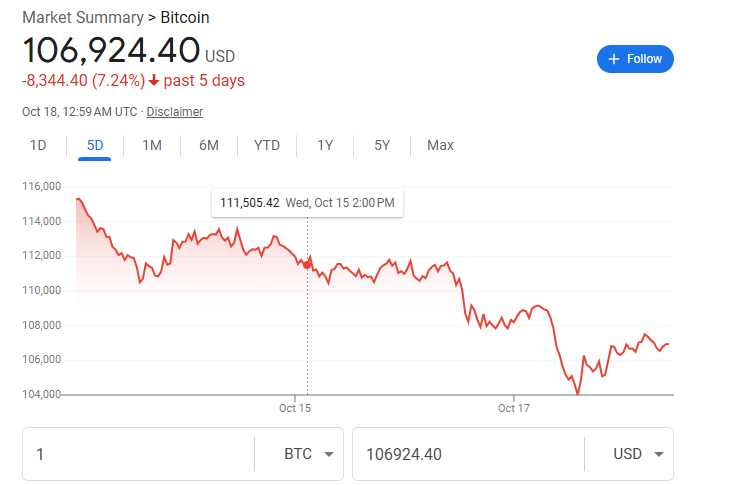
Bitcoin has plunged massively with a recent price slump that has sent shockwaves through the crypto market, as the world’s largest digital asset dipped below $105,000 for the first time since June.

Data from Cointelegraph stated that the  decline marked a near 9% drop on the weekly charts following its record high above $126,000.

The downturn reflects waning market momentum amid rising uncertainty and renewed U.S.–China trade tensions. The latest drop mirrors last week fall, when Bitcoin dipped to $104,000 on Friday, after U.S President Donald Trump announced 100% sweeping tariffs on Chinese imports.

Adding to the recent market unease, Trump’s recent speech accusing China of “economic sabotage” has intensified geopolitical tensions. The U.S. president hinted at potential increase to 500% on tariffs should China continue supporting Russia’s energy sector. Treasury Secretary Scott Bessent noted that over 85 U.S. senators back the tariff initiative.

Amid Bitcoin downward price action, the Crypto Fear & Greed Index has now plummeted to 22, indicating a state of “extreme fear” among investors. Massive liquidations further amplified the sell-off. According to CoinGlass, roughly $961 million worth of crypto positions were wiped out within 24 hours, affecting over 260,000 traders globally. Long positions accounted for approximately $749 million of the total, accelerating Bitcoin’s decline below the key $106,000 support level.

Leading cryptocurrency analyst Chris Burniske, noted that last week crypto crash, has severely damaged investor confidence. He predicts that the crypto market may remain broken for some time before a significant recovery starts.

Burniske, who is currently a partner at Placeholder VC, said he is more and more convinced that last Friday’s massacre negatively impacted the crypto market for a while. “It has been difficult to quickly develop a sustained bid due to the sell-off’s extreme violence”, he said, noting that the market’s structural and psychological harm is more extensive than most people realize.

He further noted that this cycle has been disappointing for most investors, not only due to price underperformance in comparison to expectations but also to the waning of the enthusiasm that once propelled speculative growth.

Market sentiment also soured following a sharp drop in U.S. regional banking stocks, reminiscent of the March 2023 mini banking crisis. Then, Bitcoin and altcoins experienced a similar flash crash before staging a swift recovery. “In March 2023, regional bank stocks collapsed, the crisis was ‘contained,’ but nothing really changed,” observed trading resource The Kobeissi Letter in a recent X post.

Traders now warn that Bitcoin may retest the crucial $100,000 support zone, a level many view as pivotal for maintaining market stability. At present, Bitcoin (BTC) is trading at $103,682, at the time of writing this report. Traders remain divided over whether this pullback signals the start of a deeper correction or a healthy consolidation before the next upward move.

Meanwhile, gold’s surge to a new record high of $4,200 has drawn attention  and capital away from Bitcoin’s “digital gold” narrative. Gold advocate Peter Schiff, chairman and chief economist of Europac, renewed his criticism of Bitcoin, predicting that gold could reach $1 million per ounce before Bitcoin achieves similar valuation milestones.

“It’s not just a de-dollarization trade but a de-bitcoinization trade. Bitcoin has failed the test as a viable alternative to the U.S. dollar or digital gold,” he wrote on X.

For now, fear dominates the crypto landscape as traders brace for further volatility. Should Bitcoin breach last week’s low of $104,396, analysts warn the market could face another wave of selling pressure on the path toward the $100,000 threshold.

Future Outlook

Currently, market analysts are watching the $107,000–$110,000 range as a key short-term demand zone. A break below could open the door to $100,000, while recovery above $115,000–$123,000 may help restore bullish momentum.

Microsoft Tests Advanced AI Functionalities That Integrate Copilot Assistant Deeply Into Windows 11

0

Microsoft has officially ended support for Windows 10, marking the end of a decade-long era for one of the world’s most widely used operating systems.

The move, which took effect on Tuesday, underscores the company’s renewed push into artificial intelligence as it seeks to drive adoption of Windows 11 through a new wave of AI-powered features.

The transition comes as Microsoft begins testing advanced AI functionalities that integrate its Copilot assistant more deeply into Windows 11. These features, currently available to participants in both the Windows Insider Program and the Copilot Labs testing group, reflect the company’s vision of turning personal computers into intelligent, interactive partners rather than passive tools.

Yusuf Mehdi, Microsoft’s consumer marketing chief, explained during a press briefing that the updated Copilot assistant will be able to perform complex tasks involving both desktop and web applications. Users could, for example, instruct Copilot to resize photos stored locally on their PCs or to compile all available Brian Eno songs into a Spotify playlist and start playing them automatically. Such capabilities represent the kind of seamless AI integration Microsoft hopes will define the Windows experience in the years ahead.

The company’s latest AI push builds on a broader trend in the technology industry. Anthropic, Google, and OpenAI have all developed similar AI models known as “computer-use agents,” designed to carry out multi-step operations that involve typing, clicking, and interacting across different software environments. Microsoft’s own variant of this technology, called Copilot Actions, is being introduced first to enterprise users through its corporate platforms and to consumers with premium subscriptions. The company now plans to extend this innovation directly to Windows 11.

According to Microsoft, Copilot Actions will be turned off by default when it launches. However, users who enable it will find that the tool operates in a secure, self-contained environment with its own virtual desktop. Users can observe Copilot performing tasks in real time, step by step, and can take manual control at any point. Alternatively, they may continue working on other activities while the AI handles assigned tasks in the background.

“You may see the agent make mistakes or encounter challenges with complex interfaces, which is why real-world testing of this experience is so critical,” Mehdi wrote in a company blog post. “We need to apply learnings from these tests to make the experience more capable and streamlined.”

The rollout strategy reflects Microsoft’s cautious approach as it integrates AI deeper into its flagship operating system. The company aims to ensure that privacy, reliability, and usability are not compromised in the process. During the preview phase, Copilot Actions will only function in common folders such as desktop, documents, downloads, or pictures. Users will have to give explicit permission before the assistant can access other areas of their computers.

As part of the upcoming update, Microsoft will also introduce a feature in Windows 11’s File Explorer built in partnership with Manus, a Singaporean startup specializing in AI-assisted content creation. Through this integration, users will be able to right-click a file and select a new option — “Create website with Manus” — allowing Copilot to automatically generate a website using the chosen file’s content.

Additionally, Windows Insiders will gain enhanced control over Copilot Vision, which allows the assistant to analyze what’s displayed on the screen. Previously, this feature could only be activated through voice commands, but users will now be able to engage with it directly through text chat.

Microsoft is also redesigning the Copilot interface to make it more accessible. A new shortcut will appear immediately to the right of the Start button, providing users with a one-click option to launch the assistant. The updated widget will include quick-access buttons for activating Copilot Vision or initiating spoken AI conversations. Users can also summon the assistant hands-free by saying, “Hey Copilot.”

The company’s renewed focus on AI reflects both competitive and commercial pressures. In recent years, Microsoft’s Windows and devices division has struggled to generate strong growth. In the second quarter of 2025, the segment brought in $4.3 billion in revenue, up just 2.5 percent from the previous year. Integrating AI deeply into the operating system could give the company a stronger edge against rivals like Apple, whose Mac computers continue to draw creative professionals, and Google’s Chrome OS, which dominates in the education market.

Windows 11, first introduced in 2021, shifted the familiar Start button and taskbar icons from the left corner to the center of the screen — a design meant to symbolize a new beginning for the operating system. According to data from web analytics firm Statcounter, Windows 11 became more widely used than Windows 10 for the first time in July 2025. By September, Microsoft commanded 72 percent of the global operating system market share.

Yet despite its reach, Microsoft’s challenge is no longer about expanding Windows adoption but about transforming what users can do with it. The company’s heavy investment in AI, both through its OpenAI partnership and its in-house engineering, is intended to make the PC relevant again in an era increasingly dominated by mobile computing and cloud platforms.