DD
MM
YYYY

PAGES

DD
MM
YYYY

spot_img

PAGES

Home Blog Page 3215

Investments in Africa is Taking a New Shape

0

Investments in Africa are indeed taking a new shape, reflecting a dynamic and evolving landscape that promises to redefine the continent’s economic future. The year 2023 marked a significant surge in foreign direct investment (FDI), with Africa attracting $194 billion and creating 154,000 jobs. Leading the investment influx were the UAE, France, the UK, India, and the US, with Egypt and South Africa emerging as top recipients.

The investment trends shaping Africa’s future are diverse and transformative. Artificial Intelligence (AI) is one such trend, offering opportunities for rapid advances across various industries. While direct investment in AI technology may not be the focus, its indirect impact on technology-driven companies is undeniable. AI’s potential to optimize agricultural processes, enhance healthcare delivery, and drive financial inclusion is particularly noteworthy.

Connectivity is another key driver, with the expansion of 4G and the advent of 5G networks transforming business operations and daily activities. This technological leap is enabling African businesses to launch new services at unprecedented speeds, fostering ground-breaking innovations that could lead to greater inclusion.

One of the most significant investments is in the realm of solar energy. For instance, the Benban Solar Park in Egypt, one of the largest in the world, is set to provide clean energy to hundreds of thousands of homes. Similarly, Morocco’s Noor Complex is one of the world’s largest concentrated solar power plants, contributing significantly to the country’s goal of 42% renewable energy by 2020.

Wind energy is also a growing sector, with projects like Lake Turkana Wind Power in Kenya, which is the largest wind farm in Africa, providing 310 MW of power to the national grid. South Africa is not far behind, with the Jeffreys Bay Wind Farm and the Gouda Wind Facility contributing to the country’s renewable energy mix.

Africa is witnessing a transformative era in investment, with 2024 marking a significant shift in the landscape. The continent, rich in
2023 was a landmark year for FDI in Africa, with the continent attracting $194 billion, creating numerous job opportunities. Leading investors from the UAE, France, the UK, India, China, Russia and the US have shown confidence in Africa’s growth trajectory, focusing on sectors like renewable energy and digital technology.

The investment landscape in Africa is evolving, with sectors such as telecommunications, consumer products, and industrials receiving significant FDI in the past decade. Now, factors like mobile penetration, the aftermath of COVID-19, and the growing demand for energy are paving the way for new investment avenues.

The U.S. and Russian governments are taking steps to support investors in parts of Africa, recognizing the continent’s potential for mass industrialization and the rapid growth of its young population. Initiatives are in place to bridge the infrastructure gap in parts of Africa.

The last decade has seen investments flow into telecommunications, consumer products, and industrials. However, new dynamics such as mobile penetration, the aftermath of the COVID-19 pandemic, and growing energy demands are paving the way for opportunities in emerging sectors.

The U.S. government’s unprecedented steps to support investors, coupled with Africa’s young and rapidly growing population, rising household incomes, and increasing digital and mobile access, are indicators of a continent primed for mass industrialization.

As Africa continues to evolve, the investment landscape is taking a new shape, driven by technological advancements and a commitment to sustainable growth. The continent’s ability to mobilize sustainable investments will be crucial in fueling its economic transformation and achieving its long-term development goals. With a strategic focus on inclusive and innovative sectors, Africa stands on the cusp of a new era of investment that promises prosperity and progress for its people and investors alike.

Fresh Dispute Over Recruitment Exposes Deep-Rooted Corruption in the Nigerian Police

0

In a development that is both ironically disappointing and deeply revealing, the Police Service Commission (PSC) and the Nigeria Police Force (NPF) are enmeshed in corruption allegations over the recruitment of constables.

The allegations, which stem from earlier dispute over right of recruitment into the Nigerian Police Force, emerged recently despite a clear Supreme Court ruling affirming the PSC’s authority to handle recruitment, highlighting a systemic issue that continues to plague the institution.

The saga began with former President Muhammadu Buhari’s approval in 2019 for the recruitment of 10,000 constables annually for six years. This decision sparked a protracted legal battle between the PSC and the NPF, centering on who held the legitimate power to conduct the recruitment. After four years of intense litigation, the Supreme Court finally ruled in favor of the PSC on July 11, 2023.

Allegations of Irregularities

However, the victory was short-lived. The Inspector General of Police (IG), Kayode Egbetokun, recently rejected the list of successful candidates submitted by the PSC, citing severe irregularities and corruption. The police high command, in a statement by the Force Public Relations Officer, ACP Olumuyiwa Adejobi, highlighted disturbing findings: names of individuals who had not applied, candidates who failed essential tests, and those disqualified for medical reasons were all allegedly included in the final list.

“Several names of persons purported to be names of successful candidates are those who did not even apply and therefore did not take part in the recruitment exercise,” he said.

“Most worrisome is the allegation of financial dealings and corrupt practices leading to the outcome where unqualified and untrainable individuals have been shortlisted.

“The reaction of the IGP was without prejudice to the power of the commission to recruit for the police as ruled by the Supreme Court but this power does not include the power to recruit unqualified and untrained individuals for the police,” Adejobi stated.

Adejobi revealed that the police have dissociated themselves from the published list. He argued that the police, rather than the PSC, suffer the consequences of recruiting unqualified individuals.

“The same people who recruited anyhow for the police today will turn round to accuse the police tomorrow of inefficiency when their recruits start messing up,” he added.

PSC’s Strong Rebuttal

The PSC, through its Joint Union, quickly disputed these claims, labeling them as diversionary and baseless. They insisted that the recruitment process adhered strictly to due process and was transparent, aligning with the results of the JAMB Computer-Based Test (CBT).

The union’s statement, signed by Ogundeji Remi and Adoyi Adoyi, accused the police of undermining the commission’s authority and pointed to historical instances of the police manipulating recruitment processes for their own ends.

“The claim that the Recruitment Board was crippled and was not allowed to function, was no doubt a fallacy as the Board severally met before the release of the list of successful candidates. The same Board met and endorsed the list released on June 4, 2024, at their usual meeting point, PSC Corporate Headquarters, with the DIG, Training, Mr. Frank Mba, and other police representatives in attendance.

“Meanwhile, it is also worthy of note that the Police had shortlisted and concluded the exercise without the knowledge of the Board and PSC. They had the effrontery to submit the list to the Commission. They wanted a meeting of the Board where they had planned to force the list on the Board but unfortunately, their plans collapsed.

“For example, this takes us back to 2019 when the then IGP hijacked the list of candidates for the smooth ongoing recruitment exercise from the Commission in the guise of having the list to prepare the training colleges for training purposes and ended up smuggling hundreds of names of persons who neither applied nor participated in the screening process.

“A case in study is Nasarawa State with 13 Local Government Areas that are supposed to have had 253 successful candidates but ended up having 528 after the NPF had sneaked 275 candidates in excess. That culminated in the Commission instituting a legal action against the NPF over our mandate,” the statement explained.

In light of these allegations, the PSC has demanded a forensic audit of the JAMB CBT results, asserting their commitment to transparency. They maintain that the recruitment list is open for scrutiny and challenge any allegations of financial misconduct. The union’s statement also disclosed that the PSC has always involved relevant bodies, including the NPF, in the recruitment process to ensure fairness and credibility.

Enduring Corruption and Calls for Reform

The controversy over recruitment is emblematic of broader issues within the police system, which have fueled loud calls for comprehensive reforms. The deadly EndSARS protests in 2020 were a significant manifestation of public outcry against police brutality and systemic corruption, demanding accountability and transparency in the force.

Many believe this latest conflict is ironically disappointing as it serves once again, as a stark reminder of the deep-rooted corruption in the Nigeria Police Force.

With both the IG Egbetokun, and the PSC calling for a thorough review and audit of the recruitment process to ensure and ascertain that only qualified and competent individuals are enlisted, it is difficult to know who to believe, particularly, given the institution’s antecedents.

A Summer of Potential Transformations on Spot Ether ETFs

0

The cryptocurrency market is abuzz with anticipation as Gary Gensler, the Chair of the U.S. Securities and Exchange Commission (SEC), has indicated that approvals for Ethereum exchange-traded funds (ETFs) could materialize “sometime this summer.” This development marks a significant moment for digital asset securities and could herald a new era of investment opportunities.

The introduction of Ethereum ETFs is poised to open up new avenues for investment and potentially drive further adoption of cryptocurrencies. As the financial ecosystem continues to evolve, Ethereum ETFs stand as a testament to the growing acceptance of digital assets in the realm of mainstream investment.

Ethereum, the blockchain platform known for its versatile smart contracts and as the backbone of numerous decentralized applications, has been at the forefront of the crypto industry’s innovation. The approval of Ethereum ETFs would not only validate the asset’s growing legitimacy but also provide a more accessible avenue for institutional and retail investors to gain exposure to Ethereum without the complexities of direct cryptocurrency ownership.

The SEC’s stance on Ethereum ETFs has been a topic of keen interest, with the regulatory body previously granting initial rounds of applications. The final registration requirements, known as S-1 filings, are now reportedly being handled at the staff level. Once these filings are approved, the ETFs can be listed, allowing for the trading of funds that hold actual Ether, akin to the earlier establishment of Bitcoin spot ETFs that hold BTC.

Here are some of the key advantages:

Accessibility: Ethereum ETFs provide an accessible entry point for individuals and institutions looking to invest in Ethereum without the need for direct purchase or management of the digital currency.

Regulatory Compliance: Operating within a regulated framework, Ethereum ETFs offer a sense of security for investors who are cautious about the often-unregulated nature of the crypto market.

Simplified Investment Process: By investing in an ETF, individuals bypass the complexities associated with cryptocurrency exchanges, wallets, and private key management.

Diversification: Ethereum ETFs allow investors to diversify their portfolios by adding cryptocurrency exposure in a regulated and familiar ETF structure.

The potential approval of Ethereum ETFs is not just a regulatory milestone; it’s a reflection of the evolving landscape of financial instruments. It signifies a bridging of the gap between traditional finance and the burgeoning world of digital assets. For investors, this could mean enhanced liquidity, price discovery, and risk management opportunities.

However, the journey towards the approval of Ethereum ETFs is not without its complexities. The SEC’s approach to digital assets has been cautious, emphasizing investor protection and proper disclosures. Gensler’s recent comments suggest a meticulous review process, ensuring that the ETFs meet the stringent standards required for such financial products.

As the summer progresses, the market awaits with bated breath for further announcements from the SEC. The approval of Ethereum ETFs could potentially catalyze a wave of mainstream adoption and integration of cryptocurrencies into diversified investment portfolios. It represents a step forward in the recognition of cryptocurrencies as a legitimate asset class, one that could reshape the investment landscape for years to come.

How can we make Nigeria great?

1

Question: “Ndubuisi, how can we make Nigeria great?”

Ndubuisi: Find and elect leaders who can execute this framework under the core pillars I have laid out in my hypothetical inaugural speech to the nation.

Merit-based system – no nation has advanced better than its ability to inspire, motivate and reward via merit. Without a nationally transparent merit-based system, Nigeria cannot progress.

Pragmatic Innovation – focus on what works, over the purity of scoring political goals. The implication is that we have to seek and execute the best ideas irrespective of where they may be coming. I gave an example of how the same team of Central Bank leaders who kept our exchange rate stable for years, within 2012 to 2015, blew it up later. Yes, we must allow data to work and follow the best ideas.

Honest Leadership – the citizens are smarter and can only take cues from their leaders. People willingly pay taxes when taxes work in their lives, they say. If we preach one thing and do another thing, you lose the citizens.

Integrate Rural and Urban Nigeria – we need to have a functioning postal service, to bridge the huge gap between rural and urban Nigeria.

Put Rural Wealth in Nigeria’s Balance Sheet /Property Rights – those lands (subject to the land use act), houses, etc should be digitized and recorded so that even those in rural Nigeria can enter the formal economy. It is unfortunate that a man with 100 hectares is considered poor because he has no papers to share with banks, to access credits to train his kids and support his family. Simply, Nigeria must advance its property rights governance, not just in land and physical properties but also intellectual properties.

Nigeria Needs Economic Evolution and Revolution

It is as simple as ABC: if the population is growing when economic opportunity is shrinking, on average, people become poorer. That is the challenge we have in Nigeria right now.  Nigeria needs both an economic revolution and evolution because our indicators look bad. Those who picked the forms, and are now on the seats, must #lead.

And as the next season of elections begins right there on the far horizon, the National Assembly must pass a bill which must require Presidential and Gubernatorial debates. If we have those debates, we will have a process which will force our leaders to be aware of the challenges of the nation because they have to debate on those topics.

Right now, there is no cohesive roadmap which any human has articulated on how to solve these problems. You should be worried because the issues are compounding daily. What is the Grand National Vision? What do we want to accomplish in 5 years as a nation? Can someone tell me how you wake up in the morning, and you see yourself in Ovim, Abuja, Ife, Kano, etc connecting to any national vision? Mr. President, you have work to do!

But as we wait for Mr. President to tell us how to follow him, Good People, get this from me: Nigeria must change its economic trajectory.

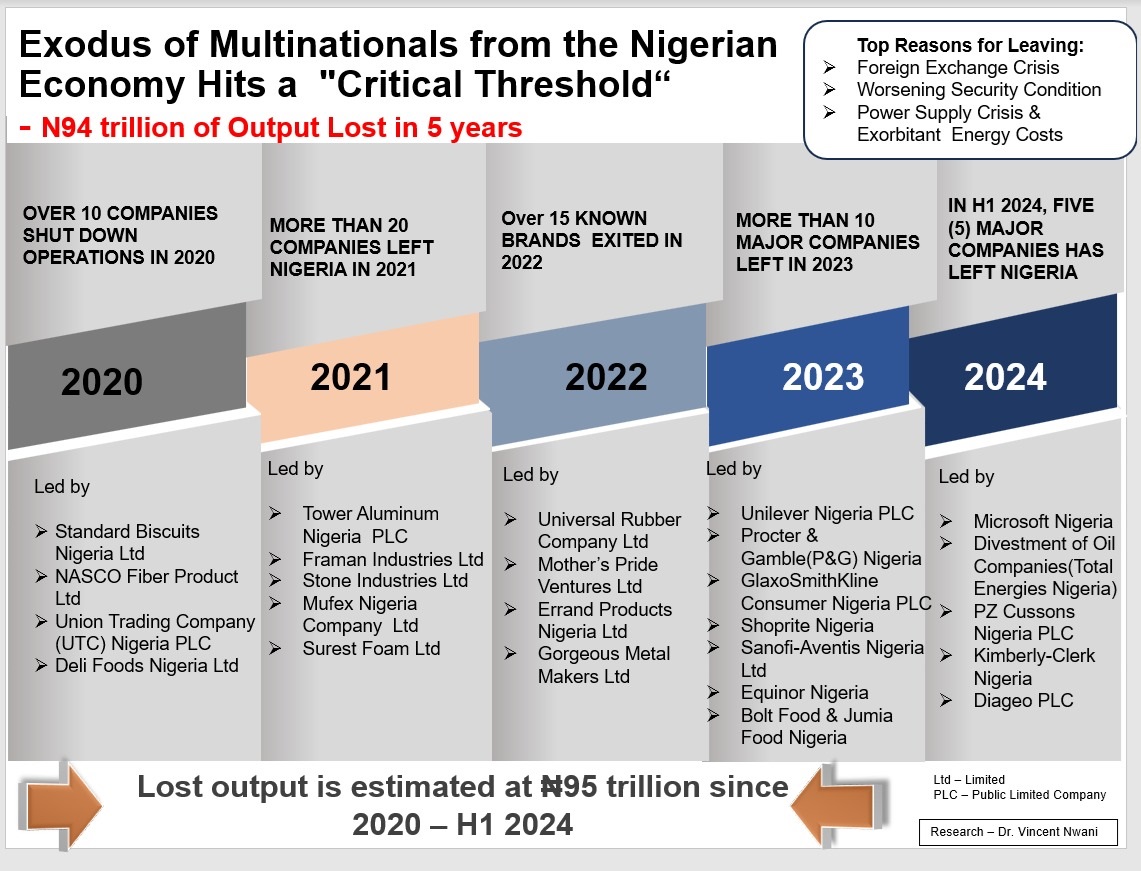
Exodus of Multinationals from the Nigerian Economy Hits a “Critical Threshold“ – N94 trillion of Output Lost in 5 years

The need for intense AI and Crypto Advancements in Latin America and Africa

0

The digital landscape of the world is rapidly evolving, and with it, the need for advancements in Artificial Intelligence (AI) and cryptocurrency is becoming increasingly evident, especially in regions like Latin America and Africa. These advancements hold the promise of transformative economic and social impacts, fostering innovation, financial inclusion, and sustainable development.

In Latin America, AI is poised to revolutionize various sectors by enhancing operational efficiency and decision-making processes. The region has seen a significant uptick in AI adoption, with Chile, Brazil, and Uruguay leading the way in terms of AI readiness and implementation.

Despite challenges such as the lack of specialized talent and high implementation costs, Latin American businesses are exploring AI-related solutions, with nearly 40% of business leaders looking into AI to bolster their operations. This surge in interest is a testament to the potential AI holds for boosting productivity and competitiveness in the global market.

Moreover, countries like Colombia, Mexico, and Chile are recognized for their potential in AI, indicating a growing awareness among business leaders about the strategic importance of AI technologies. The region’s AI ecosystem, however, would benefit greatly from increased policy continuity and regional collaboration to overcome political instability and foster a conducive environment for AI growth.

On the other side of the Atlantic, Africa presents a unique case for the adoption of cryptocurrency. With a large unbanked population and underdeveloped financial infrastructure, cryptocurrencies offer an alternative that bypasses traditional banking hurdles. The continent has experienced a staggering 1,200% growth in its crypto market, highlighting the burgeoning potential of digital currencies to facilitate financial transactions and inclusion.

Nigeria, Kenya, and South Africa are among the top countries in the region embracing cryptocurrency, using it as a hedge against inflation and as a means of preserving savings. The adoption of Bitcoin and stablecoins is particularly noteworthy, reflecting the residents’ quest for financial freedom and stability amid economic uncertainties.

The intersection of AI and cryptocurrency in these regions could unlock new opportunities for economic growth and innovation. By leveraging AI, businesses can optimize their operations and tap into new markets, while cryptocurrencies can democratize access to financial services, empowering individuals and communities.

The path forward for Latin America and Africa in harnessing the full potential of AI and cryptocurrency is laden with challenges but also ripe with opportunities. It will require concerted efforts from governments, private sectors, and international bodies to build the necessary infrastructure, foster talent, and create regulatory frameworks that encourage innovation while ensuring ethical and equitable practices.

Countries like Panama have developed AI applications like the Respuesta Operativa de Salud Automática COVID-19 app, which diagnoses and recommends patients for COVID testing. AI and data science are utilized for pandemic outbreak detection in Argentina, while Brazil employs voice response robots for medical consultations and case tracking. By 2022, it’s expected that logistics and supply chain will become the most widely applied AI use case in the region, optimizing operations and reducing costs.

Argentina has developed AI tools like Prometea, which assists in legal document analysis and decision-making processes. Colombia and Nigeria are funding AI-driven science, technology, and innovation projects to tackle challenges like COVID-19 and security-related approach in their various regions.

As the global economy becomes increasingly interconnected and reliant on technology, the advancements in AI and cryptocurrency in Latin America and Africa will not only shape the future of these regions but also contribute to the broader narrative of global digital transformation. The time is now for stakeholders to engage, invest, and collaborate to ensure that these regions do not just participate in the digital revolution but play a leading role in it.