DD
MM
YYYY

PAGES

DD
MM
YYYY

spot_img

PAGES

Home Blog Page 3249

With MiCA, Crypto Regulations Foundation can be more Solidified

0

The European Union’s Markets in Crypto Assets Regulation (MiCA) has been a topic of significant discussion within the cryptocurrency community. As the regulation is set to take effect in 2024, it promises to bring legal certainty and compliance challenges, along with global implications for the crypto sector.

MiCA represents a major milestone for the crypto industry, as it invites crypto market participants into the regulatory perimeter for the first time. This move is widely regarded as a step towards long-term stability for crypto markets, enhanced protections for users, and a more attractive investment environment for entrepreneurs.

One of the key aspects of MiCA is its approach to stablecoins, which are cryptocurrencies designed to minimize the volatility typically associated with digital assets by pegging their market value to an external reference, such as a fiat currency or a basket of assets. Under MiCA, stablecoins, or “e-money tokens” (EMTs) as they are referred to when linked to the value of a fiat currency, will have to hold suitable reserves and be well-governed.

However, the regulation has also introduced restrictions on stablecoin issuance and transactions, which have raised concerns among industry participants. The current caps on issuance and transactions for certain USD-referenced “e-money” tokens — including USDT, USDC, and BUSD — are set at 1 million transactions by volume or 200 million euros by notional value. These limits are considered too small to support current levels of activity and could lead to major disruptions in the functioning of the crypto ecosystem.

The restrictions on stablecoins have sparked a debate on whether they should be revisited. Critics argue that the caps are far too restrictive and do not reflect the growing role of stablecoins in the digital economy. Stablecoins have become integral to enabling critical use cases, such as cross-border payments and interactions with smart contracts, forming a central component of the lending and yield-generating ecosystem.

Moreover, stablecoins serve as a bridge between the fiat-based world of traditional finance and digital assets, offering a reliable store of value for investors and a safe haven from more volatile assets. They are particularly important for those in countries facing hyperinflation or other local currency debasing risks.

As MiCA moves towards implementation, there is a call for a balanced approach that acknowledges the potential risks associated with stablecoins while also recognizing their importance in the broader financial ecosystem. The regulation’s drafters are urged to revisit the restrictions on stablecoin issuance and transactions to ensure that they are aligned with the current and future scale of crypto market activities.

The conversation around MiCA and stablecoin regulations is ongoing, and it is clear that the crypto community is seeking a regulatory framework that supports innovation while ensuring market stability and user protection. As the implementation date draws closer, all eyes will be on the EU to see how it navigates these complex issues and sets a precedent for crypto regulation worldwide.

These provisions aim to enhance market integrity, ensure consumer protection, and foster innovation within the crypto-assets market. As MiCA is set to take effect in 2024, it will be interesting to see how these regulations shape the future of the cryptocurrency industry in Europe and beyond.

African Payments Company NALA Raises $40M in Funding to Expand Global Reach

0
Fund, money cash dollar

Nala, an African payments company, has raised $40 million in equity, marking one of the largest Series A deals in Africa.

The funding round was led by San Francisco-based VC firm Acres Capital, with participation from DST Global Partners, Norrsken22, HOF Capital, and other existing investors including Amplo and NYCA partners. Notably, Angel investors such as fintech founders Ryan King of Chime and Vlad Tenev of Robinhood also contributed.

Nala’s founder and CEO Benjamin Fernandes in a chat with TechCrunch, said that the latest funds follow a $10 million seed round in 2022, which will support the company’s ambitious global expansion plans. This includes scaling its remittance services to reach the Asian and Latin American markets.

Currently, Nala’s consumer app allows users in the E.U, U.K, and U.S. to send money to 249 banks and 26 mobile money services across 11 African markets. This includes regions where the company has integrated with mobile money services, such as Kenya’s M-Pesa, where users can directly pay bills into local mobile wallets.

Fernandes explained that the decision to enhance payment capabilities was driven by user demand for comprehensive control over their finances. The fintech aims to extend these offerings to the new target markets, beginning with Asia.

“This $40 million funding round marks a pivotal moment for Nala, It will enable us to go beyond remittances and extend our reach beyond Africa, building a robust payments ecosystem. We’re reinvesting this money to enhance our infrastructure, ensuring reliable, low-cost payments for all. With the launch of our payment rails and the expansion of our B2B platform Rafiki, we’re not just talking about change, we’re building it. We’ve got some bold, ambitious plans, give us a couple of years,” said Fernandes.

Nala is also focusing on its B2B payments platform, Rafiki, launched in March, to facilitate payments for global businesses operating in and out of Africa.

Founded in 2017, the payment platform aims to increase economic opportunities for Africans at large. In 2023, it acquired payment service provider licenses in several countries, including Tanzania, its home country, where the technology is directly integrated with banks and telcos, partnering with Tanzania’s leading network, Vodacom M-Pesa.

According to a World Bank report, sending money to Africa remains the world’s most expensive continent for remittances, with costs averaging 7.84 percent. In January 2024, Sub-Saharan Africa continues to lead in remittance costs, with fees reaching up to 36% for every $200 sent from abroad.

Nala CEO Fernandes pointed out that there remains a big opportunity to develop payments in Africa, saying that the sector is only ‘1% built. He further noted that with the high remittance fee, Africa Will continue to be limited by the opportunities of trade across the continent.

In a bid to ease remittance to Africa, Nala is positioned to be at the forefront of this change. In 2021, Nala pivoted to offer remittance tapping the growing money transfer market in Africa and the demand for reliable and affordable services. Its remittance offering has seen considerable growth since testing out the product in 2021, and has positioned the company to be among top fintechs transforming money transfers in Africa.

Over the last two years, the Tanzanian fintech, through its consumer fintech app, has enabled users in the diaspora including the EU, U.K., and U.S. to send money to their loved ones across 249 banks and 26 mobile money services in 11 African markets. For markets like Kenya, they have integrated with mobile money service M-Pesa enabling users living in the diaspora to pay local bills directly.

Nala confidently takes up the challenge and vows to reshape Africa’s fast-growing electronic payments.

Future of Blockchain Technology in Agriculture

0

The integration of blockchain technology into the agricultural sector represents a significant leap forward in modernizing farming practices, enhancing food safety, and improving supply chain management. As the global population continues to grow, the demand for sustainable, traceable, and secure agricultural practices becomes increasingly critical. Blockchain technology, with its decentralized and transparent nature, offers a promising solution to many of the challenges faced by the agricultural industry today.

Blockchain technology can revolutionize the agricultural sector by providing a secure and immutable ledger for recording transactions and tracking assets throughout the entire supply chain. This can lead to increased trust among stakeholders, from farmers to consumers, as the provenance of food products can be verified with ease. Moreover, blockchain can facilitate smart contracts, which automate payments and other transactions based on predefined conditions, thereby reducing the need for intermediaries and lowering transaction costs.

One of the most significant challenges in agriculture is the inclusion of smallholder farmers in the digital economy. Blockchain technology has the potential to empower these farmers by providing them with access to new markets, fairer prices, and timely payments. However, the adoption of blockchain in agriculture also presents challenges, such as the need for technical infrastructure and the digital literacy required to participate effectively in blockchain-based systems.

Smart Farming and Food Safety

The application of blockchain in smart farming practices can enhance the traceability of food products, ensuring food safety and quality. By storing data on a blockchain, stakeholders can track the journey of food from farm to table, identifying and addressing any issues that arise along the way. Smart Contracts: These are self-executing contracts with the terms directly written into code. They automate transactions and payments when conditions are met, reducing the need for intermediaries and lowering costs. This level of traceability is crucial in preventing foodborne illnesses and ensuring that consumers receive fresh and authentic products.

Here’s how blockchain can make significant impacts:

Traceability: Blockchain provides an immutable ledger, allowing for the tracking of goods from origin to destination. This traceability ensures accountability and is crucial for quality assurance and product recalls.

Transparency: With blockchain, every transaction and movement of goods can be recorded and verified by all stakeholders, fostering trust and visibility in the supply chain.

Efficiency: Blockchain can streamline supply chain processes by automating data entry and verification, reducing time-consuming and error-prone manual work.

Coordination: Enhancing coordination between partners, blockchain facilitates faster and more cost-efficient delivery of products.

As blockchain technology continues to evolve, its applications in agriculture are expected to expand. The development of more user-friendly platforms and the increasing awareness of blockchain’s benefits will likely lead to wider adoption within the sector. The future of agriculture with blockchain looks promising, with the potential for more sustainable supply chains, increased farmer income, and enhanced consumer trust in the food they consume.

The agricultural sector’s need for blockchain technology is clear. By embracing this innovative technology, the industry can address many of its current challenges, paving the way for a more sustainable and efficient future. The journey towards blockchain adoption in agriculture may be complex, but the potential rewards for farmers, consumers, and the environment are immense.

How to Convert Your Annual Salary to an Hourly Rate

0

Did you know that in 2023, over 80 million workers in the U.S. were paid at hourly rates, representing nearly 60% of all wage and salary workers? This demonstrates how understanding your hourly wage is far from a niche concern—it’s relevant to a significant portion of the workforce.

Whether you’re a freelancer, part-time employee, or full-time worker, knowing your hourly rate can significantly impact your understanding of where you stand in the wage market. This understanding can help you make informed financial decisions, negotiate better pay, and set competitive freelance rates.

In this guide, you’ll learn how to use a salary to hourly calculator to gain a deeper understanding of your income. By the end, you’ll be equipped to make informed decisions about your financial future, negotiate your worth more effectively, and perhaps even find new ways to maximize your earnings. So, are you ready to uncover the true value of your time?

Understanding Your Salary: Essential Elements of Your Paycheck

When you receive your paycheck, it’s easy to focus solely on the final amount deposited into your bank account. However, understanding the various elements that construct your paycheck can provide valuable insights into your overall compensation.

Let’s break down these components and explore how they influence your take-home pay.

1. Gross Salary

Your gross salary is the total amount you earn before any deductions, encompassing your base pay and additional earnings like bonuses or overtime.

For instance, if your annual salary is $60,000 and you receive a $5,000 bonus, your gross salary for the year is $65,000. Knowing your gross salary is crucial because it forms the foundation for all other calculations, including taxes and benefits.

2. Base Pay

Base pay is the fixed amount you earn regularly, often quoted as an annual figure, monthly salary, or hourly wage.

For example, if you’re salaried, your base pay might be $4,000 per month, while an hourly worker might earn $20 per hour. According to a survey, employees who clearly understand their base pay and compensation structure report higher job satisfaction, highlighting the importance of transparency in pay.

3. Overtime Pay

Overtime pay compensates for hours worked beyond the standard workweek, typically 40 hours. This compensation is usually at a higher rate.

For example, if your hourly wage is $15, overtime pay might be $22.50 per hour (1.5 times the regular rate).

The Fair Labor Standards Act (FLSA) mandates overtime pay for eligible employees at this rate, ensuring that additional work is fairly compensated. A study by the Economic Policy Institute found that about 43% of workers are eligible for overtime, emphasizing its significance in total earnings.

Source: StockCake

4. Bonuses and Commissions

Bonuses and commissions are additional earnings based on performance, company profits, or sales achievements. For instance, a salesperson might earn a base salary of $30,000 plus a 10% commission on sales, potentially doubling their income.

In 2022, 40% of companies reported using bonuses as a tool to attract and retain employees, according to WorldatWork. This practice underscores the role of performance-based incentives in modern compensation packages.

5. Benefits and Perks

Benefits and perks are non-cash compensation that can include health insurance, retirement plans, paid time off, and more. For example, your employer might contribute $5,000 annually to your 401(k) plan and provide health insurance worth $10,000 per year.

And this is very important too, because, according to a study by the Employee Benefit Research Institute, a high number of 78% of workers with access to comprehensive benefits reported higher job satisfaction. This highlights the significant role benefits play in overall employee well-being and retention.

6. Taxes and Deductions

Taxes and deductions are amounts subtracted from your gross pay for federal and state taxes, Social Security, Medicare, and other mandatory or voluntary deductions.

For example, if your gross monthly salary is $5,000, you might see deductions of $1,500 for taxes and benefits, leaving you with a net pay of $3,500.

According to the Tax Foundation, the average effective federal income tax rate is about 13.3%, which can significantly impact your take-home pay.

7. Net Pay

Net pay, also known as take-home pay, is the amount you receive after all deductions have been applied.

For instance, from a gross salary of $60,000, after $15,000 in taxes and deductions, your net pay might be $45,000.

According to a survey by Bankrate, 55% of Americans feel financially behind, emphasizing the importance of maximizing net pay and managing finances effectively.

8. Paid Time Off (PTO)

Paid time off (PTO) includes compensation for vacation days, sick leave, and holidays.

If you have 15 days of paid vacation annually and earn $200 per day, your PTO is worth $3,000.

The Bureau of Labor Statistics reports that the average American worker receives 10 days of paid vacation and six paid holidays per year, underscoring the role of PTO in overall job satisfaction and work-life balance.

9. Retirement Contributions

Retirement contributions are funds set aside by you and/or your employer for retirement, often tax-advantaged.

Your employer might match your 401(k) contributions up to 5% of your salary. And this is one of the most important things to calculate, because a study by Vanguard found that employees participating in employer-sponsored retirement plans had 2.5 times more retirement savings than those without access, illustrating the long-term benefits of these contributions.

By dissecting your paycheck and understanding these essential elements, you gain a clearer picture of your true compensation.

Source: StockCake

Understanding Hourly Rate Calculations

Understanding how to calculate your hourly rate is essential for financial planning, budgeting, and ensuring you’re adequately compensated for your time. Whether you are converting an annual salary, a monthly salary, or calculating overtime pay, the process involves several key steps and considerations.

Converting Annual Salary to Hourly Rate

To convert an annual salary to an hourly rate, you need to know the number of hours you work each week and the number of weeks you work each year. Typically, full-time employees work 40 hours per week for 52 weeks a year, accounting for holidays and vacation time.

Formula: Hourly Rate =

Example Calculation:

Annual Salary Hours per Week Weeks per Year Hourly Rate
$50, 000 40 52 $24.04

Steps:

  1. Annual Salary: $50,000
  2. Calculate Total Hours: 40 hours/week × 52 weeks/year = 2,080 hours/year
  3. Divide Salary by Total Hours: $50,000 ÷ 2,080 hours = $24.04/hour

Converting Monthly Salary to Hourly Rate

When you have a monthly salary, you can convert it to an hourly rate by first converting it to an annual salary and then using the method above.

Formula: Hourly Rate = ÷ Weeks per Year

Hourly Rate=(Hours per WeekMonthly Salary×12?)÷Weeks per Year

Example Calculation:

Monthly Salary Hours per Week Weeks per Year Hourly Rate
$3,000 40 52 $17.31

Steps:

  1. Monthly Salary: $3,000
  2. Convert to Annual Salary: $3,000 × 12 = $36,000
  3. Calculate Total Hours: 40 hours/week × 52 weeks/year = 2,080 hours/year
  4. Divide Salary by Total Hours: $36,000 ÷ 2,080 hours = $17.31/hour

Overtime Pay Calculation

Overtime pay is typically calculated at a rate of 1.5 times the regular hourly wage for any hours worked beyond 40 in a week.

Formula: Overtime Rate=Hourly Rate X 1.5

Example Calculation:

Hourly Rate Overtime Hours Overtime Rate Total Overtime Pay
$15 10 $22.50 $225

Steps:

  1. Hourly Rate: $15
  2. Calculate Overtime Rate: $15 × 1.5 = $22.50
  3. Multiply by Overtime Hours: $22.50 × 10 = $225

Hourly Rate Examples

Let’s look at how various annual salaries translate to hourly rates for a typical 40-hour workweek:

Annual Salary Monthly Salary Weekly Salary Hourly Rate
$40,000 $3,333.33 $769.23 $19.23
$45,000 $3,750 $865.38 $21.63
$50,000 $4,166.67 $961.54 $24.04

Next, let’s create a visual table to help understand these conversions better:

Annual Salary Weekly Hours Total Annual Hours Hourly Rate
$30,000 40 2,080 $14.42
$40,000 40 2,080 $19.23
$50,000 40 2,080 $24.04
$60,000 40 2,080 $28.85
$70,000 40 2,080 $33.65

Example: Higher Hourly Rates with Overtime

Let’s consider a scenario where an employee earns $25 per hour and works 10 hours of overtime in a week:

Regular Hours Overtime Hours Regular Pay Overtime Pay Total Weekly Pay
40 10 40 x $25 = $1,000 10×37.50 = $375 $1,375

Steps:

  1. Regular Hourly Rate: $25
  2. Overtime Hourly Rate: $25 × 1.5 = $37.50
  3. Regular Pay: 40 hours × $25 = $1,000
  4. Overtime Pay: 10 hours × $37.50 = $375
  5. Total Pay: $1,000 + $375 = $1,375

Source: StockCake

Summary

Your salary is more than a number—it’s a reflection of your skills, value, and work-life balance. Knowing your hourly rate helps you make informed financial decisions and negotiate better pay.

While the math can be complex, free online calculators simplify the process, providing accurate conversions in seconds.

Use these tools to understand your true earning potential and ensure fair compensation. Ready to see your real value? Try an online salary to hourly rate calculator today and take control of your financial future with confidence.

Why Micron’s Shares Dropped Despite Record Revenue?

0

Micron Technology (NASDAQ:MU), one of the leading semiconductor memory manufacturers, recently released a quarterly report that led to an unexpected 7% decline in its share price. This may seem paradoxical at first, especially considering the company reported revenue of $6.81 billion, 82% higher than the same period last year and above analysts’ expectations set at $6.67 billion. Analyzing this situation, we can see that the market trends are changing. Investors are becoming more focused on projected results rather than current financial performance.

For many  tech sector stocks, including Micron, the ratio of the company’s current condition to its future prospects is becoming a critical valuation factor. The company forecasts revenue of $7.6 billion for the next quarter, which aligns with analysts’ expectations but does not exceed them. This was a key factor in disappointing investors who had expected Micron’s forecast would surpass market estimates. Consequently, the company’s shares declined.

This trend indicates that investors seeking companies that not only achieve strong financial results in the present but also show optimistic forecasts for the future. Many other tech companies, including Apple (NASDAQ:AAPL), Nvidia (NASDAQ:NVDA), and AMD (NASDAQ:AMD), have experienced similar outcomes.

In his speech following the report’s release, Micron CEO Kevin McMillan expressed confidence that the company will benefit from the market growth driven by increased demand for memory for artificial intelligence systems.This argument is supported by the fact that Micron sold the latest HBM3E chips worth $100 million last quarter and expects to reach several hundred million US dollars in the current quarter.

Micron expects to raise several billion US dollars from the implementation of HBM3E throughout fiscal year 2025, which lasts until next August. This product segment could be a significant growth driver for the company, given its importance for AI solutions and high margins. In addition, in the current fiscal year, which ends this August, Micron plans to spend $8 billion on building new facilities, upgrading existing ones, and purchasing equipment. In the next fiscal year, capital expenditures will increase significantly due to the need to finance the construction of new facilities in Idaho and New York State. The first sites will begin producing commercial products by fiscal year 2027, with the second joining a year later.

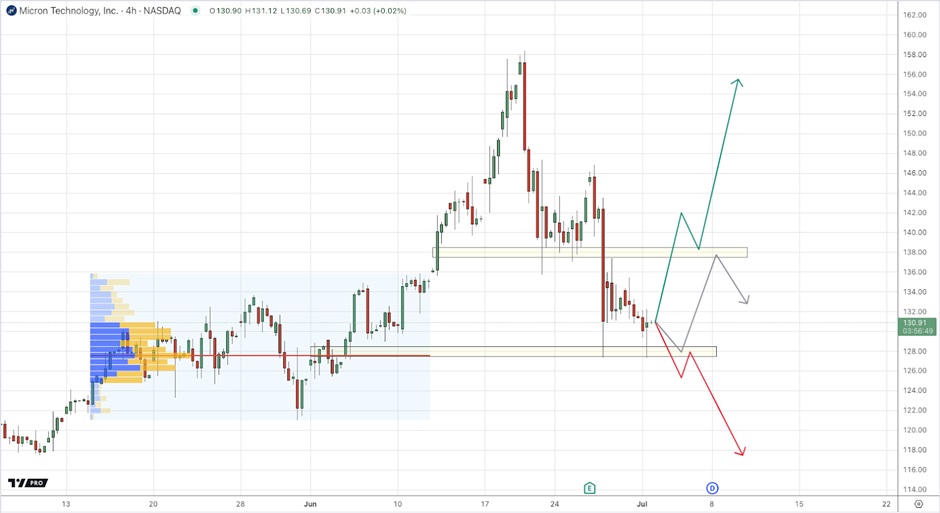
These events highlight the importance of a long-term perspective for Micron shareholders. In the short term, stocks may fluctuate due to revenue forecasts that don’t meet expectations. However, the company’s long-term potential remains high, especially given its position in the AI memory segment. Investors should consider the market’s main growth trends and the company’s strategic position in it. The price is just holding on to the volume profile point of control, the main support for $128. The main goal of buyers is to break through the resistance of $138 to return to the original prices and move to the historical maximum.

Is it worth holding company shares? Yes, provided you are prepared for short-term fluctuations. Micron has every chance of successful long-term development due to significant investments in innovative products such as HBM3E and adaptation to the challenges and opportunities of the AI market. Thus, despite short-term disappointments and declining stock prices, Micron’s long-term growth potential remains significant, making the company attractive to strategic investors.