DD
MM
YYYY

PAGES

DD
MM
YYYY

spot_img

PAGES

Home Blog Page 3257

‘Social’ Storage and Image Display – Ente V Pinterest

0

As 9ja Cosmos gears up for the Airdrop of Sino Amazons and their Sinosignias, we’ve been looking at image storage and display opportunities.

What we want:

A place where we can showcase project images with limited or no local platform engagement – we ‘drive’ the project message from other platforms (like Discord and LinkedIn), so a showcase platform with its own local engagement doctrine can confuse the message.

Community Members, Investment Prospects and others need to be able to easily identify individual images from the showcase platform, and refer to them when discussing with us.

A ‘sandbox’ type environment in which the showcase project images, the message driver platform(s) and the funnel that connects them is shielded from exposure to third party content. This rules out using highly interactive platforms (like Instagram) as a showcase platform.

Low or Zero level (spammy) message intrusion (notifications) by the showcase platform

Modern account setup/security features (Modern, think things like ZKP, Legacy, think things like KYC and 2FA)

As 9ja Cosmos needs to keep with a Web3, Blockchain and NexGen Tech image, it’s preferable we extend our visibility with third parties which conjure up compatible impressions in the minds of enthusiasts, degens, collectors, investors and builders in our space. Pinterest began in 2010, and Instagram began as Burbn, a mobile check-in app, in the same year. 9ja Cosmos launched the first ever Web 3 Country Top Level Domain (TLD) in the world (.9jacom) in 2022, so our ‘break-out’ moment supersedes them by more than a decade.

Discovery:

With this in mind, we explored ‘Ente’ which the home page describes as a ‘Safe home for your photos –  Store, share, and rediscover your memories with absolute privacy’ It was shared as a ‘suggestion’ on Discord by Handshake Director Paul Anthony Webb

‘Ente has apps for Android, iOS, Linux, Mac, Windows and the web’

There are 4 price points ranging from 50GB of storage from $3 US a month, to 2TB at $20 a month, and a 1 year free trial of 1GB

Loading:

The upload took me a few minutes. I uploaded a folders content from an old 1TB external SATA (mechanical) drive.  There were 600 Sino Amazon images of 400-600kb each, and a speed test showed my upload speed at the time to be 5mbps , so that’s not too bad. The run of the project is about 1000 units, and that’s roughly only 0.5 Gb – half of the free 1 Gb allocation.  Someone generating a lot of personal or work related content constantly on-the-fly, might eat that fairly quick.  It’s fine for a finite project under 1 GB

Experience:

Display has both with Pros and Cons. I like that the Ente environment has a ‘dark mode’ option, which I will always enable if available (easier on my eyes). Pinterest doesn’t. Sino Amazon images have differing aspect ratios, and Pinterest always makes the ‘Portrait’ images (misleadingly) appear bigger to the visitor in thumbnail view, while Ente displays all in rows of the same length irrespective of width. Pinterest however, makes use of all available space in rows. Ente arranges files by creation date, and opens a new row for a different creation date, leaving any slots in an incomplete row unoccupied. Users of Midjourney will be familiar with this format.

Images can be identified more easily on Pinterest than Ente, just by clicking on an image opens up a record with extra info about it. However, this is seriously negated by the visitor needing to be logged into Pinterest, else, they will just get the thumbnail view. Once someone is given an Ente link by the album owner, they don’t need to be logged in to see the details on a browser.

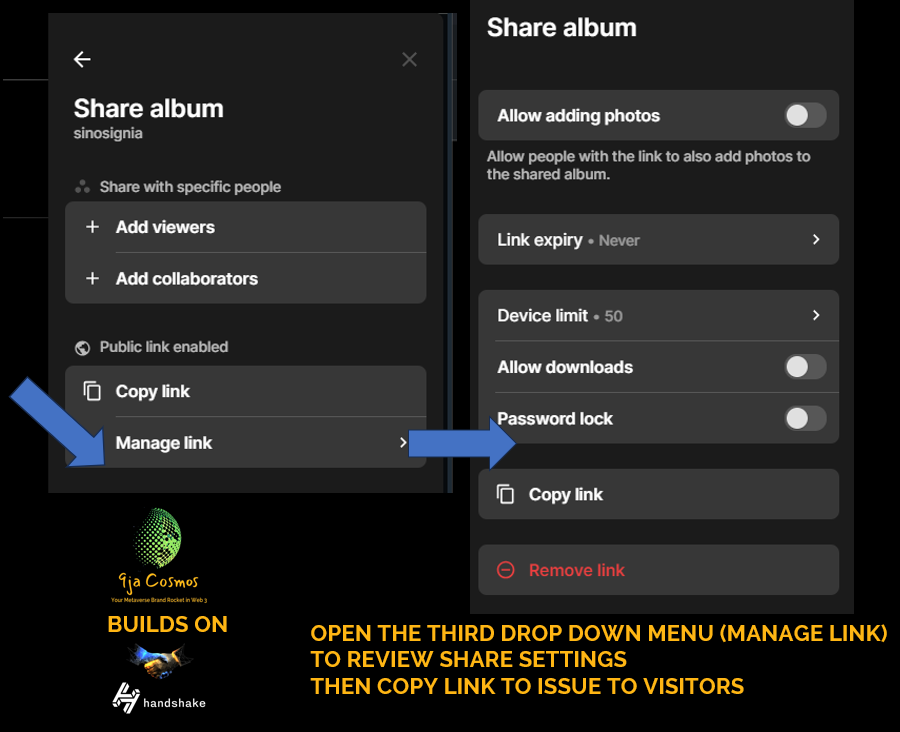
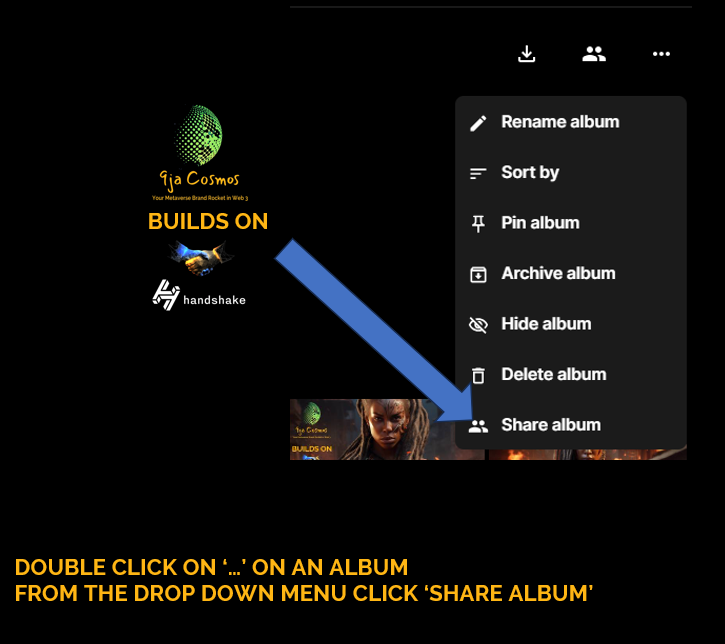
Security and Privacy: Ente is way better than Pinterest. Anybody logged in with Pinterest can copy others ‘Pins’. Ente, however, can simply leave the ‘allow downloads’ option unchecked in the share settings, and this will prevent anybody saving your content.

At signup, Ente issues a ‘seed phrase’ that many with digital wallets will be familiar with. While folks can sign up with an email address, and I choose to use an official 9jacosmos mail account capable of being verified with my registrar – Namecheap, anybody can sign up using a ‘burner’ web based free email address. Ultimately, all that is needed is to keep the  ‘seed phrase’ safe, allowing the account to be recovered on any device bearing any IP address,  so it’s ZKP of sorts.

2FA is available but not compulsory.
Pinterest is way more spammy than Ente, which is a characteristic of many of the platforms of its era.

Excerpt ‘THE MYTH OF SINO AMAZONS’ – Origin, Appearance, Dress Code and Weapon Choices.

‘Nobody knows where Sino Amazons came from … There is no telling to what extent modern graphic representations of Sino Amazons are fact or fiction.

It was known that Sino Amazons were consummate polyglots. Apart from knowing several regional languages, individual Sino Amazons knew different combinations of, example, Arabic, Persian, Kurd, Turk, Sanskrit, and indigenous tribal Central and South American, African and Australasian languages.

From around 1500 forward, they also gained command of the European languages of Colonial Powers – Dutch, English, French, Portuguese and Spanish.

Sino Amazons didn’t have one uniform ethnic appearance.  They bore features which seemed to be some fusion of regional origin with other origins further afield, often individually aligned with the range of languages they spoke.’

This defines the series as a whole, though individual appearances vary. We however constantly get spammed with suggestions that other ‘pins’ have been ‘inspired’ by us.

They are part of boards on themes that vary from ‘African Art’, ‘Vampirella’, ‘Fantasia’, ‘Wonderwomen’ and various other things, which while there may be some vague traits in common between individual ‘pins’ in these collections and a particular Sino Amazon, none of these collections even remotely meet the criteria of the Sino series in entirety.

In many cases, the content we are supposed to have ‘inspired’ has been created before our oldest Sino Amazon. We also get spammed with suggestions of content we might like to see, because apparently ‘we have a good eye’.

The spamming by Pinterest seems to be a ruse to suck ‘collection administrators’ into viewing other collections to drive up site engagement metrics.

So far, with Ente, we have only been emailed once – when we were sent the ‘verification code’ immediately following sign up! – Let’s hope it stays minimalist like this!

Conclusion:

For 9ja Cosmos purposes, both Ente and Pinterest have some trade offs in the display. Pinterest is slightly easier to use initially, but understanding how Ente works, isn’t a significant learning curve.

Ente storms ahead on Privacy and Security. Content curation scales infinitely better than Pinterest does. Pinterest constant spamming with viewing suggestions is pandemic.  Ente is far more in tune with the ‘Product Generation’ 9ja Cosmos is part of.

There are just too many areas where Ente distinguishes itself consistent with the requirements of Sino Amazons, to consider Pinterest a serious contender.

9ja Cosmos is here…

Get your .9jacom and .9javerse Web 3 domains  for $2 at:

.9jacom Domains

.9javerse Domains

Visit 9ja Cosmos LinkedIn Page

Visit 9ja Cosmos Website

Preview our Sino Amazon/Sinosignia releases (Ente)

Preview our Sino Amazon/Sinosignia releases (Pinterest)



$69 million worth of Bitcoin shorts liquidated in the past 24 hours

0

The Bitcoin market has witnessed a massive shakeout of leveraged traders in the past 24 hours, as the price of the leading cryptocurrency surged to a new all-time high above $69,000. According to data from Bybt, a crypto derivatives analytics platform, more than $69 million worth of Bitcoin shorts were liquidated in the last day, with the majority of them occurring in the span of a few hours.

What caused this short squeeze? There are several factors that contributed to the bullish momentum of Bitcoin, including:

The anticipation of the first Bitcoin futures exchange-traded fund (ETF) in the US, which is expected to launch this week. The ETF, sponsored by ProShares, will track the performance of Bitcoin futures contracts on the Chicago Mercantile Exchange (CME), and will provide a more accessible and regulated way for investors to gain exposure to Bitcoin.

The positive sentiment from institutional investors and corporations, who have been increasing their adoption and endorsement of Bitcoin as a store of value and a hedge against inflation. For example, PayPal announced that it will allow its users in the UK to buy, sell and hold Bitcoin and other cryptocurrencies on its platform, following its launch in the US last year.

Moreover, EX Twitter founder Jack Dorsey revealed that his other company, Square, is building a Bitcoin-focused decentralized exchange, which will enable users to swap fiat and crypto assets without intermediaries.

The technical strength of the Bitcoin chart, which showed a clear breakout of the previous resistance level at $67,000, and a confirmation of the uptrend with higher highs and higher lows. The next major target for Bitcoin bulls is the psychological level of $70,000, which could trigger more FOMO (fear of missing out) buying and further liquidations of short positions.

How to trade Bitcoin in this volatile market? While the current rally of Bitcoin is impressive and exciting, it also comes with high risks and challenges for traders who want to capitalize on the price movements. Here are some tips and strategies to consider:

Use proper risk management. Trading with leverage can amplify your profits, but also your losses. Therefore, it is crucial to use stop-loss orders, limit orders, and take-profit orders to protect your capital and lock in your gains. You should also avoid risking more than you can afford to lose and diversify your portfolio with other assets and markets.

Follow the trend. The trend is your friend, until it ends. Right now, the trend of Bitcoin is clearly bullish, so it makes sense to look for long opportunities rather than short ones. You can use trend indicators, such as moving averages, trend lines, and chart patterns, to identify the direction and strength of the trend, and trade accordingly.

Be flexible and adaptable. The crypto market is dynamic and unpredictable, so you need to be ready to adjust your strategy and tactics according to the changing conditions. You should also keep an eye on the news and events that could impact the price of Bitcoin, such as regulatory developments, network upgrades, security breaches, etc. By staying informed and alert, you can avoid potential pitfalls and take advantage of emerging opportunities.

Bitcoin’s surge to ATH (all-time-high) may add to Inflation

0

Bitcoin, the world’s most popular cryptocurrency, has been on a tear lately, reaching new highs and attracting more investors. But while some see it as a hedge against inflation, others warn that it may actually contribute to it.

How can Bitcoin affect inflation? The answer lies in the relationship between money supply, demand, and prices. Inflation is the general increase in the prices of goods and services over time, which reduces the purchasing power of money. It is usually caused by an excess of money supply over the demand for money, which means that there is more money chasing fewer goods.

Bitcoin, unlike fiat currencies, has a fixed supply of 21 million coins that can ever be created. This means that it cannot be inflated by printing more money, as central banks do. However, it can still affect the demand for money and the prices of goods and services in two ways.

First, Bitcoin can increase the demand for money by reducing its velocity. Velocity is the rate at which money circulates in the economy, or how often it changes hands. The higher the velocity, the more transactions are made with the same amount of money, and the lower the demand for money. The lower the velocity, the fewer transactions are made with the same amount of money, and the higher the demand for money.

Bitcoin has a low velocity because it is mostly used as a store of value rather than a medium of exchange. Many people buy Bitcoin and hold it for long periods of time, hoping that its price will appreciate. This reduces the amount of money available for spending on goods and services, which increases the demand for money and puts upward pressure on prices.

Second, Bitcoin can affect the prices of goods and services by influencing their relative value. Relative value is the ratio of the price of one good or service to another, or how much of one good or service can be exchanged for another. For example, if one Bitcoin can buy 10 pizzas today, but 20 pizzas tomorrow, then the relative value of Bitcoin has increased and the relative value of pizzas has decreased.

Bitcoin can influence relative value by changing its own price in relation to other currencies and goods and services. As Bitcoin’s price rises, it becomes more valuable compared to other currencies and goods and services. This means that people who own Bitcoin can buy more things with it, which increases their demand for those things and drives up their prices.

Conversely, as Bitcoin’s price falls, it becomes less valuable compared to other currencies and goods and services. This means that people who own Bitcoin can buy less things with it, which decreases their demand for those things and drives down their prices.

Therefore, Bitcoin’s price rally may add to inflation by increasing the demand for money and affecting the relative value of goods and services. However, this effect may not be significant or lasting, as there are many other factors that influence inflation, such as economic growth, productivity, fiscal policy, monetary policy, expectations, and shocks. Moreover, Bitcoin’s price is highly volatile and unpredictable, which makes it difficult to measure its impact on inflation.

Bitcoin’s price rally may add to inflation by increasing the demand for money and affecting the relative value of goods and services. However, this effect may not be significant or lasting, as there are many other factors that influence inflation. Bitcoin’s price is highly volatile and unpredictable, which makes it difficult to measure its impact on inflation.

Former Nigerian President Olusegun Obasanjo Advocates Learning from Zimbabwe to Combat Inflation Crisis

0

Former Nigerian President Olusegun Obasanjo has weighed in on Nigeria’s ongoing inflation crisis, proposing that the country seek guidance from Zimbabwe, which has successfully navigated similar economic challenges in the past.

Addressing a youth leadership symposium at the Olusegun Obasanjo Presidential Library in Abeokuta, Obasanjo underscored the importance of learning from the experiences of others to overcome the current economic predicament.

Nigeria, according to the latest data from the National Bureau of Statistics, is grappling with an alarming inflation rate of 29.9 percent. The sharp rise in living costs has triggered protests across the nation, particularly as essential food items become increasingly unaffordable for many Nigerians.

The symposium, themed “Opportunities for Peace: Roles of the Youths in Conflict Prevention in Africa,” was organized by the Centre for Human Security and Dialogue in collaboration with the Institute for African Culture and International Understanding. The event provided a platform for discussions on the role of youth in promoting peace and stability in Africa.

During his address, Obasanjo emphasized the need for resilience in confronting challenges, stating, “When the time is rough and tough, the tough must get going… no problem is new and no problem will be permanent.”

He urged Nigerians not to succumb to despair but to confront the inflation crisis head-on, drawing inspiration from the experiences of other nations that have overcome similar economic hardships.

Drawing parallels with Zimbabwe’s economic trajectory, Obasanjo highlighted the southern African nation’s struggle with hyperinflation in recent decades.

“We have this problem of galloping inflation in the country now but do we have a country with such problems recently? Yes we do, Zimbabwe had this problem recently. Shouldn’t we ask them how they did it even if our approach will be different? Even if whatever we shall be doing will be different but we can ask questions to navigate our way out,” he said.

Zimbabwe’s official inflation rate averaged a staggering 43 percent from 2009 to 2023, reaching a peak of 786 percent in May 2020. The crisis had its roots in the 90s, with inflation skyrocketing to an unprecedented 79.6 million percent in November 2008.

To address the inflation crisis, Zimbabwe implemented a series of reforms aimed at stabilizing prices, and exchange rates, and restoring confidence in the currency. Key measures included adopting foreign currencies as official tender, effectively halting the printing of Zimbabwean dollars, and allowing the use of foreign currencies, predominantly the U.S. dollar, for transactions. These interventions played a crucial role in rebuilding consumer trust in the stability of the currency.

Despite facing setbacks and a resurgence in inflation, peaking at nearly 557 percent in late 2020, Zimbabwe has managed to rein in inflation to a more manageable double-digit yearly rate. As of February 2024, Zimbabwe’s annual inflation stood at 47.6 percent, the highest in over a year, reflecting ongoing economic challenges but also demonstrating a degree of stabilization compared to previous years.

Obasanjo’s recommendation to seek guidance from Zimbabwe is rooted in his reputation as a leader who oversaw significant economic growth during his presidency. Described as the “most successful” period in terms of economic performance, job creation, and inflation control, Obasanjo’s administration witnessed substantial GDP growth from 2.58 percent in May 1999 to 6.06 percent in May 2007. During this period, inflation rates dropped from 11.91 percent to 8.55 percent, although there was a slight increase in unemployment from 10 percent to 12.30 percent.

In light of Obasanjo’s remarks, Nigerian policymakers may consider exploring Zimbabwe’s economic strategies as potential solutions to address the current inflationary pressures. By drawing lessons from Zimbabwe’s experiences, Nigeria could chart a course toward economic stability and prosperity, ensuring the well-being of its citizens and fostering sustainable development.

The Nigerian government’s efforts to address inflation have been ongoing. Policymakers have been implementing various measures to mitigate the impact of inflation on the economy. The Central Bank of Nigeria (CBN) has been actively involved in monetary policy adjustments to stabilize prices and support economic growth.

In recent months, the CBN has adjusted key interest rates and implemented liquidity management measures to manage inflationary pressures. Additionally, the government has initiated programs to boost agricultural productivity and food security, aiming to alleviate the burden of rising food prices on consumers.

Despite these efforts, challenges persist, and the call for seeking external guidance, as suggested by Obasanjo, underscores the complexity of addressing Nigeria’s inflation crisis. Economic experts say collaboration with international partners and drawing lessons from other countries’ experiences can provide valuable insights and strategies for navigating the current economic challenges.

Tuning Into Tech: How Technology Composes the Future of Music

0

The Harmony of Music and Technology

Just as a musician skillfully tunes their instrument before a symphony, music lovers can fine-tune their digital experience with a simple Vave login, opening a world where technology elevates music to new heights.

Sharper Sounds with High-Resolution Audio

High-res audio tech is making waves, giving listeners the clarity and depth of live performance. As the tech improves, so does the immersive experience of music.

The Symphony of Social Media and Music

Social media platforms are the new concert halls, where sharing a song can make it a worldwide hit overnight, and musicians can connect with fans on a personal beat.

3D Audio: Surround Yourself with Sound

The future of music doesn’t just surround you – it immerses you. 3D audio technology is crafting soundscapes that feel as real as the world around us.

Music Education Goes Digital

From apps that teach chords to software that listens as you play, technology is redefining music education, making it more accessible, and breaking down barriers for aspiring musicians.

Preserving Musical Heritage Through Tech

Technology aids in preserving the rich heritage of global music. Digital archives and modern recording techniques capture and safeguard the symphonies of bygone eras for the next generations.

Synthesizing Sounds for the Future

Innovation in synthesizers and digital instruments allows for new sounds and effects that were once impossible, leading to an expanded range of musical possibilities that marry tradition with futuristic soundscapes.

Melody and Machine: Algorithmic Composition

Algorithms are now able to craft complex compositions, pushing the boundaries of music. This fusion of code and chords is producing unique melodies, challenging our perception of the artist and the instrument.

Energy-Efficient Amplifiers and Speakers

Music tech manufacturers are now creating speakers and amplifiers that deliver high-quality sound while consuming less energy, aligning audiophile passions with environmental consciousness.

Augmented Reality in Music Learning

Augmented reality apps are putting a virtual spin on music education. From piano keyboards to guitar fretboards, AR is providing interactive learning environments for students of all ages.

Green Touring for Bands and Artists

Eco-friendly tech is revolutionizing how bands tour, from biodiesel-fueled buses to energy-efficient stage setups, reducing the carbon footprint of live performances.

Sound Quality Without Sacrifice

Advancements in audio compression are ensuring music streaming services can deliver high-quality sound without excessive data use, which could benefit mobile listeners and the environment alike.

Collaborative Tech in Music Production

Cloud-based production tools are enabling artists to collaborate from across the globe without leaving their studios, reducing travel while fostering global creative partnerships.

Distributed Ledgers and Royalty Distribution

Blockchain technology is streamlining royalty distribution, ensuring that when a track is played, artists and producers get compensated quickly and accurately.

Conservation of Sonic Wildlife

Technology is also helping us conserve the planet’s sonic diversity. Audio recording tech captures the rich tapestry of sounds from the wild, aiding research and conservation efforts.

Tech’s Role in Music Therapy

Music therapy is getting a high-tech upgrade. Apps and software are helping therapists tailor soundscapes to individual therapeutic needs, making sessions more effective and telling of the patient’s progress.

Making Music with Solar Power

Now, some music gadgets run on solar power. That’s great because it means making music doesn’t have to use up a lot of electricity.

Tech That Saves Old Tunes

Old songs and albums are getting a new life thanks to tech. Special digital tools are saving music that’s been around for ages so we can keep enjoying it.

Recording Studios Go Green

Recording studios are using cool tech to cut down on energy. That way, when bands make new music, they’re not using too much power.

Learning Music Online

If you want to learn music, you can go online. There are lots of apps and websites that teach you how to play instruments without needing paper or books.

Turning Up the Tech, Not the Heat

Tech helps us listen to music without turning up the heat on our planet. New gadgets for music are made to use less energy and help the earth.

Bringing Concerts to Your Living Room

Live music is now just a click away. With live-streaming concerts, there’s no need to leave your house. It saves you a trip and cuts down on all the energy that comes with big live events.

Tunes from the Wind

Imagine listening to a song that’s powered by the wind. More artists are choosing to record their music using renewable energy, so their tunes come with an extra breath of fresh air.

Battery Life That Hits the Right Notes

Your music devices are lasting longer. With better battery life, you can enjoy your playlists for hours without needing a charge, which is better for the environment.

Eco-Friendly Headphones

Listen in style and with a clear conscience. New headphones are hitting the market made from recycled materials, proving that good sound and green living do go hand-in-hand.

DJs Going Digital

DJs all over the world are going digital, cutting back on vinyl and CDs. By spinning tracks from computers or digital turntables, they’re reducing waste and keeping the beats bumping.

Conclusion

In conclusion, as we integrate technology more deeply into the creation, distribution, and enjoyment of music, we have a unique opportunity to harness this relationship for the benefit of the environment. Innovations like solar-powered instruments and energy-efficient studios illustrate that the harmony between tech and music can extend to our relationship with nature, leading to a world where every note we play or listen to is a step toward a more sustainable future. This is music to our ears and a melody that echoes the sentiment of care and respect for our planet.