DD
MM
YYYY

PAGES

DD
MM
YYYY

spot_img

PAGES

Home Blog Page 3258

The Importance of Workday Integration

1

 In the modern business world, seamless integration of different systems and platforms has become crucial due to the dynamic business environment. Of all these integrations, Workday integration is a key one for organizations seeking to perfect their operations and increase efficiency. From human resources management to financials, Workday integration provides a holistic approach that makes activities easier and faster.

Understanding Workday Integration

Workday integration involves linking the Workday platform with other applications and systems found within an organization’s infrastructure. Through this process of integration, data flow occurs between various external systems and Workday leading to efficiency at work which means reduced tasks of manual data entry. Given that it allows processes to be automated, and data shared across departments, Workday integration enables organizations to operate much more efficiently as well as make informed decisions.

Improving HR Management 

Human resource management happens to be among the main fields where Workday integration can be seen as priceless. This can be achieved by incorporating Workday with recruitment platforms, payroll systems and employee performance management tools. In this way, the entire process of employment from recruiting to onboarding and finally off-boarding will be made more efficient. This will enable HR officers to make informed decisions and therefore provide better assistance to employees.

Optimizing Financial Processes 

Another area where the integration of Workday brings significant advantages is in financial management. As a result, the financial processes of an organization may be automated, accuracy enhanced and real-time health checks on finances enabled by combining software such as accounting software, budgeting tools and expense management systems with Workday. Workday integration makes financial operations easier such as managing invoices and expenses among others while at the same time giving stakeholders greater visibility into accounts.

Improving Data Accuracy and Consistency 

Manually entering data is tedious as well as prone to mistakes. Workday integration helps alleviate these risks by ensuring that data accuracy is consistent across different systems. An organization can avoid disparities among its information sources through real-time data synchronization and avoiding double entries hence maintaining a single source of truth for all their information. Moreover, this does not simply improve operational efficiency but also enhances the decision-making capabilities through the right data.

Enabling Scalability and Flexibility 

Organizations that are growing and evolving need to consider factors such as scalability and flexibility. Workday integration enables scalability and flexibility for adapting to changing business requirements as well as accommodating growth. Be it additional functionalities, further system integrations or new market expansion, Workday integration gives an organization a solid foundation with highly performing reliable systems that can grow with the company.

Driving Strategic Insights 

In this data-driven business era, it is imperative to acquire useful analysis for decision-making and competitive advantage. Strategic insights are driven by Workday integration through aggregating different sources of information and enabling a comprehensive analytic capability. Through workforce trends, financial performance and operational metrics analysis, organizations can identify improvement opportunities or manage risks and make data-supported decisions that enhance organizational performance.

To conclude, Workday integration is capable of providing effective facilities that can assist firms to improve their processes, raise efficiency and enhance creativity. This suite of software makes sure that Workday integrates with other systems and applications within a company thereby allowing for operational streamlining, better data accuracy and meaningful insights towards decision-making. Opkey, which is an official partner of Workday, provides an automation test solution that involves functional, regression, user acceptance and Workday integration testing.

Within this no-code automation platform exists a unique set of features that makes it available to business analysts, end-users and manual testers as well. Pre-built test accelerators available at Opkey reduce over 70% of the time spent on designing the test scripts and also increase risk coverage through test discovery. It enables end-to-end automated Workday integration testing on different technologies and integrates with famous DevOps tools eliminating need for separate testing platforms. This is why Opkey is perfect for businesses looking at optimizing their entire work routine of Workday tests.

Developmental Evolution of Nations and Why Some Nations Remain Poor

1

In this piece, I explore the transformation of the world through three distinct eras: Invention Society, Innovation Society, and Accelerated Society eras.

The Invention Society era, pre-1780s, marked by significant inventions in physics and chemistry, provided the foundations for modern science. But it had limited products and services for the needs of markets. Men and women discovered elements but could not make vaccines at scale, dying when epidemics struck.

After the Invention era was the Innovation era, which was characterized by mechanization, mass production, and the rise of producer services. In that age, products and services were created to solve problems in the markets. That era has existed to just about 2020.

At the moment, the Accelerated Society era with AI systems, autonomous machines, and a centralized economy, leading to technical-societal convergence and integration, is at the fledgling level. Technology systems are enabling interconnectedness which is highlighted by seamless global transactions and evolving social norms.

Indeed, these technological advancements foster trust and familiarity among strangers, diminishing traditional barriers and accelerating societal convergence. Yes, you can enter that Uber car without even making eye contact with the driver, and sleep in that Airbnb room in a stranger’s house! Those tech stacks have brought human elements together at scale, seeding economic acceleration, even though not everyone will benefit at the same level.

Developing nations are still operating as Invention Societies, known for ideas everywhere, but limited products and services to solve frictions in markets. Developed economies are transitioning from Innovation Societies to Accelerated Societies, at a rapid level, fueled by the emergence of AI systems.

In these two videos, I explain this developmental evolution, and why many nations remain as Invention Societies, despite latent abundance in the land. As you watch, you will see that inventions do not necessarily create wealth by fiat, what makes wealth happen is innovation which happens when the inventions (yes, ideas) have been turned into products and services to solve real problems in societies.

When a nation does not develop productive capabilities to make that transition from an invention to an innovation society,  it remains poor, despite the level of ideas in that economy.

S-1 Drafts Fall On Deaf Ears As SEC Delays Spot Ethereum ETFs Decision

0

The US Securities and Exchange Commission (SEC) has continued to delay its decision on the S-1 filings for the Spot Ethereum ETFs, with recent developments showing that the SEC doesn’t plan to approve them until sometime after July 8. Crypto investors have remained undeterred by this development and see it as an opportunity to accumulate more ETFSwap (ETFS) before its price skyrockets after the Spot Ethereum ETFs launch.

SEC Delays Decision On Spot Ethereum ETFs S-1 Filing

Nate Geraci, the President of the ETF Store, recently cited sources that revealed that the SEC had delayed its decision on the Spot Etherem ETFs’ S-1 filing. Instead of approving these funds, the SEC made more comments on the S-1 filings and informed fund issuers that they have until July 8 to file their amended S-1s for their respective Spot Ethereum ETFs.

These sources also mentioned that there might be an additional round of S-1 filings after this one. However, the Spot Ethereum ETF issuers remain optimistic that the SEC will approve these funds by mid-July. They mentioned that the back-and-forth with the SEC has remained constructive, suggesting that the regulator isn’t acting ill-intently by withholding its decision on these Spot Ethereum ETFs.

In line with the mid-July timeline, Geraci predicted that the Spot Ethereum ETFs could “theoretically” launch the week of July 15. This is based on the belief that the SEC would approve the Spot Ethereum ETFs after the next round of amendments, which could come following the July 8 deadline. Bloomberg analyst James Seyffart also shared a similar sentiment, predicting that the Spot Ethereum ETFs could launch the week of July 15.

Crypto Investors Are Using This Opportunity To Accumulate More ETFSwap (ETFS)

While the SEC delays its decision on the Spot Ethereum ETFs, crypto investors are using this opportunity to accumulate more ETFSwap (ETFS) tokens. These tokens will be used to access the tokenized Spot Ethereum ETFs and other crypto ETFs on the ETFSwap trading platform when these funds launch.

Crypto investors have also been accumulating more ETFS because ETFSwap’s beta platform is expected to launch soon enough. The decentralized finance (DeFi) platform will witness an influx of users looking for an easier and more secure way to invest in exchange-traded funds (ETFs).

The decentralised platform enables permissionless ETF trading, whereby investors invest in ETFs without needing authorization from financial institutions or third-party systems like brokers. ETFSwap’s (ETFS) Know-Your-Customer (KYC) requirements are no-mandatory, allowing users to access these ETFs in seconds, unlike when using centralized trading platforms.

The trading platform boasts other exciting features. Its user-friendly interface allows users to convert their ETF holdings to cryptocurrencies and vice versa using the ETFSwap (ETFS) token. Investors can also convert the ETFS token to various commodities like gold, rubber, silver, and crude oil, among others.

The DeFi platform has also introduced futures trading for ETFs, meaning that users bet on the future price of an ETF without owning it and make significant returns from such trades. Additionally, the trading platform’s perpetual trading services allow users to hold derivative contracts without an expiration.

ETFSwap (ETFS) plans to launch its own ETF in 2025, allowing investors to maximze their gains at the peak of this bull run. It is also worth mentioning that users on the trading platform can also stake their ETFSwap (ETFS) tokens and other crypto assets to earn juicy staking rewards. Those who stake their ETFS tokens can earn up to 75% annual percentage yield (APY).

Conclusion On Buying ETFSwap (ETFS) At This Discounted Price

Crypto investors who have yet to buy the ETFSwap (ETFS) token need to hurry if they intend not to miss out on the crypto token while it sells at a discounted price of $0.0183. Given the crypto token’s role in ETFSwap’s financial revolution, ETFs could easily witness unprecedented growth once the bull kicks into full gear.


For more information about the ETFS Crypto Presale:

 Visit ETFSwap Presale

Join The ETFSwap Community

Why Nigeria Continues To Borrow And Will Continue To Borrow

1

Question: I enjoyed your lectures at Tekedia Institute. But Sir, could you explain why Nigeria keeps borrowing money? Is this ever going to stop in this decade?

My Response: I will respond as a teacher; you can of course reach out to your senator for a political response. I understand there is a new $2 billion oil-backed loan that the nation will be picking.  Please read the lecture notes on how I have classified the invention society, innovation society and accelerated society eras

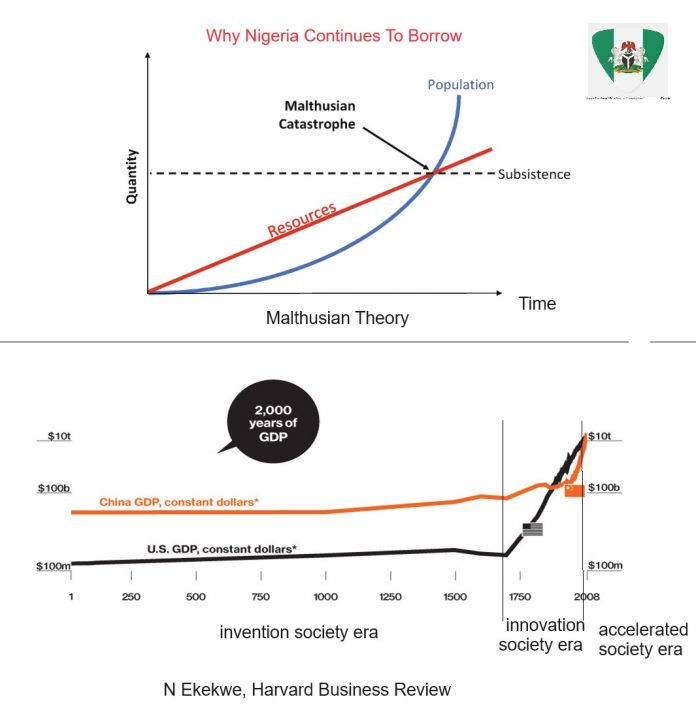
Let me add one more thing, drawing from my junior secondary school lecture in agricultural science on Rev Malthus postulation. Malthus noted that resources (say food production) were growing in arithmetic progression and the population was on a geometric progression (more rapid and faster in multiples). He came up with an inflection point – called the Malthusian catastrophe –  and that happens when the population has overtaken the resources required to support the people. 

Typically, every great nation unlocks innovation to “create” more resources so that you will keep having more resources to support the growing population. At the basic state, all nations begin in the invention society era. The plot below shows how the US and China expanded the resources (here GDP) to support the rising populations. In other words, they shifted the equilibrium and avoided the Malthusian catastrophe via the parabolic growth which reversed centuries of economic stagnation.

For Nigeria, our unlocked resources via GDP, aggregate of all economic activities, have shrunk over the last few years due to many factors, including energy price, currency loss, etc. As that was happening, the population continued to grow, creating a double whammy where more people have to share lesser resources, seeding an imbalance where policies have moved from tactical to operational (Nigeria abandoned strategic policymaking many years ago), as every week is a crisis!

In my thesis as noted in the lecture material, Nigeria is still at the invention society era. So, to overcome this paralysis, it needs to move to the innovation society era.  In the lecture note, we explained the pillars and enablers for innovation. Unfortunately, for Nigeria, that transition has not happened. 

Consequently, it has to borrow hoping to “create” more resources to support the population. This is typical in most African economies as they remain stuck in the invention era and are unable to expand opportunities by moving into the innovation era. Loan provides that operational support and that is why Nigeria will keep taking loans.


Africa’s Start-Up Funding in H1 2024: Big Four Dominant as Kenya Leads The Pack

0
Fund, money cash dollar

According to a report by Africa: The Big Deal, in the first half (H1) of 2024, the “Big Four” countries Kenya, Nigeria, South Africa, and Egypt dominated the funding rounds, with 79% of all investments directed towards ventures headquartered in these nations.

However, there was a slight decrease from the five-year average of 83%, which is notably lower than H1 2023, which saw the Big Four attract a record 92% of regional funding since data collection began in 2019.

Among the investments attracted by the ‘big four’, Kenya emerged as the front-runner for the third consecutive semester, securing $244 million, which represents almost a third (32%) of the continent’s total start-up funding in H1 2024. This figure signifies a 5 percentage point increase from 2023. East Africa, bolstered by Kenya’s performance, attracted $285 million, or 37.5% of the total funding on the continent.

Lately, Kenya has solidified its position as a premier destination for startup investors, earning recognition as a leading hub of innovation and entrepreneurship in Africa. The country has developed a robust tech ecosystem, particularly in Nairobi, often referred to as “Silicon Savannah”.

Kenya’s strategic location in East Africa makes it a gateway to the broader regional market. The positioning has attracted investors looking to leverage the country as a launchpad for expansion into neighboring East African countries.

In the startup funding report for H1 2024, Nigeria, long hailed as a powerhouse of startup innovation and the premier destination for venture capital in Africa, has recently seen its position slip. Once the leading magnet for startup funding on the continent, the country has recently been displaced by Kenya.

Nigeria’s slip from the top spot as the leading destination for startup funding in Africa highlights the dynamic and competitive nature of the continent’s tech ecosystem. However, Nigeria regained its position as the second most attractive market, with start-ups raising $172 million, accounting for 23% of the continent’s total.

This is a significant rebound from 2023 of 14%, though it hasn’t quite returned to its peak from 2021 and 2022. Nigeria’s share of the region’s funding stood at 64%, slightly lower than 2023’s 68%. Western Africa followed closely behind Eastern Africa with $270 million (35.5%) in total funding. Noteworthy deals in Western Africa included Benin’s $50 million (primarily through a single deal with Spiro), Ghana’s $29 million, and Senegal’s $11 million.

Egypt saw a noticeable decline in its share of start-up funding, attracting $101 million or 13% of the continent’s total, down from 22% in 2023. However, it still commanded 87% of Northern Africa’s funding. Morocco was the only other Northern African country to exceed $10 million in investments, raising $14 million. Tunisia and Algeria, which had shown promise in 2021 and 2022, saw limited activity since 2023.

South Africa experienced a significant drop, falling to fourth place with less than $100 million raised ($85 million), accounting for 11% of Africa’s total start-up funding in H1 2024, down from 21% in 2023. Despite this decline, South Africa continued to dominate its region, capturing 98% of the funding, an increase from 96% in the previous year. Overall, the Southern African region claimed 11.5% of the total funding.

In total, 22 African countries reported at least one $100k deal in H1 2024. This implies that the majority of the continent’s nations, or almost 60% did not register any significant start-up funding activity during this period. However, the concentration of funding in a few key markets highlights the disparity in investment distribution across Africa.